My grossness wins again (updated with contest to win book)

My short story in First Kiss (Then Tell) edited by Cylin Busby continues to garner praise for how disgusting it is. Here’s what Bookshelves of Doom has to say:

Justine Larbalestier’s “Pashin’ or The Worst Kiss Ever” was my favorite, hands down. I’ve read it three times (once aloud to Josh), and it made me gag every single time. No, that’s not a typo. I said gag, and I meant it. Literally.

I am so very proud.

Go on, read a copy, you know you want to find out if my story’s as gross as they say. Plus there are some excellent non-disgusting stories in there by the likes of Cecil Castellucci, Shanon Hale, David Levithan, and Robin Wasserman. Not to mention is perfect gift for Valentine’s Day!

Update: Cecil Castellucci is offering copies of First Kiss as a prize. All you have to do for a chance to win is email her the story of your first kiss or of your fave movie kiss. Send them to misscecil (at) earthlink (dot) net

Rules for writing

The responses to Scalzi’s talking about whether writers should be married or albino or live in igloos or smoke crack have flooded the internets. It’s so out of control I’m not even going to link to any of it. I am merely going to offer my own rules for writing:

  1. Write.
  2. Try not to procrastinate too much in your efforts to avoid 1.
  3. Unless procrastinating really helps with 1.
  4. If procrastinating to avoid 1. doesn’t help with 1. then never give me your IM handle.
  5. Don’t even give your IM handle to someone who might give it to me.
  6. Memorise Matt Cheney’s rules for writing. They totally will ensure that you do lots of 1.
  7. Split as many infinitives as you can.
  8. Always add at least one zombie—even if it’s not to your writing.
  9. Seriously, giving me your IM handle will ensure that you never write again. Don’t do it.

There’s no rule no. 10 because I’m living in a barbaric country that doesn’t have metric. Whatcha gunna do?

The Whole Sorry Day Speech

The speech that Kevin Rudd delivered at Parliament house yesterday was even more moving than I could have imagined. I cried. I never thought this would happen during my life time. I’m so full of hope for the future I feel like I could burst.

Here’s the whole thing: the four minute apology and then the twenty minute speech. It’s really worth watching all of it.


Part 1


Part 2


Part 3

Thanks to everyone who’s written to me from home and elsewhere. It’s wonderful to discover that yesterday’s historic events had an impact outside Australia. It was a great day.

National Sorry Day

Back home in Canberra the prime minister is making this historic apology on behalf of the Parliament and the Government of Australia:

Today we honour the Indigenous peoples of this land, the oldest continuing cultures in human history.

We reflect on their past mistreatment.

We reflect in particular on the mistreatment of those who were Stolen Generations—this blemished chapter in our nation’s history.

The time has now come for the nation to turn a new page in Australia’s history by righting the wrongs of the past and so moving forward with confidence to the future.

We apologise for the laws and policies of successive Parliaments and governments that have inflicted profound grief, suffering and loss on these our fellow Australians.

We apologise especially for the removal of Aboriginal and Torres Strait Islander children from their families, their communities and their country.

For the pain, suffering and hurt of these Stolen Generations, their descendants and for their families left behind, we say sorry.

To the mothers and the fathers, the brothers and the sisters, for the breaking up of families and communities, we say sorry.

And for the indignity and degradation thus inflicted on a proud people and a proud culture, we say sorry.

We the Parliament of Australia respectfully request that this apology be received in the spirit in which it is offered as part of the healing of the nation.

For the future we take heart; resolving that this new page in the history of our great continent can now be written.

We today take this first step by acknowledging the past and laying claim to a future that embraces all Australians.

A future where this Parliament resolves that the injustices of the past must never, never happen again.

A future where we harness the determination of all Australians, Indigenous and non-Indigenous, to close the gap that lies between us in life expectancy, educational achievement and economic opportunity.

A future where we embrace the possibility of new solutions to enduring problems where old approaches have failed.

A future based on mutual respect, mutual resolve and mutual responsibility.

A future where all Australians, whatever their origins, are truly equal partners, with equal opportunities and with an equal stake in shaping the next chapter in the history of this great country, Australia.

Today I am proud to be Australian.

Sometimes it really sucks to be so far from home . . .

Zombie idol!

So, the whole Maureen Johnson stick a zombie into a novel thing has just gotten heaps bigger. Like heaps. You need to go over there to check out the extent of the bigness. I heard a rumour that there are more than a gazillion entries already! A bazillion gazillion trabillion! So many that’s she’s extended the competition.

And gotten some judges in. Stellar judges such as Meg Cabot, John Green, E. Lockhart, and, um, me.

I’m excited and delighted and slightly nervous. How long does it take to read a bazillion gazillion trabillion entries? Also—Oh. My. God.—I’m a judge with Meg Cabot. I think I’m going to faint.

To forestall the fainting fit here is my little take on the whole thing:

I got him to propose to me yes even though I am a zombie he said yes first I gave him the bit of seedcake out of my mouth and my God after that long kiss I near lost my breath yes he said I was a flower of zombieness and yes so we are zombies all a zombie’s body yes that was one true thing he said in his life and the sun shines for zombies today yes that was why I ate his brains because I saw he understood or felt what a zombie is and I knew all of his grey matter and pain and I said yes I could leading him on till he asked me to say yes take my brains take my bones take my marrow take my everything and I wouldnt answer first only looked out over the sea and the sky I was thinking of so many zombie things he didnt know of Mulvey’s brains and Mr Stanhope’s brains and also Hester’s and father’s and old captain Groves’s and the grey matter of sailors playing all birds fly and I say yes your brains are the best and the pink and blue and yellow zombie houses and the rosegardens and the jessamine and geraniums and cactuses and Gibraltar awash with blood and bones where I was a zombie of the mountain yes when I put the blood in my hair like the Andalusian zombies used and how he kissed me under the Moorish wall with his brains calling to me and I thought well as well him as another his brains are bigger and greyer and then I asked him with my eyes to ask again yes and then he asked me would I yes to say yes my mountain flower zombie and first I put my arms around him yes and drew him down to me so he could feel my teeth all perfume on his skull and yes and his heart was going like mad and yes brains I said braiiins yes I will Yes.

Please don’t sue me, Joyce estate . . . is parody. Also it just sang out for zombies. Don’t you reckon?

Money advice for writers

John Scalzi has some excellent advice for writers who are trying to make money out of said occupation. Go forth, read, take notes.

While I strongly agree with most of his advice, I have issues with two of his points:

3. Marry (or otherwise shack up with) someone sensible with money, who has a real job.

This is something that worked really well for John. I’ve met his wife, Krissy, and a more formidable, fun, amazing person I have yet to meet. And she knows from money. Seriously smart about it. I wish I had married Krissy.

But, really, this is Scalzi confusing his own excellent good luck with general advice for everyone. Not everyone’s going to meet a Krissy. I suspect there’s only one and she ain’t leaving Scalzi anytime soon. Not everyone has any interest in getting married or shacking up. And, call me a romantic, but taking into account someone’s money management skills is not something I was thinking about when I fell in love.

Not to mention the salient advice my mother gave me which was to never depend on some man1 to look after you. Make your own way in the world. Earn your own money.

8. Unless you have a truly compelling reason to be there, get the hell out of New York/LA/San Francisco.

Rubbish! Big city living can be cheaper than being out in the burbs or the bush. Food is usually much cheaper, clothes too. Pretty much everything, really, except accommodation. That’s a very big except, I admit, but the notion that everything is cheaper outside big cities is rubbish. Sure NYC and Sydney have some of the most expensive restaurants and produce in the world but they also have some of the cheapest.

Living in New York or Sydney or Melbourne or any European city also means you don’t have to have a car. Cars are hugely expensive and they’re only going to get more expensive (price of oil ain’t ever going down, people). You live on your big property in Ohio or wherever and you have to have a car. I am a strong advocate of car-less living.

Cities are where a lot of the writing work is. We are still monkeys and face-to-face interaction is often more effective than emails or letters especially when you are starting out. Obviously, contacts aren’t everything: you have to be talented and hard working. There are many writers who have built careers without ever living anywhere near NYC or Sydney or London or wherever. But contacts can lead to work and there are more of them in cities.

There are more people in cities which means you’re more likely to find people like you. Living someplace where you are the only person of colour/writer/science fiction fan/nudist/australian/sculptor can really really suck. Sure you can find those communities online, but a real life community is pretty wonderful too.

And, lastly, cities are fun. They’re bursting with entertainment and great people and awesome food and all sorts of unexpected joys and pleasures. All of which I find incredibly inspiring for my writing. I’m not even sure I’d be a writer without all that wonderful city stimulation.

Ironically, I write this from a rocking chair in the country watching red-bellied woodpeckers feeding. I don’t hate the country; I just don’t want to live here.

  1. or woman depending on your inclinations []

Maureen Johson’s zombie contest

Over at insideadog Maureen Johnson is staging the best contest in the history of contests with the most excellent prize of an advance copy of Maureen’s wonderful new book, Suite Scarlett. All you have to do is rewrite a paragraph or two of your favourite book by adding a zombie. Maureen demonstrates how it is done by adding one to a scene from Pride and Prejudice. To wit:

“What think you of books?” said he, smiling.

“Books? Oh! No, I am sure we never read the same, or not with the same feelings.”

“I am sorry you think so; but if that be the case, there can at least be no want of subject. We may compare our different opinions.”

“No. I cannot talk of books in a ballroom; my head is always full of something else.”

Hearing this, a nearby zombie turned, lured by the prospect of whatever was contained within Elizabeth’s head. He was within striking distance of her when the other dancers caught him up and swept him away by accident.

“The present always occupies you in such scenes, does it?” said Darcy, throwing a look of doubt at the still-flailing zombie as he was pulled down the line.

“Yes, always,” she replied, without knowing what she said, for her thoughts had wandered far from the subject. Elizabeth’s distraction was not related to the zombie. She had not seen it, and was only vaguely aware of the fact that the time of the dance had been thrown off by the newcomer’s awkward shuffling and the panic that ensued.

“I remember hearing you once say, Mr. Darcy, that you hardly ever forgave, that your resentment once created was unappeasable. You are very cautious, I suppose, as to its being created.”

The zombie once again made his shambling way toward Elizabeth and the delicious promises of her coconut-like head.

“I am,” said he, with a firm voice designed to scare away the interloper.

“And never allow yourself to be blinded by prejudice?”

“I hope not,” Darcy replied, noting with satisfaction that the zombie had once again been dragged into the action by the remaining dancers who had not yet observed his presence in their midst.

The zombie, confounded by recent events, tired of the chase for Elizabeth. He instead ripped off the head of the nearby Sir Watkin Smiley-Franklin and commenced in the eating of his brain, which pleased Mr. Darcy even more. Sir Watkin was a terrible bore on the subject of farm taxes, and Mr. Darcy was much relieved to see all of his thoughts on the subject being consumed by the zombie’s loose, grinding jaw.

If you didn’t already think Maureen was a genius surely that proves it.

Go enter the best contest ever. If one of you were to rewrite a snippet one of my books it would make me very happy!

Snow research

I’m spending the weekend in upstate New York catching up with friends and researching snow for my next novel.

My research involved sitting in a rocking chair and staring out the window:


12:01PM


12:16PM


12:36PM (Can you see the red squirrel?)


1:33PM

Sadly, there is still not enough snow for snow shoeing, cross country skiing, or tobogganing. None of which I have ever done before even though my characters (pesky annoying things) have. But I have high hopes for tomorrow.

We went out for a walk. It were pretty and not scary cold (about 1C or 34F):

I was taught how to make snow balls, snow men, as well as snow angels. All of it fairly wet-making. But, I will admit, fun.

Apparently that big pile of sticks in the centre there is a beaver lodge. A conservation biologist told me so:

Here he (Peter Zahler) is telling me killer bee stories.1 Or it could have been the one about the crazed grasshopper mice or possibly wild boar. Peter has many fabulous stories:

Keep your fingers crossed for lots more snow tomorrow!

  1. You may recognise the name “Zahler”. Scott named one of his characters in The Last Days after Peter. []

Blurb Etiquette

Recently several friends have been on the receiving end of some very bad blurb etiquette and they have requested that I set the world straight about how blurbage should actually work. I live to serve.

What is a blurb? It’s the little quotes that typically appear on the back of a book saying how wonderful it is. For instance here is what Libba Bray has to say about How To Ditch Your Fairy:1

Justine Larbalestier has a super-cool writing fairy, and I am vastly jealous! Thoroughly entertaining, totally enchanting, wickedly funny, and 110% doos, How To Ditch Your Fairy had me grinning from page one (when I wasn’t laughing out loud). And as soon as I can figure out how to do it I’m going to ask to swap fairies with Justine.

—Libba Bray, New York Times Bestselling author of A Great and Terrible Beauty

A while back I talked at length about my policy on blurbs. The short version is: Yes, I am happy to look at books and if I love them I will blurb them.2 Turns out that there are other aspects of blurbage that I did not cover. Mostly because I did not know these things happen. But apparently they do.

  1. Never offer to swap blurbs with an author. “Hey, I have a book coming out. If you blurb it I’ll blurb your book!” This is a terrible idea. I may be a blurb purist but all the authors I know only blurb books that they enjoyed reading. They do not blurb books because that person blurbed their book and they especially don’t do that for someone who has never had a book published before and therefore has no track record. Blurbs are supposed to help to sell books but they’re useless if no one knows who the blurber is.
  2. If the author who agreed to look at your book does not get back to you DO NOT bug them. There are several reasons for not blurbing a book such as not liking it, not having time to read it, and losing said book. Putting the author in the position of having to explain which reason applies is not fair. No author wants to explain to another why they didn’t like their book well enough to blurb it. Just assume it was lack of time.
  3. There is nothing wrong with receiving a blurb from a friend unless of course that’s the only reason they’re doing it. I blurbed Cassie Clare’s City of Bones because I could not put it down. I loved it. The reason I know some of the wonderful writers who have blurbed me—Karen Joy Fowler, Samuel R. Delany, Libba Bray, Holly Black—is because I love their writing. They are my friends because of writing. None of them would blurb my books if they weren’t into them. It’s not worth our reputations to blurb books of varying quality. Every author I know has said no to blurbing a book by a friend. It’s awkward, but not as awkward as having your name eternally on the back of a book you don’t love.
  4. Never claim to have a blurb from an author if that is not the case. If the author in question has agreed to look at your book with the possibilty of providing a blurb that DOES NOT mean they are going to blurb you. I looked at several books last year and blurbed none of them. The author has agreed to read your book NOTHING more. If you go around boasting that you have a blurb when you don’t odds are it will get back to the author, who will then be much less inclined to blurb you. This is a very small industry. Word gets around.

This last point leads to a bigger point: Anyone who advises you that lying: claiming blurbs you don’t have, doctoring your publications list, claiming non-existent connections etc. etc. is a good way to get “your foot in the door” is full of it.

Don’t do this. Not ever.

Finding out that someone you have NEVER met is using your name to get ahead is vastly cranky-making. Also in the age of the internet it’s almost impossible to get away with these shenanigans. Google knows when you lie.

I think that about covers it, but if I’ve missed anything do please let me know.

  1. My apologies for the skiting, but I love this blurb. []
  2. In practice I do not blurb many books because I do not love very many. []

Title of my next book

Apparently, the top sekrit title of my new book is already out of the bag. And who was the wicked naughty person who let out the top sekrit ahead of the cover art showing up? What’s the name of that evil party pooper?

Er, um, that would be me. In this interview (no. 13) with Jim Hall of Cult Pop, an excellent Detroit TV show about pop culture.

So I will share with all of you as well. The title of my next book, formerly know as The Ultimate Fairy Book and before that as the Great Australian Feminist Monkey-Knife-Fighting Elvis Cricket Mangosteen novel, is:

How To Ditch Your Fairy

I think it is the best title ever and not only because google’s never heard of it. Not even because the genius Libba Bray came up with it. But because it perfectly describes my book and makes me smile.

My title beats google

I just typed the (top sekrit) title of my fairy novel into google and came up with ZERO hits. ZERO. No book has ever had that title before. Not only that but no one has even put those words together before. Title of my next book for the win!

I will be revealing top sekrit new title as soon as there’s a cover to go with it. So if you happens to know the top sekrit title please not to give the game away. Thank you very much!

I am now determined that all future titles of my books will beat google. It could lead to much obscureness of titles. Yay!

Genre schmenre

I had a conversation with Holly Black recently where we both admitted that every time we’re told that we can’t do some particular writing thing we are compelled to do it.

“Vampires are played out. There is no new take on vampires left!” someone will tells us.

“Right then,” we’ll think to ourselves. “Challenge! We’ll be writing a vampire story.”

“Avoid adverbs and adjectives,” someone will say.

We will immediately have an attack of the Angela Carters.

David Moles admitted to a similar reaction to definitions of genres. They make him want to write something entirely outside the limits of the genre being defined.1 Holly and me are the same,2 whenever we see a YA definition we find ourselves thinking of the exceptions and thinking of ways we can stretch those boundaries. How can we get away with writing books where the protags aren’t teens? Or have the kind of content everyone is so sure you can’t have in a YA? Or where the story does not have the immediacy everyone associates with the genre?

It’s probably very childish but there’s a level at which all writing rules (never head hop! avoid passive voice!)3 and genre definitions make my back straighten, my nostrils inflate, and leave me with an overwhelming urge to shout, “You are not the boss of me! I’ll write what I bloody well want to write!”

When I was chatting about it with Holly we decided it was a good thing. Definitions be damned!

  1. Well, okay, he said something kind of sort of like that but it’s my paraphrase and I’m sticking to it. []
  2. I also like to defy certain grammar rules: “Holly and me” sounds way better than “Holly and I” which always sounds to me like the British queen saying “My husband and I”. []
  3. Except for always add zombies. That writing rule you should all obey. []

Imitation of Life

Imitation of Life by Fanny Hurst was published to great success in 1933, made into a film in 1934, and then again in 1959. All three are a fascinating window on race in the USA. Fascinating and deeply depressing.

The movies are kind of an obsession of mine. Particularly the contrast between them. So much changed in those intervening 25 years, and so very little. David Kehr in today’s New York Times describes the films thus:

Douglas Sirk’s 1959 “Imitation of Life” is among the most closely analyzed films in the Hollywood canon, a Lana Turner soap opera turned into an exercise in metaphysical formalism by Sirk’s finely textured and densely layered images. Less well known is John M. Stahl’s first film version (1934) of this Fannie Hurst novel about the complex bond between an enterprising white businesswoman (Claudette Colbert) and the black woman (Louise Beavers) who becomes her housekeeper and supplies the secret formula for pancakes that becomes the basis of Colbert’s character’s empire.

That was the year that Hollywood began seriously to enforce what had been the largely toothless Production Code, which, among its many nefarious effects, would result in the near disappearance of socially engaged films for the next two decades. But Stahl’s “Imitation of Life” still benefits from the frankness and skepticism of the early Depression years. Though hardly free from stereotyping, it stands today as perhaps the most powerful Hollywood film about race until the civil rights movement of the 1950s.

Hardly free from stereotyping is right. The black characters are happy with their place in the world. All but the housekeeper’s daughter, Peola, who is so light-skinned she can pass for white. Yet in both films her decision to do so seems inexplicable. The black people are all happy. Why would you want to pretend to be one of the tormented white people? Look how hard the white man’s burden is!

If you were an alien watching the movies you’d be scratching your head trying to figure out what was so very terrible about being black. In neither film are there any cafes with signs saying “Whites Only.” The black characters never have to sit at the back of the bus. There’s no mention of slavery, lynchings, or the civil rights movement.

There is one horrible scene of racism in the 1959 version, but it plays out as though racism is just that particular person’s problem, not anything systemic. The most you get in the 1934 version is the kids at school looking shocked when they discover that Peola is passing. Their reaction shot lasts less than five seconds.

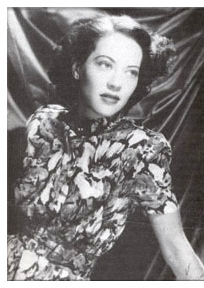
One of the things that puzzles me most is that in 1934 a black actress was cast in the role of the daughter who passes as white, but in 1959 she was played by a white actress. What’s up with that? Were there truly no light-skinned actresses of Fredi Washington’s (pictured above) calibre around in the 1950s? Colour me doubtful.1

I find the 1934 version more powerful because it doesn’t lose its focus on racism; the 1959 movie winds up being largely about Lana Turner’s scandal-ridden life, specifically her daughter killing her mobster boyfriend. David Kehr is spot on about the final scene of both movies:

Like the Douglas Sirk version, Stahl”s “Imitation of Life” climaxes with a lavish funeral procession. But what Sirk turns into a triumph of coolly expressive visual style becomes, in Stahl”s version, a sustained march of silent protest against a system as unjust as it is deeply ingrained. The film seems unable to put a name to the monumental grief it depicts with such devastating force.

That’s a large part of the problem with boths films: they are about systemic racism and injustice, but they cannot name them. Both films are exercises in avoidance, shame, and lame liberal justifications. What fascinates me is their inability to articulate the bleeding obvious: It is unjust that the black woman who makes the white woman’s life of money and privilege gets so little for it. It is unjust that the black woman’s daughter cannot get what she wants unless she pretends to be white and then when she does that she is punished.

Both films are clear that the problem lies with Peola for trying to be something she is not. Her passing is what is at fault, not the system of racial inequality that makes passing as white an attractive path.

But most of all neither of these films are about Peola or her mother: They’re about the white woman. Claudette Colbert in the first film and Lana Turner in the second. I’ve always longed for it to be remade with the focus squarely on the black woman with the miracle pancake mix.2

Happy Super Tuesday to all you USians living in those states. Vote well! I bet Peola would be happy to see a black man in the running, but sad to see how much racial and sexual inequality still exists. But we can change that, right?

  1. Well, okay, Fredi Washington was AMAZING; finding any actress as good as her would have been tricky. But Susan Kohner was definitely not up to the job. []
  2. The second film takes away the pancake empire and makes the housekeeper character just a housekeeper. Another reason I prefer the first film. []

Teenagers? Young Adult? Fiction?

I just received a very lovely fan letter from Brent one of the folks I met at ConFusion. Thank you, Brent!

In his letter he asks:

What makes your books YA? YA is a publisher’s category I understand. But what makes a publisher decide a book is suitable for YA? Do you just say “this is a YA book” when you submit the manuscript? Is it the age of the characters? If Reason, Tom and J.T. were 22, would the books still be YA? I’m a writer myself (not yet an author) and I’m very, very curious about what exactly makes a YA book YA.

I’ve talked about the what-is-YA thing before. And I think the answers are many and varied. Defining any category, any genre, is always tricky. My fave genre definition remains Damon Knight’s that science fiction is what we point to when we say “science fiction.” Young Adult ditto.

And yet that’s a cop out. Part of the problem with defining Young Adult fiction is that it’s a category defined by its audience in a way that “science fiction” or “romance” or “mysteries” or even “literature” is not. In discussions about the genre, I’ve heard many different generalisations about teenagers: Teenagers are smarter, more open, read more, are more adventurous etc. etc. I’ve even made such statements myself. They’re even true—of some teenagers. Pretty much any generalisation is true of someone somewhere, but they never tell you enough because they’re also completely untrue of someone somewhere else.

Defining a genre in terms of its presumed audience is a problem. Especially when that audience is something as nebulous as “teenagers”. According to the OED the term wasn’t even used for the first time until 1941. “Teen age” was first used in 1921. It wasn’t used as one word “teenage” until the 1940s.

Teenagerdom does not have a very long history. Only ninety odd years. Books specifically written for those in that relatively new stage of life “teenagers” weren’t really published as such until the 1960s. If anyone can tell me when the first “YA” or “teen” section of a book shop appeared—I’d be eternally grateful. My guess is the late 70s/early 80s.

YA as a publishing category is recent. YA as a publishing EXPLOSION is even more recent.

The range of books published as YA is extraordinary—setting aside all the different genres (i.e. all of them: romance, mystery, sf, fantasy etc. etc)—there are books as complex and sophisticated as M. T. Anderson’s The Astonishing Life of Octavian Nothing or Margo Lanagan’s Black Juice (two books that could not be more disimilar) both of which could easily have been published as adult.

Often a book is published as YA because its author has a track record of publishing in YA. That’s definitely the case for M. T. Anderson and Margo Lanagan whose most recent books could have gone either way. Sometimes it’s a matter of the age of the protagonists, but sometimes not. There are a fair few YA novels with protags in their early twenties.

Some books like Margo Rabb’s Cures for Heartbreak were not written as YA, but wound up being published that way.1 I’ve heard tales of lots of other writers who wound up being YA writers even though they thought they were writing for adults.

So, yes, YA is a publishing category and books are published there if that’s where a publisher thinks a book will sell best and attract the most attention. But it’s also a distinctive genre with its own flavour. Which brings me back to Damon Knight’s definition and winds up with my saying I know what YA is when I read it and when I write it.

With the Magic or Madness trilogy I set out to write YA. It was most influenced by writers like Diana Wynne Jones, Margaret Mahy, Holly Black, Megan Whalen Turner, and many others. All of whom I strongly recommend if you’re interested in reading more fantasy YA. They’re amongst the best in the field.

I hope I’ve answered your questions, Brent.

  1. The original stories that make up the book were all first published in very adult places like The Atlantic Monthly. []

Two cool things

Frozen New York. Or rather a couple hundred frozen people at Grand Central. Wish I’d seen it.

Ireland has gotten rid of plastic bags:

In 2002, Ireland passed a tax on plastic bags; customers who want them must now pay 33 cents per bag at the register. There was an advertising awareness campaign. And then something happened that was bigger than the sum of these parts.

Within weeks, plastic bag use dropped 94 percent. Within a year, nearly everyone had bought reusable cloth bags, keeping them in offices and in the backs of cars. Plastic bags were not outlawed, but carrying them became socially unacceptable—on a par with wearing a fur coat or not cleaning up after one’s dog.

Why can’t everywhere else in the world manage the same?

Scott and me have taken to walking around with flip and tumble bags. They’re bags that roll up into smallish balls. They’re most excellently convenient. I carry ’em in my handbag so I never have to resort to a plastic bag. (Via boingboing.)

See the new poll? Is improved version of old poll!

Thanks to, Mr Moles, for suggesting that what I really wanted to know was which supernatural creature are we most sick of. You’re a genius, Moles!

I will make no attempt to guide your voting since I failed so abysmally to get ghouls over the top in the last poll. Though I will say that I’m sick to death of vampire love stories. Not vampires, just them as an object of desire. They’re dead, people. Their flesh is cold. If vampires were realistically portrayed they’d be forever flicking maggots off themselves. Ewwww!

For those not quick of eye—the poll is in the sidebar to your right.

Faerie, fairy, fey, whatever . . .

If I decided that the current poll was a wee bit of market research I’d be feeling quite happy that my next book1 is a fairy book. Thing is though that it’s not a f-a-e-r-i-e book. It’s a f-a-i-r-y book.

What’s the difference you ask? Well, in YA and children’s publishing land there are dark, scary faery like those that Holly Black writes about, who would as soon gouge your eyes out as look at you. And then there’s your pink, glittery, tinkerbell kind of fairy. A la all those of the Disney books etc. etc.

My fairies are probably more Disney than Holly Black. But they’re not pink. They’re not even visible. And um they help you do specific things. Like there are good-hair fairies and loose-change-finding fairies. You can’t fall in love with them, they can’t break your heart, or gouge out your eyes, and they don’t wave their magic wands to make pages turn.2 Like I said you can’t even see my fairies.

Thus I’m not sure the overwhelming popularity of Faery in the poll oppposite is going to help me any. It’s also made me a bit despondent about my Zombie Quintet. Not to mention the snow-boarding werewolf epic. And the daikaiju versus ghouls manga series.

Just as well I have an genuine certified-as-real-by-Holly-Black faerie story coming out at the same time as my fairy novel. It’s called “Thinner Than Water”3 and you’ll find it in the pages of Love is Hell edited by Farren Miller. I’m sure there are other faerie stories in there, too. Though Scott’s isn’t, but if you squinted as you read it, you could convince yourself it was . . . Sort of.4

Though if the poll were accurate vampires would be in the lead, given that there are way more vampire books than anything else. So bugger the poll! I’ll write my Zombie Quintet anyways and the snow-boarding werewolves and the daikaiju/ghoul manga. Maybe I’ll work my way through the list. I’ve already written about witches (Magic or Madness trilogy), and as mentioned above both faerie and fairy. I have a devil story, but that’s not on the poll. It just means figuring out a new take on vampires . . . Piece of cake.

I’ll go back to writing my next novel, now . . . Hava good weekend and don’t forget the aerogard!5

  1. coming in September of this year and no longer called The Ultimate Fairy Book []
  2. A very old person reference. My apologies to those under thirty-five who read this blog. []
  3. previously titled “Lammas Day” []
  4. Other stories are by Melissa Marr, Laurie Faria Stolarz, and Gabrielle Zevin. []
  5. Not that you need it where I am right now . . . []

John Green = pornographer? Not!

Just wanted to add my voice to the zillions declaring that John Green is not a pornographer. Well, at least, not the John Green who wrote Looking for Alaska. There may be another one somewhere who is. I can not speak for all John Greens.

Maureen says it best:

In case you have never read Looking for Alaska, I’ll tell you what happens in the scene that likely caused the drama. Pudge, the main character, has one of his first sexual experiences in the book—and it does not go well, largely because neither he nor the girl he has with really have any idea what they are doing. It is a funny scene which shows just how awkward some of these moments in life can be. But it does have some sexual interaction in it, albeit of a very poor quality. It has human body parts.

Having discussed this scene many times with John, I know he finds these complaints to be ridiculous. Because that scene in Looking for Alaska? It’s pretty much the opposite of pornographic. It’s fumbling and embarrassing and hilarious. It’s not cool. It’s not slick. You don’t read it and think, “I want to do something JUST LIKE THAT.”

John Green tells the whole story—the book is being taught to eleventh graders who need a signed permission letter from their parents and it’s the parent of a ninth graders who’s trying to stop John’s book being taught at all—and defends himself most excellently and wittily here. If you want to help here’s what you can do:

There are many supporters of the book among teachers, administrators, librarians, and the school board in Depew.1 To help them, I’m asking people to email letters of support for the book at sparksflyup–at–gmail.com.

Also, if you live in Depew, the book will be discussed at the Depew Board of Education meeting on February 5th at the Depew High School Auditorium at 7 PM.

I’m writing one right now.

  1. Where the book is being challenged. []

Interview

Thought youse might be interested in a new interview with me and Ekaterina Sedia (who wrote the truly marvelous Secret History of Moscow) that just went up at Fantasy Magazine. The interview was conducted by the insightful Tempest Bradford and was all about what it’s like to be a foreignor in the US of A something me and Ekaterina know a lot about. It’s one of the most enjoyable interviews I’ve done. Any time I’m not asked to describe my books, I’m happy.

Documenting Our Lurve

Thanks to everyone for all the photos. You are all the bestest and most wondrous people EVER! As Jeff Fenech would say, “I love youse all!”

It was kind of weird to see how many photos there are of me and Scott I never knew existed. Eerie even . . .

I would like to take this opportunity to publicly apologise to my sister, Niki Bern, as well as my good friend, Cat Sparks. I’m sorry I’m always so recalcitrant about having my photo taken. You were both right that some day I would be happy you both insist on documenting everything.

That said, I now no longer need to have my photo taken ever again. Hallelujah! I shall keep intact what tiny bit of my soul is left.

Because some of you have expressed curiosity here is one photo for every year Scott and me have been together. Enjoy! We certainly have.


2001: Our wedding day. Upstate New York. (Photo by Phyllis Bobb.)


2002: On the Woomera Prohibited zone in South Australia to see a total eclipse. (Photo by Sean Williams.)


2003: Goofing around with Adrian Hobbs in Newtown back home in Sydney. (Photo by Olivia Rousset.)


2004: At the SFWA drinks night. (Thanks Liza Trombi and Locus for sending the photo.)


2005: With Andrew Woffinden and Lauren McLaughlin in London. (Photo by Niki Bern.)


2006: At the Lake Hills Library in Bellevue, Washington. (Photo by Shelly Clift. Thanks!)


2007: On our way to the National Book Awards.

She’s talking about me!

There’s a new review of First Kiss (Then Tell) the fabulous anthology I have a story in. After talking about her favourite stories the reviewer has this to say:

I didn’t love every story in this collection; some were just, “eh,” and some were good but not really my thing (I have a weak stomach, so some of them made me rather nauseous!).

She’s talking about my story! The one that Booklist called “disgusting yet hilarious”. I made the reviewer queasy. Tee hee. She also says the stories range from “funny to sweet and awkward to disgusting“. Disgusting! That’s my story again! I’m so happy.

You must all read the anthology and then let me know whether you think mine is the most disgusting story. I guarantee that it is. I’m so proud.

Very Important Question About Book Writing

Hilary! asked the following:

I have a VERY IMPORTANT QUESTION ABOUT BOOK WRITING!!!!!!!!! My Friend Weslie is writing a book and I’ve been helping her, but she won’t exactly tell me what the plot is, but i feel that since I am helping her with it anyway, she SHOULD tell me. What’s your take on it? PLEASE ANSWER PROMPTLY!!!!!

When you say you’re “helping” her I’m assuming you mean you are critiquing her work. Right? If so then, yes, it’s really difficult to make constructive comments when you have no idea where the book is going.

For instance, say she’s writing a vampire love story (judging from my poll opposite my readers are VERY into vampires) but she only slowly reveals that one of her characters is a vampre. You the critiquer need to know that so you can tell her whether her various clues along the way are too obvious or too subtle. It’s very difficult to critque a story when you don’t know where it’s going.

On the other hand, it might be that she wants to see whether you can figure out what’s happening and will rewrite depending on what you say. I don’t think this works that well unless she’s already written the entire story, in which case you’ll know what the plot is because you’ve got the whole story in front of you.

When I critique friends work-in-progress they always tell me where it’s going (if they know). Scott always tells me what the plot of his novels are before he writes them.1 My comments are much more useful when I have a sense of where the novel is going. Otherwise I’m not sure what to say except at a sentence-by-sentence level.

I’m not sure if I have answered your question. Anyone else got a different take?

  1. Things do change in the writing process, however. []

The Non-infringability of Plot and/or Ideas

People’s confusion over what plagiarism is sometimes drives me to loud and angry screamage. Thus I was thrilled to read Candy’s recent post, On Ideas, Repetitiveness and Copyright Infringement over at Smart Bitches Who Love Trashy Books:

There seems to be some confusion regarding the status of ideas in copyright law. You can’t copyright a plot or an idea. You can only copyright the specific expression of that plot or idea as recorded in some sort of tangible form. Think about the nightmare of attempting to nail down and legislate a plot or idea for a story. How specific would you have to be before you could declare something unique enough to copyright?

“An angst-ridden story about a vampire falling in love with a human.”
Dude, if you can copyright that and collect a small fee every time somebody published that story, you could have your own giant pool of gold coins to swim in, Scrooge McDuck-stylee. (Side note: doesn’t that sound like a painful idea to you? Because it always has to me.)

“An angst-ridden story in a contemporary setting about a vampire warrior falling in love with a human woman.”
OK, that’s a little bit more specific, but c’mon. (Also: goddamn, think of all those germs on all those coins. There is a reason why we call it “filthy rich.”)

What. She. Said.

Read it! Memorise it! Tattoo it all over your body!

I am so sick of people thinking that retelling a story is plagiarism. If that were so then we would have, at most, ten novels. All books about vampires, zombies, middle-aged English professors are not the same (well, okay, some of them are). It’s not about the story you tell so much as HOW YOU TELL IT. Why is that so difficult to understand?

Georgette Heyer did not plagiarise Jane Austen. David Eddings didn’t plagiarise J. R. R. Tolkien. Walter Mosley didn’t plagiarise Raymond Chandler. I did not plagiarise C. S. Lewis.

The next person who says to me, “Oh my God! Did you see that Certain Writer’s next book is set in a future world where you have to have your skin removed and replaced with carbon when you turn sixteen? That is just like Scott’s Uglies books! He should sue!” That person will get smacked. HARD.

There are bazillions of science fiction stories where something happens to you at a certain age. Logan’s Run anyone? And many more stories set after the apocalypse. There are even a fair few that deal with physical beauty and its enforcement. Like those two Twilight Zone episodes, “Number 12 Looks Just Like Me” and “Eye of the Beholder” (both based on short stories).

Watch them and read Scott’s books. The only thing they have in common is an idea. The characters, the mood, the texture of the writing, the way they makes you feel is very different. Scott paints an entire world with three-dimensional characters and relationships; those eps can only lightly sketch in world and characters. Given that they’re short and Scott’s books in the Uglies world add up to almost 400,000 words, that’s not surprising.

Same goes for the ridiculous claim that Melissa Marr is ripping of Laurel K. Hamilton’s Merry Gentry books. As if.

Holly Black refutes the claim succinctly:

I can only assume that Ms. Henderson didn’t realize there’s an entire genre of urban fantasy faery books published in the 80s like Terri Windling’s Bordertown anthologies and the the novels of Emma Bull, Charles de Lint, Will Shetterly, Ellen Kushner, Midori Snyder and many others.

It is really bizarre to me that she would point to the Merry Gentry series as though it was the first to use faerie folklore in a contemporary setting.

Plagiarism happens when you steal someone else’s words. If that future world book with the carbon skin had the following opening: “The early summer sky was the color of cat vomit.” And featured characters called Telly, Shiy, and Daniel who ride hoverboards and wind up starting a revolution and are described with language that is very close to how Scott described Tally, Shay, and David and have very similar dialogue, well, then I might start to be a little more concerned.

But remember Scott’s opening sentence is already a riff on the opening of William Gibson’s Neuromancer: “The sky above the port was the color of television, tuned to a dead channel.” It’s a little science fiction joke/homage. Homage is not plagiarism either.

Lots of books echo the words of other books. On purpose. To bring them to mind so that the reader (if they recognise the reference) can remember the earlier book and enjoy the light it casts on the one they have in their hands. Literary echoes done well are cool.

Writers are influenced by the writers who went before them. Every single book they’ve read, movie they’ve seen, place they’ve been, conversation they’ve had creeps into their work. I know that if I hadn’t read Enid Blyton, Angela Carter, Charles Dickens, Isak Dinesen, Raymond Chandler, and Tanith Lee obsessively as a kid my writing would be very different. Without Flowers in the Attic and Alice in Wonderland I might not even be a writer.

Pretty much all writers borrow plots. Even when they’re not aware that that’s what they’re doing. I was not thinking of The Lion, The Witch and the Wardrobe when I wrote Magic or Madness. Borrowing a plot is NOT a bad thing. It’s what writers do. Shakespeare did it. Afterall, there aren’t that many plots: Stranger comes to town and changes everything! Person goes on a journey and changes themself! Two people fall in love but their family is against it! Two people meet, hate each other, then gradually realise they were meant to be together!

Think about telling a joke. Some people do it well. Some people are total shite at it. It’s not the joke—it’s the way it’s told.

Here’s a game for you. How many novels, movies or whatever can you think of that fit the following descriptions. The first two are lifted from the Smart Bitches:

  • A woman dares to make the mistake of evincing sexual desire and unconventionality, the punishment for which is death
  • Scrawny, gormless boy enjoys a series of wacky adventures and eventually triumphs over adversity
  • Teen girl discovers she is faery, not human, and becomes entangled with a handsome faery
  • Teen copes with drunk/drug-addicted/loser father/mother and learns own strength

Thus endeth the rant. I must now go back to my idea and plot stealing. Novels don’t write themselves you know.

I am not an expert

I occasionally get letters from beginning writers and newly published authors who are confused by some of my writing advice and observations about the publishing industry. Confused, because they have read exactly the opposite information elsewhere.

This is my disclaimer for everything I say about writing and publishing1: I am not an expert.

I do not know everything there is to know about writing and publishing. What I post here may or may not apply to you. That’s especially true if you’re looking for publishing wisdom. I’ve only been in this game a bit shy of five years.2 There’s still a TONNE I don’t know or understand. I’m constantly bewildered by publishing. Fortunately, I know lots of more experienced publishing folk whom I can turn to for explanations, like my agent. Though sometimes it’s hard to ask because I don’t entirely understand what it is that I don’t understand. The publishing industry is arcane and weird.

As for writing. Well! There are zillions of different ways to write a novel. Me, I’ve only written six. That’s a drop in the ocean compared to folks like George Sand or Joyce Carol Oates. I’m still learning.

The novel I’m writing right now is unlike anything I’ve written. Previously, I’ve started at the beginning and written my way through to the end. Makes sense, right? This new novel I’m writing scene by scene but so far not one of these scenes follows directly from a previous scene. This novel refuses to be written chronologically. It’s making me relearn how to write a novel. It hurts my head!

All writing advice should be taken with a grain of salt. Maybe it’ll work for you, maybe not. There are no hard and fast rules, only guidelines. Do what works, chuck what doesn’t, but stay open to it maybe working for you at a different time or for a different novel.

Well, there is one rule: All novels are improved by the addition of zombies. VASTLY IMPROVED.

  1. or anything else for that matter []
  2. And only if you count from the offer. The actual contract wasn’t signed until late 2003. []

Wedding dance

Me and Scott did not have a proper wedding on account of eloping but I’d like to think that if we had done the full-blown thing we’d’ve got our shit together to pull off the now traditional surprise wedding dance a la:

or

But I suspect not. I’d settle for attending a wedding where the couple pulled off something like it. How very fabulous.

I never get tired of these vids. I love youtube.

Sites of interest

Jill Lepore has an excellently entertaining piece in The New Yorker about Benjamin Franklin’s whimsy. Being Australian, I’m not a Benjamin Franklin expert. For instance I didn’t know that he’s the originator of many aphorisms, such as “Early to Bed, and early to rise, makes a Man healthy, wealthy and wise”. An aphorism that really pissed off Mark Twain: “The sorrow that that maxim has cost me through my parents’ experimenting on me with it, tongue cannot tell.” As someone who is also troubled by mornings and in love with staying up late, I sympathise.

My fave of Franklin’s sayings is “He that lives upon Hope, dies farting.” Of which Lepore notes, “Scholars have suggested that the last one was a printer’s error, and should have read ‘fasting,’ but, I ask you, who was the printer?” Answer: Benjamin Franklin.

Tee hee. Farting . . . I think I have become a Benjamin Franklin fan.

Speaking of fabulous people, my sister, Niki Bern, has her new show reel up, which consists of scenes from well-known movies for which she has wrought most excellent digital effects. I’m so proud! Be warned though that it is a Very Big File. Go, Niki!

Teen movies

The death of Heath Ledger got me thinking about all my favourite teen movies seeing as how he was in one of my faves: Ten Things I Hate About You. And because thinking about fabby teen movies is more fun than thinking about talented people dying. I love ’em—almost as much as I love YA.

Here are my off-the-top-of-my-head favourites:

Bend It Like Beckham
Better Off Dead
Bring It On
Clueless
Dirty Dancing
Drumline
East of Eden
Ferris Bueller’s Day Off
Flirting
Ginger Snaps
Gregory’s Girl
The Incredibly True Adventure of Two Girls in Love
Looking For Alibrandi
The Lost Boys (added because of reminders in the comments)
Mean Girls
Rebel Without A Cause
Saved
Say Anything
She’s All That (mostly for the dance sequence at the end)
The Sure Thing
Ten Things I Hate About You
The Warriors
The Year My Voice Broke

You may notice that I have omitted the John Hughes oeuvre. That is because I had the misfortune of rewatching Breakfast Club, Sixteen Candles, and Pretty in Pink recently. And, to be kind, I will simply say they do not stand up.

What are your faves? And why?

Why can’t I be Guest of Honour all the time?

I will confess that I was nervous about going to High Voltage ConFusion. There were several reasons for this:

  • I’m afraid of cold places. And Detroit in winter is COLD.1
  • I’d never been a guest of honour before and was worried I’d be crappy at it.
  • I was aware that most of the people at the con would not have heard of me or Scott and was worried that they would feel dudded of a proper author guest of honour what wrote adult sf and fantasy.

I need not have had any concerns at all. I was right that most of the people there didn’t know us or our work (unless they were a teen librarian or had teen children—there were precious few actual teens in attendance). But it turned out to be a really good thing. No pressure and no expectations. It was really relaxing. One of the most relaxing weekends I’ve had in ages.

Mostly because of Anne Murphy, our liaison. I had no idea that guests of honour get someone to take care of them. It was fabulous. Anne made sure we were fed and happy. She is the best liaison of all time. Thank you, Anne! Why can’t she take care of us all the time? We’re lost without you, Anne!

There was much fun. The Opening Ceremonies were hilarious. A picture of which below. Scalzi interviewing us was very silly and totally enjoyable. Though I was bummed he didn’t bring up unicorns or quokkas.

We got to design our own panels. Thank you so much con organisers for indulging us! And thus were able to vent about stuff that’s been bugging us for ages. Why is there so little sport in fantasy and sf? Why did our audience turn on us during that panel back in Boston in 2004? Do they really just love wheat?

Thus the wheat panel which was FABULOUS therapy for me and Scott, though audience members expecting us to follow the panel description might have been disappointed. Sorry about that! But thank you for not turning on us. You were the best audience ever. Actually, all the panel audiences were smart and engaged and awesome. Me and Scott were dead chuffed that as the weekend went on more and more folks were showing up to hear us gasbag and pontificate. Yay!

The sport panel was also wonderful. Though we had way too much to say and not enough time to say it in. I especially loved that the audience was almost entirely women. Hah! There was also a sports writer, Dave Hogg, in the audience (he really should have been on the panel) who turned out—along with his partner—to be a huge Detroit Shock fan. Go, WNBA! We had an excellently geeky women’s hoops gossip.

I’ll admit that my last few cons had left me with panel fatigue. But now I love them all over again. I wish I’d gotten to see some of the panels I wasn’t on. I heard that all of Kevin Dunn’s (the science guest of honour) were brilliant. He explained soap and and all sorts of other Caveman Chemistry. I can’t wait to read his book.

You’ll be shocked to hear, however, that the best fun was not had during the panels, but at the parties and in the bar, and just generally hanging out. The ConFusion organisers and regulars are the best people on the planet. Seriously I got into so many great conversations and arguments and teasing contests. I can’t wait to go back!2

May I share with you the three best words in the world?

Roaming Pirate Party


Thanks again, Hugh, for the photo.

I haz met the Roaming Pirate Party. They haz rum3 and pirate hats and jollity by the galleon load. Best pirates ever! I shall treasure my pirate hat and t-shirt for ever!

We got to catch up with old friends like Karen Meisner, John & Krissy Scalzi, and Doselle Young. Why don’t they all live MUCH closer to me? I miss you all already. Waahh!! Not to mention making stacks of new friends. You know who you are! Yanni! Brian! Aaron! And SO MANY OTHERS! You all made it the best weekend ever.

Hell, we even got to see a movie: Cloverfield and it were good. Very good indeed.

If anyone needs a guest of honour me and Scott are so up for it!

  1. How cold? Minus a million cold! That’s how cold. So cold that I’m back in NYC and it’s freezing and it seems warm in comparison. []
  2. Any chance you could move it to a warmer time of year? []
  3. Though, obviously, being a YA author I didn’t drink any of it. Heaven forfend! []

The juvenilia panel

I have returned home to oceanic amounts of work. It is crazed!

But I must tell you briefly about the Juvenilia panel at High Voltage ConFusion before it all fades from my memory.

Short version: Best. Panel. Ever.

Longer version: It were me, Scott and Merrie Haskell. I cheated and read cute stuff from when I was 7 or 8. And some pretentious 10 year old stuff. They were brave and read teenage monstrosities so bad that we wept on account of laughing so hard. WEPT!

John Scalzi moderated and he was so appalled by the pretentious badness of Scott’s writing that he couldn’t look at Scott directly. It was AWESOME.

The best lines were:

Merrie Haskell: “Keeper of Earth Gaia,” the Light One said arrogantly, “I honor you with my manhood.”

Scott Westerfeld: Recognition of the House of Eleven took no long time, and the lady midst the compliment was none other than wench Mary, a liaress whom I had met before in the rank combats of her style, and who had left more than one of the Clan Demonus with garrote between chin and breathless breast.

Oh no, I starts to laugh all over again . . .

Heh hem. In addition to being really really really funny. Sharing our crappy writing from when we were beginning writers has the salutary effect of making it clear to those what aspire to be published writers but aren’t there yet that we published folk didn’t step fully formed from Zeus’s head. There was lots and lots and lots of bad words and phrases and sentences and stories and novels written before we were good enough to be read by anyone other than our doting parents.

Every con should have a juvenilia panel. I’ve been on two. The other one was in Brisbane in 2006 with Kim Wilkins and Sean Williams. It was just as fabulous and funny as the ConFusion one. Better in a way because the audience was much bigger thus more people got to laugh at our stumbling first writing steps.

The great photo quest continues

The reason for which are posted most indiscreetly on Scott’s blog.

I’d just like to share with you my favourite photo so far:


Kevin Dunn (science guest of honour) plus me and me old man at High Voltage Confusion in Detroit.

Why pirate hats you ask? If I told you I’d have to kill you.

And, yes, if you have any other photos of us we’d love to see ’em.

Thank you so much everyone for all the photos you’ve pointed us to. We REALLY appreciate it!

Urgent: photo help

We are in desperate need of photos of me and Scott together—preferably with other people, but no worries if you just have the two of us. If you have such photos online please include the link in the comments. Or you can send them to me at jlATjustinelarbalestier.com (replace the AT with @). If you could say where and when they were taken that would be extremely helpful.

You’ll be doing us both an enormous favour.

Thank you!

Juvenilia

Because we’re on a juvenilia panel at ConFusion, Scott is in the next room making strange noises. Some of it is laughter, most of it is groans. He’s reading through stuff he wrote when he was a teenager.

Because all my juvenilia is back in Sydney, my wonderful mother transcribed some of the earliest stuff to send me. Bless you, Jan. I just read through it.

Oh, dear.

Sad to say, but there is not an inkling of genius in either of our earliest writings. Wow. We must have worked pretty hard in the intervening years learning how to, you know, construct a sentence or two that don’t completely suck.

I might put some of it up on our sites to demonstrate that even the most talentless kid can grow up to be a writer.

In the meantime, we’re off to snowy Detroit, for the fun and laughter of ConFusion. Hope to see some of you there. We’re not bringing our computers so blogging is unlikely.

Here’s my favourite sentence from my juvenilia written when I was about 7 or 8:

A long time ago there lived a group of dragons that were called the toughies.

Don’t have too much fun while I’m away!

First Kiss

My first appearance in a YA anthology is now on the shelves: First Kiss (Then Tell): A Collection of True Lip-Locked Moments edited by Cylin Busby. I’m stoked to be in this collection. It’s dead funny and there’s not a dud story in sight. How could there be when they’re penned by the likes of Cecil Castellucci, Shannon Hale, David Levithan, Sarah Mlynowski, Laren Myracle, Robin Wasserman and Scott Westerfeld?1 If you don’t believe me about the fabulosity of this anthology then would you believe Booklist?

This entertaining collection of true “first kiss” stories by popular YA authors arrives just in time for Valentine’s Day. The risk of veering into groan-worthy, “when-I-was-your-age” territory always exists when adults reminisce about their teen years, but these authors treat their own stories with the same freshness and respect with which they approach their YA novels. The stories include Deb Caletti’s thrilling and empowering kiss, “as right as warm sidewalks and plums bought at roadside stands”; Cecil Castellucci’s secret and slightly shameful smooches with a bad boy; and Justine Larbalestier’s disgusting yet hilarious drunken kiss on a floating dock. Some stories are poems, one is a play, and a few are in comic form; despite the reality-based entries and mix of forms, the collection is classified as fiction. Kissing quotes and facts are interspersed, making this a good collection for browsing. The reader will finish this volume and know that whether a first kiss is anticipated or unexpected, dreamy or forgettable, this rite of passage provokes a complex mix of fear, excitement, and relief.

“Disgusting yet hilarious”. I am SO proud. Those words pretty much sum me up. However, the kiss I describe in that story was not, in fact, mine. I cheated and stole someone else’s story. And to make matters worse I can’t even remember whose story it is.

If you only read one anthology this year make it First Kiss!

And because I’m curious—anyone care to share the story of their first kiss? I’d share mine but I really can’t remember it. Sad, but true.

  1. Though, Scott cheated and wrote a haiku. []

I don’t think about it like that, honest . . .

Interviews hurt my brain. Being asked to talk about my work in the abstract feels weird. Especially when I’m asked about what message I wished to convey, what I want to teach people, how I want to change the world, and why did I have this bit of my book symbolise x, y, or z.

The truth is I don’t think about any of that stuff when I’m writing a first draft. Nothing in any of my books is meant to symbolise anything. As far as I’m concerned my zombies are just zombies. I don’t set out to teach anyone anything and I have no overt messages to convey.


(The secret message of my books is that mangosteens are the best food in the universe, quokkas the cutest animal, and anyone who lives somewhere cold should have their head examined.)

If other people see my zombies as representing the corruption of Western capitalism or the horrors of commodification or whatever. That’s cool. If they learn something that’s fabulous, too. One of my favourite things is hearing what readers take out of my work. Mostly it’s not anything I intended. My readers teach me stuff.1

But I didn’t do that on purpose. Truly. I don’t write like that.

I know writers who do, though. A friend of my carefully plans all sorts of symbols and always talks about the message of their book. Not me, though.

I just had to answer a set of questions from the members of the Teen Advisory Group of the Kingsbridge Branch Library in the Bronx via their Young Adult Librarian, Andrea Lipinski. Their questions were awesome. There was nothing about metaphors or meanings or messages. Bless you all! They wanted to know if I believe in magic, whether I like Sydney or NYC better, who I think is the better writer me or Scott, whether my trilogy’s going to have a fourth book, and which of my characters is most like me.

So much more fun answering those kinds of questions! Especially as the answer to all of them is “Maureen Johnson.”

  1. Except for the loony readers. You know who you are! []

But I never heard of that book . . .

Congratulations to all the Printz honorees and winner. What a fabulous line up! Can’t wait to read ’em all!

I’m especially pleased to see Geraldine McCaughrean and Elizabeth Knox on that list. They’re two of the best writers in the world right now. Regardless of genre.

I’m a little disappointed by some of the whingeing I’ve seen from people who are upset that they’ve never heard of any of the Printz honorees. Isn’t that one of the points of literary awards? To draw our attention to books that might otherwise be overlooked? Every award jury is devoted to finding the best books they can that are eligible for their particular award. Eligibility is not determined by copies sold or size of publicity campaign. That’s a good thing!

One of the reasons there’s sometimes little overlap between the Printz and the National Book Award is that they have a different pool of eligible books. The National Book Award is restricted to books by US citizens. The Printz is restricted to books published in the US, thus this year there was an English winner (McCaughrean), a New Zealander (Knox), and an Australian (Judith Clarke). None of whose books were eligible for the National Book Award.

I like awards that surprise me. I’m thrilled that it looks like all the YA Awards this year are going to have different lists. It points to how rich and diverse our field is. The number of outstanding YA books being published goes up and up every year.

Here’s one thing that both the Printz and the National Book Award had in common this year—they both honored a book that is out-and-out, no-denying-it genre. Kathleen Duey’s Skin Hunger and A. M. Jenkins’s Repossessed and you can make a strong argument for Dreamhunter and Dreamquake as well. That makes this obsessive genre reader very happy indeed.

Where do you get your ideas?

I’ve been asked this question about eleventy bazillion kajillion times and I’ve only been a published writer for about three years.1 Most recently my new (and FABULOUS) publisher Bloomsbury USA asked me, “Where do you get your ideas?” in their author questionnaire. Here’s what I said:

I steal them from Maureen Johnson.2

So now Maureen, the wise one herself, has answered the question and she’s done it so brilliantly and perfectly that I can do what I said I do: steal her idea, which is

brain monkeys


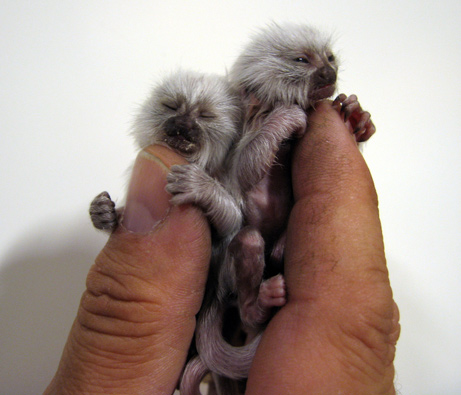
(This is how I imagine brain monkeys look. Though they are actually twin albino pygmy monkeys.)

That’s where Maureen gets her ideas from and it’s So True. Mine come from brain monkeys, too! Nasty little buggers running around in the old brain pain, flinging poo, screeching, tugging at bits that don’t want to be tugged, laughing.

Evil annoying brain monkeys.

Except when they cobble some really cool stuff together like cricket and mangosteens and Elvis and monkey knife fights (though should they really be pointing at themselves?) and quokkas and feminism and runic surfing and it congeals and melds and explodes and winds up being my next book, formerly known as The Ultimate Fairy Book, which is coming out in September and whose brand new title and cover I hope to share with you sometime in the next three or four weeks.

Glorious brain monkeys!

Now we all have the answer to that extremely irksome question. Bless you, Maureen.3

  1. I hate to think how many times Stephen King has had to answer it. I mean, seriously, if he punches the next person to ask, that should be permissible. []
  2. Was probably funnier before the most recent plagiarism scandal . . . []
  3. We must all tell Stephen King before he punches someone. []

Yes, there are CAPS

Some of you have expressed surprise and dismay that I abandoned my archy and mehitabel policy. They wants to know why and if it’s merely a bout of temporary insanity.

The why is easy: I was bored. It was get rid of the no-caps or find a new template. The one takes seconds, the other days. Not a difficult choice.

The no-caps rule lasted quite a long time. To be precise: from 25 May 2005 up till 8 Jan 2008. More than two and a half years. That’s AGES.

I don’t think the no-caps will return. Been there, done that. By all means continue to eschew them in your comments as homage to the way Things Used to Be. I’m all for stubborn nostalgia. I like it almost as much as I like change.

Calling all Australians

Regular reader, Danica, just wrote to ask me a series of excellent Oz related questions. Unfortunately I’m running around like a chook with its head cut off so I turn to youse lot, my Australian readers, to help her out. Here’s what she has to say:

So for my Comparitive Civilizations class, we need to plan a minimum three week trip to another country. Well guess what? My friend and I chose Australia. We figured the best way to get information on Australia would be to talk to a true Australian. So now here I am, using my spare block to sit in the library and write you an email. Should I be working on that Chem homework I haven’t done for the past two days? Probably. But this is more important.

Basically, I was just hoping you could tell me a few things. First off I wonder if you could suggest which part of the country we should travel in? Three weeks isn’t a lot of time and sadly we can’t see it all. Next, what are your favourite things about Australia? And no, you can’t say everything. Well you could, but I’d prefer a couple specifics. In the project, we have to include some historical and cultural facts. For example, I know voting is mandatory. Anything else particularly interesting we should know?

Finally, is there anything that we absolutely have to see or do, for our trip will suffer without these experiences?

If you love cities you can’t miss Sydney or Melbourne.

Now I must get back to work. Help her out, oh good and wise compatriots!

The other options

Some are saying that the poll is rigged because I’m only showing pictures of dresses. So in the interests of fairness here are what the other High Voltage ConFusion clothing options look like:

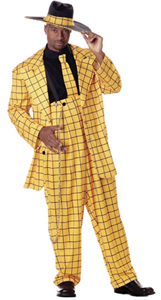
The mighty zoot suit
Who can not love it’s exaggerated shoulders? The lurid colours? The delicious saxophone wail that you are sure to hear everywhere you go?

I will admit that this is not the best example of the zoot, but I am trying to get books written, you know! I have a vivid memory of Kid Creole (of Kid Creole & the Coconuts fame) attired in a lime green and black one. Exquisite!

The purple jump suit

Because what other colour could a jump suit possibly be? Plus can double as pyjamas. Who would not look adorable wearing it?


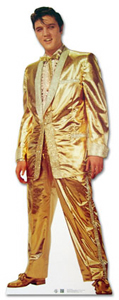
Elvis’s gold lame suit

Do I even need to explain why this is the best suit of all time? A billion Elvis fans cannot be wrong.

I do have a sneaking suspicion, however, that it only truly looks good on Elvis himself and that anyone else wearing it will be a bit trag. But then I don’t think anyone but Elvis is allowed to sing “Suspicious Minds”. Mmmm . . . Elvis.

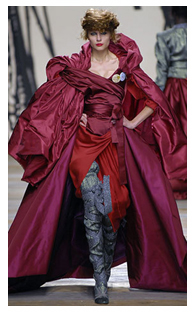
Skirt and top

In theory, far less exciting than a ball gown, and, yet, look what Vivienne Westwood does with it! Splendificerly wondrous fabulosity! Imagine the grand entrance you’d make swishing into a con dressed in this ensemble? Those boots! Those colours! That fabric! Does anything beat silk taffeta? Westwood doesn’t think so. She says you can wear it straight from your suitcase. No need to hang it. I just question how big the suitcase would need to be . . .

How to choose between them all?

Don’t forget the dress piccies here and here.

Mmm . . . clothes.

It’s heartening that you are all so solidly behind my going out and being a conspicuous consumer. Fortunately most of these outfits are not available new and must be purchased from vintage clothing providores, or, you know, stolen from museums . . . (Not that I would do that, because stealing is wrong.) So, it’s really recycling and very environmentally sound and not conspicuous consumption at all!

What a good world citizen I am. Oh, hush!

Or this one?

The voting says I should definitely get a new dress. Take that, Scott!

The first dress is here. But how about this one:


Marc Audibet for Vionnet

Or maybe this (look! black gloves!):


John Galliano for Christian Dior

Thinking about dresses is something else that’s much much easier than writing . . .

Because Scalzi made us do it

Next weekend Scott Westerfeld and yours truly will be guests of honour at the 2008 High Voltage ConFusion science fiction convention. It’s our very first time being guests of honour and we are stoked. TOTALLY stoked. In fact I’m so very stoked I’m thinking of celebrating with the purchase of a new dress. Surely, being guest of honour requires new clothes, right? I gotta look pretty, don’t I? If you have an opinion on this Very Important Matter please to express it in the poll to your right.

I’m thinking this one, though with black gloves not white:


Vivienne Westwood’s Watteau ball gown

Here’s Scott and mine’s schedule. Because we are joint guests of honour we are doing everything together:

FRIDAY 18 JANUARY:

1900 Den 1 Interview: Author GoHs by John Scalzi
Tee hee! Mr Scalzi will ask us questions and we will plead the fifth and get away with it because we know where he buried the bodies. I suspect zombies will be mentioned.

2000 Salon FGH Opening Ceremonies
We will say a few words but there won’t be an actual speech speech. Some of my words will be “quokka”, “zombie”, and “oscillate”, or maybe not. Depends.

2100 Salon FGH Dessert Reception
Where we eat dessert and natter with folks what want to natter.

2200 Den 1 Originality is Overrated
There’s this idea that writers work entirely alone and create their work out of whole cloth. That’s rubbish. If a work were wholly original no one would be able to read it. All writers are influenced by those who came before them. Most writers talk to other writers. Many are in writers’ groups and even those that aren’t frequently read and comment on each other’s work. Let’s talk about the influence and community that writers share. Even when they don’t know each other. Justine Larbalestier, Scott Westerfeld (M), Patrick Nielsen Hayden, John Scalzi, Patrick Rothfuss and Doselle Young.

I confess that I wrote this description on account of it’s something that drives me crazy and I’m looking forward to talking about it with such esteemed and smart companions. Especially Doselle. Everything is better if Doselle is involved.

SATURDAY 19 JANUARY:

1100 Den 1 Fantastic Sports
Organized sports are a vital part almost every culture on the globe. But sf and fantasy novels tend to overlook this key aspect of world-building. We examine what sports are and what they tell us about a culture, and dig up some good examples in sf and fantasy. Justine Larbalestier (M), Scott Westerfeld, Steve Ainsworth, Dave Klecha and Catherine Shaffer.

Mmmm . . . sport. If I weren’t moderator I would just spend the session teaching USians cricket.

1300 Salon G Juvenilia
Writers dust off the storage trunks, turn off the shame meter, and read from their 5th- through 12th-grade works of unalloyed proto-genius. A great way for young writers in the audience to feel much better about their own efforts. Justine Larbalestier (M), Scott Westerfeld, Merrie Haskell, K. Tempest Bradford and Marcy Italiano.

I can’t tell you how disappointed I am that Scalzi is not on this panel. Laughing at his early writing efforts was the whole reason I agreed to go to ConFusion!

1400 Den 1 SF Is Not Dead
More sf is written and consumed these days than every before, in the form of manga, video games, rpgs, and YA lit. Yet our beloved field constantly bemoans its own demise, while ignoring those 100,000 crazy kids down the road at Comicon. How do we connect these two worlds of sf? Justine Larbalestier, Scott Westerfeld (M), Anne Harris, Jim Frenkel and Peter Halasz.

Because me and Scott are sick to death of hearing the folks in the old sf people’s home whingeing about the death of sf. It ain’t dead! It’s doing just fine, thanks.

1500 Den 1 Golden Age of Young Adult Lit
Some argue that the YA books being published now are some of the best the field has ever seen. There are more of them, the quality is better, and the authors are being paid more. Is now the Golden Age of Young Adult Literature? And if so what does that mean for the next generation of readers? Justine Larbalestier (M), Scott Westerfeld, Steve Climer, Suzanne Church and Peter Halasz.

I think it is. I also think it’s just going to get better and better and better.

1700 All-Author Autographing Session
If you have books you want strange author types to scribble on here’s your chance.

2100 Concierge Literary Beer
The only thing we’re doing that you have to sign up for. It’ll be me and Scott sitting around with a smallish group of interested folks and answering their questions while we all drink beer (or water or whatever you wish to drink. I wish to drink Krug—I hope the ConCom is on top of that!).

SUNDAY 20 JANUARY:

1100 Salon H Gluten-Free Fantasy
Most medieval cultures didn’t have chainmail, swords, horses, or wheat. Yet the overwhelming majority of medieval cultures in fantasy do. What do we stand to gain by breaking the bonds of Europe on our collective imagination? And what’s so scary about bolas, sled-dogs, and rice? Justine Larbalestier, Scott Westerfeld, John Scalzi, Karl Schroeder, Jim Frenkel.

This panel is also something me and Scott came up with. It has a backstory. Way back in the dark ages we were on a panel together about fantasy where we panelists suggested that there were other settings for high fantasy other than mediaeval Europe. Scott went as far as to say that wheat is not essential to high fantasy.

The audience turned on him. “We LOVE wheat!” they proclaimed. “We hate fantasy that isn’t set in mediaevel Europe. We hate wanky literary fantasy. In fact, we hate you writers on the panel who are trying to take away our wheat!”

Scalzi was in the audience along with the wonderful Karen Meisner and they both say it was one of the most extraordinary things they have ever seen. Karen even sent Scott a Canadian license plate wth a beautiful picture of wheat on it. Scott still contends that we were caught in the wave of an Atkin’s diet backlash.

Here’s the con’s full schedule.

Hope to see some of you there! I mean if this wussy Aussie girl can brave the dead of winter in Detroit. Surely some of you can?
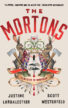
Eine Kleine Madness and Magic

All three volumes of the Magic or Madness trilogy will be out in Germany in the next few months. Here’s what they look like:

These may well be my favourites out of all the trilogy’s covers.

Talk about eye-catching! She even looks a little bit like I imagined Reason looking. Though the nose is wrong, the face too narrow, and Reason doesn’t have facial tats or elf ears or blue-black hair and eyes . . . details, details.

Here’s the first page in German:

Posh?

Thanks so much for all the responses to the grandmother question. Fascinating! Plus I might use some of your responses in my next book, which has surprised me by being set entirely in the US of A with no Australian characters. Gulp.

I just read the first few chapters to Scott and he reckons my only misstep was the word “posh”, which I had my teenage protag use to describe a super-expensive private school. Which left me wondering what word you’d use instead. What’s the USian equivalent of “posh”?

I’ve had “classy” suggested but it doesn’t work for me because “posh” also has connotations of being a bit stuck up, and hard to get into, not merely expensive. Something can be “classy” but not expensive; a person can be “classy” without being “rich”. Scott says “fancy schmancy” or “hoity toity” but those sound to me like they come from the stone ages.

I suspect I’ll be asking more such questions over the coming months.

Grace

In the vociferous arguing about the ins and outs of who behaved worst over the second test etc etc there are people implying that criticising the Australian cricket team is unAustralian and whingey.1

Please! I love my country, I love cricket, but when the men’s team behave like dickheads they should be called on it.

People who play sport at a professional level are not exempt from the social contract. No one is. Writers (to pick a random example out of the air) shouldn’t behave like dickheads either. Recently I was at an award ceremony where the speeches of the winners were generous and moving. All but one. This one person got up to accept their award without a gram of graciousness. Their speech was about the importance of their book and the judges’ perspicacity in picking it as the winner. That speech left me not wanting to read anything by that writer. I don’t even want to meet that writer.

Very few people in this world achieve things without considerable help; acting like you did it all on your own is graceless and rude.

Ponting’s and the rest of the team’s arrogance and inability to admit that they ever do anything wrong makes me ambivalent when Australia wins test matches. Don’t get me wrong. I love for Australia to win, but, well, I love it a lot more when they’re gracious in victory.2

So, yeah, this debate isn’t just about cricket. It’s about how people should behave. How we should treat the people around us. There’s a reason that photo of Flintoff offering commiserations to Brett Lee has become so famous. It captures a moment of perfect grace:


Getty Images

  1. Though what’s more Australian than whingeing?! []
  2. And aren’t ropeable when they lose. []

Not cricket

I’ve had a few people writing to ask why I’m not commenting on the disastrous second test between Australia and India. There are several reasons. I’ve not been able to follow any of the cricket as closely as I’d like. I haven’t had time.

But mostly because I’m embarrassed. And, well, I think Greg Baum and Mike Coward have expressed what I feel about it so well that i don’t really need to add anything.

I will though: I’m sick of Aussie sportsmen (and, frankly, it’s the blokes, not the women) behaving like dickheads. I’m not Indian, so the bad behaviour of the Indians doesn’t make me ashamed, and, you know what? We’re the host country here. We should be behaving like hosts. What’s wrong with a bit of graciousness? The Aussie team of 1960-61 managed it up against that fabulous West Indies team. Why can’t our current team be more like them?

Look, unlike Mike Coward, I don’t think there was ever a golden age of well-behaved cricket teams. There’s always been cheating and sledging and arrogant behaviour.1 But it didn’t used to always be us. Right now the Aussie cricket team reminds me strongly of the English under Jardine back in 1932-33. It’s not a pleasant thought.

That said, I still wish I’d been able to see it . . . And I really hope the next two tests are less horrible with much better umpiring!

  1. In fact, there’s a whole book about it: It’s Not Cricket : A History of Skulduggery, Sharp Practice and Downright Cheating in the Noble Game by Simon Rae. []

Another rewriting question

Herenya asked:

One question on rewriting, about when you rewrite. I’ve read things which say you shouldn’t mix writing and rewriting. Write it all first, then rewrite it. I can understand that “creative” and “analytical” hats can be conflicting and that sometimes one has to just write crap first before improving upon it (which is difficult if you’re thinking critically), but I generally find I bounce back and forth between rewriting previous sections and writing more. Is this such a terrible thing to do?

If mixing rewriting and writing works for you then go for it!1

My partner, Scott, spends the first few hours of his writing day rewriting the previous three days work. Once he’s got that under control, and only then, does he move onto fresh writing.

Me, I rewrite (while writing the first draft) only if I’m a stuck on the next bit. On the mornings when I wake up and know exactly what needs to happen next, I dive into it. On the mornings I don’t, I procrastinate endlessly rewrite or go back and fill in the blanks where I have notes to myself like [something should explode here] or [figure out where this conversation’s happening] or [what happened to the quokkas?].

For a lot of writers the difference between the “writing” and the “rewriting” can be blurry. If you work according to Scott’s method then your finished first draft is more like a third or fourth draft because every section has been gone over at least three times. You work according to mine then you’ve got lots of actual first draft but also some second, third, fourth, or whatever.

I know some writers who really don’t read over any of what they’ve written until they’ve got a whole draft, but I suspect they’re rare. I know of one writer who burns2 that first draft and then starts over from scratch. Some writers have gone over their work so many times by the time their “first” draft is finished they don’t need to “rewrite” at all, they’re done.

That’s one of the brilliant things about the intramanets: all the writers’ blogs and essays and interviews online means it’s dead easy to see just how widely varied writing practice is and how contradictory all the gobbets of writing advice.

Whatever works for you is the way to re/write.

Just remember that can change from story to story and from day to day. Sometimes Raymond Chandler’s advice of hanging out in the one room and not having to write, but not being allowed to do anything but write will be just the ticket. Frankly, it’s never worked for me unless I have a heinous deadline and the room I’m in has no intramanets or books or telephone or packs of cards or, well, you get the idea.

  1. As a general rule be suspicious of all writing rules. []
  2. figuratively speaking []