Thing that remains a mystery

As detailed in my previous post I have learnt much on this trip, but one thing remains a mystery:

How do women get around in high heels on cobble stone streets without destroying their ankles?

Every European city we’ve visited has had much cobble-stoneage and yet almost all the women are in high heels. It is bewildering. I have gone over on my ankles wearing the most comfortable and supportive of footwear. No harm was done because my beloved boots have non-ankle-spraining super powers. Yay boots!

I saw one woman get her heel stuck between stones. She came to a sudden and whip-lash looking halt, before bouncing about, trying to extricate herself. She was promptly rescued by a kind gentleman (who unlike me didn’t stand their giggling helplessly) and tottered off on her way as if nothing had happened. But that’s the only mishap I’ve seen. I suspect there are high-heels-on-cobble-stones training camps all over Europe.

Paris continues to be fabulous. Even without cobble stone related accidents. I don’t want to go home.

And now we are in Paris

Which I can report is wonderful though cold. Great food, great gorgeousness, great people. Thank you, Luis and Maude, for showing us such a great time!

Several people have written to ask what on Earth we are doing galivanting about Europe. I could have sworn that I mentioned why at some point. But here it is again for those what missed it:

We are here to do research for Scott’s next book part of which is set in the European alps. As it involves air ships we went for a ride on a Zeppelin. We also came to attend the Children’s Book Fair in Bologna, to launch Extras in the UK, to get some writing done, to catch up with some of our European-based friends such as Coe Booth, David Moles and Ben Rosenbaum who are all in Basel at the moment, and to eat lots of wondrous food (see poll to your right).

Things learned on the trip so far:

  • Dutch publishers hate fantasy, but they love Maureen Johnson.
  • Germans ones love fantasy.
  • Stephenie Meyer is a Scott Westerfeld fan and has been going out of her way to tell her foreign publishers how much she loves his books. Thank you, Stephenie Meyer!
  • Switzerland is INSANELY expensive for tourists. Every menu I looked at I thought there had been a series of bizarre numerical typos. Surely the soup couldn’t be twenty dollars in an ordinary cafe?
  • Ben Rosenbaum’s kids are fabulous.
  • You can get great vegetarian food that isn’t cheese and noodles anywhere in Europe that isn’t German speaking.1
  • Zeppelins are quiet and smooth and the best form of transport other than a bicycle or shank’s pony. You would not believe the views.
  • Free wifi is the best thing in the universe. Why are posh hotels so allergic to it?
  • Paris remains the most beautiful city I have ever seen.2 Though Bolzano’s pretty gorgeous too. As is Rome and Bologna. And Buenos Aires. And, um, oh nevermind.

And now I must return to having fun in Paris. As you were!

  1. Oh, okay, I can’t speak for the whole German-speaking world, but Austria was pretty dire. And what’s with all the smoking everywhere? []
  2. Other than Sydney. []

Seen in Germany + some news

Look what I saw in an actual bookshop, RavensBuch in Friedrichshafen! Isn’t it gorgeous?:

Yup, it’s the German version of Magic or Madness. It’s even more beautiful in real life. Sigh. The book next to mine (the yellow one) is by John Marsden. Two Aussies together in Germany. I’ve been stunned by how many Aussie books I’ve been seeing in translation on our travels. Oodles of them by the likes of Trudi Canavan, Sara Douglass, Sonya Hartnett, John Marsden, Garth Nix, Marcus Zusak etc., etc. World domination!

Speaking of Germany. Random House Deutschland has just made an offer for How to Ditch Your Fairy. A very enthusiastic offer and they’ll be publishing it in hardcover. I am very happy. I met my German publishers in Bologna and they’re all lovely. Possibly because they’re all named Susanne.

This is the first time one of my books has sold to another market before publication. Very exciting. HTDYF will be out in the US in early September. And I may be sharing the cover with you some time soon . . .

Vicious dogs and other joys

The main reason I haven’t been blogging (or answering email) much on this trip is that even when we have internet access there’s been no time. We has been busy with appointments and meetings and research. Almost all of which has been most excellent fun, but away-from-computer fun.1 This has been the best trip ever. I don’t see why we ever have to go home.2

One of the most excellent things we did in Bologna3 (other than meeting with many of our publishers and agents at the Book Fair) was grabbing a cab up to San Luca, the gorgeous church that looks down on the town.

The view is indeed stunning but my crappy phone camera was not up to it. Instead it managed to capture this encounter between Scott and a vicious dog. First the dog tried to tear apart Scott’s trouser legs with its teeth. Scott valiantly resisted. Sadly that part of the battle was not captured, but I did catch the maneater pretending like it had never even seen a trouser leg:

Next Scott set about slowly disarming his enemy:

Until it was putty in his arms.

Or is that a puppy? Once again man conquers nature. Or something . . .

After we’d recovered from that searing encounter, we headed down the hill into town. Conveniently there is a very very very long set of porticoes that run all the way from the church back into town. The porticoes mean it is impossible to get lost as you walk back. Even those of us who are directionally impaired.4

Once back in Bologna we returned to work at the Book Fair. Where en route to our next appointments we checked out the wall of amateur art, all vying to capture the attention of publishers. Some of it’s amazing:

We also had a squizz at the official exhibition of Argentinian illustrators, which was stunning. This is my favourite though stupidly I didn’t note down the artist’s name:

I also got one of the roaming book model robots to pose for a photo. Not really a coup given that that’s their job, but still I’d never seen such life-like robots before:

Doesn’t she look nice? I’m all for robots. Well, unless they start writing books, that is. Only humans can write books!

More next time we get a window of time + internet access. Maybe I will share our Friedrichshafen zeppelin adventure. Or possibly the world’s largest Tyrolean bathroom.

Who knows? Bye till then.

  1. Who knew such fun even existed? []
  2. Why, Scott? []
  3. Wow, that seems a long time ago now. We are now in Friedrichshafen (Germany) and have also been in Bolzano (Italy) and a gorgeous Tyrolean spa just outside Innsbruck (Austria). []
  4. I’m not, but a certain person I spend a lot of time with is. Not naming names or anything. []

Magic’s Child in paperback!!

Constant travelling, crappy intramanets, writing, and fun have kept me from announcing the best news ever:

The ENTIRE Magic or Madness trilogy is now available in paperback in North America!!

Oh, happy day. Outside of a library, borrowing from a friend, or stealing it1 this is the cheapest way of reading my books. Yay for paperbacks!

In other news we are in Bolzano. It is beautiful. I write this on my phone thinking about all the snow we tromped through yesterday. Pictures when we find working wifi and can use our computers. Snow remains cold. If they could just fix that I’d prolly like it.

And now the train to Innsbruck.

Will answer email and comments in the future.

  1. Which I do not encourage—the stealing I mean—libraries and friends are good. []

Five years of freelancery

Another year, another anniversary. Once again I mark 1 April not by being silly like some I could mention but by saying, “Oh my Elvis. I’ve been a freelance writer for exactly five years! And I’m not starving! How on Earth did I manage that?”1

For my own benefit some stats:

    Books sold: 72
    Books published: 53
    Countries books have been sold in: 104
    Countries said books have been written in: 65
    Published words: 372,0006
    Books written and unsold: 27
    Ideas collected: 372,4568

Lots of fun had at fair today. Much publishing gossip and wisdom attained. Will share with you when not exhausted. I sleep now in order to make it to the drinks, dinner and party appointments that lie ahead of me today. Yes, my life continues to be gruelling!

  1. Luck. []
  2. One non-fiction tome, one anthology, five young adult novels. []
  3. 6 in September []
  4. In order of sales: USA, Australia, Taiwan, France, Thailand, Germany, Brazil, Italy, Japan and Indonesia. []
  5. Argentina, Australia, Italy, Mexico, New Zealand, Thailand and USA. []
  6. Guestimate. []
  7. One I hope will be some day. The other NEVER. []
  8. As of 16:32 Bologna time. []

Bologna (updated)

We are in Bologna at the Children’s Book Fair. There are five of us in a tower flat. Me, Scott, Holly, Cassie and Maureen. We are the Tower Gang.

So far we have eaten really good food, gossiped and walked under many porticoes. Tomorrow the fair starts and we meet our non-English language publishers. And we eat more good food.

My life is so very hard.

Update: Fine. Here have some photos. Courtesy of Maureen, which is why she is not in them. I will remedy that later.

Roman Restaurants

While we were in Rome we worked and we ate. I wrote four thousand words; Scott about thirteen thousand. I am thoughtful writer, who thinks about her words, okay? Or something. Like Scott had an immediate deadline and I did not. My deadline’s not till August, which is AGES away.

The eating was way more fun than the writing, not that it wasn’t fun. I like my four thousand words but not as much as I loved these restaurants:

Osteria dell’Arco
Via G Pagliari 11
06 854 8438

This is a neighbourhood restaurant with a simple but elegant fit out. The owner was a total sweetheart whose good English made up for our non-existent Italian. The food was also simple but elegant. My favourite dish was home-made ricotta with roasted tomato and zucchini and intense wild mint. Though Scott’s artichoke soufflé was also pretty amazing. Way more artichoke than soufflé. Served with dried roasted artichoke. Though all the food was fabulous and the owner was very helpful picking a wine for us as neither Scott nor I know much about Italian wine.

I really loved the pace of this place. I never felt rushed. The long breaks between courses were very welcome. And we were given much help designing our vegie repast. The Waitress was also charming. She didn’t speak English (and why should she?) but did speak Spanish. Was fun getting to use my extremely rusty Spanish.

La Campana
Vicolo della Campana 18
06 6867820

La Campana is very old school, which befits a place that’s supposed to be Rome’s oldest restaurant. The waiters were mostly older blokes and spoke almost no English. We muddled by on my Spanish and guess work, which made everything that much more fun. The place cooks only traditional Italian (mostly) Roman food. Everything we had was wonderful. My favourite dish was (again) a salad. A huge oval of mozzarella di bufala with tomatoes and rocket. The tomatoes were sublime: sweet and firm and probably the best tomatoes I have ever eaten. Their skin was mostly red with some green and yellow striping and the seeds a dark green. I’m desperate to figure out what they were. Yum! The cheese was also sensational and bears no resemblance to the substance of the same name I’ve had in Australia and the US. (We actually had the same tomatoes at lunch at Cantina Cantarini Piazza Sallustio, 12—a very simple mostly fish restaurant that we also enjoyed heaps).

I ordered the wine at every restaurant we went to La Campana was the only one where they had Scott taste it. I did say old school. They also automatically gave him the cheque.

Glass Hostaria
Vicolo Del Cinque, 58 Traselevere, Roma

This was our favourite meal. Prices were very reasonable and the food was adventurous, well-executed, and delicious. Definitely not old school. This time my favourite course was my main: monk fish with almond cous cous and yellowy orangey reduction that I cannot remember what it was but it was wonderful and a sprinkling of chili. The whole thing was amazing. Dessert was sublime. We both had the orange and pavlova dish. Which was several orange segments in a line with salt and paprika sprinkled on them and then a big round kinder-surprise looking meringue filled with orange gelato with a kind of sherberty mixture at the bottom. It resembled an egg and was deeply fabulous. Even the bread was amazing. It came on a long platter with two slices of each kind which ranged from regular sourdough through to black squid ink bread.

The restaurant has a really fun fit out with dangling lights and plenty of glass. Including the tables. The wait staff are young and lovely, though sometimes a wee bit confused. The sommelier was spot on though and we wound up having the best wine we’ve had so far on this trip: a 1999 Gaja Chardonnay “Gaja e Rey”. I want it again!

The chef, Cristina Bowerman, came out to talk to us because there was almost nothing on the menu for vegetarian Scott. She was utterly charming and organised a fabulous meal for Scott that included coffee quinoa and chickory. It turned out she trained in Austin and spoke well of the wonderful restaurant we’d been to there, The Driskill Grill. Her favourite restaurants in NYC are our faves: Per Se and WD-50.

I wish we’d had longer in Rome. We didn’t manage to get in at La Pergola, which some say is the best in Rome. But there were also gazillions of neighbourhood restaurants I wanted to explore. Oh, yeah, and I guess we should have checked out the Colosseum and the Pantheon and that stuff. Did I mention we were working? Novels don’t write themselves you know! And hungry writers cannot work. Their mind’s wander and they start typing the same thing over and over again. It was essential for our careers that good food be our priority.

In short: Rome is now on my list of cities I could live in.

For a city to make this list it must be pedestrian friendly, have really good food and wine, and I must have, you know, been there. The other cities on the list are: Sydney, Melbourne, New York, San Francisco, Buenos Aires, Madrid, Paris, Mexico City.

I’m also very fond of Bologna, Salamanca, San Miguel de Allende, and Dunedin, but suspect they are all too small to live in for more than three months or so. Bangkok, on the other hand, is a bit too big, though I’d definitely love to go back and stay for a few months. Such good food there! Yum.

Oh, look at the time. I must away to my next meal.

What are your favourite food cities?

Novel hints

hillary! wanted a hint as to what the new novel is about. I will give you three:

  1. The working title is a song by an all-girl band from the nineties. The title (and song) pretty much covers what the novel is about.
  2. There have been many hints in previous posts. You just have to find them. Hint: there is a one click way to do so.
  3. There are no witches or fairies in it. Is my first stab at realism. All those teachers and idiots friends of mine who’ve been after me to read/write “proper” books will be dead happy. The thought of making them happy, of course, really annoys me. I’m still trying to figure out how to sneak some fantasy elements in. So far it’s not working out. Curses!

Hope that helps. Actually, no I don’t. Cause it’s so early in the life of this novel—I only have twenty thousand words—that I don’t want to be sharing too much. Might break it. Is tender delicate plant needing extra gentle care or will curl up and die.

Let us speak of something else. Oh, look, over there: giant flying woolly squirrels!

London, 25 March 2008, 6:16PM.

And now London

Rome was unbelievably wonderful especially the food. A friend of mine spent four months in Italy and gained around three kilos—I think I managed that in one week. Excellent!

I am at work on a post about the fabulous food we ate and a number of others—including another writing one1—but work on my next novel has got in the way of finishing them. Stupid novel! Not to mention the erraticness of our internet access. But, soon, my pretties, soon!

In the meantime I’m exhausted but happy: there’s cricket on the tellie. All’s right with the world. And even though England’s doing kind of okay I still think the Kiwis are a possibility. Those are only flesh wounds!

London, 24 March 2008, 11:12PM.

  1. See? I do listen to you. You ask that I blog it and blog it I will. []

Rome = good; Internet = not so much

Food, wine, old stuff, spring blossoms. All of it fabulous. Rome is gorgeous. I’m even getting writing done. Yay!

Internet is for crap, however. Le sigh on hotels and their inability to join the 21st century. Sorry for the non-response to emails, comments etc. Normal service will resume at some point in the future.

In the meantime to all those who asked: Yes, I will be at Scott’s event at Harrod’s in London:

Tuesday, 25 March, 3PM
Waterstone’s Harrods
Children’s Book Department
Harrods, 87 Brompton Road
London SW1X 7XL
on the 4th floor
Further details: 0207 730 1234

Hope to see a few of you there.

Rome: Friday, 21 March 2008, 11AM.

I is on plane

As you read this I will be on a plane to Rome for the beginning of our six weeks and six countries European odyssey. I will try, as I always do, to blog every day, but I suspect I will not succeed—especially during our crazy week at the Bologna Children’s Book Fair.

For the New Yorkers: look after the town while I’m away. You Sydneysiders: continue looking after my home town. I miss her! Everyone else, as you were.

Ciao for a bit,

Justine

Passing Strange

In my new I-will-go-to-shows phase I has already been to three shows this year. Three! Manon Lescaut, South Pacific, and last night Passing Strange. I know none of you recommended that one but I was taking Emily’s advice that it’s best to see a show that’s still fresh and whose cast isn’t jaded and cranky.

Passing Strange was definitely that show. I loved it.

Some brilliant music, some fabulous sendups of proper Broadway show tunes and dancing. The acting was wonderful and the writing sharp as. But what I loved most about Passing Strange was that I recognised so many of the characters. I don’t think I’ve ever seen a musical about people so familiar to me. Twas eerie.

What kind of people? Middle class wankers, who want to make art, music, write, save the world. The show mocks them and their politics and loves them. It made me so very happy. And kind of embarrassed. Cause, um, I was just as self-centred and blinkered as a teenager and into my early twenties,1 which is the period covered by this bildungsroman.

There’s something very YA about the show. In the bestest of ways. Go see it.

But don’t go expecting a proper Broadway musical cause it’s nothing of the sort. It’s started life well off Broadway, has no elaborate sets or dance numbers, and it’s definitely not got any show tunes. Go see it anyways.

Next show on my list will be In the Heights cause of your warm recommendations and because I used to live in Washington Heights.

  1. And probably later, much later, but let’s not think about that, eh? []

Settle!

Several people seem to be all het up about an essay by Robin Hobb that was posted ages ago. I blogged about it last August and I’m pretty sure it’d already been up for awhile back then. Some are going so far as to say they no longer want to read her books. Their loss. She’s a fab writer.

I has two points to make:

  1. I’m a little astonished that so few people are noticing that Hobb’s screed is meant to be funny. Writ ironical and all that.
  2. Blogging is a disaster for some people. And not for others. Knitting is a disaster for some people.

Hobb was just amusingly highlighting the pitfall that blogging can be for some. Fair enough. I’ve been highlighting the stupidity of writing rules that outlaw entire parts of speech. I’ve even outlawed nouns.

Newsflash: I’m not serious about that. I doubt very much that Hobb believes blogging will suck your soul away.

Can we all settle now? And find something truly outrageous to get up in arms about? Like Scalzi claiming all Australians are goblins. Now that’s a paddlin’!

No more nouns

I’ve decided that I’m against ’em. Ugly, nasty, smelly! Too hideously leaden and concrete. I’m done with them. Pronouns, however, are absolutely fine.1 From now on you must write without them!

  1. Yes, I’m aware that “pronoun” is a noun. What of it? []

D&D? Not me.

I have never played Dungeons & Dragons. I had never heard of Gary Gygax until he died last week.

I write fantasy and I have never written a novel that was secretly a book version of my D&D campaigns. That’s because I never had any. What’s more none of my writer friends have ever done that either. Even those who do play D&D.

I do not dispute that Dungeons & Dragons has had a huge influence on role playing and video games. I’m less convinced of its impact on fantasy books. So unconvinced that the next person who claims that all fantasy writers—really? all?—are deeply influenced by Dungeons & Dragons gets violence committed upon their person by someone mean and cranky I will hire for the purpose.

It’s simply not true. Fantasy is a huge field. Vast and wide. I’ll buy that some High Fantasy has been influenced by D&D, but not anywhere near the scale of the J. R. R. Tolkien influence. That man made High Fantasy. I’ll even go as far to say that D&D is more influenced by Tolkien than High Fantasy is influenced by D&D.

I am not knocking D&D. Some of my best friends play it. I’d even let my sister marry a D&D player. But me? I’m not a role-playing kind of girl. I’m just saying that the people making these vast claims for D&D are the ones most influenced by it and perhaps don’t have sufficient perspective. There really are plenty of fantasy writers who’ve written books entirely outside the land of D&D. Oodles of them!

Not all fantasy writers are geeks.1 I even know a few non-geeky science fiction writers. Shocking, but true.

  1. And not all geeks play D&D. []

Advances

Further to yesterday’s post: the size of your advance says nothing about your capabilities as a writer. It speaks only to your publisher’s assessment of your market value. They can get it wrong. How a book does is very often a crapshoot.

Several NYT bestselling authors I know of received tiny advances for those insanely huge selling books. I also know some first-time novelists who got six-figure advances, who not only didn’t earn out, but didn’t sell 10% of what they needed to in order to earn out.

In all cases the books were EXCELLENT.

It’s luck and chance and forces beyond your control.

For those who don’t know what an advance is or what earning out means go here.

Let’s talk about luck

Since I finally managed to sell a book, I’ve had a fair few letters asking me how I managed it and what advice can I give a struggling unpublished writer. I also read lots of other writers’s and agents’s blogs and they all get the same question, which boils down to this: No matter how hard I work and how often I submit I cannot get published.

All I can say to that is that I was unpublished for almost 20 years. It sucked. I kept writing but, I admit, sometimes I quit submitting for years at a time because I was sick of being rejected. Rejection is foul. I’ve never gotten used to it.1

It’s true that the surest path to publication is to keep on writing and writing and writing. Then you have to keep submitting. It also helps if you’re talented. Those are the facts.

But there are a small percentage of people who just can’t get a break. (Let me emphasise though that it is a small percentage. Most people not getting published aren’t any good. I’ve seen those slush piles.) Such as the writer who submits a publishable chicklit book at a time when that genre is dead in the water. Had they submitted five years earlier they woulda been published for sure. Then they turn to vampires where there’s a glut and get the same result. Or they’re bought by a house just before there is a major restructuring and their contract is cancelled. Or editors keep falling in love with their books but sales & marketing does not. I’ve seen all of these happen.

Luck has an even bigger part to play in published writers’s lives. Right now there seem to be skads of six-figure deals for YA books; ten years ago there were almost none. But even if your genre is hot, as YA seems to be at the moment, that doesn’t mean you’ll wind up with the big bucks. The vast majority of YA deals I read about on Publisher’s Lunch are “nice” deals. That is, the advances2 are between $0 and $50,000. I’d be willing to bet that most of those deals are no where near $50k. Most surveys I’ve seen peg the average advance in most genres at between $5,000 and $10,000. That’s why our Real World Deal Descriptions make more sense than those of Publishers Lunch.3

My guess is that less than 10% of writers, even in a hot genre, are getting big deals. What separates them from the other 90% of writers?

Luck.

The majority of the teen books that I’ve read and loved over the last few years were paid advances of $20k or less. Sometimes, heaps less.

I know of New York Times and USA Today bestsellers who are still only getting “nice” deals. This is especially true in romance.

I’ve seen horribly written, completely unoriginal books get huge advances and heaps and heaps of promotion and sell like crazy. I’ve seen other bad books get the same treatment and sink like lead balloons. I’ve seen good books get the huge treatment and fail. I’ve seen good books get the full treatment and do really well.4

What makes the difference? Who knows? But luck has a lot to do with it.

Getting a big advance, being well promoted, and generally noised about does not mean you are a great writer; it means you are a really lucky writer.

  1. And the bad news is that even after you get published you still get rejected. []
  2. Go here to learn what an advance is. []
  3. I’m kind of bummed they never really took off. Though Publishers Lunch did change what a “nice” deal is and added the “very nice” category. []
  4. Of course, my notion of what’s a “good” or “bad” book will most likely vary from yours. []

I am sick of

Today I am sick of the intramanets. In particular I am sick of

  • People dismissing whole genres on the basis of having read, at most, a handful of books, but more often having merely looked at the covers. I’m especially sick of Romance being dissed in this way.
  • People who read blogs solely to get offended.
  • People not being offended by stuff that really is offensive. Namely misogyny, racism and general nastiness. I’d provide links but I’m trying to get my blood pressure down not up.
  • People who dismiss a whole mode of storytelling, i.e. first person or omniscient.
  • People who attempt to drum up controversies out of nothing.
  • People who give publishing advice based on scanty or no knowledge.1
  • Bourgeois people who accuse books and other people of being “bourgeios”. Look in the mirror, mate!
  • There’s more but that will do for now. I’m unplugging the intramanets so I can go and be cranky offline.

    1. I’m prolly guilty of this one. I’m so sorry! []

    Best musical of all time

    I went and saw South Pacific this week with the fabulous Delia Sherman and Ellen Kushner. My head’s been stuffed full of those songs ever since. It’s definitely one of my favouritest musicals. I’d only seen the movie before and, well, “good” is not a word you can use to describe it. But the stage production at Lincoln Centre is wondrously good. I’d go see it again in a heartbeat.

    I’ve seen so few musicals live. Kiss Me Kate is, I think, the only other one I’ve seen as an adult. Loved it! My resolution for this year is to see many, many more. I’m dying to see Passing Strange. And I’m convinced that getting to see good productions of Anything Goes and West Side Story would make my life complete. The movie version of West Side Story is disfigured by the horrible miscasting of the leads, who can neither sing nor act, without Rita Moreno and Russ Tamblyn that movie would be unwatchable.

    I’m also a fan of Hedwig and the Angry Inch, but, again have only seen the movie.

    So what are your favourite musicals? Which do you think I should see if I get the chance? I do live in NYC half the year, afterall. I hear they have musicals here.

    Be aware though that I cannot stand Les Miserables. I also really hate the music of Andrew Lloyd Webber. I’m not even sure you can call it music. I would rather eat my own eyeballs than sit through Phantom of the Opera.

    Writers and fans

    Thanks for all the deeply smart and thoughtful comments to yesterday’s question. You lot are awesome.

    Youse lot have gotten me thinking muchly on the topic. On the one hand, I am a fan of many writers I’ve never met, like, Denise Mina, Meg Cabot, Geraldine McCaughrean, Walter Mosley, Megan Whalen Turner, Peter Temple and would probably embarrass myself by breathless gushing all over them if we were ever to meet. On the other hand, I’m a working writer who knows a lot of working writers and knows that we’re not particularly different from everyone else. (Well, except for Maureen Johnson . . . )

    I put it like this to Holly Black:

    It does not surprise me in the slightest that Karen Joy Fowler and Ursula Le Guin are friends. But it surprises me HUGELY that I am making a living as a writer and therefore I have many writer friends. I constantly have to pinch myself. How on Earth did I get here? Please don’t let anyone take it away!

    That fear is real: many writers don’t make a living at it for their whole lives. It takes a long time for most of us to get published (took me close to twenty years) and then once you are published there’s no guarantee that your books will keep selling. Styles of writing go out of fashion. So do genres.

    Your comments were all so useful, I thought I’d respond in more detail:

    Danica’s point is a really good one: “I guess we (meaning non-writers) don’t always think of publishing as an industry and don’t realize that most writers must be connected somehow.”

    That’s so true. I remember the first science fiction convention I went to back in 1993. I was astonished to see all these writers and editors I’d heard of in the one place. All of them clearly knew each other and were, in fact, a community. A pretty big community that consisted not only of those whose living was directly tied to the publishing industry (writers, editors, publishers, publicists etc) but also readers and fans and a handful of students and scholars. Long before I sold a single short story I was becoming friends with the likes of Ellen Datlow, Samuel R. Delany, Ellen Kushner, Delia Sherman, and Terri Windling. It was astonishing.

    That community—of science fiction people— is the oldest genre community I know of and has roots that go back to the late 1920s. There are also romance communities, crime fiction communities, YA communities etc., and to a lesser extent mainstream lit fic communities (though I suspect that the easy access of fans to pros is not so strong in the lit fic world).

    Tole said: “Perhaps it’s not so much that we are surprised that you know each other, as much as amazed at how lucky you are to not only have the talent and perseverance to write a novel, but that you have an amazing set of friends as well.”

    I am also amazed by that. I mean, yes, I said above that we’re not that different from everyone else, but my writer friends understand the ins and outs of this weird job we have better than anyone else. No matter what questions I have there’s someone I know who’s been through it before and can help me out. “My book’s been remaindered! Does that mean my career is over?” “Barnes & Noble aren’t stocking my book! Does that mean my career is over?” “How do you write action scenes?” “What’s the best writing software?” and so on and so forth. When I have a success that’s hard to explain to people outside the industry (my book is on the BBYA) my YA writer friends get it and can celebrate with me and vice versa.

    Having peers is a wonderful, wonderful thing. And when your peers are as talented and amazing as mine. Well, it’s pinching yourself time.

    JS Bangs made two excellent points:

    1) People think of authors as solitary geniuses scribbling away and living on water and crusts of bread, without any contact with others of their kind.

    2) It feeds people’s fear that the publishing industry is all about who you know.

    1) There are writers like that. There are definitely working writers who live a long way from their peers and don’t ever meet them at conferences and convention and so on. But I think they’re getting rarer. The internet has allowed more and more people in the same industry to be in contact with each other and break down that isolation. Is very good thing!

    2) Oh, yes, that old bugbear. Pretty much every industry from medicine to the building industry to agriculture has a certain amount of who-you-know going on. The world runs on personal relationships. What most people who are paranoid about the publishing industry don’t get is that an unpublished writer knowing some editors may get them read but guarantees nothing beyond that. I’ve had editor friends since 1993. A decade later I sold my first novel.

    I know plenty of writers who started selling before they’d met a single person in the industry.1 Knowing people in the industry means that it’s easier to figure out how it works—you have friends you can ask—but it doesn’t mean anything if you have no talent.

    Camille expanded on the solitary point: “I think, too, it’s because you can write from anywhere. With lawyers and professors and the like, generally you have to congregate in a place to get anything done. (Less now, with the Internet, but still, predominantly people go TO work.) You HAVE to physically associate with your colleagues. Writers can live anywhere and yeah, somebody above said we think of writing as being a solitary exercise.”

    That’s true. Part of my knowing so many writers has to do with my living in two very big cities: Sydney and NYC. And in both cities the writers in my genre have made an effort to make contact. Because so many of us write alone, I think the need for community is much stronger than those who work with people in their profession every day.

    Of course, there are still writers out there who don’t know other writers and aren’t part of any writing communities.

    Herenya: “I think it’s because we know who these other writers are. If I started talking about who my friends are, people would look at me blankly because none of my friends have done anything to warrant that sort of recognition (yet!) But you talk about your friends, and I think ‘oh, yes, I know who they are, I was reading one of their books yesterday.’ It’s a bit like the same sense of surprise you get when you find you and a friend / acquaintance ‘know’ someone in common, but with the awe factor involved, because we only know them through their writing and not personally.”

    That makes a lot of sense to me and jibes with my own experience. The awe factor is nicely summed up by Bill: “Myself, I’m still so amazed that certain books exist at all (say, Stranger in a Strange Land) I can’t rationally believe that it was typed by hand by a human being named Robert Heinlein. Books, especially books that change your life, are inherently mystical objects to those of us on the receiving end.”

    Even though I write books myself, I still feel that way about the books that move me. There is something fundamentally mysterious about the process of creating (no matter what you create). I think that’s why so many writers struggle to explain where they get their ideas.

    On that note, I should probably get back to doing some creating of my own.
    1. Scott Westerfeld and John Scalzi are two that come to mind. []

    Writers what know writers

    I keep getting letters from people being spun out that I know Maureen Johnson and Holly Black and Margo Lanagan and Libba Bray and Garth Nix and Cassandra Clare and a bunch of other writers. I’m trying to figure out why they’re so amazed.

    My parents are scholars; they know heaps of other scholars. I’m pretty sure that lawyers know other lawyers, dentists other dentists, hairdressers and bricklayers ditto. So what’s so startling about a bunch of YA authors knowing each other?

    I ask out of genuine curiosity.

    Elsewhere such as Indonesia

    Sartorias aka Sherwood Smith continues the cranky discussion. Both threads have really excellent comments. Fascinating stuff. If only I weren’t in computer hell, I’d be contributing to said discussions. Once things stop sucking in computerland I’ll plunge in. There’s LOTS more to be said.

    In other news I just found out that the Magic or Madness trilogy has now sold to PT Gramedia in Indonesia. I’m particularly stoked about this sale as I studied Bahasa Indonesia for four years in high school. It’s a country I’ve always been fascinated by. For those keeping count—I know I am—the trilogy has now sold to ten different countries.

    Cranky

    The world is causing me to shred rope this morning. With my teeth.

    I am cranky and have decided to share my crank with you my gentle and not-at-all cranky readers. I know that I’ve written this rant in different forms already. I fully expect to write it again. Here goes:

    Ever since I because a YA writer I have been hearing certain people accusing me and my colleagues of writing books solely for the sake of being as dark/bleak/shocking/perverted/[insert your own personal bugbear in adjectival form here]. “Why did you have to put x into your book?” is a question that almost all of us seem to hear at one time or another.

    It drives me nuts.

    YA writers who write about anything that isn’t considered to be squeaky clean or uses language stronger than, “Oh, bother!” get this a lot. We’re often accused of writing “dark,” “edgy,” “controversial” books in order to increase our sales.

    Newsflash: the inclusion of swearing and sex and drugs and the other things that render YA books less than squeaky often, nay, usually, has the opposite effect. Book clubs won’t pick them up, Wal-mart and Target won’t stock them, nor will many school libraries, and lots of conservative parents won’t let their teens buy them.

    Sure, you can point to teen books that have sex and swearing and drugs that sell; but there are just as many that don’t. It is not the automatic sales shot in the arm that so many people are convinced of.

    I have never written anything for the sake of being “dark” or “edgy” or anything else. The YA writers I know think long and hard about including anything “controversial” because nine times out of ten it will reduce their sales, not increase them.

    Valiant by Holly Black is often accused of being deliberately shocking; it’s her worst-selling book.

    Of all the YA books I’ve read, Valiant is the closest to my teenage experiences. I recognised so much in that book. I found it moving, honest, beautiful, scary, dark and brilliant. It made me weep in sadness and, by the end of the book, in joy. I’ve read it four times so far and each time it has gotten better.

    I’ve been wondering what it is about the book that bothers people. Perhaps they don’t like it because they didn’t recognise anything from their teenage experiences, therefore the book seems to them deliberately and inexplicably dark. They grew up safe and happy behind their white picket fence and weren’t interested in reading about teens that didn’t. But my friend Diana Peterfreund disagrees because she had a white-picket upbringing and she adores Valiant.1

    Maybe the Valiant haters recognised too much and that made them uncomfortable?

    I should point out that these are all adult complaints about the book: The teens who don’t like Valiant are mostly annoyed because it isn’t a direct sequel to Tithe.

    All the adult complaints I’ve heard about books like Valiant and Looking for Alaska seem to stem from discomfort with the reality of some teen lives. Have they forgotten how traumatic teenage years can be? Have they forgotten that many teenagers swear, that they not only think about sex, but some of them have it, some of them drink and take drugs? I’ve met and talked with enough teens over the past three years2 to know that many of them are extremely grateful to have their experiences reflected back at them in the books we write—whether those experience are dark or light or a mixture (which is most people’s experience). Once I would have argued against problem novels because I personally don’t like them. But I’ve heard too many teachers and librarians tell me tales of students finding comfort and guidance in a book about child abuse, or a teen with alcoholic parents, or anorexia or whatever.

    Recognising yourself in a book—in any work of art—is extremely powerful. It’s one of the ways we learn we’re not alone.

    Some teenagers grow up in very dark places. Some of them go through dark, scary times. Some teens have friends and relatives who’ve overdosed, been murdered, raped, tortured, deported, gaoled, executed. Teen lives are as varied and scary and wonderful as adults’ lives. Those stories deserve to be told just as much as the story of Anne of Green Gables.

    Some of us cope with the dark times by re-reading Anne of Green Gables. Some of us cope by reading stories that touch on our own horrible experiences or that are even worse.

    Valiant, however, is not a problem novel. It’s a fairy tale with the requisite fairy tale ending. It affirms that even in the darkest of times a fairy tale ending is possible. I love it; I would have loved it even more as a teen.

    I know that writing for teens is a huge responsibility. I take that responsibility seriously, which is why I believe it’s my duty to write books as honestly as I can.3 Whether it be the froth and bubble of How To Ditch Your Fairy or the darkness of the Magic or Madness trilogy. Pretending that teens aren’t people with as wide a range of desires and aspirations as any adult is dishonest.

    Okay, I feel slightly less cranky now. Slightly . . .

    1. I should point out that my family life was great; it was my school experiences that were dark and miserable. []
    2. Since my first teen novel came out. []
    3. You know what? I also think that’s the duty of writers of adult books. []

    Next novel poll

    What 27% of my readers want is for me to write a novel about unicorns versus zombies. And right now I gotta tell you I’m dead tempted cause it wouldn’t require nearly as much research as the current novel.1 So colour me slightly nudged on the zombie v unicorn front. I may have news to report upon said subject at some point in the future. Or not. You never know where my ten-second attention span will take me.

    The next most popular options were a ghost story where the ghosts are perfectly aware that they’re ghosts. Which would be just a regular ghost story, right? One day I will write one of those. And then the snowboarding werewolves. Gotta tell you, I don’t see it happening. I’m not oudoorsy and I am particularly against being outdoors in snow. I have no desire to try snowboarding. None at all. And you can’t write about a sport you haven’t tried yourself. Also I’d have to learn all about wolves. Too much research! I am currently against research.

    However, what most astonished me about the latest poll was that several of my readers—3% of the total—voted for mainstream realism. Clearly, they were messing with me. There can be no other explanation. Me write non-genre? Are you insane? I have noted all your names and will go after you in my own time. Watch your backs.

    Enjoy the new poll. I was feeling random. It happens.

    1. Don’t hit me, Diana. I know you’ve done tonnes of research for your unicorn novel. But my unicorn v zombies novel would be a lazy one, okay? []

    Clothes in the 1930s

    I’ve been toying with writing a novel set in the 1930s and without fail when I mention this I get the following response:

    “Why? The clothes were so drab then! Set it in the 1920s!”

    Everyone I’ve spoken to seems to think that the Depresssion meant no good clothes were made or worn for an entire decade. I blame Carnivale. My friends have visions of women in faded print dresses and men in worn suits covered in dust.

    High fashion in the 1930s was the very opposite of drab. Think of the 1930s movies of Kate Hepburn, Greta Garbo and Carole Lombard. Think about the clothes they wore. Gorgeous! Insane! Over the top!

    Yes, most people couldn’t afford those clothes, but that was true in the 1920s, too. Photos of NYC street scenes in the 1920s were just as grey as those of the 1930s.1 And, really, at what point in history have the majority of people worn haute couture?

    One of the reasons I want to set my book in the 1930s is because of the sharp contrast between the very rich and everyone else. The clothes speak volumes.

    Also the 1930s was the heyday of Madeleine Vionnet who invented the bias cut and totally shaped the look of the 1930s with her (mostly, but not always) slinky clothes. Vionnet is one of my favourite designers.2 She was a genius, who created some of the most beautiful clothes I’ve ever seen.


    Photo by Ilan Rubin

    This Vionnet dress is from 1938 and according to the New York Times is “made from silk tulle, panne velvet and horsehair with a silver lamé underdress and Lesage embroidery.” I’m betting it was not made in a day.

    There were good clothes in the 1930s, okay?

    1. And, no, not just because they’re in black and white. []
    2. Also a really good boss who paid her workers above average wages (unlike, say, Coco Chanel) and covered their healthcare and training. []

    More art

    A friend of mine, Nick Stathopoulos, is a fabulous artist. So fabulous that two of his portraits have made the finals of two of the most prestigious art awards in Australia.

    The Archibald, which really is THE most prestigie:


    David Stratton, a well-known film critic back home

    Getting into the Archibald is the Holy Grail of portrait painting back home. More, actually, because it’s the most famous art prize we have. Gets covered by all the media at home. Is very big deal. There’s even a special packers’s prize given by the people who unpack all the entries.

    And the Doug Moran:


    Shaun Tan

    While they’re both brilliant, my fave is definitely the portrait of Shaun Tan. I love how Nick’s incorporated creatures and images from Shaun Tan’s own work. The painting is gorgeous and witty and wonderful. Pretty much like Nick, really.

    Let’s all keep our fingers crossed for him. Go, Nick, go!

    Insomnia

    This post comes to you because I casually mentioned that my insomnia had been cured and immediately got an avalanche of letters saying, “Tell! How? I must know!”

    So now I tell.

    It’s not easy and it doesn’t work for everyone. In fact, the sleep doctor who put me on this regime said that the vast majority of his clients cannot stick to it and thus never find out whether it works for them or not. That’s because it’s very difficult for most people. Especially those with children. On top of that there are a (small) set of people who are addicted to their lack of sleep and the drama of it, but cannot admit that to themselves, and thus cannot undertake a systematic change of their sleep habits.

    With this regime you have to change your sleep habits and make them regular, which is really really hard:

    • You are only allowed to sleep in bed—no reading or writing or anything else.
    • You’re not allowed to sleep during the day. Not even the teeniest, tiniest nap.
    • You go to bed at the same time every night and get up at the same time every morning—to start with make them at least five hours apart.
    • An hour before you go to bed have a hot bath. This is to raise your core body temp which will then drop in the hour before you go to bed. If you don’t have a bath do some not-too-vigorour exercise for half an hour to raise your temperature. Don’t take a shower because that will wake you up.
    • You need to get up in the first hour of dawn and go out and walk or run around in the sunshine for at least 15 minutes. This is to set your something or other. Can’t remember what you call it.
    • If you can’t sleep when you go to bed, get up, and do something until you get tired again. Then go back to bed, if again you can’t sleep, get up, and do something else. This can go on until it’s time to get up. You then have to get up cause you’re not allowed to sleep during the day.

    There you have it: that’s what cured my insomnia. If you stick to it it’s very likely you’ll be sleeping again.

    As I said, though, sticking to it is the hard part. Did I mention how difficult it is?

    I was in the ideal situation to try it: I was living with people who were not disturbed by my getting up at 5AM every morning, who were also not disturbed by my being up half the night, and my being shitty all day long when I couldn’t take a nap to cope with not having slept the night before.1

    I was also a research fellow at a university where I had no fixed office hours and taught no classes. My duties were to research and write and publish. Undertaking this regime is a lot harder if you work nine to five or even longer hours and if you have children, pets or other responsibilities.

    On the other hand, if your insomnia is really bad anyways this regime is probably not a whole lot worse than what you’re already going through.

    When I started out I went to bed at midnight and got up at 5AM. The first week I did not sleep more than an hour or two during designated sleeping hours, but after that my sleeping crept up to three, four and then the full five hours. Then I expanded my sleeping to six.

    I stuck to the regime for a few more months. First I experimented with not doing the bath thing and was still able to sleep. Then I let myself sleep longer than six hours and miss the dawn walk. When that didn’t affect my sleep I started going to to bed when I felt like it not at midnight every single night. Eventually I was back to normal.

    Now—almost seven years later—I sleep fine. I do occasionally have sleepless nights. But they don’t freak me out the way they used to. I’m not afraid of insomnia any more—I’ve had long bouts of it since I was a kid. I now know what to do if an extended bout happens again. It’s a good feeling.

    I think part of what used to happen when I was locked into crap sleep patterns was that I’d be so wound up about not sleeping that it made everything worse. I’d lie in bed for hours waiting for sleep to come, getting angrier, and more depressed, and less likely to sleep. At the same time, in a weird way, I was addicted to not sleeping. It felt romantic to be up in the early hours writing when the rest of the world was sleeping. I was convinced that I wrote my best stuff when I couldn’t sleep. I even thought my red eyes and pinched insomnia face were romantic. After all lots of famous writers have struggled with sleep. Writers are meant to be miserable and tortured, aren’t they?

    Having learned how to beat my insomnia, I also beat those stupid romantic ideas out of myself. None of my fiction written while suffering from insomnia has ever been published. All my published novels are the product of a happy well-slept author.

    1. Thank you, Jan and John! []

    Zombie Idol has been decided!

    Congratulations to Adrienne and Danielle for making the finals and to Adrienne for winning. I’m relieved I wasn’t allowed to vote cause I have no idea who I’d’ve voted for. I thought both pieces were fabulous.

    I shall miss Zombie Idol. Literature without zombies popping here, there, and everywhere, well, it’s hardly worth reading, is it?

    The Finals of Zombie Idol

    I have been remiss and forgotten to point out that voting is now open for the finals of ZOMBIE IDOL!!!

    Go vote!

    Voting is open for another (almost) six hours.

    That is you must vote before 7PM Eastern US of A time.

    Go!

    The blog thing

    What Michelle Sagara and Scalzi said.

    Lately I’ve been getting a bunch of people writing me wanting advice on how to blog. They’ve been told that it’s a great way to promote their books but they don’t know how or they want some magic recipe for attracting lots of traffic.

    I haven’t answered any of those letters yet. (Hey, I owe my mother emails! No one’s ahead of Jan in the email queue.) But mostly I haven’t answered because I really don’t know what to say. For starters, I don’t get lots of traffic. I average around a thousand hits a day,1 which ain’t bad, but it’s no where near the numbers of the truly popular blogs. Also blogging just to promote yourself? Meh.

    For me the least interesting part of having a blog is talking about myself and my books. The most fun is ranting and opinionating about stuff I care about like writing, fashion, politics, cricket, Elvis and quokkas. I have a lot of opinions and I likes to share them. More than that I likes to hear other peoples respsonses to my rants. When I first started pontificating online back in 2003, I didn’t allow comments. Mostly I didn’t like the idea of flame wars or dealing with spam. When I switched to proper blogging in 2005 I quickly realised that the comments were the best part.

    Blogging’s a dialogue, that’s one of the many reasons I love it. Part of what’s so awesome about Scalzi’s Whatever and the Nielsen Hayden’s Making Light is that they’re communities. They’re smart, argumentative, witty communities and they’re that way because of the high quality posts and comments they’re responding to. You’re never going to wind up with a community like that if all you can talk about are your books. BORING!!

    I always have several posts I’m working on at once. Right now I have one about my friend Lisa Herb’s incredibly inspiring non-profit organisation, Alliance for International Women’s Rights, another about torture inspired by this incredible book, which I read because of Scalzi. Then there’s the long-overdue insomnia post, more stuff on fashion, DNA and race, and answers to reader questions about agents, how to give public readings, and world-building.

    But most of my posts are an immediate response to something I saw or read or tripped over that day. It’s occasional writing—as in, inspired by a particular occasion. I see a stupid list of rules for writing so I write my own and so on and so forth.

    Keeping a blog has changed how I view the world. Mostly for the good, but sometimes for the bad (ish). You know you might have a problem when your friends ask you, “Are you going to blog this argument?” “Er, no,” you tell them as you mentally erase the post you have just composed in your head. “How could you think such a thing?” Or worse when they ask if you’re going to blog the fabulous evening you’ve just had when that was the last thing on your mind because you was just having fun. That’s one of the many reasons I don’t blog about my life directly.

    My advice to would-be bloggers is the same as Michelle Sagara’s and Scalzi’s if it’s not fun, don’t do it.

    There are many extremely successful writers who don’t blog. There are some wonderful bloggers whose books don’t sell that well. A successful blog is neither here nor there when it come to a successful writing career.

    1. When I first started pontificating online in 2003 I had barely a hundred hits a day []

    The story of my boots

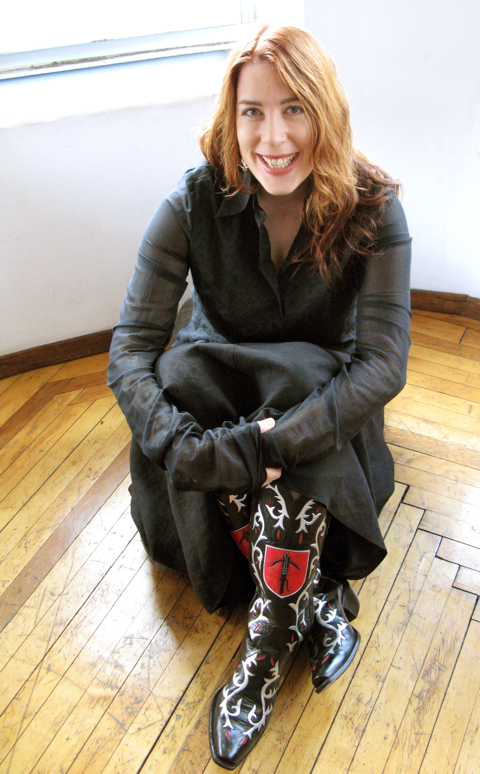
    Is like this: I have always wanted cowboy boots ever since I saw my first pair on the feet of indigenous stockmen in the Northern Territory of Australia. Those boots were beaten up and weathered like you wouldn’t believe and I’d never seen such cool boots in my entire life. Want!

    They were plain though. My fancy western boot lust didn’t develop until I saw my first rodeo. It wasn’t any of the performers who were wearing them but two women in the audience had on full cowgirl regalia and shiny, shiny boots. I am magpie. Shiny fills my heart with lust.

    Over the years, I have tried on many pairs of fancy western boots and they have never been quite right. Not shiny enough. Not shiny in the ways I want them to be. Too high-heeled. Too pointy. Too pink. Too hurty on the feet. Or perfect and way out of my price range.

    A few years back I heard that you could get cowboy boots handmade special to fit your feet and that you could have whatever design you wanted. I cannot tell you the joy in my heart when I learned of this possibility. Oh, bliss! Oh, joy! The family coat of arms on my very own boots! Want!

    Then last year Penguin sent me and Scott to San Antonio for the TLA conference.1 San Antonio just happens to be the home of Little’s Boots, one of the best makers of western boots in all of the US of A. Clearly, it was time for me to have the boots my little heart pined for.
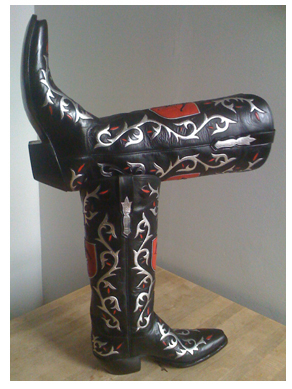
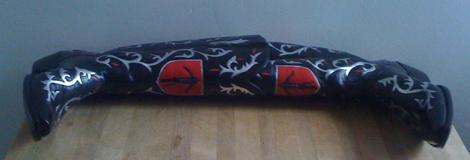
    So, I set up an appointment and early last April I went in for my fitting, clutching a printout of the Larbalestier coat of arms. In Old French my surname means the crossbower, ie the one who uses a crossbow. “L” is the, “arbalest” is crossbow, and “ier” is er. Hence the great big crossbow on the coat of arms. I have no idea what the thistles are for. Because we are a prickly lot?

    At the appointment I was asked a zillion questions. What kind of design did I want? I waved the printout of the crossbow. You want just that? In what colours? You don’t want any other design elements? Oh, I said. Look around the shop, they told me. I did. My eyes bugged out. I made many design decisions. Scott kept vetoing my more shiny desires.2 After about an hour the design was settled.

    Then they started asking me about what kind of heel and toe I wanted. What ears? How high up my calf did I want the boots to go? What did I want the top of the boots to look like? Straight or with a little v? What kind of leather did I want? Some were out of the question—you don’t use crocodile or alligator or eel for fancy boots. So my choice was between calf and kangaroo. I tried on many different boots to make my decision. Walked around the shop feeling like a rodeo queen.3

    After almost two hours of exhausting decision making, Dave Little started measuring my foot. I had not realised how many dimensions feet and calves have. This also took some time and involved Dave mocking my socks more than somewhat. (They’re cut to fit left and right feet and thus are way more comfortable than normal socks. They are also labelled with a little R and L, leaving Dave to suppose that we Australians are left and right impaired.)

    Finally, we gave them a deposit of half the total. A very big total. These boots are not only the most expensive boots I have ever owned, they are the most expensive item of clothing I have ever owned. Six months later, Dave promised, my boots would arrive. And then, because he’s such a lovely bloke, he gave us a lift back to the hotel because we were running late for our next TLA appointment. Texas hospitality is no lie.

    Dave was four months off on the arrival time. But the boots are even better than I imagined. They are the most comfortable footwear I’ve ever known. All other footwear are devices of torture in comparison. I may never take these boots off again. In fact, if it weren’t for Scott’s objections,4 I’d’ve slept in them last night.

    I love my boots.

    Now all I need is a Vivienne Westwood ballgown and my life will be complete . . .

    1. Which was the best fun ever! []
    2. Yes, the boots I wound up with are way more tasteful than they would have been had I been alone. []
    3. Justine, they name is camp. []
    4. He feared for his shins. []

    Why all the research?

    Enough of you have been emailing to ask why I wants to know about lying and DNA testing and race that I feel I should offer some kind of explanation, or several even:

    • I am hard at work building a lie-and-DNA-detecting robot.
    • I was bored.
    • Maureen Johnson made me ask you cause she’s too lazy to do her own research.
    • It’s for my new novel.
    • It’s procrastination to avoid work on my new novel on account of Scott took my IM capability away.
    • I am distracting myself from certain sad events on The Wire.
    • None of the above.

    I hope that’s cleared everything up to your satisfaction.

    More research: DNA testing and race

    Than you so much for all the excellent liar info yesterday. I’m now halfway through Paul Ekman’s Emotions Revealed: Recognising Faces and Feelings to Improve Communication and Emotional Life and finding it extraordinarily useful. Thanks to Gwenda Bond, Jenny Davidson and Malcolm Tredinnick for suggesting him. I’ll be chasing down all the other leads as well. You are all the best research assistants ever!

    Since you were all so amazingly helpful on yesterday’s research question I have another:

    Last year (I think) I read at least two articles about DNA testing being used in a classroom (or possibly classrooms) in California (but I may have the state wrong) to demonstrate that no one is racially “pure” and, indeed, to promote discussion about what race even is. The test gives the percentage of your DNA that comes from Africa, Europe, Asia or Native America. And many people get results they’re not expecting. The correlation between your skin colour and your DNA is not straightforward.

    I have googled any number of combinations and have found articles on DNA testing and race. Even on DNA testing being taught in the classroom, but not on DNA tests being used to talk about race in the classroom.

    If any of you can help with this I will be eternally grateful.

    Questions about lying

    Have any of you ever taken a lie detection test of any kind? (Polygraph or written q & a or some other kind of test I have not read about yet.) If so would you care to tell me about it? Feel free to be anonymous in the comments if you’d prefer.

    And more generally: for those of you who have told lies and gotten away with it—what’s your method?

    Do any of you believe you have the ability to tell when someone else is lying? Is it a general ability or just with people you know well?

    Can any of you recommend any good non-fiction articles and books about lying? Most of what I’ve found so far has been deeply underwhelming.

    Thanks!

    And thanks for all the fabbie fairy responses. It was mucho gratifying to see that quite a few of your fairies are already in How To Ditch Your Fairy.

    What’s Your Fairy?

    My new novel, How To Ditch Your Fairy, is set in a world where almost everyone has a personal fairy. My protag, Charlie, has a parking fairy (which she hates because she’s only fourteen and doesn’t drive and doesn’t like cars), her best friend has a clothes-shopping fairy, and her arch enemy has an all-boys-will-like-you fairy.

    So what’s your fairy?

    Or what fairy would you like to have?

    Blurry days

    Some days are more blurry than others. Like today. It’s blurry grey outside and also in my head. So instead of attempting to half-heartedly swat at my insanely long to-do list, I’m going back to bed and reading.

    I hope you get what you need out of your Sunday (or Monday or whatever day you’re facing).

    Zombie Idol voting begins

    The final five of Zombie Idol have been selected. Now all you have to do is go and vote for your favourite.

    And not to worry if you had a yen to enter Zombie Idol. This is just round one. The deadline for round two entries is midnight of 21 February (East Coast USA time). To whet your appetite here is Libba Bray’s take on Goodnight Moon by Margaret Wise Brown:

    In the great scary mall
    There were survivors
    And some dark halls
    And a picture of
    The zombie cow jumping over George Romero
    And there were three little zombies sitting on chairs
    And two dead kittens
    And a pair of severed mittens
    And a little toy house
    And a flesh-eating mouse
    And a lost sombrero and pain and a bowl of bloody rains
    And an old zombie lady whispering “braaaaiins!”
    Goodnight mall
    Goodnight sombrero
    Goodnight zombie cow jumping over George Romero
    Goodnight light
    And goodnight shotgun
    Goodnight zombie bears
    Goodnight chairs
    Goodnight dead kittens
    And goodnight severed mittens
    Goodnight useless locks
    And goodnight head-gouging rocks
    Goodnight screams
    And goodnight bloody rains
    And goodnight to the old lady
    Whispering, “braaaaiiins!”
    Goodnight flesh-eaters
    Goodnight hope
    Goodnight to the survivors trying to cope

    I’m a bit shocked that no one has inserted a zombie into Snugglepot and Cuddlepie or Little House on the Prairie. It’s not too late: send your entry to maureen AT maureenjohnsonbooks.com with the subject header ZOMBIE INSIDE! by 21 Feb. Go forth and zombify!

    More market research

    Vampires are so far ahead of the competition in my latest poll that it’s ridiculous. Fifty-four per cent of my readers believe there are vastly more bad books about them than anything else on the list. Lagging way behind are faerie and witches at 9%. Daikaiju and ghouls got no votes at all.

    On the other hand, my last piece of intensive market research found that faery and vampires were the most popular creatures of the night. What to conclude?

    1. People love vampires when done well, but hate them done badly.
    2. There’s a massive opening for novels about giant monsters and/or ghouls.

    Therefore, my next novel clearly has to be about a (reimagined) vampire who battles giant monsters with the assistance of an army of ghouls. Practically writes itself, dunnit? Though it does cry out for zombies . . .

    Which leads to my next poll, which you will find to your right.