I know you know this

But I thought I’d reiterate given some of the email I’ve been receiving:

There is no wrong way to write a novel.1

Please take all the advice I’m writing here with a grain of salt. Keep what works; throw away what doesn’t.

Hell, I don’t do the vast majority of what I’m suggesting here. Many of my working methods are weird, superstitious, or unhygenic, and thus unlikely to work for anyone but me. What I’m offering here are suggestions, tips, and ideas that I think might work for the person asking the question.

They might not.

Writing is a strange and varied game. There are a million and one ways—more!—to write a novel. I’m just scratching the surface of possibilities in this series of posts.

If you don’t agree that’s fine. But, truly, there’s no need to be writing me yelly emails to express that disagreement. It’s a waste of your time and mine. The internet is a vast space, there’s more than enough room for you to write your own series of writing advice posts. Or to comment here expressing—politely—your disagreement.

Why, there’s room enough for all our crazy advice. Bless the internets!

  1. Well, using a stylus made from the shinbone of your enemy, and writing in the blood of vrigins on skin torn from a copyeditor, who really annoyed you—that would be wrong. Don’t do that. []

JWAM reader request no. 6: Getting started

Bran-la says:

The thing that i always have trouble with is getting started. I never know what to say in the beginning or where the setting should be. What helps you get started? Any hints and tips would be wonderful!

It is a scientific fact that the majority of first chapters never make it into the final version of the novel. Here’s the very first chapter I wrote of Magic or Madness and here is the published first chapter of Magic or Madness. You will notice that the two have pretty much nothing in common.

This is good thing to know. It means you can relax and not worry whether your first sentence, first paragraph, first chapter is perfect. Odds are they won’t be in the final version.

When you’re getting started I find it’s best to just let yourself go and not second guess yourself on grammar or even spelling. Just type! When I was little all my stories began, “Once upon a time . . . ” I know it’s corny but it really helped me to get going. You can always edit out that phrase later.

I’m one of those writers whose first drafts are unspeakably bad. Total rubbish. It’s only in rewriting that they become readable. I suspect that some beginning writers are put off by the idea of their writing not being perfect straight away.

You need to give yourself permission to be bad. You’ll fix it in the next draft, or the draft after that. The first goal is to write a complete draft. It don’t have to be pretty.

As for kick starting ideas—have a read of this post, it definitely applies to getting started.

Once you start writing you’ll likely find you’ve gotten many things wrong. You don’t have to know everything about your novel before you start writing it. I never do. I usually know close to nothing about my novels when I start.

I have a novel that I originally thought was set in an alternative mediaeval Russia. It was rubbish and kept stalling and going no where. I abandoned it for a few years before I realised it was really set in an alternative fourteenth century Cambodia. I was several chapters into How To Ditch Your Fairy before I discovered it was set in an imaginary place called New Avalon.

Diana Peterfreund mentions in a comment that while writing one of her books she discovered ninety pages in that her protag was afraid of water. It changed her plot. She had to go back and rewrite everything up to that point to accommodate this revelation.

Happens all the time. Books change as you write them, as you learn more about the world you’re creating, and the people in it. This is why the first chapter is usually the most frequently rewritten chapter in the entire book. That is, if it escapes the cutting room floor.

Other kinds of writers

Now, none of this advice will be useful to you if you turn out to be one of those writers who has to know exactly what the first sentence of their book is before they can move on. My condolences!

There are also writers whose first draft is their final draft. They write slowly and painstakingly, crafting and shaping as they go. What I achieve over the process of many drafts they achieve in one but they probably take the same time with their one that I take with my many.

There are writers who cannot write a single word of the novel until they’ve figured out the entire plot in their head. From first to last sentence. If you were one of those writers than perhaps that’s why starting is so hard for you.

I know other writers who work out their novels in a detailed outline and don’t start the real writing until they’ve nailed every plot twist and character quirk. I remember someone once telling me that Tim Powers’ outlines for his books are longer than the books themselves and include maps and diagrams.

So it could be that what you think is slowness in getting started is, in fact, all part of the process of writing the novel. Some people work things out on the page, some in their head, and some in an interperative dance with finger puppets. (*Shudder*)

The only way you can figure out what kind of novelist you are is to write one. And be aware that with your second novel you may discover you’re whole different kind of novelist.

NOTE: Please ask your writing questions over here. It’s easier for me to keep track of them and answer them in order if they’re all at the end of that one post. Thanks! I’m taking writing advice quessies for the whole of January.
JWAM reader request no. 5: Characterization (updated)

Today I attempt to tackle questions about how to write the peoples in your novels. I believe I mentioned in the initial post for this month of questions that I don’t have all (or even most) of the answers. Today’s post will demonstrate that with bells on. You have been warned.

Julia says:

How do you come up with interesting believable characters? Without them seeming flat, or ridiculous, or confusing, or just completely lacking in personality?

Tim says:

Justine, I was wondering whether there is anything in particular you do when developing the voice of your character (ie. the way they speak)? Is there anything you do to try and keep this as consistent as possible throughout the story?

Monica says:

I am pretty new to novel-writing, but I’ve heard a lot about “interviewing your characters” to get to know them better. Is that something you do?

I’ll take Monica’s quessie first since it’s the easiest:

No, I have never interviewed my characters and find the idea of doing so deeply bizarre. However, if it works for you—go for it. That’s the thing about writing advice. Every writer writes differently. Some really do have conversations with their characters, and come up with astrological charts for them, and take them to the movies, some of us most emphatically do not. There’s no one right way. When you’re a beginning writer try anything and everything. Some of it will work and some of it will not.

Actually, Tim’s is pretty easy too.

Is there anything in particular I do when developing the voice of my characters (ie. the way they speak)? Is there anything I do to try and keep this as consistent as possible throughout the story?

No, there isn’t. My characters just talk to me and I transcribe what they say. Kidding! (Sort of.)

Any one else got a more useful response than this for Tim? Diana? Maureen? Anyone? (I apologise for my crap answer.)

Now for the tricky question:

How to write interesting characters

So far, I’ve already thought a lot about the questions I’ve answered for this month of writing advice. But I’ve never thought about how I write characters. Not once. Thus trying to give you tips and suggestions is breaking my brain.

I suspect the problem is that writing people and dialogue have always been my writing strengths. I spent a long time learning how to plot, how to write action scenes, transitions, exposition etc. etc. because I was crap at them. (They’re still not my strengths and I’m still learning.) Thus I can talk about how to do those till the cows come home. But the peoples?

Being asked to describe how I write ’em is like being asked to detail how I breathe. I dunno. I just do.

So I did what I usually do in this situation I talked to Scott.

    “Scott!”

    “Don’t yell. I’m brushing my teeth. I can’t hear you.”

    “If you can’t hear me then how come you’re answering?”

    “Can’t hear you!”

    “Can to.”

    “Can’t.”

    “They want to know how to write characters!’

    Scott emerges from bathroom with extremely clean teeth. “Tell ’em about Aristotle: ‘Drama is character revealed through action.'”

    “Aristotle. Right. What about your funny hat thing?”

    “Fine. Tell them about funny hats. But Aristotle’s key. And choices. Your characters have to make choices. When they make a hard decision, your reader invests in them, because they’ve lived with them through that difficult time. Also zombies.”

You all got that? What Scott said.1

You’re probably wondering what funny hats are. Scott says that when he begins a book all the characters are essentially funny hats: the girl with the big hat, the boy with red hair, the woman who lisps and so on. But eventually they become more than a funny hat, they take on other characteristics, opinions, ways of existing in the world of the novel. As he writes they grow. He does not, however, explain how he makes them grow.

Hmmm. The only simple tip I can come up with2 is to try and avoid writing stereotyped characters. Does the boy who like fashion have to be gay? Does the footballer have to be straight and a thug? Is your protag a reader and super smart and beautiful, but not in a conventional3 way? If you’ve written characters like that are they that way for solid reasons? Do they make your story better? Or do they seem tired and unoriginal?

I really hate it when a character, midway through a book, turns out to have a relative (mother is a surgeon) or hidden ability (black belt in karate) solely because the plot requires it. How convenient. If your mum’s a surgeon or you’re a black belt it would affect who you are. You’d be used to your mother not being around a lot. Being really good at a martial art, or sport, or some other intense physical activity changes the way you move and think about your body. Those are not things you can suddenly pluck out of the air for your characters in the middle of a book.

Check out some bad books with unconvincing characters. Try to figure out why those characters don’t work. Are they too stereotyped? Predictable? Boring? What is it about the way they’re written that doesn’t work for you? Too much description “violet eyes”? Not enough?

I know many of you are going to hate me for this, but when I think of unconvincing characters, I think of science fiction. Especially the science fiction published in sf magazines of the 1920 through to the 1950s. Talk about your two-dimensional characters. Those stories are all plot and no real peoples. They are a nightmare to read.

Why are they so crap?

I suspect part of the answer is that many of the writers, like Isaac Asimov, for instance, were extremely callow and didn’t know much about people. It’s hard to write people if you don’t know many or understand the ones you do know. It’s possible that part of why some writers struggle to create convincing characters is that they too don’t understand people or can’t empathise with how other people think, which makes it very tricky indeed to come up with believable characters.

It could be that as they get older, meet more people, travel more, go through different friendships, work relationships, love relationships, marriage, they’ll learn more about people and find them easier to write. There are many characters in my work that I could not have written twenty years ago.

Another part of it is, of course, practice. But if you’re struggling with writing convincing characters, writing lots of stories may not be that helpful. Why not re-read your favourite books with your favourite characters? But instead of getting caught up in the plot, read closely. Try to pinpoint the moment where you start liking the character. Now figure out why. What has the writer done to win you over? I know I fell for Elizabeth Bennett before she even comes on stage:

“But consider your daughters. Only think what an establishment it would be for one of them. Sir William and Lady Lucas are determined to go, merely on that account, for in general, you know they visit no new comers. Indeed you must go, for it will be impossible for us to visit him, if you do not.”

“You are over-scrupulous, surely. I dare say Mr. Bingley will be very glad to see you; and I will send a few lines by you to assure him of my hearty consent to his marrying which ever he chuses of the girls; though I must throw in a good word for my little Lizzy.”

“I desire you will do no such thing. Lizzy is not a bit better than the others; and I am sure she is not half so handsome as Jane, nor half so good humoured as Lydia. But you are always giving her the preference.”

“They have none of them much to recommend them,” replied he; “they are all silly and ignorant like other girls; but Lizzy has something more of quickness than her sisters.”

Even though this is still the first chapter of Pride & Prejudice, Mrs Bennett has already been established as a fool, and Mr Bennett as a man of sardonic humour. If Mrs Bennett doesn’t like Lizzy, and Mr Bennett does, then this reader has high hopes for Lizzy.

I hope there’s something in this post that will trigger something for you. But likely not. It’s a topic I need to read and think more about. My apologies for its inadequacies.

I’d really love to hear from other writers. What are your tips on writing believable characters?

Update: Sarah Monette has chimed in with a most excellent post answering many of these questions particularly Tim’s one about developing the voices of characters. Do check it out! (I am so with her on being kind of appalled by what I think of as the acting-school of writing. But as we both say it really works for many writers.)

NOTE: Please ask your writing questions over here. It’s easier for me to keep track of them and answer them in order if they’re all at the end of that one post. Thanks! I’m taking writing advice quessies for the whole of January.

  1. He didn’t really say zombies. But I’m sure he meant to. What would cause your characters to reveal themselves in action faster than zombies? []
  2. and, actually, I stole it from a friend []
  3. Oh, look, she has red hair! []

An amazing test

I couldn’t let one of the best tests and test series of all time go by without saying something, now could I?

We were there for day 3, which was splendid and full of pinkness (the shirt I wore was blinding) incident and event (how did those bloody bails not come off?), but nothing compared to the fifth day. That was mental! I can’t believe Graeme Smith batted with a broken hand. I’ve had a broken hand, I couldn’t have lifted up a bat, let alone wielded one. He totally deserved his man of the series award.

I can’t believe it came down to the last few overs. How about Ntini batting defensively? You rule, Ntini!

I rate this Australia v South Africa series almost as high as the Ashes series in England when those bastards won by, like, two runs. (I still think we was robbed.)

I’m ecstatic that South Africa and India are as good as (if not better than) Australia right now. True contests at last. And Sri Lanka and England aren’t far behind. I really hope that the West Indies, Pakistan and New Zealand start to get their shit together too.

I cannot wait until the next three tests in South Africa at the end of February. (So far away! Waaah!) But I’m stoked I’ll be in Australia to see the first two.

I am absolutely thrilled I was at the SCG for one of the days and that I got to watch every day of all three tests. Fifteen days of glorious cricket. Best game in the universe. Nothing could be better. (Well, if they sacked Ponting as captain that would be better. Though I’m not sure who to replace him with.)

Note: Yes, there’ll be more writing advice shortly. I just need a little time to recover from the edge-of-my-seat tension of that last day’s play.

JWAM Reader request no. 4: On getting published (Updated)

I’ve had a couple of questions that are about publishing, not writing. I have disqualifed such questions from this month’s advice though I might run a publishing questions month later in the year.1 But since I’ve already gotten two such questions I’m grandfathering them in.

But I will answer NO OTHER publishing questions! From now on: questions about the process of writing only. Thanks!

beth says:

I’d be interested in looking at the differences in submissions from when you were first starting to now. Could you share your query letters? Could you show us a real-life synopsis that you used when publishing one of your books? As someone with a complete novel and complete lack of success in publishing, I’d love to know more about the nitty-gritty of publishing, what it looked like for you when you sought publication, etc.

And, of course, I’d love to see your zombie attack plan

Beth, I can’t answer your second question because this is not zombie questions month. Save it for later.

Mitch Wagner says:

The one that’s really got me stumped: How do you sell a first novel? Does you really need to get an agent first? If so, how can you tell who the good agents are and who are the crooks? There’s so much writing advice out there, it all sounds authoritative, and I don’t believe any of it. I have friends who are established writers, and I don’t even believe THEM, because all they can tell me is how they got started 10 or 15 or 39 years ago, not how to get started today.

These quessies are variants on how to get published. Please take into account that I am not an editor or an agent and have, in fact, never worked in the publishing industry except as a writer. Thus I am not the best qualified person to answer these questions.

Like, for example, I have never written a query letter. Although I spent twenty years trying to make my first professional sale, I was trying to break into the genre short story market. The markets I was submitting to didn’t require a query letter more complicated than “this is my story it is x words long”.

By the time I started to shop my first completed novel in 1999, I had made enough contacts in the publishing industry that three agents and two editors agreed to look at it without my querying them. They all passed on it. That novel remains unpublished. So does the novel I wrote after it.

My path to publication was accidental. Eloise Flood listened to me pitch the Magic or Madness trilogy and then bought it from the proposal2. It helped that she’d read an early novel of mine so she knew I could write a complete novel. It also helped that she had a brand new imprint at Penguin, called Razorbill, and was desperate. I learned later that she was very nervous about the risk. Lucky for her and for me it worked out.

That is not the usual path. When I tell unpublished writers my story they tend to respond by saying. “Oh, so it’s not what you know it’s who you know.”

Which bewilders me. They seem to not hear the part about spending twenty years trying to get into print. TWENTY YEARS, people!

Or the fact that my contacts turned me down flat. Having contacts might3 get your work looked at faster, but it still has to be good, and they still have to love it enough to publish it.

I often wonder what would have happened if I hadn’t relied on my scant contacts, if I’d done it properly and queried lots of agents and editors, instead of just five. Maybe I would have gotten published faster if I’d tried the old fashioned way?

The vast majority of pro writers I know found their agent and got published by doing a lot of research to figure out what agents suited them best and then sent out query letters. Scott did it that way and he did it in the days before the internet made the search for an agent easier with site likes Agent Query. Maybe you should ask him about query letters? Though that was back in 1996.

I do know a bunch of people who’ve debuted in the last few years or about to in the next few. Every single one of them sent out query letters to get an agent.

I’m not sure if there are any big NYC houses left that officially accept unsolicited manuscripts. I do know though that they all have slush piles made up of the unsolicited manuscripts. I hear that very very very very very occasionally some plucky editorial assistant finds gold in them there hills. But it’s probably the most difficult way to get published. A manuscript from a reputable agent gets read much much quicker. My agent, Jill Grinberg, started getting responses from editors about How To Ditch Your Fairy less than a week after it went out.

Reputable agents make things happen faster. When you get an offer they protect you from signing a pernicious contract. I did not have an agent when I signed with Penguin for the MorM trilogy. That deal was much less favourable to me than the one brokered by Jill for HTDYF and the Liar book.

How do you know who’s a reputable agent and who isn’t? The easiest way is to check who their clients are, and what their sales record is. Here’s a random agents’ site and look it’s not even based in NYC. (Yes, there are good agents who are not based in New York City.) But who are their clients? Why New York Times bestseller Ellen Hopkins is one of them. Well, I’ve heard of her. A quick check on Publishers Marketplace reveals that it’s quite a big agency with a lot of agents and many recent sales.

AgentQuery allow you to find agents for your specific genre. If an agency doesn’t have any writers you’ve heard of in your genre be concerned. I assume that you are very familiar with your genre. How else could you write a book in it? Writers Beware is a great place to check if you think an agent might be dodgy. Never query an agent who charges fees of any kind. Reputable agents don’t.

It’s also a good idea to check out agents’ blogs. Kristin Nelson‘s is a particularly good one and has links to many other agents’ blogs. She often shares her clients’ successful query letters and explains what it was about them that attracted her attention.

It sounds to as if Mitch and Beth above have already been down the querying salt mines without luck. Trust me, I know how much it sucks. I’m about to get all my stuff out of storage here in Sydney and one of the things I plan to do is go through my dispiriting collection of rejection letters. Even now that I’m published and have a wee bit of a career just the thought of them gets me down. I’m not yet ready to celebrate them the way that Shannon Hale does with her long roll of laminated letters. Being rejected sucks and publishing is a world of no.

My biggest piece of advice is not about agents or editors. It’s to keep writing. Beth and Mitch appear to have written only one novel. Beth says “a completed novel”. Mitch says “first novel”. A while back Tobias Buckell ran a survey and discovered that only 35% of published writers sold their first novel. I suspect if he’d gotten a bigger response that would be an even lower percentage.

My first two novels remain unsold. I have friends who sold their tenth first. Selling your first novel is the exception, not the rule.

There comes a time when you need to set your first novel, your baby, aside and move on. Doesn’t have to be forever. I still have hopes that one day my first will find its way into print. But you have to shift your focus to the next novel. If you get no where finding an agent for it, write another.

Keep writing novels. You’ll get better with each one. It’s okay to take a break from submitting and sending out queries. You can even stop altogether. Getting published is not the thing, writing is.

Yeah, I know. That was said to me during my twenty years of trying and it was annoying as hell. But, you know what? I kept writing. And if my career comes to a grinding halt, which statistically it’s likely to, that won’t stop me either. I will always keep writing. I can’t not. (Though I’m really good at taking long breaks from it.)

I guess the other advice—which I really wish I could take myself—is to not take rejection personally. The agent isn’t thinking about you at all, but about whether they like your book, and whether they think it’s saleable.

I realise that I did not touch on synopses. My quick and dirty advice is to think of the synopsis as an advertisement for the book, not the book itself. Though you should really ask Diana Peterfreund for synopsis advice. She is much better at them than I am and claims to love writing them. I do not.

Update: Bless Diana for she has now written a post on writing synopses. And it is very good.

NOTE: Please ask your writing questions over here. It’s easier for me to keep track of them and answer them in order if they’re all at the end of that one post. Thanks! I’m taking writing advice quessies for the whole of January, but I will not be answering any more on publishing.

  1. Though I am far less qualified to answer publishing questions. []
  2. Which consisted of the first three chapters, a detailed synopsis, and bits of back story []
  3. It doesn’t always—one of my contacts never got back to me. []

JWAM reader request no. 3: How to get unstuck

There are a number of requests that touch on the same theme of getting stuck:

Jonathan says:

I’d be very interested in the pushing a dead plot post, since that’s where my novel is at.

On the other hand, I sort of know the answer already—stop reading blogs, sit down, and write.

Sylvia_rachel says:

I second the request for a pushing-through-a-dead-plot post (or perhaps a figuring-out-who-the-villain-is post). My writing projects tend to start with a strongly felt character/voice or scene, and then I have to go looking for a plot — sometimes easily found, sometimes … not.

Quiz question: Lois McMaster Bujold has said that the way she finds plots for character-driven novels is (I’m paraphrasing) to figure out what’s the worst thing she can have happen to that character, and then make it happen. Discuss 😉

Gillian A says:

I third the request for a post on pushing through with a dead plot. I’d also be interested in any comments on dealing with the ‘middle’ of a novel (although there may be elements of overlap with the dead plot advice – at least in my experience).

Dorothy says:

How can I make my plot more exciting? Like put in those kinds of turns to make you want to read the whole novel at once! So far my stories are too calculable.

Lianne says:

Sometimes when I’m writting I really like the story idea but, then I loose intrest in what I’m writng. I know that if I ever want to complete a novel, I have to stick with my idea and like what I am writing about. Do you have any advice on how to stick with my ideas?

These all amount to more or less the same thing. How do I stick with my novel? Despite the plot being dead, me being bored, me having crap ideas, my novel being totally uninteresting—how do I perservere?

My first response is, Oh, good. Another not easy question. Though I think I have at least partly answered Sylvia_rachel’s question in JWAM reader request no. 2 when I talk about nicking plots from elsewhere.

I’ll answer Sylvia’s quiz question first. Lois McMaster Bujold is the mistress of good plotting (and one of my favourite writers) so what ever she does is bound to work. Though personally, I have never consciously done that. How do you figure out what the worst thing is? Surely there are multiple answers to that question? (Which is probably Bujold’s point.)

How to deal with a dead plot

I don’t believe that any plot is dead. Only abandoned and/or recalcitrant. With the second (recalcitrance) often leading to the first (abandonment). This definitely seems to be the case for Jonathan, given the second half of his question: “On the other hand, I sort of know the answer already—stop reading blogs, sit down, and write.”

When your plot tangles, or grind to a halt, or becomes in some other way recalcitrant, sometimes the best thing to do is walk away. You need to not be in the same physical space with the problems. Go for a walk1 around the block, around the flat, whatever’s possible. Stretch our your back and arms and hands and fingers. Jump up and down on the spot. Do something physical away from your computer for at least fifteen minutes.

When you feel like the blood is actually circulating, sit down somewhere—not near your computer—and with pen and paper, or your iphone, or blackberry, or whatever—the key is that it be something that is not the thing you mainly write your novel on—write a quick schematic of where you are in the novel. You can draw little stick figures if you like representing the characters. Squares to represents the various places your novel takes place. Squiggles to represent action. Straight lines for when nothing’s happening. Etc etc. Personally I am not a visual person, I just write stuff down, you know, with words, but I have seen diagrams and sketches work for other people.

The point is to recreate your novel in a much shorter form to give yourself a different angle on it and a path forward. You may discover that not all your characters are interacting—bring two unlikely ones together. That they’re stuck in the same place—move them. And so on and so forth. Sometimes just the act of writing (or drawing or dancing) stuff about your novel away from it will trigger a solution to your plot problems.

It’s really important to take a break from your computer when you’re stuck. Don’t stay there futzing about on teh evil interwebs. That’s usually not the path to clearing brain and getting more focussed. Though if you’re writing your novel with pen and paper or on a typewriter (you lunatic!) or some other weirdness, then sitting in front of a computer could be just the break you need.

The other tried and true method—and this is the one I use most frequently—is to just push through. Sometimes that means putting in square brackets [no idea what happens here] and jumping ahead to write a scene where I do know what happens. Other times it means stubbornly writing even though you’re not sure what happens next. I did this when I got stuck with Magic Lessons and wound up writing about twenty thousand words (or whatever it was) where Tom was stuck on his own in Sydney while Reason and Jay-Tee had a fine old time in NYC. I didn’t realise I’d made a wrong turn until I had Tom sitting on his own in the cemetery saying to himself, “What am I doing here?”

Very good question.

I deleted the twenty thousand words and started from the point where Tom had been left on his own with nothing to do. This time Jay-Tee stayed in Sydney. The book began to write itself. Love it when that happens!

Scott had the same thing happen to him with Extras. He started the book in Hiro’s point of view before realising 16,000 words in that was the wrong point of view. He had to start over. Not much of what he’d written was salvageable.

Many beginning writers are appalled by these stories. “But you wasted so much time!”

Not really.

The time spent going in the wrong direction is how we figured out the right direction. Making mistakes and fixing them is how you learn to write a novel. Very few (if any) people get it right the first time.

Pretty much every novel Scott and I’ve written (and I suspect this is true of most novelists) has far more words on the cutting room floor (so to speak) then make it into the actual novel. I don’t mean that in the dramatic ditching-twenty-thousand-words-cause-of-wrong-turn way. Just that as you write, you make edits:

    First version: Her hand had gotten cold so that when she reached out to touch him he startled from the coldness of her touch. (22 words)

    Second version: Her hand was cold. When she touched him he startled. (10 words)

    Third version in which you realise the sentence not only sucks, but is unnecessary and cut it: (0 words)

So 22 words witten, but none of them remain in the complete first draft of the book. That’s just one (very bad) sentence. There are gazillions more where that came from.

Dealing with the middle, making things more exciting, finishing

I think the advice above can definitely help when you’re bogged down in the middle and will also help make things more interesting. You should also look at JWAM reader request no. 2 about generating ideas.

But I suspect that the real problem is often psychological. Who says your book isn’t interesting? You, right? Are you sure that’s not just an excuse to give up?

The most important way to deal with all these problems is to finish your book. It’s very hard to diagnose what’s wrong with an unfinished manuscript. Trying to fix things before the book is finished can complicate and slow things because once you truly finish you may discover that your diagnosis was wrong. Making your book good is easier to do when you have a complete manuscript to work with.

Your main job is to complete the first draft. This is especially true if you’ve never finished a novel before. You will never trust yourself as a writer until you have a completed ms. with a beginning, middle, and an end.

Hope this advice helps. Just remember there are lots of different solutions to these problems. Some will work for you, some won’t.

NOTE: Please ask your writing questions over here. It’s easier for me to keep track of them and answer them in order if they’re all at the end of that one post. Thanks! I’m taking writing advice quessies for the whole of January.

  1. I know that’s tricky for some of you Northern hemisphere types given that it is literally below freezing right now and I’ve heard tales of people in Canada dying of exposure when they went out to get the paper and the door slammed behind them []

Categories

I’ve just added six more categories:

As a result of all the extra categories, I’ve gotten rid of the “writing and publishing” category, which was pretty much useless, and amalgamated the MorM books under one category: “Magic or Madness trilogy”.

Wow. I feel so organised. First new year’s resolution is now off the list!

JWAM reader request no. 2: Generating ideas

Travis Says:

Where do your ideas come from? Every time I try to write something, I can’t think of any interesting thing for my protag(s) to get themselves into. Very frustrating stuff.

I have written so many posts answering your first question that I created a separate “ideas” category for it. However, I think you’re asking something different. The issue is not where I get my ideas from, but how you can generate some of your own, and thus find interesting things to happen to your protags.

When beginning writers ask this question I tell them to take a plot from somewhere else: a fairy tale, a movie, a novel, manga, anime, anywhere at all really. But change it. Change it a lot.

Say, you decided to use “Little Red Riding Hood”. Why not make the protag a boy? And instead of crossing the woods to meet his grandmother, he has to get from one end of your city/town/neighbourhood to visit his uncle. And in place of a wolf there are members of an enemy gang trying to stop him.1 And it’s set in a future where water is scarce and worth more than gold. Or whatever you want. If you get stuck throw in another plot. Like one from Naruto maybe or High Noon or Great Expectations or something.

Every time you get stuck have something blow up. Or someone come running in brandishing a gun. Or someone discover that their new best friend is their long lost sister. Just keep throwing more stuff in until it feels like you have enough to work with.

I also suggest fixing someone else’s story you think is broken. Next time you read a book you hate, or stop watching a movie because it’s deeply lame, try to figure out what you hated about it and how you would fix it. Then write your improved version. This is a great way to learn how to plot.

Trying your hand at fan fiction—setting a story in someone else’s world with someone else’s (maybe minor) characters—like writing a story set in Harry Potter’s world about Hagrid or in the Middleman universe about Lacy. It’s a great way to learn. You already have a world and characters. But it really helps you learn how to plot like no one’s business. It’s no surprise that the pro writers who come out of fandom are plotting geniuses. Counter-intuitively they’re also very good at characterisation and world-building. You learn A LOT playing in someone else’s world.

Now most of these borrowed-plots stories and fixing of other people’s disaster will probably suck. But they’re an awesome way to learn.2

I once3 wrote a story by opening up two books at random in my room. I closed my eyes, spun around, and grabbed a book and opened it before opening my eyes. I was staring at an entry in an almanac about Lammas Day. The second book opened on the “Demon Lover” ballad. The resulting story was at long last, after many many rewrites, published this year.

I don’t need to generate ideas using tricks like that any more because after so many years of writing ideas come easily. That’s true of most things in writing (in life, really) the more you do them (plot, write dialogue, transitions, action scenes etc.), the easier they become, until they’re a habit you couldn’t break if you tried.

NOTE: Please ask your writing questions over here. It’s easier for me to keep track of them and answer them in order if they’re all at the end of that one post. Thanks! I’m taking writing advice quessies for the whole of January.
  1. Wait a second does this mean that Warriors is a retread of “Little Red Riding Hood” and not whatever Roman myth the creator claims? []
  2. Some fanfic is just out and out genius. []
  3. more than fifteen years ago []

Note to livejournal people

Please stop writing and asking me to resume blogging. I never stopped.

For some reason the lj feed of my blog is broken and has no posts after 18 December. So while I have blogged every day since then none of those posts have shown up on that feed. I have no idea why and no idea how to fix it.

Perhaps one of you lj people knows how to fix it? I’d be much obliged.

Sadly, though my writing about this here is completely useless given that lj people rarely venture outside the world of lj. Oh well.

JWAM reader request no. 1: Choosing povs

Malcolm Tredinnick Says:

Picking a point of view and how you learnt to work with the different types would be something I’d be interested to hear about. As a reader, I kind of know when the point of view works for the story and when it doesn’t, but I don’t really know how consciously writers make the choice or how you do it.

Hmmm, a tricky one first up. Curses!

I think I may have mentioned that for most of my writing life i.e since I was five and first started, I wrote short stories, not novels. I’d start many but not finish them. But I finished hundreds of short stories. None of them were much good as stories, but they were excellent for learning stuff like how to use the different points of view.

And, wow, did I. I even have a few stories written in second person. Those were on purpose experiments, but in my early days I did lots of experimenting without knowing what I was doing. I would change points of view willy nilly. One minute a story would be in first, and then in limited third, and them in omniscient. I’d write from Jack’s pov, then Chan’s, then Jill’s, then Kara’s. Sometimes all in the one paragraph. Those stories were mostly unreadable, but slowly I started to learn my way around the four basic povs.

In those early bouncing-around-all-over-the-place stories I had no control over what I was doing with pov. I didn’t notice the constant changing. That was something I learnt by writing all those bad stories.

How does that translate to what I write now?

The first draft of Magic or Madness was written in third person. I also thought the book was going to be entirely from Reason’s pov. I wound up with Reason’s voice being in first and the two other pov characters, Tom and Jay-Tee, being in third. I’m not sure how that happened. Reason just wasn’t working in third. Her voice seemed flat. As soon as I tried shifting it to first, the book took off. I’d found the right voice.

I think my struggle to find the right voice for Reason stems from the trilogy beginning life as a set of ideas, rather than with a specific character. Both How To Ditch Your Fairy and the Liar book began with the strong voice of the protag. Both are in first person. It never occurred to me to change. Didn’t need to.

Scott says he uses first person when the book is more digressive—So Yesterday, Peeps—it allows him to stop the narrative and say, “Hey, let me tell you this cool thing.” He uses third when the narrative has more of a straight drive, like the Midnighters and Uglies books.

My current novel is (at least partly) in omniscient. It’s big with a large cast of characters. I believe that omniscient is the point of view best suited to epics. I think Dunnett’s and Pullman’s1 deployment of it is a large part of what gives those books their distinctive epic feel. If I can make it work even half as well as they do I’ll be home and hosed.

I’m loving writing in omni. I love being able to move from a close in view of a character’s thoughts all the way out to a sweeping view of the city and that character’s place in it. Omniscient feels like the most metaphysical point of view. The most flexible too. It allows for straight driving narrative, digressions, whatever I want to do with it. Right now I am deeply in love and feel that it is perfectly suited to the huge story I am attempting to tell. Bless you, omni!

Hope that answers your question, Malcolm.

NOTE: Please ask your writing questions over here. It’s easier for me to keep track of them and answer them in order if they’re all at the end of that one post. Thanks! I’m taking writing advice quessies for the whole of January.

  1. in His Dark Materials []

January is writing advice month (sticky post) Updated

[UPDATE: I’ll be answering questions about the process of writing only. No questions about publishing. Thanks!]
[UPDATE the second: This is for the folks asking about what order I’m answering the questions in. I’m answering them in the order they come in. Though I’m bundling similar themed questions together. If you’ve asked two unrelated quessies I’ll answer your second one only after I’ve gone through everyone else’s first questions. Hope that makes sense! I’ll be turning off comments on the last day of January. I won’t be doing daily writing posts after that. Though I will try to answer all quessies. It’ll just be slower. Much slower.]

I am working on organising my writing process posts so that they’re more accessible. In so doing I discovered that there are several different writing posts I’ve promised, but haven’t gotten around to. Someone wanted me to write about the differences between being a full-time published writer and being a part-time writer. (More deadlines!) Someone else wanted advice about writing proposals. (Accept that you must suffer!) Someone else requested that I explain how to write dialogue. (With more ease than I write anything else. Honestly, it’s the non-dialogue bits that are hard.)

I will write more detailed answers to those questions this month.

I was also thinking of posting about how to get started, on characterisation, and how to push forward even when your plot has died. Any takers for those topics?

Do any of you have other requests for posts on writing or questions you want answered? Any aspect of writing that you particularly struggle with? Now’s the time to ask. I will leave this post at the top of the blog for the whole month so you can come back to it when a question occurs to you. Yes, even though this post is at the top, there are new ones below. Nothing can stop me blogging every day!

To avoid asking quessies I’ve already answered check my writing faq. I also have a post on How to Write a Novel and How to Rewrite.

Remember that it’s only five years since I sold my first novel. I’ve learned a tonne in that time, but there’s still lots I’m learning. I may not be able to answer all your questions. And for definite my answers won’t always work for you. Every writer finds different solutions. All writing advice should be used as needed and ignored otherwise. There’s no one way of doing anything in the land of writing.

I await your questions!

Happy new year!

Last day of 2008 (updated)

Yup, it’s my annual what-I-did-this-year skiting post. I write these mostly for myself so I can easily keep track. Hence the last day of the year category. Thus you are absolutely free to skip it.1

This year was exceptional. I’m still pinching myself. My first Bloomsbury USA book, How To Ditch Your Fairy, was published and seems to be doing well. I was sent on my first book tour, which was fabulous. It’s insane how much fun I had and how many fabulous schools, book shops and libraries I visited in California, Michigan, Missouri, New York, Ohio, Pennsylvania and Texas. Thank you to everyone who came to see me while I was on the road. It was a blast getting to meet you all! I loved hearing what fairies you all have!

Now this is going to sound like the acknowledgments page but bear with me cause I thanked my fabulous editor, Melanie Cecka in print, but not the wonderful publicity and sales and marketing folks because, well, I didn’t know them back then. Deb Shapiro is the best and funniest publicist I’ve ever worked with, Beth Eller is a genius of marketing, and all the sales reps who’ve been flogging the fairy book mercilessly across the USA are too fabulous for words. Extra special thanks to Anne Hellman, Kevin Peters, and Melissa Weisberg.

HTDYF also sold (along with the liar book) to Allen & Unwin in Australia. This is a huge deal because it’s the first time I’ve had a multi-book deal in Australia and A&U publishes many of the best writers in Australia, including Margo Lanagan, Garth Nix, Penni Russon and Lili Wilkinson. My editor and publisher, Jodie Webster, is a joy to work with. So’s Sarah Tran and Erica Wagner and Hilary Reynolds and everyone else on the Alien Onion team. Bless!

Both Bloomsbury and A&U seem even more excited about the liar book than they were about HTDYF. Which is a huge relief to me because, um, it is not the most obvious follow-up to the fairy book. Older, darker, scarier, completely different. Stuff like that. Here’s hoping that not too long into the new year I’ll be sharing the title, the cover, a sneak preview, and other such fabulous things.

The fairy book also sold in Germany to Bertelsmann, who published the Magic or Madness trilogy there and gave it the best covers ever. It was awesome getting to meet the two Suzannes: Krebs and Stark in Bologna. Thank you for believing in my book so strongly that you bought it when it was still in manuscript. I still can’t quite believe it.

Speaking of the trilogy it sold in Indonesia to PT Gramedia and in Korea to Chungeorahm Publishing, which means it’s now published in ten different countries and eight different languages. All of it Whitney Lee’s doing. It’s astonishing to me how well the trilogy is doing more than three years after first publication. Fingers crossed that will continue.

I also had two short stories published. A rarity for me. My last short story was published back in 2004. These two were the first I’d written since then. Short stories are not my thing. They’re so much harder to write than a novel. ““Pashin’ or The Worst Kiss Ever” appeared in First Kiss (Then Tell): A Collection of True Lip-Locked Moments edited by Cylin Busby and was universally declared to be the grossest story ever. “Thinner Than Water” is in Love is Hell edited by Farrin Jacobs. I’m proud of them both for very different reasons. But don’t expect any more. Writing short stories hurt my brain.

Last year I was wise and only aimed to write one novel in 2008. Just as well because that’s all I did this year no stories, no articles, nothing else. I wrote the liar book and began the 1930s book. It’s very clear that I’m a one-book-a-year girl.

I also mentioned in that one-year-ago post that I had three sekrit projects. The first is no longer a secret: the Zombie Versus Unicorn anthology that I’m editing with Holly Black, which marks the first time I’ve edited original fiction. Am I excited? Why, yes, I am. It will be out from Simon & Schuster in 2010 and we’ll be announcing our insanely excellent line up of authors in the new year. Truly, you will die at how great our writers are.

One of the other sekrit projects morphed into a solo project (the 1930s book) and I’m still hoping that the last of the sekrit projects will go ahead some time next year. Here’s looking at you co-conspirator of my last remaining sekrit project! You know who you are.

Next year will be taken up with writing the 1930s book and editing the Zombie v Unicorn antho. The 1930s book is the biggest most ambitious book I’ve tried to write since my very first novel set in ancient Cambodia. I’m loving the researching and writing. Immersing myself in another era is the most fun ever! I think my next ten books will all be set in the 1930s.

My 2009 publications. This is a WAY shorter list than last year:

    Update: Possibly September: paperback of How To Ditch Your Fairy

    September: the liar novel for Bloomsbury USA.

    October: the liar novel for Allen & Unwin.

Yup, just the one two novels from me and one a reprint. Sorry! You should also get hold of Cassandra Clare’s City of Glass when it comes out. It’s the final book of the City of Bones trilogy and the best of the three. I read it in one sitting on my computer.2 Then later in the year there’s Robin Wasserman’s sequel to Skinned. You know you want it! Yet another book I read in one go. Also on my computer. Think how much better it will be between actual covers.

Then there’s the three YA debuts I’ve been talking about by Peterfreund, Rees Brennan and Ryan. If you read no other books in 2009 make sure you read those three. I’m also dying to read the sequel to Kathleen Duey’s Skin Hunger, which was my favourite book of 2007.

Last, but not least, the old man has his first novel in two years, Leviathan, coming out in September. Fully illustrated by the fabulous artist Keith Thompson and better than anything else Scott’s ever written. I’m so proud of him and of this book. You’ll all love it. Seriously, it’s worth the price just for the endpapers!

I travelled way too much this year. Italy, Switzerland, Austria, Germany, the UK, France, Canada, all over the USA, and home to Australia. Again. Looks like the same for next year. I have no idea what to do about that. I guess when you try to live in two different countries at the same time that’s the price. Oh, and lots and lots of offsets. We try to be good.

This is where I usually say that I think the coming year’s going to be fabulous. But this year I’m not sure. The economic news back in the United States has been dire. Friends have lost their jobs, their editor, their imprint. It’s scary in publishing right now and it’s even scarier in many other industries. I really hope good governance in the USA will make a difference world wide. But I just don’t know. I had great hopes for the Rudd government and here he is botching the fight against climate change and trying to put up a filter for the internet in Australia. Ridiculous. Surely Obama’s government will not be so stupid.

Here’s hoping 2009 will see a return to sanity all around the world, but especially here in Australia.

Happy new year!

  1. I would if I were you. []
  2. Actually I was lying in bed. Whatever. []

Congrats, South Africa

South Africa just won their first test series against Australia in Australia. I’ve been dead impressed by them. Especially by debutant Jean-Paul Duminy. What a way to score 166 runs! He now has an average of more than a hundred. And he’s awesome in the field. He is looking to surpass Ntini as my favourite South African cricketer. I can only see South Africa getting better as more and more South Africans get excited about cricket. Under apartheid they only had a small pool of white cricketers to draw on. Now the pool gets bigger and better every year. If that keeps up they will be dominant for a long time.

South Africa and India have both beaten Australia in a series this year. Convincingly. It’s good to see more than one strong test side in the world. It’s good for cricket not to have Australia winning everything. Really, there’s only one nation that we must always destroy—England. If we keep doing that I’m good.

I’m hoping, though, that the third test will be a little closer. Not just because I’ll be going but because three strong test sides is brilliant for cricket. I want to see Australia fight back. I want to see them strong. I think they need to drop Hayden and have Phil Hughes in his stead. And we really really really need a new captain. Ponting is lost without Warnie setting his fields for him. And how about giving that Bollinger lad a go? There’s a lot of talent out there. Let’s see them get a go at test level.

Another reason it’s so awesome to be home. I have now watched ten days of cricket some of it astonishingly good: Mitchell’s bowling in Perth, Duminy’s fightbacks with the South African tail, Ponting’s almost century. And I’ve been really enjoying Shane Warne’s commentary. I wonder if I can get tickets to the musical? Bless you, Warnie.

And, yay, South Africa!

Write what you know, NOT!

“Write what you know” is one of the most frequent pieces of writing advice. Problem is, it’s rubbish. As Cat Sparks discusses at length in this excellent post:

We’ve all heard that old adage ‘write what you know’. Well, that’s a damn fine idea if you happen to be an articulate astronaut, outback adventurer, brain surgeon, fashionista, rock star, molecular biologist or trapeze artist. But if, like me, you’re just another white middle class wage slave, maybe you want to rethink that hoary old chestnut. Because maybe we just aren’t that interesting and maybe what we know about is duller than a public service tea break. I have developed a better idea. Find something you don’t know much about, learn it up and run with the baton from there.

Almost every book I’ve written has involved me doing research. Obviously, I did that for my two non-fic books. But also for my novels. The Magic or madness trilogy has a protag, Reason Cansino, who’s a mathematical genius. I am not. I can barely add up. I had to learn about Fibonaccis, prime numbers, and many other mathematical concepts that I barely grasped and have now completely forgotten, but hopefully make sense and worked in those three books. I’ve had some maths fiends write and tell me how much they appreciated Reason’s mathsiness. Those are the compliments that mean the most to me because that was by far the hardest part of writing the trilogy. I was writing stuff I didn’t understand. Or only barely. And only for long enough to write those bits of the book.

None of my novels are about people who are like me. Charlie in How To Ditch Your Fairy is a jock. I love sport, but I’ve never played that much and have never excelled. I would never have made it into a sports high school, even if I’d had the talent, cause I don’t have the discipline, and I really hate being told what to do. Charlie loves it. Rules make her happy, being at the strictest, most irrational high school in the world makes her happy. It would have driven me nuts. I would have been expelled within a week. Sometimes I think Charlie is the character I’ve written who is least like me. She has little intellectual curiosity, she’s happy with how things are, she loves rules, and she’s very very disciplined. Writing her was a revelation—I wound up liking and even understanding her. Whereas if we’d been at school together, I doubt we’d have had anything to talk about. Charlie doesn’t read or watch tellie and she doesn’t have much of an imagination.

If I’d’ve stuck to writing what I know, I wouldn’t have written any of those novels.

That’s not to say that I use nothing I know. Sometimes I give characters aspects of myself. Reason has spent time on indigenous settlements, so did I. Tom (also from the trilogy) has a father who’s a sociologist, so are both my parents. Tom in the trilogy loves fashion; so do I. But we’re still different. I’m challenged to get a button onto a shirt; Tom can make any item of clothing from scratch. So it required research to make his fashion prowess believable.

For me, one of the great pleasures of writing novels is exploring worlds I don’t know. I didn’t know anything about New Avalon when I began HTDYF. It’s an amalgam of places I’ve been, but it became its own city. Not like anywhere else. I didn’t know it until I wrote it. But I especially love learning about the characters I populate my books with. None of them have ever turned out the way I thought they would. They’ve all forced me to stretch as a writer, to learn things I didn’t know—about mathematics, about being an athelete, about being someone other than myself. It’s a gift to get to live in someone else’s head for awhile. It’s why I kept writing for twenty years without being published. It’s why I will keep writing long after my career has dried up. And it’s why I’m so bewildered by those writers who keep writing the same book over and over again. Maybe I should write a novel about that kind of writer so I can figure it out?

Forget about “write what you know”. Or, rather, don’t be limited by that injunction. One of the scariest things I encountered on my tour was when I was being shown around a lovely school and I was introduced to all the different grades, even kindergarten, and in one class, second grade, I think, the teacher told her students that I was a writer:

“She writes stories for a living!”

The kids looked a bit bemused by this information but smiled and waved at me. I smiled and waved back.

“When you were their age,” the teacher asked me, “you wrote about your own experiences, didn’t you?”

“Oh, no,” I said immediately, “I wrote about dinosaurs and wizards and witches and monsters and—”

The teacher cut me off even as many of the kids were giggling. “Yes, but don’t you agree that it’s much better to learn to write from your own experiences?”

I don’t think that at all. I was horrified. So horrified that I just stared at her, not able to articulate my response. I don’t think anyone noticed because someone realised we were running late and I was led away. But later that day I made it a point to talk about how important and fun it is to write about stuff you don’t know, and that the way to do that is to make it into something you do know.

For example, maybe you have an excellent idea for a story about a kid whose mum is an elephant trainer? But you don’t know anything about elephants or what goes into training them. Start reading up on it and once you have go to the zoo nearest you. See if you can interview the zoo keeper about how they keep their elephants. Ask yourself lots of questions: How happy are elephants to be trained? How much longer do they live in the wild than in captivity? Would your character have an ambivalent attitude to their mum’s job?

That’s a lot to learn. Maybe you can ground your story by setting it somewhere you’re familiar with, or giving your protag some aspect of yourself. I doubt anyone writes a story that’s entirely made up of stuff they don’t know. In fact, once you’ve researched it, you do know it.

Hmmm, I think I’ve come full circle: write what you know.

But remember that what you know includes everything you’ve learned, all your research, everything you’ve read, or heard or seen. So the more you read, and hear and see, the more you have to write about.

Australia

No, not my homeland, the movie. I went and saw Australia because my sister, Niki Bern, worked on it. I doubt I’d’ve gone otherwise. I’m not a fan of Nicole Kidman’s acting unless she’s playing a psycho or a bitch. Her turn in Moulin Rouge is one of the worst pieces of miscasting I’ve ever seen. The ads for Australia are full of Kidman’s eyes afluttering and Jackman looking all manly. They did not fill my heart with hope.

Also the title put me off. Was Lurman claiming he could sum up my country’s history in one film? That he could encompass everything important in one movie? Right. Good luck with that, Baz.

Or, worse, was he pandering to dumb and kitschy expectations of non-Australians? I can’t tell you how many folks I’ve met on my travels who are astonished to discover there are cities in Australia. Or are convinced that the entire country is one great big desert and that all Australians are just like the crocodile hunter. To which, sigh.

brandonwalter

It was not as bad as I expected. There are worse ways to spend three hours (or however extremely long it was). I wasn’t bored that often, which was more than I expected. For which I thank Brandon Walters playing Nullah. This eleven-year old actor single-handedly saved the movie. When he’s on screen that’s where you’re looking; when he’s not you pine for his return.

Lurman should have ditched the tedious Kidman/Jackman story and told Nullah’s instead. I wanted to know more about him, more about his mum and about King George. Walters was by far the most convincing and interesting actor in the movie. The only one who didn’t seem to be embarrassed by his lines. The only one who made the cliches seem fresh. If the movie had been about Nullah, it could have been amazing. Instead it was a frequently cringe inducing, occasionally beautiful, sometimes funny, but mostly an embarrassing big fat mess.

Other than Nullah the highlight for me was seeing my sister’s name in the credits. Her biggest one thus far: Compositing Supervisor. Go, Niki!

If you’re going to see Australia wait till it’s on DVD—that way you can skip all the bits that Brandon Walters isn’t in.

My favourite fairy so far

Someone just wrote and told me they have a hiccup fairy. Whenever they get the hiccups this fairy makes them go away within a minute. Fabulous!

D’you know it never occurred to me when I was writing How To Ditch Your Fairy that so many people have fairies. I have enough fairies now for about a million sequels. Tis a pity I’m unlikely to be writing them.

Anyone got a fairy they haven’t told me about yet?

Up to date correspondence & the joys of fanmail

I am now almost up to November answering my correspondence. There’s only a hundred more emails to answer! Yay!

If you’ve written to me this year and not heard back from me, that means I either didn’t get your email, or you did not get my response. Either way best thing to do is to write me again.

I received more fan mail this year than all previous years added together. (Which, admittedly, was not hard as I received very few until this year.) Of all the fabulous things that have happened to me in 20081 those letters are by far the best. The majority were about posts and essays on this website—especially requesting writing advice. The next biggest group of letters were about the trilogy, and lastly about How To Ditch Your Fairy. Though to put that in perspective HTDYF has already attracted more letters in the few months since it was published than Magic or Madness did in its first 18 months of publication. Yay, fairy book!

Thank you so much for the wonderful letters. Each one gave me a tremendous lift. Even if I was already in a good mood they made me happier still. While I’ve always wanted to be a writer, until my first book came out, it had never really occurred to me to think about what that would actually mean, about what it would be like to have readers. I know that sounds a bit bizarre, but I was so focussed on my writing, and on getting published, that I just hadn’t considered that part of the equation: that being published means being read by people I’ve never met. I’m glad that part didn’t occur to me ahead of time. I think it would have spooked me. But it turns out to be fabulous.

Thank you for all the letters pointing out the typos and errors in my books and my blog. I really appreciate them and do what I can to fix future editions. Keep ’em coming!

Thanks to everyone who wrote and begged for more books in the Magic or Madness and HTDYF universes. I’m pretty sure that HTDYF is a standalone and the MorM series a trilogy, but I’m thrilled my books left you wanting more. The best way to get more is to write it yourself. There are gazillions of wonderful fanfic sites out there. You could add your own stories about the further adventures of Tom and Charlie. Go forth and create more fanfic! Mash up MorM with Buffy or Nana. Or HTDYF with Naruto! What would be cooler than that?

Thanks for all the tips on quokkas and mangosteens and cricket and 1930s fashions and photo sites. Much appreciated! Though I’m horrified that any of you are settling for dried mangosteen or mangosteen juice. Ewww. There are no substitutes for the actual fresh fruit!

Good luck with your writing. Yes, sometimes it can be hard and you don’t know what’s going to happen next. That happens to the professionals too. The only thing you can do is keep pushing through. Don’t give up. But remember to have fun with it too. One of the best things about not being published yet is that you have heaps of time to experiment. Write the same story in all the different points of view. See which one works best. Try writing a story backwards. Starting at the end and working your way towards the beginning. Write in lots of different genres. Muck around! Have fun!

Thanks for your letters, your comments, and all your support. It means the world to me.

xo

Justine

  1. Of which more on the last day of the year. []

Boxing Day

I love Boxing Day.1 It is the most excellently lazy day ever. Right now I have my feet up, watching the beginning of the Boxing Day test, while eating my brekkie of mango, banana, sheep’s milk yogurt and granola. (We ran out of passionfruit. Get some more tomorrow.) Is there anything better than this? I don’t think so.

I have high hopes for this series between Australia and South Africa. The first test was splendid. Every day (except the last) was full of reversals and much excitement. I didn’t see the series in India so this is the first time I’ve seen the Aussies up against a team that can beat them in ages. It’s most excellent. If only we had a better captain. Ponting’s a great cricketer but I’m deeply unimpressed by his captaincy skills.

Mmmm. Boxing Day, cricket, mangoes, laziness. I’m home, aren’t I? If it were up to me I’d never leave.

Hope you’re all having a marvellous day wherever you are and whatever day it is. Hope you are having as much relaxing fun as I am!

  1. I know the date stamp for this post says Xmas Day, but it’s not. I was too lazy to change to east coat aussie time from east coast usian time. []

Fred Astaire versus Gene Kelly

A frequently debated question is who was the best dancer? Fred Astaire or Gene Kelly.

The answer is: the Nicholas Brothers!

Feast your eyes:

Fayard and Harold Nicholas have never been surpassed. Just astonishing. Even Fred Astaire admitted the fabulousness you have just watched was the best dance sequence he’d ever seen. He was correct.

On the research front: Yes, that sequence is from Stormy Weather and yes it was released in 1943. But they were the top act at the Cotton Club from 1932. As you all know the Cotton Club was the top entertainment venue in New York City in the 1930s, which co-incidentally is when and where my next book is set. So rewatching the fabulous Stormy Weather totally counts as research cause it recreates many 1930s era Cotton Club numbers.

Next stop Emperor Jones from 1933, which I don’t even have to justify. Yay!

For those suggesting 1930s films: I much appreciate it. Just keep in mind I’ve been doing this research for well over a year and have been obsessed by Hollywood films of the 1930s since I was knee high to a grasshopper. Thus if it’s readily available on DVD odds are I’ve already seen it. But if it’s relatively obscure, or only just released on DVD, then suggest away!

Not that fussed

Initial disclaimer: I realise that just by announcing that I’m not that fussed I’ll be seen as protesting too much. To which I respond: Whatever.

In the course of reading Diana Peterfreund and Carrie Ryan’s lovely posts about all the ways in which YA is dismissed by people who know nothing about it and have read at most two YA novels, and the New Yorker blog post that set Carrie off, I realised that I, in fact, wasn’t particularly annoyed or outraged by it. There are a few reasons for that:

  1. The post in question, while declaring that it is the exception that proves that YA is not worth reading, raves about a novel by a truly wonderful writer: Kathe Koja’s Headlong. I’ve not yet read it. (Tragically, it is not set in the 1930s.) But I have heard great things and I’ve read several of Koja’s other novels. She’s a genius. Pure and simple. Anyone spending time praising her work in a public forum is okay by me. Continue!
  2. I’ve seen that kind of dismissal of the genre many times before—not just YA, but also sf and fantasy. It’s boring and I’m bored by it. Yawn. Been there done that. The more you hear an erroneous set of assumptions, the less they bother you. I’ve also mounted the counterarguments and had them largely fall on deaf ears so I can’t be bothered saying it all again. I’l leave it to those more able and willing. Like Diana and Carrie and Maureen Johnson and John Green and Jennifer Lynn Barnes.
  3. We’re doing better than they are. I don’t want to skite about my genre, but . . . Oh, who am I kidding. I totally want to skite! I don’t care that there are adults who will never read YA because there are heaps of adults who are reading it. Not to mention the gazillions of teenagers. YA totally outsells adult litfic. Our audience is bigger than theirs. Our books earn out; theirs mostly don’t. Many of the YA writers I know can make a living writing; most of the litfic writers I know can’t. Many YA writers sell in multiple territories. We have books in Korean and Russian and Indonesian and Turkish and Estonian as well as English. We get fan letters from our readers all the time. We’re doing just fine; it’s adult litfic that’s in trouble.

Now that last skiteful point may turn out to be an historical aberration. Horror as a genre was riding very very high in the eighties and look at it now! Exactly. There are very few “horror” sections left in book shops and Stephen King’s pretty much the only one still doing fabulously well. Best to take that point with a grain of salt. I imagine that when the genre dries ups and my books stop selling1 I’ll be annoyed all over again at those mean litfic types peeing on YA. But I hope not. On both counts. But, yes, especially in the US, this has been a very scary year in publishing.

In the meantime, yay for Koja praise. Yawn to ignorant dismissals of any genre. And yay for all us YA writers doing just fine, thank you very much, while the rest of the publishing world collapses. Some of you astute followers of publishing in the US may have noticed that there were way more job losses and other slash-and-burns in the adult publishing world than there were in children’s/YA. Maybe the current spate of litfic sniping at YA is sour grapes?2

Oops, seems that I’m still skiting3 Look away, pretend you saw nothing! And read whatever damn books you want to read: litfic, YA, romance, fantasy, manga, airplane manuals, cricket books. It’s all good.

I’ll get out of your way now . . .

  1. Those two events may or may not be concurrent. []
  2. Well, except that as I pointed out t’other day many of them haven’t even heard of us. []
  3. Which is dangerous given how precarious publishing feels right now, even though book sales are actually up in the USA on what they were the year before. []

Yes, this is research too

Eleanor Powell and Buddy Rich rocking out (starts at about 1:25 via Emma Bull):

Okay, I admit that this comes from 1942. However, part of my 1930s novel takes place on a cruise ship just like Ship Ahoy. Well, except for not being a sound stage. And, um, one of my characters adores the Tommy Dorsey band. So even though this is a future Tommy Dorsey band appearance that she will never see it totally counts as research. And also another of my characters can see into the future and uses that ability to follow Eleanor Powell’s career.1 Thus watching this clip is TOTALLY research.

Lord, how I adore Eleanor Powell. Broadway Melody of 1940 is one of my favourite movies of all time. I know everyone squees over her “Begin the Beguine” routine with Fred Astaire, which to be sure is deeply squee-worthy, but I also love this one (gets going around 2:15):

Eleanor Powell + boats = joy!

And Broadway Melody of 1940 totally counts as research because it was shot in 1939 and last time I looked that was in the 1930s.2

Just in case some of you have never seen “Begin the Beguine” here you go:

You’re welcome!

  1. Some of these things may not be true. []
  2. Even though my book is more set in the early 1930s. But never mind that! []

Fruitz I has them

<br />

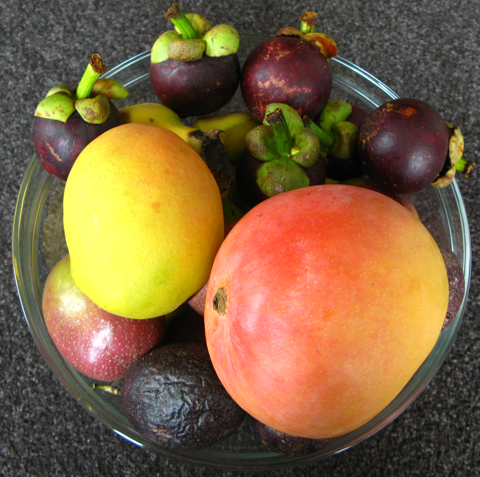
Look at my pretties! Two different kinds of mango and passionfruit, mangosteens, sugar bananas! I couldn’t figure out how to fit the yellow and white nectarines and the peaches into the bowl as well. Or the box of black cherries.

Mmmm, summer home in Sydney. Happiness. Ain’t nothing else I want.

I believe I’ll help myself to another mangosteen. Or am I in more of a peach mood? Or how about those rambutans? Decisions, decisions . . .

YA and other animals

Diana Peterfreund and Carrie Ryan saved me from writing a post I’d been sort of planning for awhile—on the various lame ways people dismiss YA—but which I kind of couldn’t be arsed actually writing. So bless them both!

I’ve come across this example all too often:

“XYZ is pretty good, for a book for children, but I doubt the author will be allowed to take it to the next level, because children’s books rarely do that.” (The “that” in question, by the way, is a rebellion against the powers-that-be by the teen main characters, which is so common in YA fantasy and SF books that it’s practically a cliche.)

Succinctly put, Diana!

Though mostly what I get from adult writers and readers in place of dissmissals, are blank expressions. “What’s YA?” they ask. This happened to me most recently here in Sydney. I ran into a friend I hadn’t seen since we were studying for our PhDs together. She’s a successful (and fabulous—I love her work) writer of adult fiction and memoir, winner of many awards and grants, very clued in to the Australian publishing scene, but when I told her what I write, she didn’t know what I was talking about, and hadn’t heard of any of the top YA writers or novels I named. It was very disorienting. She didn’t even know Twilight.

I’m trying to decide whether that’s better or worse than all the people who assume that all YA is exactly like Twilight. Yes, I have had people seriously say to me, “YA? Isn’t that the vampire romance genre?”

Sigh. Don’t get me wrong, I have nothing against Twilight. In fact, I’m a hundred per cent for it. Stephenie Meyer’s success has created a whole generation of readers. Many of whom, I’m convinced, wouldn’t be reading without her. A few of her fans have gone on to read my books. Bless her and bless them! I feel the same way about Meyer that I feel about Rowling. Grateful bordering on worshipful.

But as the readers of this blog know, there’s more to YA than vampire romance. Why, we have zombie romances, faerie romances, troll romances, robot romances—we have any kind of romance you can name. My next novel is a liar’s romance and the one after that is a 1930s romance.

See, stupid YA knockers or ignorers, we has much variety in YA! Why, I’ve even heard rumours that there are YA novels that aren’t romances at all. Though I’m yet to confirm it.

Hardcovers versus paperbacks

I found this article on whether to go hardcover or paperback for a debut novel dead interesting. It’s a debate that doesn’t happen much in the Oz market where the vast majority of books are paperback orignal.

I prefer reading paperbacks because I find hardcovers are usually too heavy and unwieldy.1 The books I love best I like to have in hardcover (first edition, natch) but I usually have a paperback reading copy as well. Um, yes, I can be a bit compulsive about my fave books. What of it?

How many of you buy hardcovers? How many wait for the paperback? Are there some writers you’ll buy in hc and others you only get in pb?

  1. Though, I confess, I adore little hardbacks. They’re so cute! []

The efficacy of book tours

I know some people are getting up in arms about Kevin Baker’s article in the Village Voice on book tours and sundry other matters but I think he makes some good points. For instance this bit:

For the likes of Stephen King or J.K. Rowling, for the writers of certain detective fictions, romances, teenage-vampire series, pet horoscopes, Star Wars novelizations, dog-buddy stories, celebrity memoirs, novels that have recipes in them, and other peculiar genres, the book tour is indeed a triumphal, rock-star road trip, complete with lines out the door and readers dressed up in costumes. For the rest of us, for those of us who just write, the book tour can be a lonely, disorienting experience, one that will tempt you to do any manner of ill-advised things.

Leaving aside the snotty implication that there are real writers and not real writers—it’s definitely true that book tours work much better for some genres than for others. Writers of YA and children’s books have a much better time of it because even if the book shop events are sparsely populated the school visits never are. Every time I had an event with five or less people,1 the next day I’d spend talking about books and writing with a few hundred keen students bursting with excellent questions.

For the writers of that endangered genre of adult literary fiction there are no school visits—from what I’ve heard it’s book shops or nothing. No matter how many times you told yourself it was building your career, a tour of nothing but tiny audiences, or no audience at all, would get very depressing.

I have a friend who writes in that genre. On one of her tours, when her latest book was on the New York Times bestseller list, she had several events where no one turned up. Not a soul. This boggles my mind. On Scott’s tour the lowest turn out was maybe forty. All the YA bestsellers I know who tour get crowds. Which makes me agree with Mr Baker that perhaps book tours just don’t suit his rarified genre. For some reason teenager readers will turn out while adult litfic readers won’t.

I wonder why? Do the readers of his genre dislike going to events at book shops? Do the writers of his genre insist on doing readings? Which really are—except for the most gifted readers—the most boring way of interacting with a book-loving crowd. In my experience of attending and doing book shop events, punters are much more interested in hearing writers talk about how they came to write the book they’re promoting, than hearing a chunk of it read out loud. They prefer to hear us tell stories rather than read them.

I read a lot of publishing blogs. It strikes me often that those who write and publish the litfic genre are way more depressed than those of us in other genres. Readership seems to be way down and they suffer from a conviction that their genre is the only important genre thus this loss of a “serious” readership strike them as a sign of end times. Maybe that’s another reason they have less successful book tours? They’re too depressed and thus too depressing.2

I don’t think the success of a tour is entirely about genre though. All the writers who tour well have had more than one successful book whether they’re Libba Bray, Ian McEwen, or Nora Roberts. They have a body of work that’s attracted a big readership. If Stephen King had toured for Carrie I’m guessing the turn out would not have been that impressive. One big book does not a fan base make. Several big books do.

So, yeah, the book tours which draw big crowds are all tours of big-selling, popular authors, who’d probably sell a lot of books whether they went on tour or not. It may be that single-author book tours are an outmoded way of promoting less well-known books and authors. Maybe it would work better to send a bunch of authors out together, especially if they know each other. Some of the most fun events I’ve seen have been like that.

Or maybe as Mr Baker suggests there are better, less soul-destroying, more innovative ways to get the word out about an author. I’ve been very interested in the various book trailers and so on. I have no idea how effective they are. I’m yet to buy a book on the basis of a trailer.

Seems to me that the tried-and-true method of getting large numbers of ARCs to influential people is still best. If they love it and start talking then bingo! you’ve got most excellent word of mouth. Which remains the most effective way to sell books, no matter what your genre. I mean isn’t a book tour just an expensive manner of trying to get word of mouth going? Isn’t that what all promotion of anything tries to do?

Now if only there were a little shop in Schenectady that sold “word of mouth” as well as “ideas” . . .

  1. Though truth be told some of the small events were the best of the tour cause they were made up of die-hard MorM or HTDYF fans or readers of this blog who had excellently curly questions. []
  2. Okay, my tongue’s a wee bit in my cheek on this one. []

Outlining v winging it

One of the conversations that I have most frequently with my good friend, Diana Peterfreund, is about our different writing methods. She’s an outliner; I wing it.

Tis most excellent fun talking writing with her precisely because we could not be more different. So different that we frequently wind up talking at cross purposes. Last time we had this discussion we got hung up on the phrase “first draft”. Turns out that what she means by “first draft” is not what I mean.

Because Diana outlines she figures out much of the novel before she begins writing. I figure things out as I write the first draft. Thus my first drafts—zero drafts really—are frequently messy conversation spines. A large part of what I do when I rewrite my first draft is make it coherent. Describe where the conversations are taking place, illuminate thought processes—flesh the skeleton out.

Diana’s already figured out most of that stuff before she types a word. She has a clear vision of her book before she starts writing. I have only the haziest of notions, which changes as I write. I had no idea when I started writing How To Ditch Your Fairy that a large part of would take place at a sports high school in an alternative universe in the city of New Avalon. I found all of that out as I wrote.

Diana’s “first draft” is much closer to the final book because she wasn’t figuring stuff out as she went along; my “first draft” is a mess. So when she says she doesn’t like to change her first draft too much I think she’s insane. Because I keep forgetting that her first draft is not a broken mess like mine.

On occasion I am made to write an outline or a proposal by my agent or editor. I hate writing them more than anything in the whole world. I would much rather write the book than a description of it. The reason for this is that I don’t know what the book will be until I write it. Writing a description of the book before writing it is pretty much impossible for me.

Diana, on the other hand, loves proposals, outlines and the like. They make her excited about writing the book. Whereas I see them as something that gets in the way of writing a book. I sold the Magic or Madness trilogy before I wrote it on the basis of a proposal, which consisted of the first three chapters, an outline, and short descriptions of the world. It was some of the most difficult writing I’ve ever done. Writing the first three chapters was easy. Writing the rest of the proposal was nightmarish. The only way I could do it was to tell myself that the outline was an advertisement for the book, not a description of the book.

I never looked at it again. It did its job of selling the book; I did mine of writing it. Never did the twain meet.

I’m not exactly sure what Diana’s planning and outlining looks like, though she has posted pictures of her plot board. It seems crazy detailed. I’m not even sure how I’d go about doing that. Though sometimes I make notes before I start writing.

My notes for the Liar book start on the 24th of February 2005. I wrote seven short notes—jotting down ideas and a few lines—before I started writing in earnest at the beginning of this year. Those notes amount to a few hundred words (to put that in perspective this post is more than 900). That was my planning. Except that the first time I read those notes again was for writing this post. The point for me is not the notes, but the act of writing them. I remember because I wrote them down, which means I don’t have to look at them again.

It’s not until I have a completed first draft that I get serious about planning. In my pre-Scrivener days that’s when I’d start using a spreadsheet to map out the structure of the book and see where and how it was broken. With Scrivener the structure is plain to see—on the cork board—-making the spreadsheet redundant.

So my outlining and planning stage comes after writing the book. Diana’s comes before. Which makes me wonder if our novel-writing methods are actually that different. What she works out in her head, or on paper, or plot board before beginning the actual writing; I do during the writing. I nail down the structure once I have a draft. Whereas Diana does it before she begins the draft.

All the same things are happening just in a different order.

Maybe winging it and outlining are identical methods put into practice in a different order? Maybe all novelists write in the exact same way but merely change the order? Maybe we are all the same?! Me and Diana and Jean Rhys and Vladimir Nabokov, all identical!

Or maybe not.

Heh hem.

Either way my method is the best method. I’ll get back to applying it to my latest novel now.

Later!

Evil drivers

I know many of the readers of this blog also drive and I’m quite sure none of you are evil but perhaps you could help explain to me how some drivers develop a pathological hatred of law-abiding pedestrians once they are behind the wheel of their petrol-guzzlers?

Yesterday I was minding my own business crossing the road legally: I had the pedestrian green light about half way across it started to flash. A very angry taxi driver in an unoccupied cab started trying to push his way past me and the other pedestrians in a most threatening manner. Readers, I confess that I and another pedestrian made a USian hand gesture in his direction at which point he turned red and started pounding his horn like one possessed as we pedestrians calmly completed our legal crossing of the road.

It was an astonishing reaction given that he was breaking traffic laws in a most arseholic manner and we were merely pointing out his arseholery. If he weren’t behind his metal cocoon he would have leapt out and strangled us.

What gives?

I would love to say this is the first such incident, but I have had demonic drivers honk as I and my fellow pedestrians cross the street legally so many times I have lost count. Are they unaware that flashing red signals that pedestrians may complete their crossing? Are they unaware that it is illegal to pound their horn in that manner? It’s also illegal to attempt to run over pedestrians.

Why do so many people turn into monsters behind the wheel?

And some folks wonder why I hate cars.

I don’t want to skite

But I’ll be eating here very very very soon.

Have I mentioned that I love being home in Sydney?

Now if only I didn’t have to work so hard and could take some days off to really enjoy it. Like, say, tomorrow, in front of the tellie what will be showing the first test against South Africa at the WACA.

Can’t have everything I spose.

Hope you’re all as happy as I am.

Debut YA to look for next year

I am going to go out on a limb and predict that these three titles will be the big debuts of 2009:

Diana Peterfreund’s Rampant
Killer uni***ns and the tough gals what fight them. It’s funny and exciting and romantic and has amazing action scenes. What more do you need to know?

Carrie Ryan’s Forest of Hands and Teeth
Zombie apocalypse, scary nuns, and a girl who’s never seen the ocean. You know you want this.

Sarah Rees Brennan’s The Demon’s Lexicon
I have not yet read this one but Scott has and he keeps bugging me to read it. He loved it. I’m a huge fan of Sarah’s extremely witty and wonderful blog so I have high hopes.

They’ll all be out next (northern hemisphere) spring. I guarantee that you will love them.

What books are you all looking forward to next year?

Writers blogging

From the comments on the last post I get the feeling some of you think that I’m saying writers shouldn’t blog.

Au contraire.

Many of my favourite blogs are by writers. I love writers’ blogs! I love reading about their struggles with their writing, about their thoughts on craft, their battles with their psychotic neighbours, the zeppelins they build. I love learning how different most writers approach to writing a novel is from mine. In fact, later this week I’ll be posting a bit more about outlining versus winging it. Cause who gets tired of that topic? Not me!

I frequently encourage writer friends to start blogging. In fact, I feel a little swell of pride about certain writers’ blogs because I’m convinced my nudging them is part of why they started blogging. Go me!

There are a gazillion positive effects of blogging: direct communication with other writers and readers you wouldn’t otherwise meet, becoming part of communities,1 having fun, talking craft, encouraging everyone to try fresh mangosteens2 etc etc.

And, yes, if your blog entertains people there’s a chance that some of them will wind up buying your books. All I’m saying is that if that’s your sole motivation for starting a blog then odds are you will be disappointed.

It’s rubbish that starting a blog is an excellent way to flog books. The majority of brand new blogs have teeny tiny audiences. It takes ages to build one. And if all you’re doing is flogging your books you will never build an audience. Because a blog full of exhortations to BUY MY BOOK is pretty much the most boring blog in the universe.

Which does not mean that I don’t want you to buy my books. I do! But only if you want to and if you can afford it. But I’m just as happy with you borrowing them from the library. Support your local library!

Or not reading them at all
. Life’s short and there are many wonderful books. I totally get reading Dorothy Dunnett’s Lymond chronicles or King Hereafter or anything by Jean Rhys or Angela Carter or Jane Austen before you’d read my books. I’d certainly rather read them or Alice in Wonderland or way too many books to name than anything I’ve written.

Quite frankly I’m just as thrilled by the people who enjoy this blog as I am by the people who enjoy my books. The fact that there’s often no overlap between those two groups is awesome. It means I can amuse people who have zero interest in YA or fantasy but have a fascination for cricket or mangosteens or quokkas or any of the myriad other topics I crap on about.

Which is yet another reason I love blogs so much. They’re places where we can share and discuss our obsessions. There are few things more fun than that.

  1. Especially important if you live in a small town far from other writers. []
  2. Dried, juiced, tinned mangosteens are all abominations. The one true mangosteen is the fresh fruit. Which can now even be purchased (for a fortune) in the US of A. []

In which I repeat myself

Taking up blogging is one of the least effective things you can do to promote your book.

There, I’ve said it.

Don’t take up blogging cause your publisher says you should. Or because of John Scalzi. Yes, he’s sold tonnes of books and gotten heaps of fans because of his blog. He is the exception. Very few writers who blog have thirty thousand plus hits a day.

Scalzi’s been blogging for more than a decade. Ten years ago he had maybe a few hundred people a day reading Whatever. It took him years of consistently good and frequent blogging to build that audience.1

Much like building your writing career, really. Most novelists don’t have a huge audience after just one or two or three novels. It takes time. Blogging’s exactly the same. Would you rather put your hard work into your next book or building a blog that may or may not pay off for you in five or ten years time? If you enjoy blogging then, sure, go ahead.

Blogging can help promote your book when it’s other people’s blogs talking about it. A mention on boingboing or Whatever or [insert name of popular blog here] can definitely help. Even a whole bunch of smaller blogs all talking about your book can have a cumulative effect. But basically that’s just good old word of mouth. The elusive and incredibly desirable thing that sells so many things.

I have no idea how you get that going other than to write the best book you can and hope your publisher gets behind it.

If you don’t want to blog please don’t! And please don’t blog solely to promote your books. Do it if you enjoy it. Do it cause you have something to say.

Thus endeth this oft repeated rant.

  1. And all those other authors with insanely popular blogs? Most of them were already popular—like, say, Meg Cabot—before they started blogging. Not because of their blogging. []

The best thing

The best thing about being home—other than hanging out with my family—is the fruit. So far I have gorged on cherries, lychees, mangoes, passionfruit, sugar bananas, nectarines, peaches and . . . wait for it . . . mangosteens!

Mmmmmm.

My life is perfect.

Follow-up quessies

In response to my most recent post I’ve had quite a few adults writing me and pointing out that their job does not end once they leave the office at the end of the day. That they too have vast amounts of homework. The professions mentioned were teacher, lawyer, academic, editor, architect, and engineer.

What other jobs require lots of after hours work?

Are there any well-paying jobs that don’t?

One more thing

One more thing that I think some wannabe published writers don’t understand. Being a professional writer means having homework ALL THE TIME. (Thanks to Jennifer for pointing this out.) And when your homework comes back covered in red you have to do it over. Sometimes you have to do it over multiple times. And then your homework gets checked again by several other people (copyeditor, proofreader) and then you have to look at it again.

It’s like the worst homework ever. Homework that NEVER EVER ENDS.

I’m just saying . . .

Perfecting your craft

A large part of being a writer—whether you’re published or not—is working to improve, to perfect your craft. One of the biggest obstacles for many beginning writers doing that is that they sometimes get so obsessed with getting published that they forget about the writing.

It took me twenty years of striving to make my first professional fiction sale. I know how you feel—I felt it. I was desperate to get published and that’s part of why it took me so long. I kept getting distracted from perfecting my craft. From writing and writing and writing and rewriting and rewriting and rewriting. From reading and studying the best (and worst) writers I could. I was more obsessed with seeing my name in print than I was with becoming a better writer.

I didn’t figure that out until I was in my thirties. Co-incidentally that’s when I started getting published.

Once I became a published writer I spent even more time perfecting my craft. When you’re a pro you start getting editorial letters and dealing with copyeditors and proofreaders. All of whom work to make your books as good as they can be by, yes, pushing you to further perfect your craft.

If you think that perfecting your craft is some annoying thing people who don’t want to publish you tell you just to keep you out of print, you’re wrong. They’re telling you because it’s at the heart of being a writer. No publisher worth their salt publishes a first draft. Those professionally published books, even the ones you hate, were edited and rewritten and copyedited and proofed.

If you are unprepared to work to make your book better and to improve your writing skills then maybe you don’t really want to be a writer?

Privacy and blogging

Boingboing links to a dead interesting piece on facebook and privacy. It’s something I think about a lot. Well, not facebook, which I currently avoid as actively as I avoid twitter, but privacy and blogging.

Because it happens frequently that my ideas about privacy and those of others do not line up. Fer instance, I never blog about the stuff I hold to be private, which includes most of what’s going on with me offline, except as it relates to my writing career, and even then I share only what can be publicly shared. Thus you don’t hear about my selling a new book until the contract is signed. Which means an interminable wait between my knowing that a book is sold and my telling you. Whereas I have seen writers blog the very first offer.

It goes the other way too. I blogged about how much I earned last year because I think it’s important that wannabe writers are acquainted with just how little a reasonably successful full-time writer earns.1 I know several writing bloggers who are appalled that I shared my income. I also blog sometimes about when the writing is not going well. Again there are writing bloggers who think that’s way too private to ever share.

But that side of the privacy issue is easy. We bloggers blog what we want to blog. We’re in control. If we think something’s too private for blogging then we don’t blog it. What we don’t have control over is what our friends and family choose to share in the comments thread. I have had friends bring up stuff I consider deeply personal in comments. I delete those comments. But even so, sometimes those comments are up for quite awhile before I see and destroy them. *Shudder*.

Less egregious are the friends and acquaintances who use comments to say, “Hi, how are you doing? We should get together.” I write and say, “Hey, you have my email address. I love you but what are you doing putting stuff like that in a comments thread about the end of publishing as we know it?”

It feels to me like an etiquette breach. If we haven’t seen each other in ages and you want to reconnect—email me. There’s a contact form on every single page of this blog. Here’s a rule of thumb: if you post in comments something that is of no interest to anyone but you or me then it should be an email, not a comment.

My blog is my public face. It’s a place to discuss a wide variety of topics—books, writing, publishing, Elvis, mangosteens, quokkas and so on and so forth. I expect people to stay on topic and the vast majority of folks do. Tis why I love my blog. The people who comment here seem to have the exact same notions of blogging etiquette that I do. Bless you all!

Note: I am not saying this to remonstrate with anyone. When my friends do this I call them on it and they apologise and never do it again. They are quick learners. Or, you know, tolerant of my eccentricities. Just as when I do stuff that bugs them they call me on it and I attempt never to do it again2. It’s a beautiful thing.

However, I keep being made aware that many, many, many others don’t think about blogging in the same way I do. They are surprised when I mention my feelings about this. They think I have a major stick up my arse. “If you want to keep your life private,” they ask, “why do you blog?”

There are many people who live their entire lives online. They share. In my opinion they massively overshare. But, hey, it’s their blog they can do what they want with it.3 Some also mark their blogs as a place with an in crowd, who can talk personally with the blogger, and whose comments always get a response. When the blogger in question has a public career as a writer or an artist or a musician or what have you I wonder how appealing that makes the blog to potential readers. Do they feel shut out? I know I am never tempted to comment on such a blog.4

What do you lot think? Am I a fuddy duddy? No, don’t answer that! What are your thoughts about privacy and blogging? How do you feel when a personal discussion takes place on a blog that you went to cause you like the blogger’s music or art or writing?

  1. Sure some earn heaps more, but not many. []
  2. Though sometimes I fail cause I am not as quick a learner as they are. []
  3. And I confess that there are some extremely personal oversharing blogs that I’m deeply addicted to. []
  4. I try hard to make this blog as inviting and non-in-group-y as I can. In the olden days I would respond to almost every comment. Sadly, I am no longer able to do that. Though I am still more likely to respond to comments by people I don’t know than I am to comments by the known. []

In which I am naughty

I have a mountain of work, admin, packing, and correspondence to catch up on, but instead I am reading through my new favourite blog, Cake Wrecks, which I discovered via an old favourite blog, Jenny Davidson’s Light Reading. I’m sure all of you have been enjoying it for years. What can I say? I am slow.

So far it has led me to many pleasures but few top the delight of the world’s worst Dalek cakes. I confess that I laughed so hard I cried.

Then it led me to this. The making of the most incredible cake I have ever seen:

Apparently it took twelve days to make. Wow. Just wow.

YA book recs for the holidays

Quite a few people lately have been asking me for book recommendations. They want to know what new YA they should be buying for the holidays. Sadly, I am in less of a position to help than usual.

For most of this year I have been solely reading books about (or published during) the 1930s. The only non-1930s books I’ve read have been manuscripts I’ve critiqued for friends. This means I have not read Hunger Games yet. Or the second Octavian Nothing or the National Book Award winner, Judy Blundell’s What I Saw and How I Lied or Coe Booth’s Kendra which I hear is every bit as good as the wonderful Tyrell. Or anything, really. Nor will I be reading any of these, even though I dearly want to, until I finish the first draft of my thirties book in September.

Thus the only recently pub’d books I can recommend are the ones that I read ahead of time:

    Holly Black Kin. Part one of the best graphic novel ever. Faery and betrayal. Twelve and up.

    Cassandra Clare City of Ashes. Second book in the City trilogy. Sequel to City of Bones. This is the series I recommend to people who are looking for something to read after they finish the Twilight books. And guess who one of their biggest fans is? Stephenie Meyer. There’s love, action, adventure and it’s really funny too. Twelve and up.

    Shannon Hale Rapunzel’s Revenge. Also the best graphic novel ever. A non-wimpy Rapunzel. Hurrah! Twelve and up though I think this one skews in both directions. I think many ten year olds would love it. Adults too.

    Maureen Johnson Suite Scarlett. New York family living in falling apart hotel. Funny, witty, joyful with excellent pratfalls. Spencer may be my fave new character. Twelve and up. But I know many adults who are smitten.

    Margo Lanagan Tender Morsels. Can’t describe it. Beautiful, poetic, ferocious, excellent. Sort of a fairy tale but not. I think I have changed my opinion of bears. Listed as fourteen and up in the US. Personally I agree with Allen & Unwin’s decision to publish it as adult.

    E. Lockhart The Disreputable History of Frankie Landau-Banks. The best book she’s written and I love all her books. A National Book Award finalist. This book is so amazing that I’m rendered dumb trying to come up with the words to describe its wit, genius, and splendiferousness. Just read it. Twelve and up.

    Lauren McLaughlin Cycler. Gorgeous sex-changing screwball comedy. Fourteen and up.

    Lauren Myracle Bliss. Clever creepy scary excellence. *Shudder* I have not been able to stop thinking about this book. Fourteen and up.

    Robin Wasserman Skinned. My favourite YA science fiction novel of the year. Philosophical and page turner-y at the same time. What does it mean to be human when your body is not your own? And how do you cope with high school when you’ve gone from being Queen Bee to the loseriest loser ever? Twelve and up.

That’s all I got, however, and I know many other fabulous YA books came out this year. So why don’t you tell us about them?

Don’t just give titles. Tell us why you’re recommending them. Don’t recommend mine or Scott’s books. I know about those. If you could also mention what age their publisher thinks they’re suitable for. Many of the people asking for recs are parents.

Thank you!

Black Wednesday

Well, yesterday was crazy. People I know lost their jobs or are now in danger of doing so. Some author friends lost their imprints. It’s all scary stuff. But publishing is not the only industry in convulsions. We’re in a recession. It’s bad all over.

To answer those asking if I still stand by Tuesday’s comments. I do. Things are bad, but they’re less bad for children’s than for adults’. Publishing is going to change a lot over the next decade.

But here’s my main source of comfort: People are always going to want stories.

My sympathies to everyone who had a really bad day yesterday.

A very good question

The most poignant question me and Scott were asked at BookPeople was the following:

What advice do you have for middle school “uglies”?

We rambled on about how middle school/high school (if you’re Australian) doesn’t last forever etc etc. How we too were unhappy in 6th, 7th, 8th grade.1 But I’m not sure our answers were satisfying. And we didn’t really suggest any survival techniques.

I have been thinking about this question ever since. Do any of you have any ideas for how to survive the dark days of primary and secondary education? If so, do please share.

  1. Actually I hated all of school from kindergarten all the way to year 12. []

Publishing doom and gloom

Here in the USA’s publishing capital, NYC, there are many signs of a publishing downturn: reports and rumours that books sales are down and that the big chains are ordering less books. A few of the big publishing houses are laying off staff, cutting expenses, not acquiring books, and various agents are seeing a slow-down in their sales, especially for debut novels.

Of all the genres children’s (which includes YA) seems to be the least affected. Sales have slowed but not nearly as drastically as in adults. The Times reports that while parents are curtailing their own spending they’re still buying their children presents. It’s interesting that the recent Times article that covered Houghton Mifflin Harcourt’s freeze on acquisitions did not mention that the freeze does not apply to children’s books.

Children’s books are relatively inexpensive. Especially compared to adults. An average YA hardcover is US$16 while an average adult hardcover is US$24. Quite a difference. Adult books are also given higher advances (on average) and earn out slower, if they earn out at all. Several people told me that way more of their children’s list earns out than their adults. You hear that? We are profitable.

While sales are down, every single children’s division has at least one bona fide hit. Not all of those hits are as insanely huge as Stephenie Meyer’s Twilight books, which have earned every employee at Little Brown a bonus, but they’re still doing very nicely. Not to mention that Meyer’s books have also benefited other authors by creating a demand for “more like that, please!” I’ve gotten quite a few letters from Twilight fans telling me they turned to the Magic or Madness books because they’d run out of Meyer’s. I am very very very thankful to Stephenie Meyer. She and J. K. Rowling are a huge part of why children’s is as profitable as it is. Bless you both!

That said, we are in (at the very least) a recession. Libraries are seeing big increases in traffic and more and more people are borrowing when before they might have bought (which as I argued yesterday is far from a bad thing for authors). Like I said, sales are down. They’re down all over and for many things not just books. (Unless you make Spam, that is.)

So am I worried?

Well, sure. But not that much more than usual. Publishing is a risky business even when the economy is booming. Genres go in and out of fashion, as do authors. I know writers who were doing brilliantly in the 1980s, who are now only published in the small press world. How many of the super popular children’s writers of the eighties and nineties are popular and publishing now?1

Most writers don’t make a living writing even in the best of times. Unpublished writers who are freaking out that they’ll never break through in such tough times are forgetting that their odds aren’t great anyway. It’s not just the unpublished who have trouble. The vast majority of authors with one published book never publish a second. Even long established writing careers go into decline.

Publishing is a tough business no matter what the economic climate. But at least we’re in the strongest part of our industry, and at least we’re not on Broadway, or making cars.

  1. Judy Blume, Garth Nix, Tamora Pierce, J. K. Rowling and, um, probably heaps of others I’m not thinking of right now. []

Borrowing books is good

Recently a fair few folks have apologised to me for reading my books, but not buying them. “I borrowed them from the library. Sorry!” “I borrowed them from a friend. Sorry!” “I just can’t afford to buy as many books as I want.”

Never apologise for borrowing a book. On the big scale, borrowing books is good because that’s what keeps libraries alive: the more people who borrow books from libraries the more likely they are to be funded. And the more libraries there are the more people who are reading. Most people can’t afford to buy every single book they want to read. I know I can’t. That’s why we have libraries. That is a very very good thing.

Borrowing books from your friends and talking about them is excellent because it helps strengthen friendships and build communities. Plus it’s one of the best ways of finding out about good books. I heartily approve of borrowing and lending books. Why, I even do it myself.

I also approve of books being loaned and borrowed because it helps my career. Every time someone borrows one of my books from a library that justifies that book’s existence there. And if it’s borrowed often enough and starts to fall apart, the library will order more copies. Or if it has an excessively long wait because too many people want it, the library will order more copies.1

Certain books I loan out to friends never return, so I buy another copy. There are books I’ve borrowed from friends, that I loved so much, I bought my own copy.

All of which helps the author of those books.

Word of mouth is the most powerful tool in helping a book sell. What better word of mouth could a book have than lots of people eagerly borrowing and lending it? If reading a book for free destroyed a book’s chances of success then why do publishing companies give away thousands upon thousands of copies of books in the form of Advanced Readers Copies (ARCs) every single year?

It can’t just be because they’re crazy. Though maybe I should ask Maureen? She knows everything.

To recap: borrowing books is good.

  1. I’m assuming a well-funded library. Sadly, that’s not always the case. []

Signed books

I’ve had a few folks write to me to ask where they can buy signed copies of my books. The answer is there are many many places. I was just on tour, see, and wherever I went I signed books. Even if you have zero interest in whether a book is signed or not these are all very fine bookshops that you should check out if you haven’t already:

California:

Borderlands Books
866 Valencia St.
San Francisco CA 94110
Bonus: they have two gorgeous Sphynx cats.

Kepler’s
1010 El Camino Real
Menlo Park, CA

The Storyteller
30 Lafayette Cir
Lafayette, CA

Copperfield’s Books
140 Kentucky St
Petaluma, CA

Books Inc.
601 Van Ness
San Francisco, CA

Michigan

Schuler Books & Music
3165 Alpine Ave
Walker, MI

Pooh’s Corner
Breton Village
1886 1/2 Breton Rd. S.E.
Grand Rapids, MI

Ohio & Kansas City, Missouri

Joseph-Beth Bookstore
2692 Madison Road
Cincinnati, OH

Fundamentals
25 W Winter Street
Delaware, OH

Cover to Cover
3560 North High Street
Columbus, OH

Books & Co
Books & Co at The Greene
4453 Walnut Street
Dayton, OH

Reading Reptile
328 W. 63rd Street
Kansas City, MO

Philadelphia & NYC area

Big Blue Marble Bookstore
551 Carpenter Lane
Philadelphia, PA

Voracious Reader
1997 Palmer Ave
Larchmont, NY

Books of Wonder
18 West 18th Street
New York, NY

Texas

BookPeople
603 N. Lamar
Austin, Texas

Barnes & Noble
Northwoods Shopping Center
18030 Highway 281 North
San Antonio, Texas

Canada

Bakka-Phoenix Books

697 Queen Street West
Toronto, ON

Indigo Bookstore
Yorkdale Mall
3401 Dufferin Street
Toronto, Ontario

A couple of things

Love is Hell, an anthology including stories by me and Scott as well as Melissa Marr, Laurie Faria Stolarz and Gabrielle Zevin is now available in the US of A. The extra good news is that it’s a paperback. Cheapness!

A portion of the proceeds of Love is Hell will benefit College Summit, a nonprofit that helps more kids get into college.

Let The Right One In is a Swedish vampire movie set in the early 1980s. It’s also one of the best genre movies I’ve seen in years—scrap that—it’s one of the best movies—no modifier needed—that I’ve seen in years. You all need to go see it. Not least because every time I think there’s nothing new that can be done with vampires, someone does something new and fabulous.

Enjoyable review

It’s dead boring to be hit with reviews on a writer’s blog. Yawn. But this one, in addition to saying lovely things about How To Ditch Your Fairy, made me giggle. Twas the last paragraph plus the photo that did it:

Caution: Despite the suggestions in the book, I was not able to get rid of my fairy, Pixie. And unlike Justine’s fairies, mine is very visible and very loud. Check out the photo below to see what a “makes you trip and wakes you up too early” fairy looks like.

Go over to Allison’s blog to see the accompanying photo. You will giggle. Oh yes, you will.

Thanksgiving Day

This is my favourite USian holiday. A day set aside to give thanks for the good stuff in your life is a lovely idea. I’m extremely lucky because I have so much to be thankful for that if I listed them all this would be the longest post in the history of blogging.

Instead I will be brief:

I am thankful for the fabulous readers of this blog. Whether you comment or lurk I am grateful for your continued support.1 Without you there’d be no point. You all rule.

Happy Thanksgiving!

xo

Justine

  1. Even those of you who kvetch about my unorthodox grammar. []