Bibs and Bobs

Working hard thus am not so bloggery as usual. Other than the novel I’m writing here’s what’s up in Justineland:

Daphne Lee has posted the unedited (and illustrated) version of her interview with me where I persist in getting the name of Samantha from Bewitched‘s grandmother wrong (got all that?). Daphne reports that Magic or Madness sold out in Kuala Lumpur the week the interview appeared in The Star. How stupendous is that?

Last night the New York Liberty beat the Houston Comets in overtime in Houston. Scott and me, we was screaming at the television like you wouldn’t believe. So happy! And as usual when the Liberty win everybody played their part. They are so teamy and ball-sharey and good. And now they’re better than 500 for the season. Being a Liberty fan is all about the ups and the downs. Thankfully they’re a bit more uppy at the moment. Next live game is Friday. Can’t wait! Season tickets make me happy.

The last two days of the Tour have been heart-stoppingly good. I don’t ever want it to end.

Many of my Oz sf friends are in Melbourne having a really good time. I am not even slightly jealous. Honest.

Write now. Many words.

I Hate Rest Days

The Tour is taking a rest day today. What’s that about? Rest day! What about me and other viewers like me? What are we supposed to do while the riders are slacking, luxuriating in bubble baths and drinking champagne and generally not riding their bikes and cat and mousing one another? It’s an outrage! There should be no rest days on the tour. None! Lazy slackers!

If you put the missing rest days back in then the Tour would be closer to 4 weeks long than 3. Imagine it! A whole month of the Tour de France. July truly would be the Tour month, every day of it. How fabulous would that be?

But would it be enough? How about all of the (Northern) summer? And have all the epic races of June July August merge into one big Tour de Europe? Or even better: why not have it last all year long? A Tour de World with races on board cruise ships as the cyclists are transported from one continent to the next. And with no rest days ever. In fact “rest day” would become a euphamism for dropping out of the race (permanently). Winners would be announced on a daily, weekly, seasonally and yearly basis with all the existing races (yellow, green, polka dot etc) in place but extra categories like a running silver jersey for the racer who’d been in the race for the longest and . . .

I can’t stand rest days! Why do I have to wait almost twenty-four hours for the next stage?! Especially now that Armstrong isn’t in yellow! Aaaaarrrggghhh!!!!!!!!!!

Letters from the Past (Part 2) plus a Rant

Åka the proprietor of the blog, Läst och tänkt i annien dropped into translate:

Läst och tänkt i annien means read and thought in annien, where annien is my “idioverse”, the universe as perceived through my eyes. It is mostly about fandom, books, physics and strange or peculiar things.

I was reflecting over the fact that annien seems to be inhabited by so many more men than women (i’m a physicist and sf fan), and that maybe the books i read are likewise unequally populated. at the same time I happened to see the link to you from mumpsimus, and threw it in together with the other things. i also liked the first letter, but quoted asimov because it tied in better with the science and science fiction theme. I want to avoid too long quotes.

That was it, i think. Just ask if you want to know anything more.

Thanks for making these letters available! I have sometimes read or heard about what kind of discussions that occured in the magazines, and as a piece of history it is fascinating. Now I just want to read some old letter columns about the role of science in society and literature, to see what kind of opinions people had on that.

Thank you!

The letter columns of old sf magazines are wonderful, and yes, the role of science and literature does get debated. (Though by far the most common kind of letter merely rates the stories of a previous issue.) But even the most seemingly banal letter reveals a lot about the thoughts, feelings and ideas of the time. I found the letters columns of Astounding and Thrilling Wonder Stories the most active and interesting.

I’ve been hoping that since my book, The Battle of the Sexes in Science Fiction, was published there’d be more work on the culture of science fiction that goes into archives (public and private) looking at the letters and editorials in sf magazines as well as the stories and, as importantly, looks at the fanzines. So far, there still isn’t nearly enough. (Though if anyone comes across any such work—do let me know!) But I keep hoping.

Anyone doing work on sf is only doing half the job if they don’t look at sf culture. If you’re writing about sf now, that means you have to look at all the online debate not just published stories and novels. It’s what I encouraged the essayists to do for my collection Daughters of Earth.

But it’s difficult. Most scholars working on sf don’t have access to collections—there aren’t that many in the world—and most collections don’t have large (or any) holdings of fanzines. Private collections (particularly of fanzines) are even more inaccessible, often stored in the attic, garage, boxes under the house: all of which are unlabelled. Tricky. And on top of that many of those magazines and fanzines are falling apart. Particularly the ones from the war printed on inferior paper.

But it’s work worth doing and more to the point it’s fun. Reading those letters takes you back to a whole other world, one full of surprises, I wasn’t expecting to come across such strongly feminist letters in the pages of an sf magazine from the 1930s and yet that’s exactly what I found.

Letters from the Past

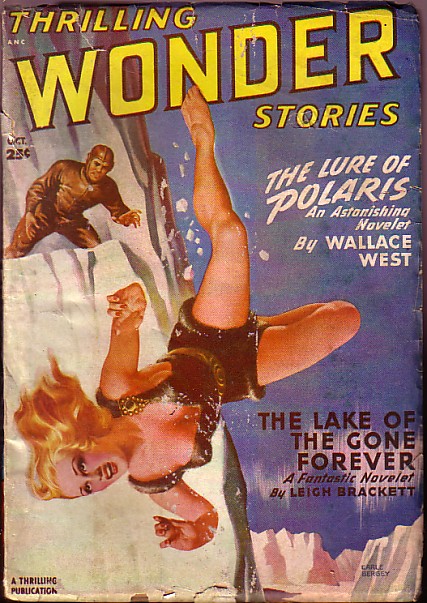
Over the past few days there’s been a remarkable jump in traffic to this page of my website. The letters reproduced there are from the late 1930s and debate the role of women in science fiction. I adore them. They’re funny, warm, silly and just plain gorgeous. A little investigation revealed links from mumpsimus, coalscent, swisstone and Läst och tänkt i annien (tragically, I don’t read Swedish, so I have no idea what that means and I don’t share my husband’s love of wacky google translations).

The commentators do seem to be remembering that Asimov was a kid at the time, just eighteen. And, by all accounts, he was a young eighteen with little knowledge of sex, theoretical or otherwise. Readers of these letters should also keep in mind that he was a possum stirrer of the first order, frequently arguing in the letter columns for the sheer joy of arguing. A type not entirely unknown in our equivalent of the letter cols of yesteryear—the comments sections of blogs.

It’s unsurprising that it’s Asimov the commenters focuss on, after all, he’s the big name, but the letter I find most moving is the first one, “five of a kind”, from a Naomi Slimmer of Russell, Kansas. It provides such a vivid window into her life back then. I wondered why none of the people posting and commenting about the letters had mentioned it. Then I realised that I hadn’t put the full text up. Woops. That is now remedied. Thanks to those linking and commenting for giving me the nudge to notice my oversight.

And a little extra treat just for those who read my blog. Here’s my favourite line from a letter to an sf magazine. For context—the letter was part of a debate about whether “sexy” covers and interior illustrations (i.e. scantily clad women) belonged in sf mags or were cheapening a clean and nobel genre:

“What’s wrong with sex inside or outside as long as the gal shows expression in her eyes?”
—B. W. Williams
Startling Stories January 1953, p. 136.

Niki is safe (updated)

I woke up, as many of us here in the USA did, to the news about the London bombings. I’ve had a couple of emails expressing concern about my sister who’s working there. I’ve been emailing with her all morning and she’s fine, as are all her friends.

I haven’t heard from my friend Veronica Schaones. My fingers are crossed. Update: she’s safe in France. Phew!

I’m hoping that your family and friends in London are fine. I can’t imagine what those people whose family and friends aren’t are going through. It’s too horrible to think about.

Puce

My friend Justine (also an Australian) asked me the other day what colour puce is. I’ve read a tonne of Georgette Heyer where it’s a colour that pretty much no one looks any good in, so I had always imagined it was a kind of cacky yellow-brown (on a puce=puke or puce=poo etymological model). It had never occurred to me to look it up. But Justine did. And read that it was a non-saturated red (I forget the whole description), but it sounded like terracotta, which is a lovely colour.

Here’s what the OED says:

puce [pjus], a. (sb.) [a. Fr. puce sb.:-L. plex, -icem a flea; couleur puce flea-colour (17th c.).]
a. attrib. or as adj. (orig. puce colour): Of a flea-colour; purple brown, or brownish purple.

1787 Best Angling (ed. 2) 83 Dip a feather in aqua fortis, put it on the ash,..and it will make it a cinnamon, or rather a puce, or flea colour.
1791 Hamilton tr. Berthollet’s Dyeing I. i. i. ii. 32 Colours inclining to red on the one hand and black on the other, such as mordoré and puce colour.
1820 Chron. in Ann. Reg. 197/2 A rich twilled sarcenet pelisse, of a peuce colour.
1834 Mrs. Carlyle Lett. I. 10 The old black gown (which was dyed puce for me at Dumfries).
1893 J. Ashby Sterry Naughty Girl ix. 79 His puce silk suit, his muslin cravat.
b. As sb. = puce colour.

1882 Garden 16 Sept. 260/1 Blooms of..rich dark puce, suffused with maroon.
1897 Daily News 25 June 2/6 The mountains had all put on..the purple puce of twilight.
1900 F. H. O’F. in Lond. Let. 26 Jan. 133/1 Varying shades..from palest peach to deepest puce.
c. Comb. puce-coloured adj.

1812 Sir H. Davy Chem. Philos. 212 The puce-coloured oxide of lead.
1874 Garrod & Baxter Mat. Med. 410 Cochineal yields when crushed a puce-coloured powder.

That also sounds like a colour that’s all over my wardrobe. A gorgeous colour. Except for the bit about fleas. Flea-coloured? Huh?

Robbie McEwen v Stuart O’Grady

Several people have asked what I make of Robbie McKewen using his head and shoulders to try and muscle Stuart O’Grady out of his way yesterday. Stuart O’Grady = Good; Robbie McEwen = not so much. I’m pleased there are consequences for that kind of behaviour.

That is all I have to say on the matter.

How to Get an Agent—a New Musing

I’ve just put up a new musing responding to that much asked question:

How to Get an Agent

The short answer is that there is no one way to get an agent. Luck and hard work both play their part. But first you have to figure out whether you’re ready for representation. Don’t even think about pursuing agents until you have a finished novel. And make sure that novel is as good as you can possibly make it. Then make it a whole lot better. Rewrite and rewrite and rewrite and then rewrite some more before you send it to anyone. And, yes, this does apply to you. And yes it applies to non-fiction proposals too. Even though you don’t need a completed book you do need the best proposal you can possibly write.

Continue reading How to Get an Agent.

How to Get an Agent

Of late I’ve been receiving quite a few emails asking me how you go about getting yourself one of those mythological creatures known as the literary agent. It’s a question frequently asked of most published writers. You should also take a look at Ian Irvine’s the “Truth about Publishing” which explains how the publishing system works (be warned: it’s depressing).

The short answer is that there is no one way to get an agent. Luck and hard work both play their part. But first you have to figure out whether you’re ready for representation. Don’t even think about pursuing agents until you have a finished novel. And make sure that novel is as good as you can possibly make it. Then make it a whole lot better. Rewrite and rewrite and rewrite and then rewrite some more before you send it to anyone. And, yes, this does apply to you. And yes it applies to non-fiction proposals too. Even though you don’t need a completed book you do need the best proposal you can possibly write.

When Scott got his first agent he didn’t know any other writers or anyone in science fiction publishing. His first step was to find out which were the best agents representing adult science fiction. He did this by looking at the acknowledgments pages of his favourite writers, as well as looking up agents in the various writers’ guides available at the time. (You’ve got it much easier these days; you can use Agent Query.) He then spent a whole week writing the perfect query letter, before sending it out to every suitable agent. (That’s important: do not be sending your YA cheerleader novel to someone who only handles adult non-fiction.) He received only one request to see his novel. He sent it and she signed him up. Let me reiterate, at the time Scott had no connections, knew no one in literary publishing, indeed, he’d never met an agent before. This is the traditional method for finding an agent and it still works. But remember that query letter has to be good. Agents get hundreds and hundreds of queries a week.

I got my first agent because I like people. I always have. I frequently wind up in conversations with total strangers in the queue for the loo, at bars, restaurants, parties, wherever. Meeting new people is one of my favourite things in the world.

So my first agent? It was 1999, I had just flown from Sydney to NYC (via LA) to spend six months in NYC researching the New York Futurians for my post-doctoral fellowship. I arrived at JFK knackered out of my mind and found myself in the longest queue for cabs I’ve ever seen. The woman in front of me asked where I was heading. I said Manhattan. We agreed to share a cab. We got talking. Turned out that she was a writer too. A real one with a published book and eveything. Once in the cab we were already fast friends. Then the cab got stuck in traffic and it took almost two hours for us to get into the city. By the time we finally parted ways I felt like I’d made a friend for life. But as usually happens we never saw each other again.

We didn’t forget, though, and almost a year later I received an email out of the blue from a friend of Pang-Mei’s. She was starting up a new literary agency and Pang-Mei had described my Futurian project to her. She was intrigued and wondering if I had representation. She asked to see samples of my work. I sent them to her, she signed me up.

Before she emailed me, I’d already made an effort to get an agent for my first (written) novel (which to this day hasn’t sold, though it’s come close a few times). At the time I had no professional fiction publications (not even a haiku) and precious few of any other kind. My manuscript was rejected by three different agents. One in Australia, two in the USA. At the time I thought the novel was as good as I could make it (maybe it was) but I’ve since rewritten it several times and it’s much much better now. Did I send it out too soon? Probably.

All three of those agents represented friends of mine. They agreed to look at my novel because said friends had recommended it. I did not need to write a formal query letter. (To this day I have never written one and hopefully I never will.) Having that connection meant that my manuscript was read and that I got a prompt response. Two of the agents even took the time to sit down with me to explain in detail what they thought was wrong with the novel. (An exquisitely painful experience—let me tell you—at the time I wasn’t used to criticism. Years of living with Scott has since hardened me.)

But did my connections get me an agent on that occasion? No, they did not. Unless an agent likes what you’ve written and thinks they can sell it, they will not take you on as a client. Not even if you’re best friends with J. K. Rowling. It’s that simple.

The common theme here is being connected. But how do you get connected? I did it by going to science fiction conventions and meeting lots of writers, other aspiring writers, editors, agents, publishers and fans. All of whom were full of gossip about the publishing industry and books and writers and who the best agents and editors are. After going to two or three conventions I was connected in a way I’d never thought possible. I’d had conversations with some of my favourite writers in the whole world. It was dizzying.

Without even intending to I was laying groundwork for my own fiction publishing career. (Remember though the most important groundwork for a writing career is to write and write and write.) But let me put it in perspective. None of this was instantaneous. I attended my first convention in 1993. I finished my first novel in 1999. I got my first agent in 2000. My first (non-fiction) book was published in 2002. My first professional fiction sale came in 2003 (the Magic or Madness trilogy to Penguin/Razorbill). My first novel was published in 2005. Not exactly greased lightning.

The not-intending-to part is important. Over the years I’ve seen ambitious aspiring writers go to conventions and try to make as many connections as possible as quickly as possible. I’ve seen them rock up to parties and just happen to have the manuscript of their novel in their bag, ready to hand over to the first agent or editor they talk to who expresses interest. Not a good look. Desperation and naked ambition make people on the receiving end nervous.

So, am I recommending that you go to conventions to make connections but pretend that you’re not? No. I’m saying that if you’re even vaguely a people person going to a convention or festival or other gathering of writers who write stuff similar to you (horror conventions if you write horror; romance if you write romance; sf for science fiction and fantasy; writers’ festivals for mainstream) you’re going to meet at least one or two like-minded people and become friends. After more than ten years involvement with the sf community, nearly half my friends are part of that community. The most important thing I’ve gotten out of attending conventions is friendship, becoming part of a community that extends over many continents. I have sf friends in Argentina, Australia, Canada, France, Japan, the Netherlands, Spain, the UK, and the United States (and I’m sure I’m forgetting some countries).

That many of these friends are writers, editors and agents is secondary, but, yes knowing them wound up making it easier for me to become a published writer. (But remember, some of them weren’t any of those things when I first met them.) I’ve been invited to contribute stories to an anthology just because I happened to be in the room with the editor who was talking about it. Most themed anthologies aren’t open submission, you have to be invited, and to be invited editors have to know who you are. If you’re unpublished—as I was at the time—it’s damned hard to get the invite. So far I haven’t had a story accepted for one of those anthologies. Like I said, being known gets your foot in the door, but it doesn’t get you published unless the editor loves what you’ve written. Established writers with many published books still get rejections.

The best panel I attended at WisCon this year was Common Questions for Pros. It featured the diametrically opposed Robin McKinley and Scott Westerfeld. In good spirit they disagreed about how to write (Robin: in one big, compulsive, mind-destroying burst; Scott: in the same place, at the same time, every day, with the goal of writing a thousand words), as well as about how to go about getting an agent, or published. Scott spent a lot of time talking about the community in a similar vein to what I’ve written above. Robin McKinley kept making the point that if you prefer the life of a hermit, if you can only handle people in small doses, then the becoming-connected route is not for you. You can, she insisted, get published without knowing a soul in the industry. After all she managed it. (So did Scott.)

I totally agree (and for the record, so does Scott). I’ve seen people at cons schmoozing because that’s what they think they should be doing and looking utterly miserable in the process. If you don’t like talking to strangers then don’t do it.

Here’s something else Scott and Robin McKinley agreed about: the writing is the thing. No matter how connected you are, if your writing doesn’t cut it then you will not be professionally published. Your writing must always come first. There’s no race to be published. I swore to myself that I would have my first novel published before I was thirty. It didn’t happen and I’m glad (though that’s definitely not how I felt at the time). Right now I’m a much better writer than I was at thirty. I hope that like Ursula K. Le Guin and Carol Emshwiller I’m going to be an even better writer in my seventies and eighties. That’s one of the great things about being a writer: there’s no use-by date.

Good luck.

New York City, 4 July 2005
Tour de France (updated)

At least there’s one epic non-US sports event I can watch live in the USA: the glorious Tour de France. The first stage began today and the yankee, David Zabriskie, is warming the yellow jersey for Lance Armstrong. I’m not saying Armstrong’s gonna win overall, but we all know he’s going to be seeing a lot of yellow time. There goes my writing schedule!

This is where I’ll be getting my online coverage. Thanks again to Christopher and Gwenda for introducing me to the glories of the daily peloton.

I Wish I’d Seen It!

Sometimes the pain of being so very far away from live coverage of the cricket is just too much. Australia and England tied the one-day finals. The match sounds mind-blowingly good. Now I’m even more excited about the Ashes series.

Stupid non-cricket loving USA. With its stupid games that make ties an impossibility. I’m grumping off to continue writing the great Australian YA cricket Elvis fairy mangosteen novel. Talk amongst yourselves (yes, both of you!). (Oh, and Margo? Amongst, amongst, amongst, amongst, amongst!!!)

Saga of a Typewriter

I’ve been a fan of the lovely Ms Tingle Alley for some time now, but I think this is definitely one of her most gorgeous posts eva! And I speak as someone who can’t stand typewriters, though I do have a dim memory of my parents having a gorgeous red Olivetti one, and my longing to play with it, but that was before computers and word processing programs, without which I can’t even begin to imagine writing. And writing by long hand?! The utter utter horror of it!

Agent Trouble

The last two posts at Bookangst 101 are all about writer/agent relations. Fascinating stuff. I must be very lucky because I’ve only got one ex-agent, and we didn’t part for any horrible reasons. So far I’m enchanted by my new agent who passes the caring test with flying colours, and my foreign rights agent not only cares, but has been doing a stellar job. I’ve never experienced any of the hassles Lauren Baratz-Logsted (and, by the way, excellently fabby surname) discusses. On the other hand, I’ve heard some tales that would make your hair stand on end, even worse than hers, but sadly they are not my tales to tell.

I’m so glad I’m still basking in the warm glow of a brand new relationship with my brand new agent and can now just concentrate on the writing part. After all, other than getting you better deals, that’s what an agent’s for: they do a hundred per cent of the part of your job you don’t want to do (shopping your work around, negotiating, understanding contracts and royalty statements etc. etc.), for fifteen per cent of your income. Seems fair to me.

Books of Wonder

Went into the fabulous Books of Wonder children’s bookstore today to drop off an arc of Scott‘s Midnighters 3: Blue Noon. (Yup, the final Midnighters book is that much closer to being a real book. Exciting, eh?) We were greeted with effusive expressions of happiness. I believe Sara snaffled the arc for first read. (I’ve just started my re-read, and, wow, does it crack along.)

It was meant to be a quick visit, drop off the arc, then hurry home to get some solid writing in before tonight’s game. But we ended up having a good old goss about which b.e.a. books we’d read and enjoyed: Totally Joe, Teach Me and Rebel Angels all got dissected (in a positive way!). We also raved about Valiant and because of Sara and Elena’s enthusiasm we walked out of the shop with copies of Looking for Alaska and The Boyfriend List (Elena’s favourite book in the whole wide world–right now). I’m now itching to go read them, but I should at least attempt to do some work today . .

This is why I love that shop so much. Everyone working there really, really, really knows books. They’re passionate, opinionated and enthusiastic and handsell their favourites like you wouldn’t believe. And they love talking books. I could go in there and swap opinions, get recommendations and natter for hours. Actually, what do I mean, “I could”? I just did.

I walked out of Books of Wonder in the best mood. I adore good books, and good book people, and good book stores. Happy sigh.

Okay, time to work now.

Claire Light is My Hero

At last a USian who understands the plight of those from the Southern Hemisphere. John Scalzi had the gall to refer to me and my people [scroll down] as “antipodean”, but Claire the wonderous (I don’t think it’s a co-incidence that her name means Clear Light, do you?) pointed out a few truths to the Southern Hemispherist Scalzi:

I’m sure you didn’t mean any harm by it, but you should know that “antipodean” is considered outdated and condescending among many people of a southern hemispherian persuasion. to name an entire half of the world “the antipodes” is to claim that that half is “opposite” or “other”, implying, of course, that the half from which you speak is the base, or standard, from which the “antipodes” deviates.

There’s also a very bad connotation with the “podes” part of it, implicit in images of feet stomping, walking on, and generally dissing the “other” in culturally inappropriate ways.

You go, girl. Onya!

This July Claire will be blogging every Friday over at Scalzi’s Whatever so that he can finish the sequel to the incredibly enjoyable and unputdownable Heinlein homage Old Man’s War. Don’t forget to go say hi to Claire.

Mumble Mumble

Should be writing, shouldn’t be flibbergibberting all over the interwebby thingie. I think I’m addicted to spirit fingers. It’s my favourite blog eva! What’s not to love? Its name is a reference to the finest film ever made (except for all the other really good ones). Must stop reading through the archive, must stop spraying water over my laptop from laughing too hard. Must do some actual work.

Blogging has eaten my brain. I knew it!

Magic or Madness in Thai

Yup. Magic or Madness just notched up its fifth sale, this time to Amarin Printing and Publishing in Thailand. My foreign rights agent, Whitney Lee, is amazing, having now sold my book in Taiwan, France and Thailand (the other two sales were to the US and Australia).

I’m particularly exited because this is the first non-English language sale where I’ve actually been to the country. I adore Thailand. I love the sound and look of the language (Thai script is just gorgeous), the food (tamarind, mangosteens, steamed salty duck eggs, miang gung, snake beans, fish cakes, green mango salad, banana blossoms, massaman curry, kaffir limes, chilli jam, I could go on and on and on), the incredible art, both ancient and contemporary. It’s one of the most amazing countries I’ve ever visited and, what’s more, like Taiwan, it’s in my part of the world. Not nearly so remote as France. Thailand is a country I grew up knowing about. A neighbour. Some of the kids at school were from Thailand or had parents or grandparents from there. And now my book’s going to be available in Thai in Thailand. Yay!

The sale also made me wonder how Thailand is doing in the wake of the tsunami. It’s been two six months now, yet I rarely see any articles about the situation in all those countries where thousands died and millions lost their homes. Funny how quickly catastrophic events disappear from the headlines.

Hollywood Drives Me Nuts, Again

I been seeing a bunch of filums lately. Well, okay, two: Batman Begins and Land of the Dead. The first was okay, definitely the best Batman movie thus far (but, frankly, that’s faint praise, and I will always prefer the campy tv show), the second was a most excellent zombie film and a perfect end to Romero’s zombie quartet (though, I admit it, I hope there’s more). I enjoyed it greatly.

However, no matter how far above Hollywood’s average these films are (and Land of the Dead really really is) they still had at least one thing that drove me crazy. In Batman Begins it was Batman’s whole I-will-not-kill thing, which seemed to only apply to direct killing. Indirect killing? No worries. He can blow up buildings, leaving only one survivor (not to mention all the innocent creatures housed therein) and drive his car like a maniac destroying many other vehicles, and people-populated structures with impunity. And back in the bat cave is there a tally on the wall listing all people killed in the course of his batman do-gooding versus those saved by his do-gooding? No, there is not. How does his head not explode from that contradiction?

In Land of the Dead it was money. So here we are in this future zombie-overrun world (it is, indeed, the end of the world as we know it) and the small pockets of survivors in electric-fenced enclosures still use paper money. What’s more they plot and scheme to take that money out of their small enclosure to other survivor populations that may or may not exist. What use would those people have for paper money? Or even for gold? Wouldn’t antibiotics, food, water, guns, alcohol (and other substances that take you away from the horrors of zombie world) be the real currency? It was particularly annoying because so many aspects of Romero’s zombie future made sense. And genre films that make sense are such a refreshing rarity.

Judging from Cherie Priest’s review, I will not be going to see Bewitched. This makes me sad (though Cherie’s review made me happy). I loved that show when I was a kid. I worshipped Elizabeth Montgomery. And, frankly, our Nicole? She is no Elizabeth Montgomery.

So how come characters always get a whole lot dumber when given the Hollywood treatment? Bridget Jones, Samantha and, um, I can’t think of any others, but I’m memory-challenged. I’m sure there are thousands of others. Anyone?

I go write now. About smart teenagers.

Not Sleeping

It’s 4AM and I’m homesick, so I’ve been browsing the world wide interwebby thingie looking for aussie blogs to feed said homesickness. Possibly not a good idea. Like cheering yourself up by listening to Billie Holliday.

I realise that I haven’t heard anyone speak with an Oz accent in days. That makes me sad.

A Real Writing Day

Today, for the first time in weeks and weeks and weeks I had a proper writing day. I typed and typed and then typed some more. My novel grew longer and better. It was fun. I remembered my characters, their voices were as clear to me as the last time I had a real writing day. Such relief. And then in the evening I read the first three chapters to Scott who declared them well and good (and made some useful—though irritating—suggestions for changes).

My aim was to have the first draft done by the end of July. I’d begun to doubt I could do it, but now I’m full of confidence. No worries at all. Writing is dead easy.

What was Really Found

Remember that recent study that got all the publicity about overweightness and obesity not being such a big deal? Well, fabulous science writer, Rebecca Skloot, explains it all in a way that makes sense. Thank you!

My maths and science education sort of petered out in about year seven, so I’m always incredibly grateful for anyone who can help me understand such matters.

Ah! That’s more like it! (updated again)

England have to make 35 runs an over in order to win. They have but one wicket left. I’d call that a pretty difficult situation. Though, they could hit a six off every remaining ball, so it’s not technically impossible.

I feel so much better. The world is not spinning out of control. The curse has been lifted. Yes, it’s only pyjama cricket, but I’ll take it! I just hope this Australian victory doesn’t mean the Pistons will lose tonight. Nope, not superstitious, me.

Life is good.

Update: now it’s 61 runs an over. Yup, that’s impossible. And now it’s 73. And now, 120. Now 177. Aren’t numbers fun? And then the match was over. Woo hoo!

Update 2: My superstitious fear was correct: the Pistons lost. Sigh. I have to be honest, though, I wouldn’t trade an Australian victory against England for the Pistons taking the NBA finals. No way. I wouldn’t even swap Australia beating England at tiddlywinks or snap or twister for a Pistons victory. Sorry. England are the age-old, mortal enemy. They must be destroyed! (On a sporting arena. In a fair sporting manner.)

I Got Me an Agent

Yup, at long last, after an epically long search, I’m agented! My new agent is Jill Grinberg of Anderson Grinberg Literary Management. She’s fabulous. Fulfills every one of my perfect agent requirements (which, as I’ve mentioned, all the other agents I met also fulfilled), and liked and understood my twelfth-century Cambodia novel (which only one other agent was into).

Jill also brought an extra something I hadn’t even realised was important to me: she understands the Australian market and its relationship to the UK one. Given that she represents a slew of other Australians—including such wonderful writers as Alison Goodman, John Marsden, and Garth Nix—it figures.

I’m feeling dead chuffed with my decision, but also a little sad about the other agents I decided not to go with. Mostly, though, I’m just relieved that it’s done and I don’t have to go on any more agent first dates or agonise over my decision. Yay! I got represented!

Sigh (updated)

I thought today I would get back to the new novel. I was so looking forward to it. No such luck. Some more tweaking on Magic Lessons is required. So a slight delay in its journey into typesetting and ARCland. Sigh. And in me returning to the cool fairyland of my new book.

Oh well, mustn’t grumble, this is all so much better than my last job! Or any job I’ve ever had . . .

Updated: finished! This time Magic Lessons truly roolly is off on its way to ARCland. My happiness is big.

Expensive Cities

So I spend most of my time in two top 20 most expensive cities in the world: Sydney at number 20 and NYC at number 13. Tokyo and Osaka top the list.

Of course, it’s the real estate prices that do it. Both cities can be damn cheap to eat in, and to buy clothes, and a host of other goods and services. Most expensive leg wax I ever had was in Madison, Wisconsin. Cheapest: right here in NYC. It wasn’t very good, but.

via Vertical Books

Basketball Good

Once Daughters was banished from my life, yesterday was all basketball all the time. First up: off to Madison Square Garden to watch the Liberty make easy work of destroying the San Antonio Silver Stars. We invited two friends of ours who’ve never seen the Liberty play. I believe we have a couple of converts. Yay!

And then home to watch the final quarter of the sixth game of the NBA finals where the men’s San Antonio team was also beaten. Dee-troit! Bas-ket-baaall!

Now if only the cricket would start doing what I want it to!

All Finished

The Daughters of Earth manuscript was finished, packed in a box, and posted back to the tender ministrations of its publisher yesterday (only a couple of days late). Magic Lessons is also back with its publisher (on time) and about to be typeset. It should be an ARC in a few weeks. Yay!

Thanks to Tim Pratt and Pauline Dickinson and the good folks of Sydney Uni library’s Rare Books (why didn’t I think of them in the first place? [Slaps forehead]) for coming through with the page numbers. And thanks to everyone for being kind during these last few weeks of way, way, way too much work. Now I can go back to writing the new novel. If I wasn’t so knackered I’d be dead excited.

Help! Urgent Request for SF Magazine Info

I don’t have the page numbers for the following stories. If anyone out there has them I’d sure appreciate your sharing said knowledge with me. And, yes, please pass this along to anyone you think might be able to help.

Your reward for helping me out? You get your name in the acknowledgments for Daughters of Earth.

Asimov, Isaac. “Profession,” Astounding Science Fiction, (July 1957):

—. “The Mule,” Astounding Science Fiction, (Nov-Dec 1945):

Hamilton, Edmond, “The Man Who Evolved,” Wonder Stories (April 1931):

Piper, H. Beam. “Omnilingual,” Astounding Science Fiction, (Feb 1957):

Reed, Kit. “To Lift a Ship,” The Magazine of Fantasy and Science Fiction, (April 1962):

Sheldon, Raccoona. “The Screwfly Solution.” Analog (June 1977):

Tuttle, Lisa, and George R. R. Martin. “The Storms of Windhaven.” Analog (May 1975):

Wilhelm, Kate. “The Chosen,” in Damon Knight, ed., Orbit 6. New York: Putman, 1970.

And, yes, I realise the last one isn’t a magazine.

For those wondering, nope, still not finished with the ms. of Daughters.

No Mentioning a Certain Country that Begins with the Letter ‘B’

And I don’t mean Burma or Bolivia or Bulgaria.

There’s some heavy black magic being worked against our baggy green boys over in England. You lot better take your spells off Ricky and the other lads immediately. If this keeps up I may have to reconsider WorldCon. Gloating poms? (Yes, I mean you, Andrew and Cheryl!) No, thank you! My sister‘s living over there and it’s not been pretty for her of late. And, oh, the hassling she’ll get come Monday! Ouch.

Not that I have lost faith. Once we get rid of the bad mojo, all will be fine.

More B.E.A. Books

As I’m taking a break from copyedited pages for a moment, I thought I’d report on the other b.e.a books I’ve been reading. As instructed I have now read Teach Me, All the Fishes Come Home to Roost and am halfway through V for Vendetta.

They’re all amazing. I seem to be blessed by the god of picking up only good books. Yay me.

Teach Me is such a scorching read I thought my eyes would melt and dribble down my face onto the page. The book is so intense, captures so perfectly romantic obsession, teenage monomania (I’m not saying other age groups don’t get monomanical, I’m just saying R. A. Nelson captured that particular kind of monomania), and heartbreak that the book verges on being too uncomfortable to read. It’s extraordinary and will surely sell by the truckload.

All the Fishes Come Home to Roost is a wry smile of a book, which is incredible given that it’s a memoir of a truly appalling childhood. Rachel Manija Brown was dragged off to India to live on an ashram with her parents. At a very early age she realises she’s an atheist stranded amongst the obsessively godly. She’s also forced to go to the most hellish school I’ve read about in years, populated by brutal nuns who beat the students no matter what their behaviour: good, bad or indifferent. It’s also a lovely memoir of Brown’s reading history, from stirring histories of Indian heroes to fantasy, which she discovers after the following exchange:

“Have you ever read a book called Dragonsong? I think you’d like it.”

“No, but I like the title. Is it really about dragons?” I had been disappointed by Madeleine L’Engle’s Dragons in the Water, in which the dragons were boringly metaphorical.

Some of Brown’s reading history is almost identical to mine: Lots and lots of English boarding school books, mostly written by Enid Blyton. The colonical influence is still strong in Australia and India.

I don’t think either of these books come out till September, so if you weren’t lucky enough to snag them at B.E.A., you’ll have to wait, but they’re both totally worth waiting for.

This is My Blog

and I’ll write about sports if I want to! So stop emailing to tell me to post about “more interesting things.” The very idea!

But there won’t be much posting about anything—interesting or not—over the next few days. This is my last day to fix Daughters of Earth and the copyedited Magic Lessons just arrived and has to be back with my publisher by Tuesday morning.

Bye for now.

Deee-troit! Baaas-ket-ball! (Part 2)

I love the way basketball makes a second seem like a really long time. The game is so fast it makes time slow down.

I love that tonight seven Detroit players were in double figures. No stars. Lots of sharing the ball. Just like the WNBA.

Red Pencils! Help!

Anyone in NYC know where I can buy some really good red pencils that don’t break every ten seconds? I’ve barely been editing with these ones for half an hour and I’ve already gone through four of the little monsters from hell. Enough!

The Good Old Days

Gwenda links this morning to a new blog set up to discuss sf and fantasy from the safety of annonymity. As Malcolm Reynolds would say, “I got no beef with that.” This is a very small genre, everyone knows each other and if you really want to say what you think perhaps annony-mouse is the way to go. I read through all of them, from most recent to first, and as Gwenda point out none of the posts put the boot in. It’s mostly when you should be voting/nominating for awards and discussions of stories/books recently read. Then I got to the first post.

Sigh.

Same old thing: back in the good old days sf was earth shattering . . . now, not so much.

Bollocks.

And I’m in a pretty good position to say bollocks because I’ve read through a vast deal of sf between 1927 and 1975, including at least one story from almost every issue of amazing and astounding during those years. Not to mention a fair amount since, right up to the year we are currently standing in. And you know what? There was an awful lot of dreck being published at the same time that Neuromancer, Dune, The Left Hand of Darkness, “Time Considered as a Helix of Semi-Precious Stones”, and “Houston, Houston, Do You Read?” first appeared. Stories and novels you never heard of because they have justly disappeared into obscurity.

Here’s something else that happens every five years or so in the letter columns of sf magazines (and now online): One generation starts mourning for the golden days of sf which was mostly when they were first excited and enthralled by the genre. They look back on the glories of Doc Smith and are horrified that anyone could compare him to Heinlein. And so on and so forth. This has been going on for a long time. Herodotus looked back with nostalgia on his good old days when, no doubt, the science fiction really, really rocked.

Right now there’s more sf and fantasy being published than ever before and some of it is absolutely amazing. I don’t think I’ve read more than a handful of collections that are as fine as Margo Lanagan’s Black Juice. If there’s any justice, then, like Left Hand of Darkness and the other classics named, Black Juice will last and last and last. So should Gwyneth Jones’s Life. Not to mention so much young adult fantasy literature being published right now. I’ve never felt so overwhelmed by how bloody high the standard of most of what I read is. Holly Black’s Valiant, Elizabeth Knox’s The Vintner’s Luck. I could go on and on and on.

The good old days are imaginary. Always were, always will be. Give it a rest.

Sledging

I adore the way the oz media runs articles on sledging for the sole purpose of repeating some of the choicer examples. This one’s my current favourite ’cause it doesn’t bother pretending to be against it, plus it repeats my favourite anti-W. G. Grace sledge.

What do you reckon my chances are of getting some sledging going on science fiction panels at this year’s WorldCon? That’d liven them up quicksmart, not to mention preventing Gwenda’s death declaration from coming true.

Howl’s Moving Castle

I loved Howl’s Moving Castle. I enjoyed all the liberties it took with the Diana Wynne Jones novel. I loved it for all the moves it made that Hollywood films don’t, like going in unexpected directions that make sense (unlike Hollywood’s much vaunted reversals which almost never do), and having a wonderfully charasmatic old woman as the heroine who was neither Hallmark cute nor a wicked witch, for being heartwarming without being chunderous, and for being genuinely magical.

Thank you. If it’s on where you live go see it. Now!

Acknowledgements

Whenever I open a book I go straight to the acknowledgements. And then when I finish the book I return to them. For me the acknowledgements are a strange kind of map to the book I’ve just read, or rather a set of clues to where the book came from, how it transmogrified from a bunch of ideas in some writer’s head into a fully-fledged world that I can spend time in.

Acks are crucial. Yesterday, over at Tingle Alley the proprietress posted some interesting thoughts on this micro-genre. Those posts and follow-up comments got me thinking about exactly why I think acks are so important.

My default position is that no one writes alone and acknowledgments are the proof of that, the place where a writer gets to acknowledge their debts. The length of the acknowledgements section is directly proportional to how many people were involved in making the book happen. Thus non-fiction books have much longer acks than fiction ones. My first book, a heavily researched non-fiction tome, has acknowledgments that go for five pages. It had to because that many people helped me research and write the book over the many years between beginning my phd thesis in 1992 and the resulting book being published in 2002. My novel has only one page of acks because it took less than two years from conception to publication—trust me, in this business that’s amazingly quick—and thus required the assistance of many fewer people.

Acknowledgments admit that a book emerges not just from one writer, but from a community. Without these particular editors, copyeditors, librarians, friends, lovers, children, pets, this particular book would be a different book. There are different sets of fingerprints on every page.

Besides, finding your name in the acks is one of life’s great pleasures. Every time it happens to me I’m dead chuffed, why should I withhold that chuffage from the people who’ve helped and supported me?

In the Tingle Alley comments Jenny D talks about her embarrassment at the extreme length of the acknowledgments in her first novel. It took a long time to write and involved the input of many people, some of them very famous (like Joyce Carol Oates & J. M. Coetzee—I confess I haven’t heard of all the writers she mentions, but I’m plenty impressed by Oates & Coetzee) who Jenny D claims to have hounded for their input. She worries that her acks thus look like a horrendous name-dropping fest as well as reminding herself of her callow youth.

I have done exactly the same. I still flush with horror over the earnestness with which I harassed Janette Turner Hospital when I took her one semester undergraduate creative writing course. But here’s the thing: it’s one of the best ways to learn your craft—whatever your craft may be, plumbing, painting, singing, basketball—you go after older, wiser, better, more patient people than yourself and ask them to teach you. And sometimes they do. It’s not something to be embarrassed about, though, of course, both Jenny D. and myself are. But, you know, there’s not a lot the nineteen-year-old me did that I’m not embarrassed by now (not to mention the me’s at a whole raft of other ages, some distressingly close to my current age).

While agreeing that there’s much that is wonderful about acknowledgments, Ms Tingle Alley also enjoys

the pristine simplicity of a ‘To Véra’ and that, say, Lolita contains no references to librarians or pedophiles who were helpful in the writing of the novel. Yet when I ask myself why, I have no idea. Except that it’d be like finishing watching a play and having the costume designer and props guy come trotting out for a bow, like having the backstage come forward.

That it would ruin the magic of a novel you’ve been lost in to have the artifice, the underpinnings, held up for scrutiny?

Sometimes I feel the same, or not quite the same. But there are books that would be better off ack-less. There’s one (which I won’t name) that I love, yet the acknowledgments are so cringe-making I have to rush past them, pretend they’re not there. Trust me, I have thought about ripping the offending pages out, but I suspect that in their absence they would loom even larger. They are truly that embarrassing. One paragraph is devoted—in ornate language, liberally festooned with smatterings of Italian—to detailing how much this particular writer loves their spouse. It is to retch.

I imagine it is just this kind of acknowledgments that is spoofed here (via Tingle Alley) or that Salon spoofs in an essay on the acks of Elizabeth Wurtzel’s books (thanks, Ginger). But I can’t say because I haven’t read her books. Not even the acks. And though these spoofs are clever I could only half enjoy them, because I have written gushing acknowledgments, and can imagine mine being mocked in just that way, and because I believe it’s better to gush (however cringe-makingly) than not to acknowledge at all.

And yet, I know writers—generous, big-hearted, wonderful writers—who do not have acknowledgments in their books. I asked why. "Because," one told me, "I have thanked the people who need thanking, I see no need to do it publicly. They know who they are." Another said it struck them as unnecessary and somehow crass. Another maintains that most acknowledgments pages are show-offy: Look at me! I have a cat, a husband, a wife, friends, children, editors, agents! I exist! They feel that the book should be left to stand on its own. That once published, the writer should step out of its way, not loudly proclaim ownership for several pages.

I kind of agree, but when I look at the acknowledgments page of a book I’ve just read, especially if I’ve really enjoyed it, I’m looking at some hint of where it came from, who helped it into life. I’m looking for its place in a community, in several communities. I’m looking for the connections that mark it as part of the web of humanity. Perhaps, I’m looking in some small way for some other, more tangible way it’s connected to me. Not just because I love it, but because I also have family and friends and editors and agents. Or maybe I’m just vainly hoping my name is in there too and I’ll find it if I just look hard enough.

New York City, 10 June 2005

This and That

Interwebby thingies I read and enjoyed today:

Tingle alley has some flittering thoughts about how fascinated she is by other writers’ acknowledgments here and here. Me too!

Some more Australian gloating about the coming Ashes series.

A cool review of David Levithan’s Boy Meets Boy.

Lesson learned today: sometimes google is definitely not all that, and a trip to the library is required. My attempts to find out more about the recording, publishing and reception of Bill Broonzy’s”Get Back (Black, Brown and White)” inspired by Josh’s comment here yielded close to nothing. Anyone out there got any leads please to let me know!

I finished up with the oz version of magic or madness—damn it’s hard to read through your own book a gazillion times. I honestly don’t think I can look at it ever again. But I’m dead pleased to be that much closer to having the book out in my own country! Now, back to the monster that is Daughters of Earth.

Nark, not Snark

A friend recently pulled me up for saying someone was being narky, telling me that the word is ‘snarky’, not ‘narky’.

Uh no, I said ‘narky’ and I meant ‘narky’.

For the friend who still thinks I’m making it up I turn to the Macquarie Dictionary:

nark
–noun 1. an informer; a spy, especially for the police. 2. a scolding, complaining person; one who is always interfering and spoiling the pleasure of others.
–verb (t) 3. to nag; irritate; annoy: “This made me a little narked, then I realised that I was only young and he wouldn’t have thought that I was applying for the job myself.” –ALBERT FACEY, 1981. 4. Obsolete to cause (a person, plan, etc.) to fail: he tried to nark my scheme
–verb (i) 5. to act as an informer. [Romany nak nose]
narky, adjective

and to the OED:

narky Irascible, vexed, bad-tempered, sarcastic. First citation: 1895 Leeds Mercury Weekly Suppl. 13 July 3/8 “Doan’t let’s get narky ower it”.

Okay, that’s enough narkiness out of me.

Then There Were Two

Now there are two manuscripts sitting on my desk glaring at me, waiting to be checked and made perfect. The pages for the Australian edition of Magic or Madness just arrived. Corrections on it and Daughters of Earth are due the same day. At least morm isn’t 800 pages long and full of complicated footnotes and bibliography and other irritating scholarly apparatus. Stupid scholarly apparatus.

There go my fingernails.

James Howe (updated)

In amongst all my book expo america booty was James Howe’s the misfits and totally joe. I read them yesterday. Yes, both of them. Wonderful, funny, heart-warming (in the non-chundery way). They had all the merits of fine writing and of shortness (oh, how I love short books!). They made me happy.

Particulary, the misfits on account of how it is influenced-like by the writings of mister damon runyon who I hear from a not entirely disreputable party is not without a certain amount of merit. if you haven’t already read them do so immediately. Well, except for totally joe which isn’t out till September—oh how I love b.e.a. booty!

Hmmm, what should I read next? Rachel Manija Brown’s All the Fishes Come Home to Roost, V for Vendetta or teach me by R. A. Nelson or Kelly Link’s Magic for Beginners? Life is good.

Update: Scott has posted an account of our day at the b.e.a so I don’t have to. What he said.