Eeeek!

The follow on has been enforced. England cricket fans are in transports of delights. Clearly they’ve forgotten 1981 Headingley—a test match can be won by the side what has had the follow on enforced on their arses. Taint over!

Do I begrudge the English their gloating? Well, of course, I do! They’re England. The enemy! I shall have to lie back and think of cricket and wait for the reasons for their gloat to dissipate. The sound of Australia getting their batting shit together is helping a great deal!

What a cool day of cricket it’s been thus far! Many wickets fallen, many runs scored. If only, only, only I could be seeing it on the tellie and not just listening to the BBC!

Discouraging the Bad Writers

There’s a lively conversation going on over at Making Light set off by this amusing piece, “Everyone does not have a novel inside them“, by Tim Clare in the Guardian. Clare rails against the myth that publishing is an evil cartel bent on keeping new voices out and longs for a way to discourage all the crap writers who dream of instant fame and fortune from even thinking about getting published.

In amongst (ha, Margo, I say, ha!) the conversation at Making Light some yet-to-be-published writers worry that they are the ones aimed at and make noises in the direction of quitting, or not bothering to try to get into print, which leads Patrick Nielsen Hayden to write this:

Indeed, the moral of this conversation, like all such conversations, is that no matter what you do to discourage bad writers, a significant number of the good ones will take what you say to heart and slink away in shame.

Amen to that. It will never cease to amaze me how many truly wonderful unpublished writers end up being discouraged by this kind of conversation, and don’t realise it’s not aimed at them. And then, as Cat reminded me, there are those writers who were once truly awful and then got a lot, lot, lot better (nope, I won’t be pointing out any examples).

Which is to say, yup, it’s a shame so much crap is published, but tonnes of fab stuff is too, and in this age of the interwebby thingie it’s become easier and easier to find the stuff what you will like. And like that.

Australian Writing—sucky or not? (Updated)

I dunno, but sometimes I reckon us Australians are just a wee bit too insecure about our doings. There’s been much debate around the traps about whether oz genre stuff now is as good as it used to be, or world beating, or in a crisis, or something. Sonya Hartnett (bless her) reckons it’s all crap (except her). I reckon she’s bloody good and so are other Oz writers (sticking to children’s/YA writers). But I also reckon they’d be fine writers were they born somewhere else (providing they got the same opportunities). Obviously, they wouldn’t be the same writers, but they’d still be excellent.

Hmm, dunno what I’m trying to say here. Go read a really good book, like, Peeps for example, which was written by an honorary Aussie (he’s a permanent resident and does a truly excellent Adam Gilchrist impersonation) . . . it being Peeps week and all.

Update: David Moles makes mock of me and my people.

Safe Reading

This made me giggle. Safe reading positions for reading a very, very, very heavy book: Hunger’s Bride, by Paul Anderson. Via Tinglealley. Caaf gives the book’s weight in weird USian measurements. I’m guessing a couple of kilos. Whatever it is, looks tough on the old wristies.

Now I want to write a really, really heavy book. Wonder how my editors will feel if I turn in the ms. of Magic or Madness iii and it’s, say, 200,000 words long? The first two were around 65,000, so clearly it’s time for a wristbreaker . . .

Peeps! Peeps! Peeps! Peeps! Peeps!

Peeps, Peeps, Peeps, Peeps, Peeps, Peeps, Peeps, Peeps, Peeps, Peeps, Peeps, Peeps, Peeps, Peeps, Peeps, Peeps, Peeps, Peeps, Peeps, Peeps, Peeps, Peeps, Peeps, Peeps, Peeps, Peeps, Peeps, Peeps, Peeps, Peeps, Peeps, Peeps, Peeps, Peeps, Peeps, Peeps, Peeps, Peeps, Peeps, Peeps, Peeps, Peeps, Peeps, Peeps, Peeps, Peeps, Peeps, Peeps, Peeps, Peeps, Peeps, Peeps, Peeps, Peeps, Peeps, Peeps, Peeps, Peeps, Peeps, Peeps, Peeps, Peeps, Peeps, Peeps, Peeps, Peeps, Peeps, Peeps, Peeps, Peeps, Peeps, Peeps, Peeps, Peeps, Peeps, Peeps, Peeps, Peeps, Peeps, Peeps, Peeps, Peeps, Peeps, Peeps, Peeps, Peeps, Peeps, Peeps, Peeps, Peeps, Peeps, Peeps, Peeps, Peeps, Peeps, Peeps, Peeps, Peeps, Peeps, Peeps, Peeps, Peeps, Peeps, Peeps, Peeps, Peeps, Peeps, Peeps, Peeps, Peeps, Peeps, Peeps, Peeps, Peeps, Peeps, Peeps, Peeps, Peeps, Peeps, Peeps, Peeps, Peeps, Peeps, Peeps, Peeps, Peeps, Peeps, Peeps, Peeps, Peeps, Peeps, Peeps, Peeps, Peeps, Peeps, Peeps, Peeps, Peeps, Peeps, Peeps, Peeps, Peeps, Peeps, Peeps, Peeps, Peeps, Peeps, Peeps, Peeps, Peeps, Peeps, Peeps, Peeps, Peeps, Peeps, Peeps, Peeps, Peeps, Peeps, Peeps, Peeps, Peeps, Peeps, Peeps, Peeps, Peeps, Peeps, Peeps, Peeps, Peeps, Peeps, Peeps, Peeps, Peeps, Peeps, Peeps, Peeps, Peeps, Peeps, Peeps!!!!

Coming this Thursday! Check it out!
I Successfully Predict the Future

A month back I confidently announced that the New York Liberty would make the 2005 WNBA playoff season. This has now come to pass. The Liberty are on a five-game winning streak despite having lost Anne Wauters, one of their top performers this year. Now it’s just a battle to see whether we get homecourt advantage or not. Here’s to our winning streak going on and on all the way to the WNBA finals.

I also predicted that Australia will win the Ashes and like Michael Slater I’m sticking to that prediction. Nor do I have any of his “healthy” doubt. It’ll be tough but we will do it.

Thursday sees the beginning of the fourth test at Trent Bridge and the Liberty have their final home game of the season. I’m feeling good about both.

Knowing the Publishing Industry

Just came across this on Agent 007‘s blog:

Some [agents] even go so far as to say that they don’t want to take on anyone who doesn’t understand publishing. From one such agent: “It becomes my thankless, frustrating and largely UNPAID job then to coach you about the industry if I were to take you on.”

This baffles me. First of all, how can agents and editors expect authors to understand this industry when most of us in it are still trying to figure it out.

What she said! (I’m assuming Agent 007 is a she.) Yes, someone looking for an agent should do research on how to do so, but how can a newbie writer be expected to know how returns work, or advances, or royalty statements, or why in some large publishing houses editorial and marketing and publicity operate like separate little fiefdoms with little knowledge about what goes on in each other’s dominion?

I’ve known many published authors, editors, agents, publicists, booksellers and etc. for more than a decade now and I’m still pretty hazy on many of the finer (and not so fine) points of the publishing industry. Having now had two books of my own published has taught me a tonne more, but I’m still flummoxed by royalty statements, the language of contracts, how to approach publicity, and many, many other aspects of the trade. And I still really, really don’t get why the returns system hasn’t been dismantled.

Definitions (updated)

In an excellent essay on fantasy Teresa Nielsen Hayden elegantly points out the problem with trying to define fantasy literature:

It’s hard to come up with a good definition of fantasy literature. It’s easy to come up with a definition that includes fantasy, but most such definitions also take in a lot of other kinds of storytelling. For instance, it has been observed that, in a sense, all fiction is fantasy. This is true, but it isn’t useful.

That’s why my favourite definition of science fiction is Damon Knight’s: “science fiction is what I point to when I say science fiction” (or something like that). Most of us know what we mean when we talk about a certain genre, trying to narrow it down absolutely, and get other people to agree with you is futile—way more trouble than it’s worth.

Update: What Knight said was something like this: “Science fiction is what we mean when we point to it”.

Query Letters

Barry Goldblatt, all round good guy and big time young adult lit agent (he reps such mega stars as Angela Johnson and Holly Black), explains what he wants in a query letter. It’s very clear and to the point. Useful stuff.

For those who don’t know a query letter is the letter you send to an editor or agent to say that you’ve written this very cool novel and would they like to see it.

Personally I’d rather write a novel than a query letter. Hmm, that doesn’t put it strongly enough, because I love writing novels. I’d rather eat my own eyeball than write a query letter. They’re so hard!

Especially the pitch bit. Uggh. I hate it when people ask me to describe what my books are about. I um and ah and go into too much detail or not enough. Or if Scott‘s there I get him to do it. Scott has the pitch gene, I do not. His pitch for Lord of the Rings:

Midget saves the world!

I guess you have to hear him do it . . . See? I can’t even repeat other people’s pitches without rendering them less than stellar. Sigh.

Only Ten More Days

I’m suffering from post-Third Test malaise, especially as I just realised that there are only ten more days of the best Ashes series of all time left. Only ten days! And if it rains (not that that would ever happen in England) or either Test comes to a precipitious close, then it could be less than ten days.

Sigh.

In the meantime there’s plenty of cricket reading to be doing. Much of it on Australia’s inability to figure out the mysteries of reverse swing. Here’s hoping that they find their zen master of Irish. Maybe Imran Khan’s available?

This an’ that

Read this article in the New York Times about art by the stolen generation. Gorgeous, gorgeous work produced under the most appalling circumstances.


The Picker Art Gallery
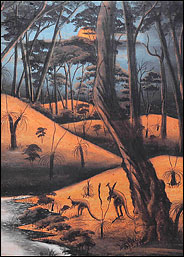
“Down to Drink,” by Parnell Dempster.

Australian young adult writers are conquering the entire universe. I was dead proud that Magic or Madness had already sold in five countries (USA, Australia, Taiwan, France, and Thailand), now I see that I’m underachieving. This article by Rosemary Neill is also startling because it’s so well-researched. It’s refreshing to read something in a mainstream news source about publishing and actually learn something. Via Yoof Literature (thanks, Lili!).

Speaking of research . . . Did anyone else watch the NBC so-called “news” report on the shocking new content of teen novels which aired Monday night? I watched it because R. A. Nelson who wrote Teach Me was interviewed. He spoke for about six seconds. The report consisted of people saying, “Look at the cover of this YA book!” Cut to cover of Gossip Girl or the like. “This book has shocking content! Should we let our children read books with shocking content?” Cut to a parent. “I’m shocked that my children are reading books with shocking content!” Cut to some random other person who is also “Shocked! Shocked by teen books with shocking content!” The 2 minute report ended with an admonition to parents to be wary of the shocking, shocking, shocking content of teen books.

I hadn’t watched “news” on television for ages and I gotta tell you I was shocked, shocked, shocked by the “content” of that report too!

Puce Redux

My friend, Ron Serdiuk, proprietor of the wonderous Pulp Fiction bookstore in Brisbane, just added this comment to the long ago puce thread. I think it worthy of elevation to a post of its own. He wrote:

I know that the historical origins were worked over and the flea blood/shit thang was put forward and everyone was fairly happpy with that and it seemed to be the end of the discussion . . .

but I don’t think that’s all there is.

I think the actual colour changed—and relatively quickly in hostorical terms—and became something else entirely.

Certainly now – according to Richard (source: decorator and paint charts) and Leanne (source: printers’ colour guides)—t’s either a cherry-ish red or an orange-y pink.

But even as far back as Heyer’s georgian setings I think it had already taken this road. whenever it’s used in her works it either—if used in the context of a male wearing it suggest dandyism or effeminacy—or when a woman is involved it seems to be vulgarity or a younger girl wearing something showy and inappropriate.

Neither suggest a sedate flea blood/shit purple-y brown to this little black duck.

I think we need a whole social history here. could be a great idea for a thesis . . . or maybe a popular history volume to supplement that wonderful book “mauve” from a few years back – (tho’ doubt one could find that puce made nearly as earth-shattering an impact as that aforementioned shade of purple! astonishing!)

One way or another, it aint over yet . . .

Says Justine: Interesting . . . there certainly aren’t many people who can carry off pinky-orange! Though I’m not sure I’d describe this colour as “sedate”.

We Did It!!!

Australia has saved the third test and grabbed the draw. It was unbelieveable. I’ve never seen (actually heard) anything like it. There is no game like test cricket. Nothing compares. This is one of the most incredible Test series of all time.

Should you wish (though I can’t think why you would) you can read a somewhat overexcited exchange about it between Niki, Jonathan and me here.

I’m going to go take a cold shower. I’m all aquiver, I am.

What I Learned Today

Miyazaki’s Spirited Away is, and I quote, “too scary! too scary! too scary!” for two year olds.

At first Marlowe was enchanted. Then it got dark, the parents turned into pigs, and demons started appearing out of nowhere. And that was the end of Spirited Away for Marlowe. “Too scary! Too scary! Too scary!”

Never give up on the Liberty. They always come back in the second half. (Unless they don’t.) Um, Coach Coyle? How come Erin Thorne got more minutes than Shameka Christon?

Never give up on the Australian men’s cricket team (not that I didn’t already know that). Yeah, yeah, England have declared. Yeah, yeah it would be a miracle to get four hundred on the final day of a test. But I have not given up! Just a flesh wound. The merest of grazes!

Rosé is the only thing to drink on a hot summer day. That and young coconut water. Or, you know, actual water. Or champagne. Or whatever drink you happen to like . . .

Thunderstorms rule! (Yeah, I already knew that one too.)

Too Young to Publish—A New Musing

I’ve just put up a new musing. Yeah, yeah, it’s been a long time between drinks, but I’ve been busy, okay?

Too Young to Publish

Recently I’ve had a number of letters from teenagers wanting advice on how to get their novel published and wondering whether their age will make it harder for them to get it into print. Specifically, would they be discriminated against because they were only thirteen or fourteen or fifteen or sixteen or whatever?

The simple answer is no. When you submit a query letter to a publisher or agent you don’t have to tell them how old you are. You’ll be rejected or accepted on the quality of your submission.

Continue reading Too Young to Publish.

Crowds = Good

Watched the New York Liberty beat the Charlotte Sting in double overtime last night. Wonderful close fought game, which you wouldn’t expect given that Charlotte have only won four games this season and are already out of playoff contention. But they’ve got a new coach—the glorious Muggsy Bogues (whose height is anywhere between 4ft 11 and 5ft 3 depending on who you ask—whatever—for an ex-NBA player he ain’t tall)—and many amazing players: Sheri Sam, Helen Darling, Tangela Smith, Tammy Sutton-Brown.

I think I know one of the reasons the Sting have been having such a rotten run. There was almost no crowd. The arena in Charlotte was echoingly empty. Surely having almost no-one yelling for you must make it hard to play your best. The Liberty often surpass themselves at home. I’ve seen them fall apart and then pick themselves up because we in the crowd were screaming our hearts out for them. If there’s no-one watching you, there’s no-one there to egg you on, to abuse the refs for you, there’s just silence.

Most published writers know how that feels. I don’t know a single one who hasn’t experienced the audience of none or one. Who hasn’t sat there ready to sign for no-one, staring off into space, looking depressed and forlorn. Just the expression to not attract any impulse purchasers who might have bought your book if you were sitting there looking cool and interesting. That’s why you should always do events with someone else, so that even if you both attract no-one you can at least natter away to one another with insouciance, elan and charisma, or, you know, something just like.

As Fred Dagg used to say, “I’ll get out of your way now.”

Bloody Rain (update)

Just as the follow-on was avoided and Warne was cruising towards a century the skies open up again. Bloody England with its bloody rain.

Update: The emaciated fourteen-over day is over and Warne finished on 78, including 6 fours and a six. Gallant Gillespie screamed along to 7. Well blocked, lad, well blocked! Australia is now only 180 runs and three wickets behind. No rain predicted for tomorrow or Monday. We can still win this! We can!

Aussie! Aussie! Aussie! Oi! Oi! Oi! Warnie! Warnie! Warnie! Oi! Oi! Oi!

Too Young to Publish

Recently I’ve had a number of letters from teenagers wanting advice on how to get their novel published and wondering whether their age will make it harder for them to get it into print. Specifically, would they be discriminated against because they were only thirteen/fourteen/fifteen/sixteen or whatever?

The simple answer is no. When you submit a query letter to a publisher or agent you don’t have to tell them how old you are. You’ll be rejected or accepted on the quality of your submission.

Being young can be an advantage in getting published. I was first published when I was nine. A short poem in The Newcastle Morning Herald (now The Herald). My mother sent it in and it was published with my age listed. While the poem was clearly a work of genius, odds are that if I hadn’t been nine, it wouldn’t have been published. As it happens I was more embarassed by the publication than I was proud. The kids at school teased me non-stop for the rest of the year. Happy days.

Up to the age of 15, I had a number of other poems and stories published. Without motherly intervention even. Every one of them with my age beside my name. After that, nothing of mine was published until I was in my thirties.

What happened?

Another simple answer: I started competing with adults. I stopped listing my age and started sending to more grown up venues. My work was not as good as that of the grown ups. I didn’t find my way into print again until I was way past my child prodigy days.

The teenage me was cast into deep, dark despair by this. On my seventeenth birthday I had a midlife crisis. There I was seventeen years old and still no novel published! I was a complete and utter failure! What was wrong with me?

Another easy answer: I wasn’t good enough yet and I wouldn’t be good enough until I’d learned to write and rewrite and rewrite again. Until I got past thinking my first drafts were perfect and that rewriting involves a wee bit of chipping at the surface of a story. It’s much, much harder than that. And, I’m belatedly learning, more fun too.

If you’d have told me back then I wasn’t good enough and had a lot more to learn about writing I would not have believed you. Actually come to think of it, people did tell me back then. But they were polite about it saying that I had a "great deal of promise" and a "bright future ahead". Blah, blah, blahdy blah. I didn’t want to hear it. I wanted to be published immediately! Before I hit twenty-one or, worse, thirty and was too decrepitly old to enjoy it.

Now, of course, I’m incredibly grateful that no one did me the disservice of publishing me back then. I’ve kept a lot of my juvenilia and, well . . . it shows promise.

I have a couple of friends who were not so fortunate. They were first published in adult venues when they were still teenagers. Both of them are horrified that their learning and growing as a writer has been done so publicly and that there’s nothing they can do to make all that evidence of early missteps go away. They both wish they’d spent more time honing their craft and less time desperately trying to get into print.

But how do you hone your craft?

Read a lot. Write a lot. In that order. There are very very few good writers who aren’t also good readers.

Never send off a first draft for publication. Even though the temptation to do so is enormous. I mean you wrote a complete draft! A whole poem/story/novel! It has a beginning, a middle and end! The sense of accomplishment is enormous you can’t wait to show your work of genius to the rest of the world.

Resist that feeling.

Wait a few weeks after writing something, then reread it, rewrite it (and I don’t mean just fixing typoes), then give it to some people you trust for comments. (Not your parents. Most’ll just tell you it’s wonderful no matter what.) If you have friends who read a lot give it to them. Or to a teacher you trust. Give it to as many people as you can think of. Trust me, most of them will not get back to you with comments.

Ask the ones who read it to tell you when they got bored. Ask them to tell you the plot. This is a great way to figure out if your readers are reading what you think you wrote. It’s amazing how often they aren’t.

When they get back to you with all their comments, rewrite it again. Many of the comments will be intensely annoying and boneheaded and will make you want to end the friendship with the idiot who said them. Resist your urge to do so. Resist the urge to tell them how moronic they are. Also resist the urge to cry (I still haven’t quite mastered this one). Instead look for parts of your story/poem/novel that all readers had problems with. Figure out how to fix it. Most likely the solution you find won’t be the one they suggested. (Later on when you’re published you’ll find this also applies to your editors.)

Learning to take criticism is one of the major prerequisites of being a professional writer. Once your work is accepted for publication, your editor will criticise what you have written and ask you to rewrite it. Usually many, many times. And after it’s gone through all those rewrites she will often forget to tell you good it is. There will be few gold koala bear stamps. Your editor’s primary concern is to get rid of that which sucks. It should be yours too.

Just as important: don’t get too caught up in the praise your readers offer you. If your readers only have good things to say about your manuscript, enjoy it, but then be suspicious. Very few pieces of writing are perfect first go. (I rewrote this essay several times and then gave it to Scott to read and it could still stand a bit more rewriting.)

Once you’ve made your manuscript as good as you can possibly make it—if it’s a novel that should take months, maybe even years—then and only then do you send it out for publication.

But how do you get a novel published?

With great difficulty. Getting published is very, very hard no matter how old you are. Most novels never find their way into print. Even really good ones.

Ian Irvine outlines the whole process in his essay, The Truth About Publishing (the link’s in the menu on the left). I strongly advise reading the whole document through to the end. It’s depressing, but it’s also very very useful. I wish I’d read it back when I was fifteen.

Good luck. Do not despair when you are rejected. Welcome to the club. There isn’t a writer in the world who hasn’t been rejected. Many, many times.

New York City, 13 August 2005

The Hebrew translation is here.

For those young writers who are angered by this please read my clarification.

I love Shane Warne (even if he’s not as cute as Daniel Vettori*)

First one ever to bag 600 wickets, top scored for Australia, and hasn’t trodden on his stumps this test, nor has there been any new scandal in the past few days!! What is not to love about Our Shane?


From the BBC site


* For the record I do not have a crush on Daniel Vettori, but a friend of mine is going to marry him when she grows up. I haven’t had a crush on a cricketer since Michael Holding. Sigh.

non sequitur

Just reading the 8 & 15 August issue of the New Yorker which includes Louis Menaud making the following assertion about Edmund Wilson:

When it came to most physical activities, he was inept. He did not, for instance, know how to drive a car.

Excuse me?

Many people do not drive cars. Some of them are highly ept at a whole range of physical activities. They have simply chosen not to learn how to operate the greatest killing machine of this century and the last. Any fool, ept or not, can drive a car. Takes a wise person to choose not to.

A Few Words about the unique-to-the-Australian-edition afterword

I’ve had some inquiries from folk who want to know what they’re missing out on by not having the Australian edition of Magic or Madness with its unique-to-the-Australian-edition afterword. One person was convinced that the Oz afterword contains the answers to all the questions left unanswered at the end of the book.

Not so.

It’s just this wee little thing that you wouldn’t understand if you aren’t Australian. Nothing to bother your non-Australian heads about. So you can just relax and get on with your day.

If it makes you feel the better the USian edition has a glossary and the Oz edition doesn’t. So it’s special too. As are you!

Magic or Madness in Australia

Two copies of the Australian edition of Magic or Madness just arrived. They’re beautiful. All tradepaperbacky and shiny and lovely and Australian, complete with the unique-to-the-Australian-edition afterword. It’ll be available in book stores there next month. My birthday month. Yay! Only sad thing is I won’t be there to see ’em till November. Sob. Why am I never in the country in which my books are coming out when they come out?

Here’s what it looks like being read by Marlowe, one of our Aussie house guests:

Marlowe thought the book was okay, but a bit lacking in train engines and explosions. I shall attempt to correct that in the sequel.

A Proper Con Report

I’ve been receiving some mail that is a little, um, miffed that my so-called con report doesn’t talk about any of the panels and readings I attended, or people I hung out with (not true: I mentioned Russ, Darren, Fiona and Richard), or give any sense of what the con was actually like.

a) That’s what my con was like: a cricketfest.

b) Sorry.

Here are people I hung out with who did write reports: Gwenda, Jed, Lauren, Scalzi.

Other than the cricket and catching up with my friends, my highlight was getting to hang out and gossip with Connie Willis—yes, I’m a pathetic fan girl—and you know what? As good a writer as she is I think I prefer listening to her telling stories. And I don’t care about what. She’s the best ranconteur I’ve ever met. And I know from ranconies.

Georgette Heyer

I read Cotillion while on the recent London/Glasgow trip. Yes, that’s right in eleven days I was able to read only one book. That should give you a measure of how busy the trip was and how knackered I was at the end of each day.

Anyway. I was delighted by the response to my recent throw away comments on Heyer, but because I was on said trip with scanty interweb thingy connectivity I was never able to respond to the response. Sob.

In those discussions Harriet mentioned Cotillion as one of her favourites which spurred me to pick it up for a reread. I adore the book. But I didn’t always. On my first read as a teenager I found it a terrrible disappointment for the very reason I love it now: Heyer buggers around with your expectations, the hero isn’t who the teenage me wanted it to be. Why, he isn’t even in the petticoat line! She shows the reader exactly how selfish and awful a rake really would’ve been. The book is delicious and clever and subversive and funny and full of delight at messing with her own formula. Divine!

As are Frederica and Venetia. (And if I could stand to reread it I’d probably find the same of The Grand Sophy.) All those books were first published in the 1950s or early 1960s. Many years after The Black Moth was first published. By which time she must’ve been well and truly ready to mess around with the genre she pretty much created.

I’m dying to reread all her books in chronological order to see if this theory is even remotely true. Tragically, the rest of my Heyers are back in Sydney in storage. And more tragically I have many other books I actually have to read, not to mention the ones I have to write. Like this one and the final Magic or Madness book. Sigh.

CricketCon

Look, I know it was supposed to be all about science fiction blah blah blah, but I spent the five days of Glasgow’s WorldCon thinking, talking, breathing, and whenever possible (sadly not nearly enough) watching the cricket. Blissful. And I even had the luxury of being able to talk about it with actual Australians! Thanks to Russ and Darren and Fiona and the rest of the many Aussies I wasn’t stuck talking about it with gloating poms preening about their victory barely snatched from the jaws of defeat. (Though to be honest my best cricket convos were with Justina‘s fabulous and very English husband, Richard.)

Almost as good, I got to read about it in actual offline newspapers. There are some good things to say about the New York Times but the coverage of cricket is shockingly inadequate. Not quite as bad as their coverage of the women’s basketball, but bad. The Guardian on the other hand. Ah, what a great great newspaper. Pages and pages and pages all about Freddie and Shane and Messers Ponting and Strauss and the rest of them. Some of it writ by the incomparable Gideon Haigh (bless him).

The second test was unbeliveably exciting: Australia and England in their different ways managed to make a dog’s and an angel’s breakfast of it. In the end I’m glad England won.

Yup, you heard me.

England has gone cricket mad. Sales of cricket gear is through the roof, littlies are signing up to play cricket at their local clubs in record numbers, pubs are full to overflowing of people piling in to follow the day’s play. A dying sport has been revitalised. I’ve said it before I’ll support the baggy greens with my dying breath, but I love cricket above all.

Just Quickly

We’re in Glasgow. It’s gorgeous and fun and you just can’t get bored by Charles Rennie Mackintosh.

Trip so far:

London: great (though bloody expensive) food (Niki and Lauren & Andrew have been most excellent guides), brilliant markets, cheap clothes (bought the most gorgeous 15 pound skirt). It’s not the city I remember, though I did get some awe-inspiring rudeness—so it hasn’t completely changed. Best restaurant was David Thompson’s Thai one in Soho (I forget the name). Thompson’s Australia’s guru of Thai food. Was wonderful watching Lauren and Andrew’s delight in finally trying decent Thai food. I also gave them their very first mangosteens. Heavenly!

Glasgow: gorgeous, love all the Rennie Mackintosh everywhere. Had the most brilliant black pud and organic cider at Cafe Gandolfi. Cider in the UK is the best I’ve had in my entire life. Superb.

And tonight WorldCon begins. In the meantime the second test is on the tellie and Warne is bowling beautiful.

This is the life.

(Internet access continues very intermittent.)

(Oh and the time date for this is NYC time. Couldn’t be arsed changing it. Time here is 2:34PM.)

Off to London

Done packing. Car gets here in 30 mins. Then it’s into the big jetplane and across the skies till we get to London where my sister lives. Can’t wait.

Except that it’s cold there. Sob. And even colder in Glasgow. Double sob. Just as it was getting to be a proper summer here we go somewhere damp and cold. What were we thinking?

Not sure what my internet access will be. Dunno if I’ll post. But I’ve become a blogging addict so if I can I will.

Enjoy yourselves while I’m gone.

My World Science Fiction Convention Schedule

Yes, like everyone else in the entire sf world, I will be jetting over to Glasgow to partake of science fictiony thingies for several days at the World Science Fiction Convention. I’ll hang out with me mates, meet new people, and spend a lot of time in the bar watching England being destroyed by Australia in the second test at Edgbaston. Can’t wait. (I’m just sad that it won’t be in an English bar. Fortunately there’ll be enough English sf fans around that my gloating enjoyment of their team’s destruction will have an audience. In fact I’m going to greet every new person by asking if they’re English or not. And if they are, I’ll say, “Cricket. Ashes. Ha ha ha!”)

Friday 2:30pm Reading

I’ll read some stuff. Maybe from Magic or Madness, or Magic Lessons (the sequel to Magic or Madness—the reading will contain no spoilers), or I could read from my brand new novel which no one knows nuthink about and I’ve never read out loud to anyone but me spousal. Dunno. I’ve got half an hour, but that’s ridiculously long. I don’t like to read for more than 15 minutes, that way me and me audience (both of us) can go to the bar and watch England being destroyed in the second test.

Saturday 12:00 noon Feminism as Setting

Trudi Canavan
Anne K. Gay (M)
Jon Courtenay Grimwood
Mari Kotani
Justine Larbalestier
Ruth Nestvold

Description: Feminism is no longer the story, instead it’s the setting—what has this meant for feminist writers?

My take: Huh? I don’t agree with the premise. Feminism can be both setting and story, these are not contradictory terms. Plus it will be tricky to work a discussion of the cricket in.

Sunday 11:00am The 1950s, 50 Years On

Gail Dana
Irma HirsjSrvi
Justine Larbalestier
Greg Pickersgill
Mark Rich (M)

Description: The 1950s saw the Golden Era of Science Fiction film and the blossoming of writers such as Asimov, Sturgeon, Dick, Farmer, Walter M. Miller and Poul Anderson. What do we think of them now?

My Take: How could you list the best of the 1950s sf writers and not include Alfred Bester? Or Theodore Sturgeon? Or Margaret St. Clair? I’ll argue that sf writing in the 1950s was indeed a golden age, the period when sf turned its attention to the social sciences and examined social issues more than ever before. It’s often argued that that didn’t start happening until the 1960s which is crap. Also the 1950s saw some of Keith Miller‘s finest batting and bowling.

See you in Glasgow.

Randomly

Georgette Heyer books remain most excellent on the umpteenth reread. On this occasion Venetia, Frederica, and Sylvester. Am unable to decide which I like better: Venetia or Sylvester. Right now am tilting towards Sylvester on account of authoress Phoebe’s roman a clef, the hero, Sylvester’s attempt to “mount” the heroine, and the truly appalling Sir Nugent Fotherby. But the sexy talk between Venetia and her Wicked Duke Damerel is hard to go past.

Can’t stop listening to Missy Elliot’s latest The Cookbook. Current fave: “We run this”.

The latest New Yorker has a gorgeous account of just how much Samuel Pepys (1633-1703) drank in a day:

At about ten o’clock, he would have his “morning draft”—usually “small” (or weak) beer, but sometimes regular beer or even wine. Cakes might be eaten with the draft, but dinner was the day’s main meal, then taken at noon, and, at least on some occasions, this was washed down with wine—possibly watered, given the volumes that Pepys records knocking back. During the rest of the working day, more wine might be consumed; Rhenish wine (sometimes sugared); “sack” (sherry or Spanish white wine); claret (red Bordeaux); “Florence” wine; “burnt” or “mulled” wine; wine flavoured with wormwood. He might also have further drafts of beer (traditionally hopped) or ale (traditionally unhopped), and specified as Margate, Lambeth, China, or Hull).

Fair enough. Drinking water back then was dangerous. I’d’ve been dead of cholera so very fast. I love me the taste of water. Especially New York City tap water which was unavailable to Pepys. Poor bastard.

It finally got hot here in NYC. I’m very happy.

And No. 2 Wins

There were many responses—thanks everyone—to my which-form-of-acknowledgments-should-I-go-with question, so rather than respond in the comments I’ll do it here. It’s my blog I can do it any way I want to. So, nyer.

I’m so thankful to the respondees that I’m thinking of adding an extra line to the acks:

And finally I’d like to thank Scott, Jeremyt, Claire, Barry, Gwenda, Ray Davis, Marrije, Richard b, Jonathan, Stephanie Burgis, the eagle-eyed and amazing Micole, David Moles, Shelly Rae, John Scalzi and Parker for telling me what form these acks should take, Janni for sitting on the fence, and Patrick Nielsen Hayden, Lauren and Jenny D for writing the dangerous minority opinion.

(For those of you wondering, nope, I have no idea who any of these people are. Honest.)

So, yes, being someone who always goes with popular opinion, I reckon it’ll be number two, and sand in the face to the dissenters Patrick, Lauren and Jenny D. Cause, you know, that’s what victorious marauding mobs do: they kick sand in dissenters’ faces. (Just close your eyes tight and you’ll be fine.)

Like Parker, I want both. The author’s acks for their gossip value, and also a credits page so you can figure out who designed the really cool dingbats, as well as who the coypeditor was (to either avoid or demand they copyedit all your future work). You do sometimes see editors and interior designers credited, but never copyeditors or publicists or proofreaders.

Jonathan writes: i’ve not written a novel, but there are a bugger of a lot of people who help with an anthology.

Speaking as someone who’s done both—there are a shitload more people you have to thank putting together an anthology than a novel. Relatively speaking writing a novel is a piece of cake.

In response to Patrick’s suggestion that I should: late in life, publish a tell-all memoir of such flamboyant magnificence that it eclipses all your work thus far.

I so don’t think so. Memoirs are hard work. You have to remember stuff and inadvertantly and advertantly (is that a word?) offend people, and get sued, hire lawyers, and, argh, no bloody way. I figure I’ll just keep my acks and dedications as fulsome as ever and if anyone feels like writing my memoir for me they can piece it together from aforesaid acks and deds. Piece of cake.

Gwenda wrote: What I loved best about Emily G’s column was the idea of critiquing acknowledgements and I must, sort of shamefully, admit that it was one of my favorite catty reviews ever. I’d far rather read catty reviews of acknowledgements than books.

You’re not saying that you’d rather read a catty review of acks than read a book, right? Cause that, Gwenda, is troubling. If you’re saying you enjoy catty reviews of acks over catty reviews of books, I’m with you. Unless the catty review is of a book I really really hated, or by an author I really hate, or by an ex (friend or lover) who was particularly mean to me, or by an English person (though not, Andrew, one from Nothern England), or someone who was once mean to any friend of mine ever, or by someone whose name is Rupert, Randy or Violet (I hate those names).

Those aside, reading a good vivisection of the acks page is indeed much more gratifying (except for the vague horror that perhaps you yourself have offended in just that way and could one day be on the receiving end of such an ack review). I very much enjoy a good mock of acceptance speeches and award ceremonies. “You love me! You love me! You really love me!” or how about, “I’d like to thank my agent, and God . . . ” You just have to adore the hierarchy in that little speech. Agent always comes first.

I confess that I have been obsessively reading, and yes, sometimes mocking, writer’s acks and deds for years. Ray Davis points to a wonderful dedication, Kyle Baker’s “This book is dedicated to whoever I’m going out with now.” I love it. I very much enjoy the good old “this book has been published despite the complete lack of support and obstacles put in my way by my family.” I’m paraphrasing several I’ve seen over the years. I giggle at certain over the top professions of love in the ack page. One stays with me. It appeared in an English language book, but is in a romance language and reads, “And to [name of beloved] I love you, so much, so much, so much!” And no the book was not a romance, it wasn’t even fiction, rather it was non-fiction of the driest kind.

Kathryn Cramer writers: I feel so naive. I thought acknowledgments were for finding out who really wrote ghost-written books.

Ah yes, all those books with this effusive ack: “This book would not exist without the research, editorial and all round amazing skills of [insert name]. Without you I’m nothing!”

Claire writes: of course, i’ve already received an offer of marriage from you, so i feel i’m already in the in crowd. so if you went with #1, i’d expect you to list me under “offers of marriage conditionally refused during editing process.”

Claire, sweetie darling angel, if I thanked every single person who refused my offers of marriage while writing and editing my books, the acks would be longer than the damn book. So won’t happen. Sorry.

A Most Excellent Sunday

Yes, this is more about sport. Look, I know many of you can’t stand sport, but I don’t care (feel free to stop telling me about your lack of interest). Sport—and I’m talking watching it, not doing it—has been keeping me from burning down buildings since I was a wee thing. I’ve a sports brain. I am obsessed. Come the Olympics and I can barely leave the house. (Yes, I like to play some sports too: tennis mostly and not very well. I have a long legacy of sports played and abandoned—largely through injury.) I love following a particular team, knowing its history, the players, the management, the gossip. I love knowing the ins and outs of a particular sport, rule changes, how it’s reported (or not reported a la The New York Times and its total lack of interest in the New York Liberty), fluctuations in popularity et cetera, et cetera.

The Liberty just won their third straight game! And it was on the road. In a low scoring, very very very defensive game, the Liberty held off the Minnesota Lynx (who peed all over us in our last encounter). We even out rebounded them! They’re much bigger than us and yet we outdid them on the boards. It was the most incredibly pleasing victory, even better than our effort against Sacramento because we were tough and gritty and fought. Yay, the New York Liberty!

Between that and today’s slaughter of England and the end of the Tour this was a most excellent sporting Sunday.

That is all.

La La La (updated)

Stupid English weather with it’s stupid rain. The fourth day of the first Ashes test has yet to begin. And Australia with only 5 wickets to bag. Most annoying. Better not rain tomorrow. Better not end in a draw. Bloody English weather!


Getty Images

Especially as Scott after much diligent googling found a bar in NYC that shows the cricket! Thus earning my eternal gratitude and undying devotion (not that he didn’t have it already, mind). That’s right, yesterday we watched the last hour of play at Eight Mile Creek in Soho surrounded by Aussies. Most excellent. They’ll be showing all of the Ashes—every day of every test—from the 5AM start till the end of the day’s play around 1PM. Bonza! Strewth! Bewdy, mate!

Last day of the tour! Who will wear the green? Please, please, please let it be Stuart O’Grady! And please let there not be any horrible prangs. Will Rasmussen be happy with being king of the mountain after yesterday’s disaster? I hope so. Poor baby. Twas horrible to watch.

And there’ll be much jokeying around in the last few places of the top 10. There’s only seconds between the fifth, sixth, seventh and eight places. Vinokourov just grabbed himself extra seconds to draw (almost) even with Levi Leipheimer in fifth place. My boy, Cadel Evans, is in eighth spot. Be lovely if he could move up. But you know what? A top ten finish in your first Tour is pretty bloody awesome.

And Lance, of course, will take the yellow in his last tour. He’s had an incredible career and proved himself to be without doubt the best on the tour. I fell in love with the Tour during the Miguel Indurain era, he of the mighty lungs, at the time everyone said we would never see his like again. And then along came Lance.

And how about next year? Who’s gonna win once Lance is gone? Who will be the next Tour god? I’m kind of hoping it will be more in the nature of an intense two or three or more way rivalry between several amazing riders with a different one winning every year. I cannot wait!

Update: yup, Lance got the yellow, Cadel Evans kept his 8th spot, Thor Husvold got the green, with Stuart O’Grady second.

Cricket resumed and Australia won by 239 runs. Not saying anything more. Gloating is in very poor taste.

Going Out on a Limb

The New York Liberty are gonna make the playoffs. There, that’s my money on the table. My team is gonna figure in the postseason.

They’re looking absolutely bloody amazing at the moment. Elena Baranova has come good, blocking, rebounding, being incredible in defence, hell, even Erin Thorne looked good last night. The Liberty just won two games back to back on the road, and last night against the Sacramento Monarchs they were magnificent, never looking like they were going to do anything but win (we’ll just ignore the last two shambolic minutes).

On a good day my team can beat any other team in the league; and, yeah, on a bad day they can lose to any one too. That’s the glory of the Liberty.

More on Acknowledgments and a Poll

Gwenda links to Emily G berating people for their intensely irritating acknowledgments page and gives a fabulous list of don’ts. Now, I’m on the record as being all for acks, and I didn’t entirely agree with some of her complaints, but I sure was struck by this suggestion: I propose a straightforward film-style list of credits on the last page.

Interesting idea. So now I’m thinking of doing it for my next book, Magic Lessons. Here’s what it would look like:

———-

Publisher & editor: Eloise Flood

Editor & prodder: Liesa Abrams

Fellow pedant & seeker of perfection: Andy Ball

Answerer of annoying questions and all round helpful person: Margaret Wright

Designer of the beautiful interiors: Chris Grassi

Copyeditor of the Gods: Polly Watson

First Readers: John Bern, Gwenda Bond, Pamela Freeman, Carrie Frye, Margo Lanagan, Jan Larbalestier, Karen Meisner, Sally O’Brien, Ron Serdiuk, Micole Sudberg, and Lili Wilkinson.

Jilkminggan and Ngukurr memory refreshers: John Bern, Jan Larbalestier, and Kate Senior

Fashion consultant: Janet Irving

Provider of space in which to write: Allen Haroothunian (Sydney) and Drink Me cafe (New York)

Supportive family: John Bern, Niki Bern, Jan Larbalestier, and Scott Westerfeld

———-

What do you reckon? Is that preferable to this:

———-

I’m very lucky to have such smart, incisive, hardworking editors as Liesa Abrams and Eloise Flood. Thank you. Thanks also to Andy Ball, Chris Grassi, Polly Watson, and Margaret Wright.

My first readers are eagle-eyed and amazing. Thank you, John Bern, Gwenda Bond, Pamela Freeman, Carrie Frye, Margo Lanagan, Jan Larbalestier, Karen Meisner, Sally O’Brien, Ron Serdiuk, Micole Sudberg, and Lili Wilkinson.

Thanks to John Bern, Jan Larbalestier, and Kate Senior for refreshing my memories of Jilkminggan and Ngukurr.

Janet Irving answered all my questions about fashion and fabrics. (If I still managed to get it wrong, blame me.)

Allen Haroothunian let me use his home in Camperdown (Sydney) to finish the first draft and the first round of rewrites. Much appreciated. Large chunks of the first draft were also written at Drink Me café (New York).

Lastly, to John Bern, Niki Bern, Jan Larbalestier, and Scott Westerfeld: you four make everything easier and more fun. Here’s to more good food and wine together.

———-

Which is less annoying? Record your vote in the comments.

How to Do Your Head in (updated)

Watch the Tour on the tellie while following the cricket through the BBC’s online radio and exchanging emails about it with your sister. Apparently I don’t multitask well. My head hurts. Thankfully the Tour is finished for the morning and I can concentrate on the cricket.

Am really enjoying the cricket right now. McGrath is bowling like a demon. He’s already gotten fivefer. Ha ha! I knew that Australia getting out for 190 was all about the wicket, not about the bowling. Of course now that Australia is in it’s all about the bowling not the wicket. No, I am not one-eyed.

Oh my, I’d forgotten about the BBC commentator—Blofeld’s appallingly plummy accent. It is to gag. Ack. Ack. Ack.

Update: 17 wickets taken in one day! Australia all out for 190; England 7/92 and only one real batsman left. McGrath gets his 500th test scalp with unbelievably brilliant bowling. As Merv Hughes said “Fair dinkum that was a good day’s play.” I reckon!

Most Excellent Breaking News (updated)

Margo Lanagan, brilliant author of Black Juice and many other fine books now has a blog! Woo hoo! And a bloody superb one it is too! This news has made my day.

She’s even linking to some of her bad reviews and posing excellent questions such as: “Since when is ‘polished and clever’ the definition of good writing?” Since never, says I.

My only complaint is that so far she’s not enabling comments, thus depriving us all of the pleasure of welcoming her to blogland; and her of the pleasure of editing our comments (scroll down).

Update: as noted by Marrije in the comments, Margo has now enabled us all to get in amongst it with her and comment to our heart’s content. Yay!

Hiding the Trilogy and Unfinished Books

I just finished reading Elizabeth Knox‘s Dreamhunter (the English edition is called The Rainbow Opera) and I absolutely loved it. Couldn’t put it down. Fabulous worldbuilding, gripping plot, gorgeously realised characters, and, bloody hell, but Knox can write. It’s easily one of the best books I’ve read this year, or last year, or pretty much any year.

But.

Yes, I have a but. And it’s a but I suspected I was always going to have about this book, because the lovely Lili Wilkinson of the Centre for Youth Literature who sent me the book from Australia (it’s not available in the US yet) warned me that is has a cliffhanger ending and the sequel isn’t out yet.

No big deal, I thought. But now I’ve read that cliffhanger ending, and now I’m sitting here with no second Dreamhunter book to read and it’s driving me completely insane and filling me with rage at the publishing industry that would do such a horrible thing to me, an innocent reader! I mean not only am I in the midst of the worst narrativus interruptus of all time, but I don’t even know exactly when the sequel is going to come out. Only that it’s called Dreamquake and will be out next year. When exactly? Which bit of next year? The January bit or, shudder, the December bit?

And Dreamhunter is not a whole finished book. It’s cruel to launch it on an unsuspecting public in this form. Nothing on the cover, spine, or back indicates that it’s the first half of a duology. There’s no hint in the cover copy. Nothing in any of the front matter, not even in the back matter. Why?!

Well, okay, I’m being disingenuous. I know why. Because many publishing houses believe that the punters won’t buy book one of a series unless it’s by a known-quantity. Say J. K. Rowling, or Robin Hobb, or George R. R. Martin. While Elizabeth Knox is huge in New Zealand and her adult books have been (justly) acclaimed (go read Vintner’s Luck), Dreamhunter is being marketed as young adult, and in that area she is an unknown. Safest bet, think the publishing people who make these decisions, is to not let on too strongly that it’s just part one, otherwise the punters mightn’t shell out the money for it.

That’s kind of what happened with my book, Magic or Madness. Though the front flap copy does mention that it’s the first book of a trilogy, it’s not mentioned anywhere else. A fair few people have missed it, and been cranky that the book ends without wrapping up all loose ends. Not my fault, if it were down to me it would’ve had a great big 1 on the spine and mention of it’s triloginess on the back cover, but it wasn’t down to me, and thankfully, say the Penguin people, because they reckon that would have really hurt the sales. (And in my defense: there are lots of ways in which Magic or Madness stands alone. Dreamhunter just stops in the middle of the story, nothing resolved at all.)

So, shockingly sometimes the interests of the people reading a book and those of the people who produced the book don’t coincide. This leaves me, the reader, waiting ludicrously long amounts of time for the sequel to books that I foolishly read before their sequels are published. What to do in the meantime? Reread Dreamhunter many, many times. And pray that Knox doesn’t pull a Pullman on me with the sequel.

Life is Good

I’ve written 1,500 words today. Bloody fine words, too. Or at least so they seem in the first flush of having written them. Yay first flush!

And Scott just threw together a late lunch of fresh baked rye caraway bread supporting the weight of manchego cheese, sliced perfectly ripe heirloom tomato lightly sprinkled with salt, and a sour pickled tomato. For dessert: two perfect majool dates. Have I mentioned my love of Russ & Daughters?

Now I and my happy palate will write more words.

Australians: One and Two

Today’s Stage ended in an all out sprint with two Aussies coming out on top. I’m happy, even if I was hoping they’d come in the other way around—Stuart O’Grady, and then Robbie McEwen. And it’s always sad to see a breakaway mowed down within sight of the finish line. It’s gonna be a tight race for the green jersey. Fingers crossed that it winds up on O’Grady’s shoulders and stays there till the end. But with McEwen’s current form, well, sigh.

Desperately Seeking Inspiration

I’m endlessly fascinated by the search terms that lead people to my website. Today these desperate words typed into google led them to some not-exactly-directly-related pearls of wisdom: inspire me to write my thesis.

Ouch.

I remember those days. I finished my PhD thesis in 1996, having started researching it in 1991 (and taken a year off due to some bone breakage), but it sure felt like it took a lot, lot, lot longer than that. At the time writing my thesis seemed by turns nightmarish, unendurable, hallucinegenic, boring, fun, hideous, never-ending and plain out-and-out pointless. I endlessly procrastinated until, faced with the prospect of no more scholarship, I buckled down and wrote day after day, night after night, barely sleeping, or eating, or doing anything else, until I was a sobbing insane mess and the thesis was finished.

Eventually it became The Battle of the Sexes in Science Fiction, a book I’m still ambivalent about because it’s not the book I wish it was. To me it will always be my PhD thesis: the monster that almost broke my brain.

Hmmm, that’s not very inspiring is it? Here’s why you should write your thesis:

  • Until I finished mine I had never managed to finish anything long. I had started many novels, but never finished one. Finishing my 120,000 word thesis taught me not only that I could crap on at length, but that I could produce a (mostly) coherent, whole text. That’s a mighty fine feeling and a bloody useful skill. I’ve since finished four different novels. Now when I start a novel I’m no longer afraid I won’t be able to finish it, just that it will suck.
  • The research skills I learned have come in mighty handy over and over again. Yours will too.
  • Finishing my PhD thesis meant that I was eligible to apply for a post-doctoral fellowship. I was lucky enough to get an Australian Research Council one, which ended up changing my life. Once you’ve got your PhD you too can apply for post-docs as well as academic jobs. No comment on how much fun writing all those applications is (I applied for six and got one and was ecstatic with my strikerate).
  • Having a PhD under your belt can be helpful in landing other jobs. A PhD proves that you can stick to and finish a major project, that you can organise yourself, that you know your way around a library (or whatever facilities you used for your research—don’t want to leave out science types), and that you know how to make a very small amount of money go a very long way.

On the other hand, I know plenty of people who haven’t got a PhD who are quite capable of finishing long prose pieces, have great research skills, a job, and know how to make a tiny budget stretch . . .

How the Future Isn’t

Mely has a lovely post detailing the future she’s sad we haven’t wound up with yet. Hint, it’s not the oft-touted Gernsback one. I’m with her on almost everything except immortality, which Scott has convinced me is a profoundly bad idea. Just imagine if certain world leaders never ever died.

I’d also really love a working transmat beam, because while I’m always saying I love travelling, I really, really, really, don’t. What I love is being somewhere else. If I could skip the whole many, many hours in a plane or whatever on the way to the somewhere else, I’d be dead happy.

Also I’d be very happy with food in patch or tablet form. I hate it when I just need food as fuel and there’s no time to enjoy it. I’d much rather down a pill and keep doing whatever I was doing and then, when there’s time settle in for that three hour sumptious feast accompanied by the very best wines, or a just-made-in-front of you taco from a market stall, or the bestest juiciest mango of all time. Also imagine how much easier pills or patches are to transport versus, say, grain. An end to world poverty, anyone?

And how about books in electronic form that are easy to read and don’t suck?

And, and, and . . .