

Contest Results
Contest results are now up. And thus ends our blogging gig at insideadog.
So here is one. And from a fellow Australian, naturally:
There was more talk, more laughter. One moment Arabella thought that he would walk away with the other men. The next Lord Petre feared that she would turn back to the box with Miss Blount, and that his chance would be lost. The chance for what, he could not say. Neither of them heard a word of the conversation; each of them looked for a reason to address the other. They both wished, vainly, that everybody would go away. At last, as the audience began returning to their seats, they found themselves face-to-face. Lord Petre stood mute, looking at Arabella intently. She struggled for a pleasantry to break their silence.
—Sophie Gee The Scandal of the Season
No writing technique is evil and wrong. It’s all about the execution.
That we have another post up on insideadog. The penultimate, we think. The last one goes up Monday morning (Oz time) and Sunday night (US of A time).
Someone just told me I’m wrong about Bring It On being the best movie of all time. Excuse me? If I say it is then it is! This is my personal list of the best movies of all time. I cannot be wrong about it.
I’m not saying there aren’t other best movies of all time. There are! The Princess Bride is one. Rififi is another. Not to mention Out of the Past and Lagaan.
I am also not wrong about mangosteens being the best fruit.
Or The Wire being the best television.
Or Emma and Hellsing and anything by Osamu Tezuka being the best manga.
Or zombies being the best monsters.
And cricket absolutely is the best sport.
So nyer!
Though, of course, I reserve the right to tell you that your choices of best movie etc of all time is completely wrong. Because I am blog overlord.
We only have a few more days left on Insideadog. Check out our latest post there.
Someone just wrote to ask me what to do when the writing is not going well. Fortunately, Diana Peterfreund has just written on this because I have no useful answer.
I suspect my own struggles with sentences that crumble as I type, with plot and character and meaning twisting out of my control, are at least partly because I’m very early on in my career. Old timers are much smarter about this stuff. Fer instance, my parents heard Thomas Kenneally interviewed the other day and he said that the writing got easier as he got older. After having written for more than forty years and having produced a bazillion gazillion novels (or, you know, thirty odd) he knows his own process and what to expect.
I don’t.
Not really. I’ve only written six novels and the writing of each one was different. I’ve been a freelancer writer for four years. I still have no idea how long it takes me to write a book. I can tell you how long the last one took, but not how long the next one will.
When you’re starting out you don’t know what to expect. You don’t know what you’re capable of. When the crappy writing days hit you—it’s a shock and you don’t know how to handle them.
Even super disciplined writers, like my old man, have days of words dissolving into puddles of putrescence, when they can’t focuss, and can barely squeeze out five words let alone a thousand.
What he does is keep writing. That’s where the discipline comes in. The act of getting yourself into the chair and typing—even if the words you’re producing make William McGonagall look like a genius—can be enough to get you past the crap and into the good.
Or not.
Sometimes people just need a break.
And only the writer can figure out which it is.
Personally, I’m pretty much always convinced that I need a break. Preferably in a place where there’s plentiful cricket coverage (alas, poor England), the food is fabulous, and the wine even better.
Sadly, my deadlines say otherwise . . .
From this sensible article on cheating in sports by JERÉ LONGMAN for the New York Times:
Fausto Coppi of Italy, who won the Tour de France in 1949 and 1952, was once asked if he ever fueled himself with amphetamines.
“Only when necessary,” he said.
How often was that?
“Most of the time,” Coppi replied.
The Tour de France ranges from 3,000 to 4,000 kilometres long (1,800 to 2,500 miles) which must be covered really fast in three weeks over hill and dale with just two rest days. Evidence is pretty strong that chemical assistance has been used since the tour began.
Longman points out that the two sports that have had the most drug scandals are the ones that have pursued the issue most vigorously: cycling and track & field. The end result: people think those are the sports that are jam packed with drug cheats. Yet it’s very likely that there’s not a pro sport in the world that doesn’t have athletes who use performance enhancing drugs.
My biggest concern is that athletes are taking drugs that can cause them long term damage (even death) because the hypocrisy around the issue means that drug use is unregulated. And some of the drugs being taken have never been properly tested. That’s scary.
In an ideal world there would be drug-free athletes. What we have now is a world in which not everyone using is getting caught, those who stay clean are at a disadvantage, and there’s doubt and suspicion of everyone. I’m not sure it’s tenable. But I’m not sure what is.
Which is to say I’m bummed I didn’t get to follow the Tour this year. I’m thrilled at how well Cadel Evans did. And I’ll be making sure I get to follow it next year. And hoping that something really radical and smart happens across all sports to regulate drug use in a way that make for more transparency and way less potential harm to athletes. And while they’re at it, if they could end all match fixing, that’d be grouse.
Update: Jenny Davidson has pointed to this fascinating article by Stuart Stevens on performance-enhancing drugs. Stevens tries a whole bunch of them, notes the results, and comes down firmly against them. Well, against almost all of them.
It’s midnight on the east coast of Australia (10AM on the east cost of the USA) the beginning of the final day of the LOLYA contest. Get your entries in by 11:59PM of today, Tuesday 31 July (East coast USA: 9:59AM 31 July). The comments will be turned off at that time.
We’ll announce the winners on the morning of 6 August (the evening of 5 August in the US of A).
Good luck!
Because Jenny Davidson says she enjoys a good rant we have provided her with some ranting action over on insideadog.
While I don’t think it was anywhere near best-movie-ever-made status, there was a lot I enjoyed about it compared to your average sf movie, which as a genre I mostly hate. Seriously the amount of sf films I think are okay (in a non-camp way) is very very small. Sunshine gave me a mission to save the world without big long speeches about saving humanity, uniformly good acting, no boredom, plus it was pretty.
What I didn’t like were the standard annoying Hollywoodisms, like, and here come the spoilers, …
I am in crunch time. I am in crunchy crunch time. The busyness I have been complaining about has rebounded on itself and leapt to a whole new level of busy. In a word: Aaaarggghh!!!!
I’m going to keep blogging. I made a little bet with myself to see if I could blog every day of July and so far so good. I hate to lose bets with myself. Especially fun ones. Also blogging kind of clears my head. Dunno why but when I’m deep in writing, blogging really helps me to unwind—that and a glass of wine.
However, I’ll no longer be replying to comments as much as I have been (which I know has been down on what it used to be)—Sorry! The UFB has to be rewritten and that’s my top priority.
Then there’s the email problem. A while back John Green declared email bankruptcy. I think I may have to do the same. I have more than five hundred unanswered emails, which I know is nothing compared to Cory Doctorow who gets, like, two thousand a day, but, well, I ain’t coping. Important emails are getting lost in the shuffle. So I’m going to put them all in a folder to be dealt with after crunch time. I hope that if it was important folks will resend.
I’m very sorry for not replying. I suck.
So from now until I’ve finished the rewrites and made solid inroads into the new novel, I’ll be very bad about answering email and your comments here. And if I am responding to comments here in the next few months—that means I’m being an evil procrastinator and you have my full permission to hassle me about it.
Now I return to the UFB.
For research purposes, I am going to drastically increase my zombie culture consumption.
Thus far I’ve been reading and loving The Walking Dead by Robert Kirkman. (I read the trades not the skinnies—so no spoilers for the latest issues!)
I also plan to read World War Z, An Oral History Of The Zombie War by Max Brooks. So no spoilers, people!
Update: Forgot to mention I have read the entire and very excellent Kelly Link zombie oeuvre.
What other zombie books and graphic novels should I be reading?
And there’s the movies—because really the whole zombie thing is very movie driven.
Obviously I’ve seen and loved all the George Romero zombie films. Yum. My faves. Yes, even the recent Land of the Dead that I’ve heard quite a few people bagging. The only one of his I think is a bit sub-par is Day of the Dead and even it is totally worth watching.
I’ve seen The Dawn of the Dead remake. Very disappointing.
And obv. there’s 28 Days Later and 28 Weeks.
Not to mention Shaun of the Dead. Very droll.
There’s also Jacques Tourneur’s I Walked with a Zombie. Yes, that’s right I’m open to non-Romero voudun-style zombies.
Update: Also forgot to mention that, yes, I have seen the Resident Evil films. I love ’em.
So what are the best zombie movies that I haven’t seen? And if you could sell ’em to me and not just list titles. I’m trusting youse lot to be my zombie entertainment quality control.
Via Elizabeth Bear a discussion of how writers feel about getting editorial letters.
First up, for those who don’t know an editorial letter is pretty much what it sounds like: a letter from your editor about your book, telling you all the things they want you to change in your manuscript. You only get an editorial letter if they’ve already bought your book.
The responses over at Blue Rose Girls are varied and run from love to hate and back again.
Me, I love editorial letters. I will go so far as to say that I find them sexy.
Seriously, imagine receiving a long letter (I’ve had up to ten pages single-spaced) that is all about your book, that totally gets what you were trying to do, and has billions of awesome ideas about how to make it better. I get a yummy shiver every time I receive my latest ed letter.
I’m lucky, of course, I’ve never had a bad ed letter. Mine have been not only full of insight and brilliant structural solutions, but they’ve been well-written and witty as well.
My relationship with my ed letters runs like this:
I am a much, much, much better writer now then I was before I was professionally published. Part of that is because I write far more than I did back then, but a larger chunk of it is from being edited by professionals. My ed letters push me much farther than any other criticism I’ve ever received. My editors want my books to be the very best I can write as much as I do. They have a vested interest in them being good—it’s not only their job, but my success is their success, and my failure is their failure.
To sum up: a good ed letter and thus a good editor are worth their weight in mangosteens. There is nothing finer!
Last year there was a fair amount of debate about whether M. T. Anderson’s Octavian Nothing is YA or not. Personally, I think it is, but I can see where those you don’t are coming from. You can make a case either way. Octavian fulfills my requirements for YA.
I just finished a book which doesn’t fulfill those requirements even though it’s being sold as YA. Like Octavian Nothing, Margo Rabb’s Cures for Heartbreak is a gorgeously written, deeply moving book. I loved it.
I just don’t think it’s a young adult book.
Here’s why:
The protag is not a teenager. She’s someone in her thirties looking back on her teenage years and how she coped. This gives the book a distant, elegiac quality, which fits the subject matter perfectly, but means that the book is not ya.
YA is not a detached genre. It’s the very opposite of detached. It’s about heightened emotions, out of control situations, learning to be yourself and how you fit into the world. Mia Pearlman is looking back on those heightened emotions, on her loss—she’s examining and dissecting those feelings, but in a controlled, almost clinical way. When I read YA I want to be in the protag’s head feeling what’s going on there without a strong sense of those experiences being mediated.
Obviously, that’s an illusion—there’s always the writer in the way—but to me that “transparency” of experience is one of the hallmarks of YA—it’s what makes Octavian Nothing YA—and if it’s not there I feel like I’m reading something else. One of those adult novels.
Who else has read it? What did you think?
To reiterate: I strongly recommend Cures for Heartbreak. It’s an extraordinary examination of grief and suffering. And a really beautifully evoked portrait of New York City. I loved it. But it’s not YA.
Last Sunday her team narrowly beat my team, and on the one hand, I was deeply bummed—it was so close! We almost had them!—on the other hand, damn she’s a fine fine player. And, oh, how much I love watching her play. I just prefer, you know, when she’s playing for the Opals and they’re winning the world championships.
How good is Lauren Jackson? So good that we have to triple team her:

That’s Tiffany Jackson, Ashley Battle and Shamika Christon doing the honours. Go Liberty!
She’s 196cm (6ft 5in) but she can run like the wind:
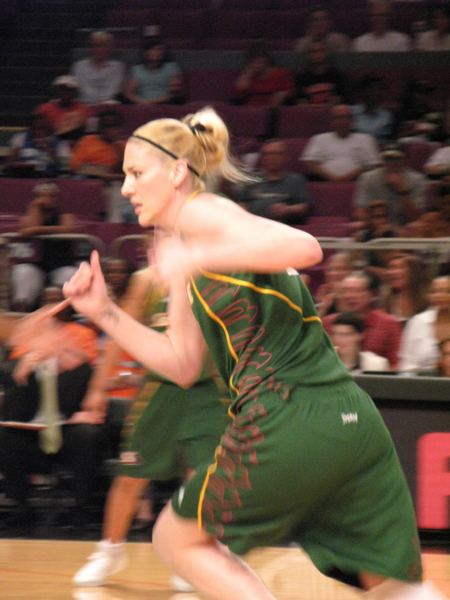
She’s so mighty that mere chairs cannot contain her:
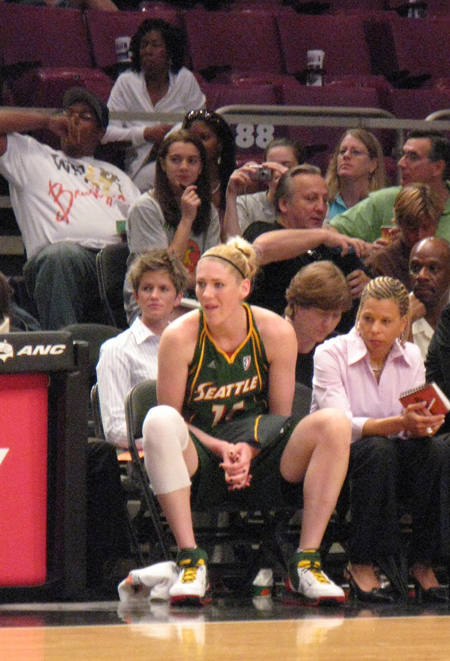
She smiles like a goddess:

And battles like a warrior:

That’s the Liberty’s Janel McCarville attempting to battle back.
She’s my hero:

Cathrine Kraayeveld (obscured by the non-corrupt WNBA ref) and Shamika Christon attempt to shut the mighty Loz down.
Oh, and um, just in case you think I spent the whole game stalking LJ, I also saw this great hat:

All photos by Scott Westerfeld. Thank you, Mr Husband!
I just came across a post claiming that blog’s readership consists of
three of us, a couple of our friends on occasion, that person who runs Safe Libraries, people who stumble upon specific posts when Googling, and the YA authors who Google themselves.
Now given that I got to that blog because I was googling Scott (husband-googling surely isn’t as egregious as self-googling, right?) this made me wonder how many other blogs have readership that breaks down that way. And how do those who read and write about books on their blogs feel knowing that certain authors are likely to come across those discussions?
I can tell you that I am deeply weirded out when a writer comments or emails me after I mention their book even though several times it’s led to excellent exchanges and even friendships. It’s one of the reasons I only bag books that are written by dead people (take that, Herman “bores my arse off” Melville and Henry “creepy sexist loser” Miller!) or where I reveal neither the title nor author and disguise the plots. Because for us delicate writers reading a bad review is like being stabbed through our very hearts.
Also the one very slightly negative thing I ever wrote about a book on this blog elicited a long email from the author explaining why I was completely wrong. This person was not a YA writer. The book was non-fiction and the author well-known. The whole thing made me feel really uncomfortable.
So what about those of you who write less than positive reviews? How do you feel about the authors reading your words of dissatisfaction? Are you tempted to post your bad reviews of Moggle’s Baby by Ustinej Labelisterai or Squinting at Arkansas by Hojn Eergn just so you can bag ’em in peace?
Does knowing that self-googing writers might come across what you say about their books affect what you write? And how do you feel when an author comments on your blog? Even if it’s just to say “thank you” for a good review? Does it make you shudder and scream, “Stop googling yourself and go write! Isn’t that what you’re supposed to do for a living?! Leave me alone!”
In the New York Times sisters (and friends of mine) Catherine Gilbert Murdock and Elizabeth Gilbert discuss recent findings that older siblings have higher IQs than younger ones. They are wry and amusing. Especially if like me you have one sister. (Not telling whether I’m older or younger.) Go read! (If you don’t have a login bugmenot is your friend.)
Catherine & Liz are both fabulous writers. Liz’s latest Eat, Pray, Love has been no. 1 on the New York Times bestseller non-fic paperback list for weeks and weeks and weeks. Seriously, everyone I’ve ever met has read and loved her book. I keep getting emails from people asking why Scott and me are mentioned (amongst many others) in the acknowledgments. The subtext being, “I can’t believe you know an actual famous person!” Well, yes, we do. Plus we were once on the same street as Bill Clinton. We could see his head just peeping out over those of his bodyguards. Us and famous people—we’re like this. I’m just saying . . .
And Catherine’s Dairy Queen has been praised over hill and dale. I loved it, but I loved the sequel Off Season even more. It’s my favourite sequel I’ve read in ages for many, many, many reasons but mostly because of what she does with the romance plot. Brilliant, moving and so very true. Go read! I’m really hoping there’ll be a third book. Catherine?
Is everyone in the entire universe curled up reading Harry Potter and the Deathly Hallows?
The silence it echoes . . .
I do not have a copy yet. So anyone who spoils me in any way will be horribly punished. Not that I expect any comments given that you’re all reading.
The contest is open until the end of this month (rules are here). The response has been amazing. I mean, we were hoping for at least half a dozen responses, there’s been more than fifty.
If you don’t want to spend all day being clicky with links, the lovely Lili Wilkinson has put all the covers in one place. And as more come in she’ll keep adding them. Check it out!
I have no idea how we’re going to pick winners. So many of them make me giggle. Now if only someone would do a cover in praise of zombies or that mocked uni***ns . . .
This is officially the best contest ever!
Today I finished and sent off something I’ve been working on for quite awhile that has been kicking my arse and keeping me from working on the secret shiny new things I want to work on, not to mention the delicious Ultimate Fairy Book rewrites.
Anyway now it’s done!
And right at this minute I think it’s pretty good. I’m all buzzy and happy.
Ironically, I now want to expand it into something even bigger and more complicated. Last week I was dying to finish it; this week I’m wanting to keep at it.
Stupid brain.
But the feeling of having written something I’m proud of? Yum. I hug it to my chest. Especially as I know next time I read it I’ll prolly hate it.
Anyone else done something they’re proud of lately? (Other than all the fabulous LOLcovers. Mate, we’re going to have some trying times deciding the winners.) Tell us all about your prideful work!
I’m gunna be drinking champers tonight!
Holly Black is making me giggle (via Gwenda). Now all I can think about is vampire elves and zombie unicorns and werewolf-griffins and pirate-orcs and . . . and which of all of those would win in battle and what they’d look like and what they’d eat. Would vampire elves still not like steel and not tell lies? And what would a novel with all these creatures in it be like?
Oh, hush, Justine. You have stories to write! Novels to unbuggerize! Admin to adminerate! Stop procrastinating.
Over at insideadog Scott has had an attack of the lolcats and defaced several fine Australian young adult book covers. I am deeply horrified. Has he no sense of the sacred?
If you feel the urge to vandalise some other book covers (they don’t have to be Australian or young adult) post the links to your efforts in the comments thread over there. The best ones will receive a lovely Extras T-shirt. The contest is open until the end of the month and we’ll announce the winners in early August.
Via Garth, this fascinating article comparing Enid Blyton and J. K. Rowling. Here’s the paragraph that made me fall over:
Enid Blyton wrote nearly 800 books over a 40-year career, many of them quite slim, as well as close to 5,000 short stories. She sold 200 million books in her lifetime, with few translations until the 1960s and 1970s, and has sold some 400 million altogether. About half of her titles are still in print, and they still sell 11 million copies a year, including a million for the Famous Five series and three million Noddy books.
Wow! Rowling thus far has sold 325 million. So she will overtake Blyton (within the year I reckon) selling fewer titles (7 as opposed to 800) much faster. For the sake of Rowling’s health and sanity I hope she doesn’t up her output: Blyton wrote 10,000 words a day. The most I’m able to consistently write a day is about 1,500. I have written 10,000 in a day but it was during the sprint to finish my PhD thesis and I was not a sane or happy bunny rabbit doing it.
Enid Blyton wrote the first chapter book I ever read by myself: The Magic Faraway Tree. I adored it so much that she was also the author of the second, third, fourth, fifth, sixth, seventh and etc. chapter books I read on my own. She was my first author crush. After the Faraway books I fell for the Naughtiest Girl books. Only to be disappointed when she learns her lesson and becomes good—goodness? Bleah! Why was she no longer throwing chalk?!
Then I became so deeply obsessed with the Mallory Towers and St. Clare’s books that I begged my parents to send me to boarding school. When they refused I’d bully my sister into having midnight feasts with me. I’m not sure if they ever actually happened at midnight, but. I was very little when I was devouring her books.
I also read Famous Five and Secret Seven but I never liked them as much as the others. Julian was a bully, Dick was a whinger, Anne was unspeakably wet, and George wasn’t nearly tough enough. I kept waiting for her to murder Dick and Anne. Never happened. I guess Timmy the Dog was okay. And the Secret Seven weren’t even memorable enough to rail against.
I’ve never gone back and read her books again. Frankly, I’m too frightened of what I might find. She was one of the strongest influences on my becoming a writer and in particular in becoming a genre writer. My love for the Faraway Tree books led to my being exposed to all sorts of other wondrous books like the Susan Cooper’s, The Hobbit, Alice in Wonderland and Ursula Le Guin’s Earthsea trilogy. I didn’t read these books just once but over and over again.
Blyton taught me how to read, how to tell a story, about drama and suspense and action, how girls are better than boys, glasses make you ugly, and how dobbing your mates into the authorities is always best. Some of those lessons stuck a wee bit better than the others . . .
I know Enid Blyton had little impact in the USA, but did you yanquis have comparable authors you fell for as a first-time reader? And non-USians, come share the Blyton love! Testify!
I just found out what ambrosia salad is.
I will NEVER understand this country.
I think I’m going to be ill.
In time for Monday morning back home we blog about writing together, which is something we get asked about a lot. Hope youse lot enjoy!
And here’s a tip for all you aspiring authors out there: if you ever sell your film rights, and they tell you that you’re going to get a percentage of the gross net deficit, what that actually means is that you’re going to get . . . nothing. The Princess Diaries movies have yet, according to my bi-annual statements, to earn a profit.
Oh, and authors don’t get DVD sale money, either. At least, I don’t! Remember, I was a nobody when I was negotiating my film contract . . . so it was sort of take it or leave it. I took it. And I don’t regret it. Thanks to those films, a lot of kids who might not otherwise have picked up my books did so, and I will always be grateful for that! (It’s hard not to be when you get letters every day that go, “Deer Meg, I never read a book before until I saw your movie The Princess Diaries. I loved it so much I bought your book of it. Now I can’t stop reeding. Just to let you know, though, your book has a lot of mistakes in it. In the movie the dad is dead. In the book he’s not. You should fix this. Love, Brittany“)
So she definitely got ripped off, but it paved the way for all this other fabulous stuff: way more of her books selling, bestsellerness, much better deals with Hollywood, really gorgeous clothes etc etc.
I sometimes regret the less-than-good deals I signed before I had a clue (or an agent) but I gained quite a few clues out of the experience. Also it’s important to remember that a beginning writer—even with an agent—usually doesn’t have that many options. A less-than-fab deal may be all they can get, but it may—with luck and hard work—lead the way to better deals in the future.
Not everyone is going to have Meg Cabot levels of success. Leaving aside the luck, very few writers can work that hard. If I wrote as many books a year as she does I would die. For the last few weeks I’ve been (leaving the monster admin aside) working exclusively on one novel and one short story and it’s just about killing me. In that time Cabot would have written three new novels and gone over the copyedits and proofs of at least three others. Not to mention all her blogging and interviews and appearances and etc.
Okay, now I’m tired. But the point of this post was not to make comparisons (how odious they are!) but that there are many different paths to publication, many different kinds of writing careers, and that very few writers—even the Meg Cabots of this world—make it big straight away (or ever).
And besides all that you should read the interview cause Meg Cabot is funny. She makes me laugh.
Two friends of mine have had their books made into movies. Karen Joy Fowler‘s Jane Austen Book Club and Holly Black‘s Spiderwick Chronicles will be out in September and next February respectively, and can now be seen in trailer form right now.
I can’t tell you how rarely this happens. Lots of books get optioned, which means that someone has paid the writer for the right to make a movie based on their book. An option usually lasts a year and if work hasn’t started on the movie by the end of that time the option expires. That’s what happens in at least ninety per cent of cases; rarely do options result in films being made.
I know lots and lots of writers who’ve had work optioned. I’ve come close to an option myself, but Karen and Holly are the first to have had an actual Hollywood movie made. It’s like a miracle. A well-deserved miracle. If you haven’t read their books you should—they’re awesome.
I’m definitely gunna go see both movies the second they open. Can’t wait!
I am not a superstitious person and thus far every Friday the 13th has passed by without incident for me or anyone I know. Still as a writer the idea of a day of bad luck appeals to me.
Have any of you been aversely affected by it? Any stories to tell? Do you have any other days you think are unlucky? I had one friend who would not go outside on his birthday because he was convinced it was cursed.
Here’s hoping today passes without untoward incident for anyone!
So, um, I seem to have won three awards this year. I know! I was as shocked as you. Anyways, I thought it might be fun to have a squiz at ’em. For annoying scheduling reasons I managed not to be at any of the award ceremonies so I’ve only just got my hands on two of them and have yet to see the third. It’s back home in Sydney being babysat by my parents (thanks Jan and John!).
Here’s the Susan Koppelman (thanks for accepting it for me, Brian):

Photo by Scott Westerfeld
The Norton (thanks, Eloise):

Photo by Scott Westerfeld
And the William Atheling (thanks, Sean):

Photo by Niki Bern
Contrast in awards styles, eh? I loves it!
For youse lot is now over at insideadog. A most excellent quessie even if I do say so myself. Go forth and satisfy my curiosity!
Also I’m really sorry for not answering anyone’s emails or responding to comments in like a million years. Remember how I’ve had to give up The Tour? Well, the business keeps on keeping on. But I’m really enjoying reading everything you have to say. Youse lots are funny, wise and most excellent. Thank you!
And back to work I go.
Blerk. Well, not all blerk. Just mostly blerk. Short stories? I stab them in the eye.
Scott and me are gunna be guests of honour at ConFusion 2008 in Detroit in January. This is the first time either one of us has ever been a guest of honour at a science fiction convention (or any con for that matter) and we are dead excited. And to add to the joy—lots of other splendid people will be there, including Mr John Scalzi who is toastmaster. What bliss he will have saying mean things about me and Scott. That bastard!
I can’t wait!
We also get to suggest panel topics. We’ve come up with a few cunning and provocative (wink, wink) ones like “Originality is Overrated” and “Science Fiction is Not Dying”, but if you guys can think of any panels you’ve seen at cons that you thought were particularly excellent, or have some ideas for panels that have never been used, let me know. It will be a lot of fun to do some that aren’t your bog standard “Women in Science Fiction” or “Fantasy versus Science Fiction” or “I’m so bored I’ll eat my own eyeballs”.
La la la! I’m going to be a guest of honour!
Certain folks are uncomfortable with books aimed at teenagers depicting them thinking about or, even worse, having sex.
Problem is many many teenagers think about sex. Quite a lot of the time. And way more of them have sex than most people are comfortable with. In the US of A a rather large percentage of teenage girls wind up pregnant. Last time I looked it was a bigger percentage than any other first world country.
Yet the US of A is the first world country most concerned about books that address these issues. More books are banned here than anywhere else in the western world. And a fair few of them are banned for “inappropriate content” which often enough boils down to sex.
This is the great dilemma of writing for teenagers: the tension between writing to reflect teenage experience or writing to be instructive and good for teenagers. I think teen books that don’t touch on sex in some way are fundamentally dishonest to the experience of being a teenager.
Afterall, even those teens who have no interest in sex are wondering why they’re not like everybody else. They’re getting hassled by their peers for not dating. Sometimes their parents are worried about them too.
Sex is inescapable. And restricting a teenager’s reading to Anne of Green Gables (which, by the way, is kind of a sexy book) and their viewing to the Disney channel is not going to stop them from thinking about it and wondering about it, but it may well keep them from useful information that could help them. And from finding books that reflect who they are.
Cause that’s one of the many fabulous things books do: reflect who we are back at us. Let us know that we’re not alone, we’re not a weirdo (or, at least, not that weird), that there are other people who look like us, think like us, and who are freaked out by the stuff that freaks us out.
The idea of sex is scary and weird and compelling and dangerous and funny—so’s the idea of becoming a grown up. There are teen books that cover almost every possible permutation of that strangeness. That is a good thing.
It seems to me that the tension I mentioned above—between writing to reflect teenage experience or writing to be instructive and good for teenagers—isn’t really a tension. Because if you write well, if you manage to reflect some teen experience and tell a compelling story—story’s key!—then odds are that the book is “good” for them and for any adult who reads it. But not good in a castor oil way. Not good in a what-doesn’t-kill-you-makes-you-grow kind of way.
Meg Cabot’s All American Girl: Ready or Not tackles the whole when-to-have-sex thing. It’s light and funny and I raced through it. Sarah Zarr’s Story of A Girl deals with early sex (the girl is thirteen) with a manipulative older boy (seventeen) and the consequences (she’s branded a slut by her father and everyone at school; the boy goes about his life with no ill effects). In their own way both books are powerful and moving—Cabot’s made me laugh; Zarr’s made me cry—and I wish they’d been around for me to read as a teenager.
I do believe that writers for teenagers have a special duty of care, but then I believe that for all writers: we should strive to get it right, to be honest to the emotions and experiences we’re writing about. We don’t all of us manage it all of the time, but we bloody well try.
Marrije asked over on insideadog if I’ll be following the Tour de France this year. Sadly, I will not.
This year has gotten out of control. I cannot afford to spend hours every day watching the Tour and following it online. I am incapable of following the Tour non-obsessively. So for the first time in years I’m not following it at all. (No spousal pressure was brought to bear in the making of this decision. Well, okay, just a little bit. I am not husband-beaten! I am not!)
Waaaahh!!!!!
The New York Liberty (10-8) will have to sustain my sport-following needs this northern summer.
And now I go back to the myriad tasks that confront me. At this point it’s so bad I’m resorting to triage. “Which of these tasks will most blow up in my face if I don’t do it?”
But, you know, Vive Le Tour!
We’ve now answered the first of the quessies we were asked. Feel free to ask more over there.
Gotta tell youse I’m starting to really enjoy the whole she said/he said thing. I’ll miss it when it’s gone.
As you can see I’ve been experimenting with a new look for the blog. Basically what I wanted was the old look plus an extra column. Sadly I couldn’t figure how to change the old template. (Css skills=zero.) So I mucked around with another template trying to get it to look like my old one. This is as good as I’ve managed.
There are many things I’m unhappy with:
I’m off to see the Liberty take on the Sacramento Monarchs at Madison Square Garden. Maybe I’ll figure out how to fix these problems when I get back. If any of you wise folks have suggestions I’d love to hear it!
Let’s go Liberty!
Sometimes it seems like the hardest part of writing a book is coming up with a good title, so I wasn’t surprised by E. Lockhart, Sarah Mylnowski and Lauren Myracle struggling to find one. I’ve seen those arguments before; I’ve been in those arguments before.
The discussion that flowed from my post about their title poll is almost exactly like what happens when you, your editor, your agent and others are agonising over what title to go with. There’s always someone who hates every title. And they always have really convincing reasons. The arguments are intense and passionate. Getting the title right seems like the most important thing in the world and also the least likely thing in the world.
And then the book is titled and everyone forgets about it. The title is rarely mentioned again. I’ve had one reviewer complain that Magic Lessons and Magic’s Child are boring, generic titles, but that’s about it. It’s like the title becomes the thing itself and arguing about it feels like arguing about whether “table” is a good name for actual tables. They just are tables. What else would you call them? (You know other than “mesa” or all the other words in other languages for “table”.)
Sure, a really good title helps heaps: I picked up A Great and Terrible Beauty because of the title (I’m one of the few people who wasn’t in love with the cover—I’m not down with headless women). I’ve also picked up books because of their covers. But if the book isn’t good it doesn’t matter what the title is or how fab the cover. The title and cover are all about making us punters pick up the book after that it’s up to the actual words inside.
I just stopped reading a wonderfully titled book a third of the way through. I loved the musicality of the title and the premise it promised. I’d heard good things about the writer, but the book sucks. I hates it.
There’s no sense of place. I had no idea where I was until place names were mentioned. In fact, the book is mostly dialogue or first person self-absorbed monologue. The awesome premise is not really explored—it’s like the writer had this cool idea and then had no idea what to do with it. I didn’t believe in any of the characters, or what they were doing, or the first person narrator’s response to them. The brilliant title didn’t stop me putting the book down and reading something else.
Titles really aren’t that big a deal. I’ll be buying and reading E., Sarah and Lauren’s book no matter what it’s called. I bet heaps of other people will too.
E. Lockhart (The Boyfriend List, Fly on the Wall, Dramarama) Sarah Mlynowski (Bras & Broomsticks, Milkrun, Frogs & French Kisses) and Lauren Myracle (TTYL, TTFN, L8R G8R, Rhymes with Witches) are writing a book together about three girls taking a road trip through the sticky heat of Florida in pursuit of love and adventure.
They’re stuck on what title to use. I so sympathise. Picking the right title is a nightmare!
So right now Harper Teen is holding a quiz. All you have to do is read the three top titles and vote on your choice.
It takes seconds. I just voted. Won’t tell you for which—don’t want to sway the results. But, um, I sure do like the idea of lessons in badness . . .
The results will be announced 1 August.
Our first post for insideadog is now live. Go over and check it out. We’ll be there all month.
Today there is a most excellent article in The New York Times about just how bad flying in the US is. Delays are up by 39% this year and that’s based on the airlines’ stats which everyone says are deeply wrong:
As anyone who has flown recently can probably tell you, delays are getting worse this year. The on-time performance of airlines has reached an all-time low, but even the official numbers do not begin to capture the severity of the problem.
That is because these statistics track how late airplanes are, not how late passengers are. The longest delays—those resulting from missed connections and canceled flights—involve sitting around for hours or even days in airports and hotels and do not officially get counted. Researchers and consumer advocates have taken notice and urged more accurate reporting.
The vast majority of internal US flights I’ve taken in the last four years have been delayed or cancelled or our lugguage has been lost. We’ve even managed to have all three happen on the same trip. Now when I book tickets, I first check to see if there’s a train I can take instead, then I do whatever I can to make sure it’s a direct flight (thus no missed connections) and that it leaves in the morning. Because if your flight is cancelled and it’s later in the day no way are you getting on another one until the next day.
It’s reassuring to know that my experiences are in no way unique. Air travel in the US is falling apart. The delays, cancellations, lost luggage aren’t even the worst of it. Dealing with the often grumpy airline employees makes everything a thousand times more horrible. It’s totally understandable that they’re unhappy—they’re underpaid and overworked and spend all day dealing with seriously pissed off people. It has to be one of the worst jobs in the world. And yet the crankier we are, the crankier they are, and it becomes an ever spiralling thing.
I am so very very glad we’re taking the DragonTrain to DragonCon. And that it’s a hundred days or so before I have to endure more air travel.
As I mentioned me and Scott will start blogging for insideadog tonight. We’ve got some ideas already but what would you like the both of us to talk about?
Later this week me and Scott will start blogging together at insideadog. That’s right you’ll get a twofer—we will both be the writer in residence for the month of July. Though in Australia July starts on Friday the Sixth which in America is Thursday the Fifth. Got that? Not to worry, I’ll post here to let you know when we’ve started posting there.
Insideadog is the premier youth literature site in Australia—possibly the world! Past writers in residence have been such illuminati as Randa Abdel-Fattah, D. M. Cornish, Nick Earls, Simmone Howell, Margo Lanagan, Melina Marchetta, Garth Nix and Marcus Zusak. Not bad, eh? Pretty stellar company to keep. Do come over and say hi.
In other news it’s the fourth of July here in the US of A, which is their independence day. The celebration of telling the Poms to bugger off! (If only we Australians had done the same!)
Happy fourth of July, everyone! Be safe with the fireworks. Don’t drink too much. And eat only enough to make you happy.
It is full of tribulation. First he must endure poverty and the world’s indifference; then, having achieved a measure of success, he must submit with good will to its hazards. He depends upon a fickle public. He is at the mercy of journalists who want to interview him and photographers who want to take his picture, of editors who harry him for copy and tax gatherers who harry him for income tax, of persons of quality who ask him to lunch and secretaries of institutes who ask him to lecture, of women who want to marry him and women who want to divorce him, of youths who want his autograph, actors who want parts and strangers who want a loan, of gushing ladies who want advice on their matrimonial affairs and earnest young men who want advice on their compositions, of agents, publishers, managers, bores, admirers, critics, and his own conscience. But he has one compensation. Whenever he has anything on his mind, whether it be a harassing reflection, grief at the death of a friend, unrequited love, wounded pride, anger at the treachery of someone to whom he has shown kindness, in short any emotion or any perplexing thought, he has only to put it down in black and white, using it as the theme of a story or the decoration of an essay, to forget all about it. He is the only free man.
—Cakes and Ale (1930)
Leaving aside that Maugham is under the delusion that everyone is male except wives and those in need of marital advice, how does all of that apply to us pro writers now? Or, rather, to this pro writer in particular.
Tribulation? Check.
Fickle public? Check. Why can’t all of them love all of us all the time? Or even know who we are!
Mercy of journalists who want interviews? Of bloggers yes. Of journalists not so much. But frankly I kind of like it that way.
Of photographers who want to take the writer’s picture? Hah! If only Maugham had lived to the current day when almost everyone in the first world has a bloody camera and feels compelled to plague everyone else with it and will not accept the idea that some people do not want their photo taken. Is there anyone left who’s never been photographed? Are there any souls left unstolen?
Editors who harry the writer for copy? Oh, yes. Just the same! Bastard editors!
Tax gatherers who harry a writer for income tax? How odd. I didn’t realise that in 1930 only writers had to pay tax.
Persons of quality who ask the writer to lunch? Are my editors and agents “people of quality”? Are librarians? I’m gunna say yes.
Secretaries of institutes who ask the writer to lecture? I imagine that still applies. Not to me though. No secretary of any institute has ever asked me to lecture. Rotters!
Women who want to marry the writer? Now, I’m bummed. No woman or man has ever asked me to marry ’em just cause I’m a writer.
Women who want to divorce the writer? But, here’s the upside: no one’s ever asked me for a divorce on account of I write words that turn into books on shelves. Poor Mr Maugham!
Of youths who want the writer’s autograph? This has happened occasionally. And, oh, how I loves it! More, please!
Actors who want parts? Parts of what? Most definitely does not apply.
Strangers who want a loan? Do letters from Nigeria count?
Of gushing ladies who want advice on their matrimonial affairs? Actually, because I wrote this piece I have had a handful of people asking for advice on their love life. None of them gushed though and they were boys as well as girls.
Earnest young men who want advice on their compositions? Check. Though not all earnest, not all young and not all men.
At the mercy of agents? Check. I guess. But my agents, Jill Grinberg and Whitney Lee, are so lovely and so very good at what they do it’s hard to think of it that way.
Of publishers? Check.
Of managers? Writers had managers back in 1930? I didn’t even think they had them now. How strange.
Of bores? Check. But just a tiny percentage of the number I had to deal with when I was an academic.
Of admirers? Check. There’s one or two. Bless their every breath.
Of critics? Check. One or two of them and all.
Of their own conscience? Huh? What is this “conscience” Maugham speaks of? And why would I be at it’s mercy? I am confused!
As for Maugham’s one compensation:
Whenever he has anything on his mind, whether it be a harassing reflection, grief at the death of a friend, unrequited love, wounded pride, anger at the treachery of someone to whom he has shown kindness, in short any emotion or any perplexing thought, he has only to put it down in black and white, using it as the theme of a story or the decoration of an essay, to forget all about it. He is the only free man.
Maybe I’m more neurotic than Maugham—figures, it’s more than seventy years later, neuroticness has definitely grown—but just writing about a trauma or experience does not expunge it for me. Or maybe that’s just because I haven’t really done it. I haven’t written about the people I love who have died. I haven’t typed for hours to make it go away. I am not free.
Though I’ll wager that my writer’s life is heaps happier than Maugham’s!
I do agree with him, though, that the writing part is by far the most wonderful thing about being a writer.
That, and the champagne.
The tactic of writing to librarians to make them disappear books has been around for some time. The following is from Somerset Maugham’s Cakes and Ale (1930). The protag’s uncle is talking about his nephew’s friendship with a local author:
“They bicycled together last summer, and after Willie had gone back to school I got one of his books from the library to see what it was like. I read the first volume and then I sent it back. I wrote a pretty stiff letter to the librarian and I was glad to hear that he’d withdrawn it from circulation. If it had been my own property I should have put it promptly in the kitchen stove.”
Wouldn’t it be lovely to think that didn’t happen nowadays? Alas and alack.
I just read five reviews of the same book.1 One praised the sharpness of the dialogue.2 Another said it was sloppy and the dialogue disconnected. One said it was the best book of its kind published this year. And another hoped that this was the limit to how low the genre could descend. The fifth neither loved nor hated it.
I was given an ARC of this particular book. I stopped reading after the first four pages because I found it cliched, derivative and boring. In particular, it’s a very mediocre pastiche of a writer I happen to love. That’s another reason I stopped reading and re-read a book by that author instead.
The book is now on one of the New York Times bestseller lists. I won’t tell you which, except to say it’s a list I’ll never be on. (Not that I fancy my chances getting on any of the lists I’m eligible for. Not writing tickets. Honest!)
This left me wondering (yet again) how very differently we all read. We can pick up the exact same book and find entirely different things in it. So much is shaped by what you’ve already read. Like my dislke of the book being fed by its marked similarities to the much better writer. I raised that point with someone I know who loves the book in question and they said they thought it was better than the original writer. To which I could only splutter, “Are you barking mad?!”
I have never met anyone I agree with about everything. Scott and I come pretty close. But he thinks American Beauty is a good movie. And does not love Elvis the way I do or, actually, in any kind of way. I guess it would be dull if we agreed about everything.
And yet I am still shocked every time someone (whose opinion I respect) hates something I love. Or loves something I hate.
And when I hate something that everyone else seems to love—like a certain Printz honour book from a few years back—it feel strange and uncomfortable.
You’d think that reading all the reviews of my own books (which range from over-the-top praise through to appalled condemnation of their awfulness, paper-thin characters and condescending language) would have finally hammered home how variable and contradictory people’s responses are.
Nope.
Intellectually I get it; emotionally I don’t. I’m starting to wonder if I ever will.
People, why can’t you all just think like me?