Elite, elitist, elitism

Scalzi riffs on the absurdity of the extremely wealthy and privileged Lady de Rothschild accusing Barack Obama of being “elitist”. The comments thread is most excellent and raises lots of interesting questions.

Like what does “elitist” even mean? And what does it mean when applied to Obama as it has been so often this year?

Educated? When was the last time there was a US president without a university degree? Or a serious candidate for that office without a high school diploma?

Rich? Pretty much everyone accusing him of it is much richer than he is. McCain is, Hillary Clinton ditto, and Lady de Rothschild very very much so.

I am very puzzled by the whole thing. I’m pretty sure that Obama is the only one of that lot who ever had a food stamps dinner.

Do they just mean they think Obama is smarter than them? Better dressed? Sexier? What?

Am I an elitist? I have a PhD. So do both my parents. I make a living writing books. I have been known to eat caviar and drink champagne. But I bet not nearly as much as some of the folks who are calling Obama an elitist. I’m definitely considerably poorer than any of them. Obama included.

Why wouldn’t you want the head of your country to be educated and smart and the best person for the job? If you’re looking for a surgeon to operate on your child you don’t pick someone you’d like to have a beer with. Surely your country deserves that much care?

Since when was being amongst the elite of your profession a bad thing?

The whole thing is an enormous puzzle to me.

What do you lot reckon? Are any of you elitists? Elite? Drowning in elitism? Speak your piece!

The next novel

A bunch of questions are being asked about the next novel both here and in emails. Here are some answers:

When is it due?

August

When will it be published?

September 2009

Who is publishing it?

Bloomsbury USA

What is it about?

Lies

What’s it called?

As mentioned the working (and I hope permanent) title is the same as a song from the 1990s by an all-girl band. Feel free to guess. No one has gotten close so far.

Is it a sequel to How To Ditch Your Fairy?

No

Why isn’t it a sequel to HTDYF?

Because

Will there be a sequel to HTDYF?

Maybe

How long do you think it will be?

75,00-85,000

How long is it now?

54,013

Wow, you have quite a few words to go and August isn’t very far away—are you panicking?

Aaargh!! Damn you!! Leave me alone!! STOP asking questions!!

You seem a bit tightly wound—have you thought of maybe getting a massage or something?

I kill you. I kill you with my bare hands.

I is sorry

That I haven’t answered emails in ages and ages or done many many other things I’m supposed to do. Like respond to comments here. But you may have noticed from some of my posts of late that I has book.

I has unfinished book.

Which must be finished before not too long.

Thus I am only capable of two things:

  1. Writing said book.
  2. Complaining about writing said book.

All else—communicating with other peoples, washing clothes and dishes and floors and self etc, paying bills, following the Tour de France, functioning like normal human being—all is on hiatus till book be done.

That is all.

The writing-not-easy thing, part the millionth

Yes, again! What of it? I promise this will be the last whingeing-about-writing post. Truly.1

I think I’m still in shock that my job is not always a doddle. You see, I fully expected that it would be.

Let me explain:

A full-time novelist is all I’ve ever wanted to be. Obviously the main reason I wanted to do it is because I’ve always loved telling and writing stories and I’ve done it since I was knee-high to a grasshopper. But I also kind of figured that it would be easier than any other job. Writing stories was fun. Something I did when I wanted to take a break from the onerous crap that I had to do. Surely doing it most of the time would be even more fun?

I imagined my life as a full-time novelist would involve never having to get up before noon, writing only when I felt like it, never being stressed, six-figure advances for every book, mangosteens for every meal, and walking on rose petals while fairy dust fell from the sky.

None of this has happened! NONE of it.2

I’ll admit that my job is not as hard as some people’s. I’m not down a coal mine. I’m not in a war zone. I don’t run the risk of death or injury very often—though paper cuts can be nasty.3 Many people work way harder than I do. Like my sister, who does 3,000 hour a week in dark rooms, making everyone in Hollywood’s hair look real, and the monsters look super scary.4

What was I saying?

Oh, yes, I thought writing would be the easiest job on the planet and I’d never have to work hard. So every time I do have to work hard it’s a horrible shock. Thus my whingeing.

Though it probably is the easiest job on the planet, which leads me to the depressing thought that no job is without hard bits. How unfair is that?

  1. Though I am writing a novel about a compulsive liar so I could be practicing. Plus all I’m doing right now is writing. What the hell else do I have to blog about? []
  2. Though I do occasionally get to eat mangosteens. []
  3. Not to mention RSI and back pain. []
  4. Or something. I’m never entirely clear on what exactly Niki does. []

More on writing being not so easy

This is going to be a bit mutual linky-linky.1 Maureen Johnson linked to my quick little whinge about writing sometimes being hard before going into more detail about the sometime not fun-ness of it. And now I am linking to her. Quoting her even:

When writing goes well, it feels magical . . . but there is no magic to it. Writing goes well because you have done some work. You have spent MANY MANY MANY HOURS sitting at your desk, written pages and pages and pages of useless crap, read piles of books, done a lot more wrong than you have right, questioned your sanity and talent . . . and just kept going. No muse involved.

Maureen is against muses. In fact, I suspect that she would advocate killing them:2

I hate muses . . . I mean, with the obvious exception of Olivia Newton-John in Xanadu. This idea that all you have to do is sit around and a muse lands on your head, dances around your desk, and whispers in your ear and BANG! BOOK!

Forget that. Get yourself a can of anti-muse spray. The things are credit-stealing parasites.

Personally, I think Maureen’s just jealous because—like me—she doesn’t have a muse. In fact, I’ll be honest and admit that the reason I think this is that I, too, am jealous. Frankly I would love to have a muse inspire me to work. Better still I’d like a muse to do the damn work for me.3

Imagine it: I’d be in my bedroom, lazing around, catching up on all the manga I haven’t had a chance to read in ages, because I’ve had to do so much research for this stupid book while my muse would be in the study working its arse off. Sounds good to me.

Sadly, that has never happened. Maybe if I’m more gooder?

I think part of the reason people refer to their muse is because they have no idea where their ideas come from.4 They should’ve asked Maureen. Trouble is all the muse talk makes it sound like ideas and inspiration are the most important part of writing, which, sadly, is rubbish.

I wish it wasn’t. I get dozens of ideas for novels every single day; I do not write dozens of novels a day. Nor do I write 4,380 novels a year.5 Even when you realise that it takes several ideas to make one novel the percentage of my ideas turned into novels is very very small. I’ve never managed to write more than one novel a year . . .

This does not mean that I think ideas are unimportant—I read a novel recently that was entirely void of ideas, let alone original ones, and I gave up after a few chapters—it just means that you can have the best idea in the world but if you don’t put in the hard yakka to transform them into a novel, or a play, or whatever, then they’re just ideas.

Also no muse—even Olivia Newton John—is going to help you do that.

  1. “You’re fabulous!” “No, you’re fabulous!” While those watching gag. []
  2. Possibly I was clued in to her sentiments by the title of her post: “Death to Muses” []
  3. And while they’re at it the flat needs vacuuming and dusting. []
  4. Or because they’re barking mad. []
  5. Which is how many ideas I have in a year assuming an average of 12 a day. []

How to Write a Novel Redux

It has come to my attention that many readers of my post on how to write a novel are under the misapprehension that it is a description of how I write novels.

It is not.

It wasn’t even an accurate description of how I wrote them back when I wrote it. Lo, those many years ago.1

The novel I’m writing now makes no use of a spreadsheet,2 I did not borrow the plot for it,3 and the first sentence does not begin with “the” or “once upon a time”.4

I wrote the how-to-write-a-novel post for two reasons:

  1. I thought it would be funny. Maureen Johnson had just written a very amusing how-to-write-a-book post and I wanted to try my hand at the genre.
  2. I was also responding to the beginning writers who’d written asking questions about novel writing. Thus I was thinking about what might work for them. A common complaint was that they could never think of a plot. Hence the borrow-a-plot advice. Also they worried about the length and how to organise such a big amount of words. Hence the spreadsheet advice.

Personally, pretty much every novel I’ve written has been produced differently from the previous one. I have no set methods. Though I have lots of madness.

The novel I’m writing right now is the first one I’ve written with Scrivener and that’s making a huge difference to how I’m writing it. I’ve certainly never written a book completely out of order before. The last scene is already written though many from the middle are not. For me that is very strange.

I’m sure there are people who write each novel in the exact same way5 but most of the writers I know say they find each one different and have to figure out how to write it as they go.

I am the same.

  1. Well, okay, almost two years ago. []
  2. Scrivener renders spreadsheets unnecessary. []
  3. I’ve never written a novel that way, though I have written a number of short stories that retell ballads. One you can find here and another one will be published as part of Love is Hell later in the year. []
  4. None of my novels do. Though Magic Lessons begins with “once”. []
  5. There are some who write the exact same novel over and over again. []

I can make herbs grow?

I’ve been experimenting with growing herbs in pots in my teeny tiny NYC flat. So far only marjoram works. All others die. Well, okay the chervil died. But it died horribly without ever giving so much as a sprig of useful chervil.

The marjoram has thrived. It is the best plant ever. Magical even. I cuts away more than half the plant to add to the eggs in the morning by evening there’s more than enough to flavour my pasta sauce. Magic, I tell you!

My sister says that rosemary is also dead easy to keep alive. I cook with rosemary a lot so I may give it a whirl. Do any of youse lot have green thumbs without actually having a backyard? (Or front yard for that matter.) I have window sills. That’s it. Other than rosemary and marjoram what else do you think I’ll have a shot at keeping alive?

Thanks!

Congratulations, Atlanta

Atlanta Dream: 91; Chicago Sky: 84

The first win for the Atlanta Dream has made me very happy I can’t imagine how thrilled the Dream fans are. They have had the longest losing streak (0-17) in WNBA history without actually being a bad team. Quite a few of those losses were thrillers. I know. I watched the game where the New York Liberty barely beat them.

I think it’s astonishing and wonderful that more than 8,000 people have shown up for every one of those games even when they’d lost ten, fifteen, seventeen in a row. And now they have their first win. Woo hoo!! And w00t! It’s good for Atlanta and it’s good for the whole league. May it be the first of many many more.

Warriors

Just saw Warriors with someone who had never seen it before. She was disappointed that the mime gang has so little screen time. She concedes however that other than that it is the best film ever made.

Then we decided that we need to form a YA novelist gang but we couldn’t agree on the colours. On account of one of us kept insisting on fuchsia and certain others of us were dead against it.

I think my next novel is going to be Warriors meets The Wedding Planner. There will be lots of mimes. It will go off!!

The hard bits

The hardest part of writing a novel isn’t the beginning, or the middle, or the end. It’s not getting characters right, world building, keeping your sentences gorgeous, it’s none of those things. The hardest part is having to write when you don’t have the heart for it.

When you’re sad, or distracted, or in a bad mood, or bored. It’s writing when you can’t think straight, when the words are arranging themselves in dreadful “sentences” that hurt your brain. It’s writing when writing is the last thing you want to do, and every word, phrase, sentence is a struggle.

Writing through a crap day is the very hardest part of being a writer. Then getting up the next morning and doing it again. And the next. And repeat until the bloody book is finally finished.

(Blurbs are still harder, but.)

The Art of Writing Blurbs (updated)

NB: The Alchemy of Stone is not a YA book.

I have just read a splendid book, Ekaterina Sedia’s The Alchemy of Stone, and now I must blurb it. I am realising once again that blurbing a book is really hard. As you may have noticed from this blog, I am not naturally succinct. I fail at all forms of writing that are on the short side: blurbs, pitches, haikus, summaries. They are all nightmarish to me.

I am so crappy at pitching my own books that Scott uses my feeble attempt to pitch Magic or Madness to a Sydney bookseller as his standard example of how not to pitch. (After hearing me out the bookseller put on a forced smiled and said, “Hmm, that sounds really complicated.”)

I wish I could just say:

Ekaterina Sedia’s The Alchemy of Stone is rooly good. Read it!

—Justine Larbalestier, Magic or Madness

Or do as Quentin Crisp used to, which was to respond to blurb requests with the following:

You may attribute to me whatever words you think will assist in the marketing of this fine work.

On this occasion my problem is that The Alchemy of Stone is a really complicated book and I love it but I don’t know how to describe it and thinking about it is hurting my head.

Maybe that should be my blurb? Hmmm.

The Alchemy of Stone is a really complicated book and I love it but I don’t know how to describe it and thinking about it is hurting my head. Buy it! Read it!

—Justine Larbalestier, Magic or Madness

Blurbing a dense, original and smart book like Sedia’s is especially hard. There are so many things to say about it. I love the alienness of the protagonist, Mattie, who is an intelligent automaton in a world in which automatons are dumb: they can neither talk nor think and are used as servants. How she grapples with being the only one of her kind and with actually knowing and talking to her creator is the heart of the book. She never once reads like a human being and yet she is a compelling character. I like her. I want her to succeed.

I love, too, the stone gargoyles who watch over the city, the power struggles between Mechanics, Alchemists, and the hideously oppressed miners and farmers, the subtle yet brilliant worldbuilding, the quasi-myth like though also fairy tale-ish feel to the language. Oh, yes, the language! Sedia’s a gorgeous maker of sentences. Not in an obvious show-y off-y way. Many of her sentences are sparse and unadorned. Yet several times I had to back up and re-read in order to savour and relish the implications of a particular word or phrase.

You see my problem? And I haven’t even really begun to describe why I enjoyed the book so much. Or mentioned the Soul-Smoker or explained why I don’t think it’s steampunk, which leads me into a long rant on why I don’t find “steampunk” a very useful term for describing books.

Stupid blurbs. I kick them.

How about:

Ekaterina Sedia’s The Alchemy of Stone bursts with inventiveness from its robot heroine to the Soul-Smoker and stone gargoyles that watch over the city. The book is full of explosions both literal and metaphorical as well as being a gorgeous meditation on what it means to not be human. I haven’t been able to stop thinking about this beautiful book.

—Justine Larbalestier, Magic or Madness

Or something. Did I mention that I hate writing blurbs?

Alchemy of Stones is rooly good. Read it!

Update: Here’s what the publisher decided to go with:

“A gorgeous meditation on what it means to not be human. I haven’t been able to stop thinking about this beautiful book, from its robot heroine to the Soul-Smoker and stone gargoyles that watch over the city.” —Justine Larbalestier, author of Magic or Madness

Explosions ahead!

The fabulous and multi-talented—she runs, she swims, she writes, she academes!—Jenny Davidson’s first Young Adult novel, The Explosionist is published today.

Woo hooo!!!!!!

I for one cannot wait to read it. I’ve been following Jenny’s blog for a few years now and it has led me down many long and pleasant internet paths. Her interests and expertises are wide and diverse and her blog is one of my very favourites. If The Exposionist is a tenth as interesting and smart as Jenny is then it will GO OFF!!!

Run, don’t walk to your nearest book shop or library and get yourself a copy! I know I’m going to.

Live long and marry (updated)

There’s an auction going on over in the wonderful world of LJ to raise money

for the fight against the California initiative which will legally destroy existing same-sex marriages and ban any further ones. If the initiative passes, it will write discrimination into the state constitution, annull existing marriages, and make Mr. Sulu cry.

You can find more information about the auction here. There are some amazing items being offered for auction, not just jewellery and other objects but services. Writers offering to write a story for you, or to critique your own writing. Trust me that is a very big offer.

Sadly, I don’t have time to offer anything like that. Or I could offer but it wouldn’t happen till 2042 or something.1 But I would like to support the cause because I believe in LOVE! George Takei and Brad Altman finally being allowed to get married after being together for more than twenty years? Well, it made me very teary indeed. And I’m not even a Star Trek fan.

My offer: I will name a character (or something) after you in my next novel.

You can go bid on it here.

Update: I forgot to say that bidding ends on 15 July (USA time).

  1. Plus I suck at short stories. []

This is my thousandth post!!!

Since May 2005 I have written a thousand blog posts!1 Those posts contain around 300,000 words which is longer than any of my novels, though, fortunately not longer than all of them put together.2 I am verbose! Yay for verbosity!

And yay for blog statistics! Here are some other numbers:

The posts here average 13 comments each. Given that when I started I was lucky to get any comments at all that number startles me. Of course, I have all of you to thank! Yay readers and commenters and lurkers and the occasional drive-by visitors. I love youse all.

The numbers of words in the comments is approaching 800,000. Astounding, eh?

I’ve averaged just under a post a day. But in the beginning I did not post nearly as much as I do now. The addiction has crept up on me slowly. Now going a day without blogging leaves me jittery and discombobulated. Must. Blog. Or. Die.

My most popular post by a very big margin is How to Write a Novel. Every day people arrive here to imbibe my novel writing wisdom after googling “how to write a novel”. So I recommend all writers post their own thoughts on same and give it the same title. Cunning, eh? Though maybe you should be less silly about it than I was.

Other than “how to write a novel”, my name, and titles of my books, the most popular search terms that lead here are “quokkas”, “Jill Grinberg” (my agent), “crazy writers”, “Sheryl Swoopes”, “Andrew Symonds”, “how to rewrite” and “what should I wear”. I feel that’s an excellent representation of the blog seeing as how writing and publishing, fashion, quokkas, women’s basketball, and cricket are some of my main topics. I am saddened, though, that “zombie” leads so few people here. Must work on that. Expect oodles more zombie posts.

When I first started this blog it was read by my mum, my dad, my sister and a few of my friends. Now I average over a thousand visits a day from people I’ve mostly never met. Who’d’ve thunk it?

In the olden days a thousand visits in one day meant that John Scalzi or one of the other internet gods had linked to me, now it’s standard and seems to be on the rise. Yay! And THANK YOU!

I don’t know if I’ve mentioned this before but I love blogging. LOVE it. I love the speed and ease of it,3 having an idle thought and being able to publish it almost instantaneously. And I especially love the responses. The comments you leave—even when you’re completely wrong—yes, I’m looking at all you lunatic car and coffee worshippers—not to mention Diana and her crazy outlining love—make doing this way more fun.

It’s such a contrast to the novel-writing. I write the novel, send it to a few first readers, wait and wait, get a few responses, rewrite, send to agent and editor, wait and wait, rewrite, send it back to editor, wait and wait, rewrite, and so on, until it makes its way through copy editing and proofing and finally at least a year later winds up being read by more than that small handful of people. Is maddeningly slow. The instantaneousness of blogging keeps me sane while I wait.

Because of blogging I get to enjoy people’s thoughts and responses and teasing and off-topic musings. I watch conversations emerge and go in places I never would’ve expected and I get to join in and generally feel less alone. Tis a wondrous thing.

Honestly, I don’t know what I would have done without blogs. Not just my own but all the other fabulous blogs out there that make me laugh and think and keep me informed and giggling and more in touch with what’s going on at home and elsewhere.4

Bless you intramanets and blog world. I adore being part of it.

Here’s to another thousand posts. Another billion!
  1. I am only counting the posts here, not my previous musings, which go back to 2003. []
  2. Because that would be embarrassing. I should admit that I’m cheating slightly by including the novel I’m writing now in that total. I could have cheated worse and included the two unpublished novels . . . []
  3. Well, most of it. Sometimes I take ages to write a post like the How To ones. []
  4. I would link to some but there are too many! Check out my blogroll for the blogs I love. []

Lost in your book

My job means that I spend many hours each day lost in the novel I’m writing. It’s a very weird way to make a living. When I have a looming deadline—like I do right now—and have to drop everything but finishing said novel I feel like I get further and further away from real world and more and more lost in the imaginary one. Talking to real people in the real world gets trickier and trickier.

I was thinking about this today and decided that it’s no co-incidence that “novel” and “navel” have only one letter different. No co-incidence at all.

Now I return to imaginary world.

Apocalypse now

I just read a couple of short articles by Bev Clark about what it’s like living in Zimbabwe right now. It reminded me of pretty much every end of the world book I have ever read:

Yesterday, Joseph, a 12-year-old boy arrived at my office door. He was hanging limply over the railing staring at me with blank eyes. His mother had been a regular visitor, coming once every two weeks for a handout to keep her going in this country with over one million percent inflation. Her thin body was wracked by AIDS. Last week Zanu PF militia tried to force her to go to a rally. She refused. They broke her leg. Her compromised state made it impossible for her to survive. So her orphan son has carried on the visits that his mother started.

Even simple stuff like going to the toilet is difficult now:

Almost every day the office block is powered by generator. It’s seldom that we can rely on the Zimbabwe Electricity Supply Authority (ZESA) to provide services. Water is a luxury too. Turn on the taps and not much happens. Because toilet paper can’t be found in regular supermarkets and stores, the building administrator has demanded that all office workers bring their own toilet paper to work. Trouble is it’s hard to find so the next best thing to wipe your bum with is The Herald newspaper; a fitting use for Mugabe’s vile, daily news distorter. But that of course leaves the toilets blocked.

Remember with the rate of inflation—a million per cent—toilet paper—if you can find it—is expensive. A New York Times article by Michael Wines from early May asks,

How bad is inflation in Zimbabwe? Well, consider this: at a supermarket near the center of this tatterdemalion capital, toilet paper costs $417.

No, not per roll. Four hundred seventeen Zimbabwean dollars is the value of a single two-ply sheet. A roll costs $145,750 — in American currency, about 69 cents.

The price of toilet paper, like everything else here, soars almost daily, spawning jokes about an impending better use for Zimbabwe’s $500 bill, now the smallest in circulation.

Imagine what it’s like shopping with that kind of inflation and daily fluctuations in prices Bev Clark writes that

[t]he last time I went shopping it took me longer to pay for my few purchases than to shop for them. The swipe machines have a limit of Z$9 billion. So go figure if you want to buy a small packet of meat, which at today’s price is, Z$151 billion. Yesterday I bought a chicken for $26 billion. It looked rather strange. All bent and buckled but I bravely bought the bird needing a change from my usual beans and rice. I left it out last night to defrost and I must say that in the cold light of day it’s a bit of a sight. I threw it in the pot anyway.

She was lucky to get the chicken:

I wandered around the near empty aisles for a while checking out the near empty shelves. At the fresh meat counter a variety of Zimbabweans picked up and put down punnets of budget beef unable to afford even the bits of fat and bone trying to pass for a potential square meal.

Too many people in too many places in the world are already living in an apocalypse.

Itchy grossness

There’s a fascinating article in The New Yorker, “The Itch” by Atul Gawande. It’s all about what causes itching, how we experience it, and what happens when it goes horribly wrong. HORRIBLY WRONG.

The case the article revolves around is so gross that I had to stop reading for awhile. Me, who is a connousieur of grossness, who is proud of how gross my story in the First Kiss anthology is. And yet I feel compelled to share. Since I am a good person I will share after the cut.

WARNING: If you are easily grossed out DO NOT continue reading. If you have ever had shingles DO NOT continue reading. I am not kidding about this warning.

George Carlin

So, um, before he died I had never ever heard of George Carlin. You know, just like you yanquis had never heard of all those song from yesterday. Sorry!

So it is only retroactively that I have decided that George Carlin is wonderful. It was his piece on stuff that totally charmed me:

Makes me want to throw all my stuff away. Well, you know, except for the really good stuff. Got to keep that stuff . . .

Songs heard a million times

Recently the National Film and Sound Archive in Canberra launched Sounds of Australia a collection of recordings to mark Australian history and culture. One of the most recent additions was “Most People I Know (Think that I’m Crazy)” by Billy Thorpe and the Aztecs.

Fair enough, thought I. That’s a song I’ve heard a million billion kajillion times and think of as being very Aussie. I also thought it was one of our first hits overseas. However, my extremely accurate research indicates that that might not be so. I’ve been asking several of my USian friends if they know the song. So far none of them do.1

So, do any of you non-Australians know this song? And if you did were you aware that it’s Australian?

For bonus points do you non-Aussies know “Eagle Rock” by Daddy Cool? (Try not to laugh to hard at the vid.) So far no-one I’ve asked, not even Scott, knows this one:

And how about Yothu Yindi’s “Treaty”? It could not be more Aussie. Hope it winds up in Sounds of Australia:

As should “From Little Things Big Things Grow” by Kev Carmody and Paul Kelly:

Version the most recent:

Version the original(ish):

Thank you non-Australians for participating in my extremely scientific survey.

  1. Except for Scott and I think he’s tainted from having spent so much time in Australia and prolly heard it there. []

Charlie haz face!

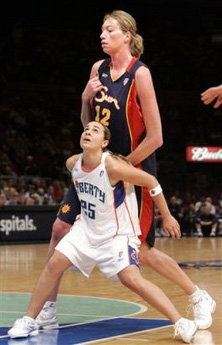
And now that she has a face I’m even happier with the cover than I was before and, let me tell you, I was pretty happy. But now she’s not only escaped the headless woman curse, it’s also clear that she bears a bit of a resemblance to Leilani Mitchell of the New York Liberty, who looks exactly how I imagine Charlie would look if she wasn’t, you know, imaginary:


Copyright 2008 NBAE. Photo by Ned Dishman/NBAE via Getty Images

The selling of books and complications therein

Justine Musk has an excellent essay on her career as a novelist in the mass market paperback salt mines and it is very good. It involves numbers and market realities and other concepts that make the writing-is-art! crowd nervous and/or cranky.

Note: I do not think writing-is-art and publishing-is-a-business are mutually exclusive notions. I think that in order to do the one it really behooves you to understand and get your head around the second. Even if in doing so you conclude that you’re better off self-publishing. Or writing your novel in a series of haikus on the back of Anzaac bickies and floating them out to sea at dusk each night for the next ten years.

Have I mentioned that it took me many many years to make my first professional sale? I seriously thought about doing the floating biscuit (cookie) thing. If only I weren’t so bad at writing with icing.

Apocalypse survival (Updated)

Some of the folks on the not-driving thread seem to think that driving a car is an essential skill come the apocalypse. I think they are wrong. Even if the apocalypse isn’t caused by a petrol-eating bacteria, the days of oil-fuled cars are numbered. And once civilization breaks down there will be no more drilling for the little oil that’s left. Cars will only be useful to sleep in or to scavenge for spare parts to make something that’s actually useful.

I reckon genuine survival skills include:

  • Being fit and strong
  • Knowing first aid and/or being a doctor
  • Knowing how to find food (i.e. knowing what’s edible) and water in even the least promising circumstances
  • Being good at making and fixing stuff

I’m also unconvinced about the usefulness of guns. For starters they’re really really really LOUD. If things turn heap big awful bad, keeping a low profile to prevent the marauding nasties from finding you will be a high priority. One shotgun blast and that’s your low profile gone. It’s much more useful to know a martial art. It keeps you fit and teaches you how to look after yourself. It’d also be useful to know how to use quiet weapons like knives, or bow and arrow or, best of all, the mighty crossbow. Similar range to many guns but much much quieter.

By my own critieria, I’m pretty much buggered. All I got is that I’m reasonably strong and fit, but I fail on everything else even if my surname does mean “crossbower.” Unless there’s a big demand for storytellers, someone with a lot of Elvis trivia, and the ability to roll their tongue.

How about youse mob?

Update: I has added related poll. Look to right hand sidebar. Top of page.

Non-drivers

I was just reading Meg Cabot’s blog. You know as you do when you have a deadline and you’re worried that it may defeat you. Because Meg Cabot writes around four thousand books a year and never misses a deadline. So I figured reading her blog might make her productivity and non-lateness rub off on me, who has never written more than one book a year. Fingers crossed.

And what did I discover? Meg Cabot doesn’t drive either! Doesn’t have a license. I am not alone.

Well, actually I know that because I live with someone who doesn’t have a license and hasn’t driven a car since 1988. But he knows how to drive. Whereas I do not. I had exactly one driving lesson and it did not go well.1 Besides I’ve never really liked cars and have always lived in cities where you don’t need to drive.

So who else of my readers—over the age of 18—doesn’t drive? Any of you?

  1. Do not ask. []

Brief note to the lurkers and newbies as well as general excuses

In the last few weeks there’s been quite a bit of delurkification as well as some new commenters. Ordinarily I would respond in the comments and welcome you personally but, well, I has deadline. And book for deadline is scary and complicated and not genre and I may be out of my depth and um,

PANIC!!!

But I hate to be rude and I love to see new folks here. So,

WELCOME!!!

To everyone else: sorry for not responding as much even though I read all your comments,1 also for being months and months behind with email, for not having done that thing I promised I’d do for you, and for generally being as slack as, um, a very slack person.

Book comes first! Before hygiene, friends, nutrition, changing polls, health, admin and pleasure. Is just how it is.

  1. Except for the ones about USian gridiron. Boring. []

Music not a cure for homesickness

I have been conducting a series of scientific experiments on how to cure homesickness. Here is my latest finding:

LISTENING TO MUSIC FROM HOME DOES NOT WORK.

In fact, it makes it much much worse. I have been listening to Oz music for the last four hours. Some of it music I don’t even like. So far I have cried 4.7 times.

I feel my findings are conclusive and I can now cease the experiment.

Next: The stabbing-your-hand-with-toothpicks cure.

Wish me luck.

Pretty!

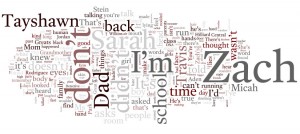
I’ve been playing with wordle, which is a lovely app by Jonathan Freiberg that a bunch of writers have been playing with on account of it is irresistible. You plug in your novel (or whatever text you want) and the app makes it all pretty. You can futz with the layout, the colours, the fonts etc. Procrastination heaven!1

I fed in a bunch of my novels. And oohed and ahed. And then I fed in my novel what I is currently writing and lo and behold not just pretty but useful. I could see at a glance what words I’m overusing and which characters and threads are getting the most attention. Interesting . . .

Notice that I have made it small enough that there are no real spoilers. I am so good to you people.

And did I mention pretty?

  1. What do writers on a deadline live for but to procrastinate? []

Bad writing days

The fabulous Robin Wasserman was recently asked these two excellent questions:

  • Is your mood affected by whether you have a good writing day or a bad writing day?
  • When you’re having a bad day, do you conclude that your entire life must be somehow defective?

My answer is a big fat yes: YES!

Especially to the first question. I’m extremely foul to be around when the writing isn’t going well and a total delight when it’s going swimmingly. On good writing days there are rainbows everywhere, the birds sing, and a large bowl of fresh mangosteens shows up out of nowhere. It’s magical, innit?

In fact, I’d be really surprised to discover writers whose moods are unaffected by how the writing’s going.1 I imagine this applies to most other professions. Very few of us can get home after a crap working day and just shrug it off.

I cannot tell you how often I have had the following conversation with my various writer friends:

Me: How you going?

WF: My life sucks! Everything about it is misery and woe. I might as well kill myself.

Me: Writing not going well?

WF: It is the WORST BOOK EVER WRITTEN! Anyone who claps eyeballs on it will contract the most horrible disease known to humanity! Or they will cease to be able to read. Or die. My book will kill them DEAD! My book is the end of civilization as we know it! Why was I even born?! Aaarrrggghhhh!!

We writers are a neurotic whingey bunch.2 When we are in that kind of state it’s best not to remind us that the day before we thought it was the best book ever written. All you can do is nod and smile and make sympathetic noises and offer us food or liquid we find particularly comforting.

Only when we’ve calmed down is it safe to mention that we have expressed similar sentiments in the past. That, in fact, we have said the exact same thing about every book we’ve ever written. And yet we managed to finish those books without the world ending.

The only time the good writing day = joy; bad writing day = horror isn’t true is when I’ve been working too hard. Writing every single day, for long hours, for weeks, for months on end to meet a deadline can do my head in. As it goes on and on and on, even when I’m happy with the words I’m producing, I become increasingly grumpy until I finally send off the millstone manuscript and earn myself some writing free days, at which point the rainbows, singing birds and mangosteens reappear.

Only to disappear when I go too long without writing. And repeat.

How about youse mob? How say you to these questions?

  1. Though given how people can disagree about pretty much anything I won’t be that surprised. Truly, I know someone who hates fruit. Seriously, all fruit! I know! I couldn’t believe it either. []
  2. Obviously, except those lucky sods who only have good writing days. []

I has no ARCs so please stop asking

In the last few week I’ve had several people asking that I send them a How To Ditch Your Fairy ARC so they can blog about it.1

While that’s a lovely offer, and I can’t tell you how thrilled I am that so many of you are keen to read the book, it so happens that I do not have any ARCs of HTDYF. Truly. The tiny number I was given were handed out to local Big Mouths.2 I also swapped with a few writer friends for their ARCs. I have none left. Not even my parents and sister got a copy.

The person to ask for an ARC (of any book) is the publicist of the company that publishes it. But in order to get one you’ll have to show that giving you the book will help spread the word about. That is how it works.

The reason that a number of reviews have appeared of HTDYF recently is because 500 ARCs were handed out at BEA. A decent number were also sent by my publicist to key Big Mouths all over the USA. I have sent no one an ARC. It is not my job to do so. That’s why the author is given so few in the first place. We’re usually not the best placed person to get them into the hands of the most important Big Mouths.

So the person you should be bugging for ARCs is not me, but my publicist. And, no, I will not give you her email address. With a wee bit of googling you will find it on your own.

Besides, do you really want an ARC? They’re full of typoes, they fall apart easily, and they don’t even smell as good as a real book. And guess what? HTDYF will be a real book very very soon. While the official pub date’s in September I’m pretty sure it’ll start showing up in shops in August. August! That’s mere minutes away.

  1. I also remain many months behind with email. If you wrote to ask me for an ARC this is my reply. Sorry not to respond more personally. []
  2. Isn’t that a quaint term? It refers to the booksellers and bloggers and librarians and journalists who are well known in the YA world and are very good at getting the word of mouth flowing. []

Not thinking structurally

Warning: This post is longish, rambling, and possibly incoherent.

I don’t think structurally.1 But most of my novelist friends do. When they talk about the books they’re currently writing, they rabbit on about three and four-act structures, beats, setting things up for the climax, the dénouement and blah blah blah.

I’ve never thought about my books that way. I have no idea what the act structure of any of them is. I don’t know what a beat is. I am an idiot savant novelist.

I suspect part of this is because when I first started learning how to write novels I’d never heard of act structures or outlining so I didn’t use any of those models for writing a novel. I winged it. And thus learned how to write novels by winging it.

Mostly I have no idea where my books are going. I’ll have an initial incident, or sense of the protag, or a setting. Occasionally I think I know how the book ends, but mostly not. In fact, when I think have an ending I find out that I am wrong.

When I’m writing the first draft, I’m very often lost in the sentence level, or going from scene to scene. For a long time, I can’t see very far ahead, which means I don’t have much of a macro view. Not until I’ve written the first draft and can look at the whole thing. When I start rewriting, deleting and moving scenes around, I don’t do it to balance out acts—on account of having no idea what the different acts are—I do it to get the book to feel right:

This bit drags = I delete it or trim viciously.
This bit doesn’t really make sense so early in the book = I move it.

The way I think about structure is most clearly articulated in my post on how to rewrite, proving that I do think about structure, just not in the organised way so many of my friends do.

I wonder if part of this is the winging it versus outlining it school of writing. In order to write an outline you have to start with an overall sense of the structure of your book.2 Whereas I learn what the structure of my book is by writing it.

I’ve been thinking about this a lot because I just realised that the book I’m working on right now has three parts. Could they be three acts? Could I accidentally be doing what I thought I didn’t know how to do? The first part sets everything up, introduces all the characters, reveals the main conflicts. The second part, well, I’m not sure how to describe what the second part’s doing given that there’s not even two thousand words of it. And the third part will, hopefully, bring stuff to a head and then wrap everything up. Or something.

We’ll see.

I defnitely feel that I have a much stronger sense of the structure of this novel and where it’s going at a much earlier stage. I’m about half finished and I’m pretty sure I know where it’s going and how to get there. It is most odd.

I suspect that Scrivener may be at least partly to blame. The way it works has made me aware of the overall shape and, well, structure of my book almost immediately.

I’m also enjoying writing this book a great deal. Something about working with Scrivener has forced me to think about the craft of writing in ways I haven’t before. I feel like I’m being stretched and the book is better for it. Even if I do wind up writing a book with the English-speaking world’s most conventional structure: the three-act structure.3

Whatever. Nothing wrong with reinventing the wheel.

  1. I’ve been tinkering with this post for quite some time. Part of my problem writing it is that because I do not think structurally about my writing I do not really have the language I need to write this post. I borrow other writers’s language, but most likely I don’t use it in the ways they intend, hence the messiness. I’m just feeling my way and thinking out loud. My apologies! []
  2. I once wrote an outline of a book—for Magic or Madness. However, I wrote it in order to sell the book (and trilogy) and once I got stuck into the writing I never looked at the outline again. []
  3. I may have more coherent thoughts once I’ve actually finished it. []

In Which I am Irritated by a Review

Did anyone else read this review by Laura Miller of Leonard Marcus’s Minders of Make-Believe: Idealists, Entrepreneurs, and the Shaping of American Children’s Literature? I haven’t read the book, but I have read Leonard Marcus’ edited collection of Ursula Nordstrum’s letters, Dear Genius, and his biography of Margaret Wise Brown, Awakened by the Moon, both of which I found fascinating. What little I know about the history of children’s book publishing industry in New York City I learned from those two books.

So I was excited to see that Marcus has a new book out and read the review eagerly. And, well, it was my least favourite kind of review, one that bitches about the book under review not being the book they were hoping for:

What probably strikes many people as the most fascinating aspect of the history of children’s literature in America—the children, and the literature itself—takes a back seat to editors and reviewers, printers and magazines, libraries and bookstores.

Lucky Miller to have her finger on the pulse of what strikes people as the most fascinating aspect of the history of children’s literature in the US. Even with the modifier “probably” she seems pretty certain. But whether her supposition is true or not—and I have no idea how you’d prove it—it’s a bizarre thing to complain about given the book’s subtitle: “Idealists, Entrepreneurs, and the Shaping of American Children’s Literature”. Seems to me that the words “entrepreneurs” and “shaping” are a pretty clear indication that Marcus’s book is going to be about the children’s book publishing industry and the “editors and reviewers, printers and magazines, libraries and bookstores” who made it happen.

Miller says the book will mainly be of interest to “historians and people in the industry”. I’m guilty of both those charges, being a publishing geek who’s part of the (broader) children’s publishing industry, as well as an ex-academic who did history, I am this book’s target audience.

Like I said, I have not read Minders of Make-Believe. Perhaps it is as off the mark as Miller claims; I’ll find out when I read it. But I will not find fault with the book for doing exactly what it sets out to do.

Goose meet gander

Apropos of Becky Hammon playing for Russia comes this article from The New York Times about all the foreign nationals that are playing for the US Olympic squad:

Marching into Beijing Stadium under the American flag this August will be a kayaker from Poland, table tennis players from China, a triathlete from New Zealand, a world-champion distance runner from Kenya and a gold-medal-winning equestrian from Australia.

Though I am shocked, SHOCKED to my core, that an Australian would desert our fine country to play for another nation especially when they’re a good shot a gold medal. How are we going to keep coming third in the Olympics despite our small population if the big countries steal all our Olympians? Huh? Way to take your tax-payer funded training and give the benefits to the peoples what didn’t pay those taxes!

Um, what was I saying? Oh, yeah, if it’s fine for the US to have representatives from other nations than it’s fine for USians like Becky Hammon to represent a different nation. And, er, I guess that goes for Australia too, what’s had any number of foreign nationals represent it over the years.1

  1. Wow, that was really hard to write. []

And so does wombat excrement!

No, not really. I just wanted to type “wombat excrement”.

I’ve had some complaints about not changing the poll. The reasons for that are that:

  1. I’ve been really busy. This book ain’t writing itself!
  2. I’m waiting for a clear winner. Seriously, ugg boots, lingerie as outer wear, formal shorts, pregnancy dresses and tops on the non-pregnant, and low riders are pretty much neck and neck.
  3. It’s my favourite poll. I would miss it if it were gone.

I’ve also been cooking. The farmer’s market at Union Square has gotten good again after its hideous nothing-but-gourds winter doldrums.1 The spring garlic especially is making me really happy. Also I have discovered garlic scapes. Yum. I’ve been frying them with tomatoes and serving on bread with soft boiled eggs and whatever greens looked best at the markets. Yummiest breakfast ever.

Anyone else a farmer’s market addict? What’s best where you are? And what have you been doing with it? I mean other than just plain eating like I am with the strawberries that are just coming in. Delicious!

  1. Yet another reason not to be in NYC in winter. []

Dingo urine saves lives

Tasmanian marsupial lives that is. Scientists back home have discovered that marsupials really really really don’t like dingo pee. They avoid it like the plague which means that farmers and the forestry industry can stop poisoning wildlife in order to protect crops. Spray the wee around and the critters stay away and the crops grow unmolested. Everybody wins.

Apparently it also makes a really lovely perfume.1

  1. No, not really. []

Review the fourth

Okay, now I’m embarrassed.

Here’s another review of How To Ditch Your Fairy this time from Murex Brandaris of Imperial Purple:

Well, the Advance-Copy-Of-Brilliant-Books fairy has struck again. In a manner most mysterious I have found and read a copy of Justine Larbalestier’s latest literary foray (due out in September) and I saw that it was good. In fact, it is her best novel to date.

*Cough* *cough*.

Third HTDYF Review

This is getting a little bit nuts. (In a very good way!) The book isn’t even out until September and yet here’s a review by Carlie Webber of Librarilly Blonde. It’s a tiny bit more spoilery than the other two but just as enthusiastic:

Why you’ll love it: First, it’s funny. There is never enough humor in YA, and HTDYF is not only funny, but it’s a smart, sarcastic kind of funny.

I can’t tell you how pleasing it is to hear that people are amused. Writing a comedy filled me with terror that no one would laugh. But at least three people have so far. This week’s reviews have made me very happy. Thank you.

Waiting to hear what people thought of your book is one of the weirder stages of being a novelist. It’s vastly nervous-making. Especially when your book is a big departure from your previous novels.1 These early positive reviews are making me feel much more relaxed about HTDYF making it’s way into print. Even if every other review tears it apart, I’ll have these three to hug to my chest. And I’ll have Carlie’s Jay-Z inspired How To Ditch Your Fairy rap, which made me laugh and laugh:

If you feelin’ like a jock, girl, go and brush your fairy off
Walk everywhere girl, go and brush your fairy off
Fairies is crazy, baby, don’t forget Fiorenze told you
Get that fairy off your shoulder

And, yes, you really do have to read the book for that to make sense.

  1. Though nothing is as anxiety-making as waiting for your first book to come out. My thoughts are with you Lauren, Carrie and Sarah! []

How I finished my first novel

Often when people find out what I do it turns out that they harbour ambitions of writing a novel too. Mostly they just daydream about it. But sometimes they confess that they’ve had a whack at it but not very successfully. “How do you actually finish a novel?” they’ll ask. “Starting’s easy but how do you finish?”

I cannot tell you how many novels I started but did not finish before I finally managed to complete one. Not because I don’t want to tell you, but because I honestly don’t know. On the hard drive of my current computer there are fourteen unfinished novels. But there are others that didn’t make it to this computer. Not to mention many notebooks that are lost or in storage. I started my first novel before I was twelve, started many more in my teenage years, not to mention my twenties, but I kept stalling.

Every. Single. Time.

I could write beginnings. Some of them are corkers. I could even get some of the middle stuff happening. But I could not get to the third act. Hell, I couldn’t even finish the second act.1 None of my unfinished novels get anywhere near the climax, let alone the actual ending.

There were lots of reasons why. My short attention span was definitely part of it. I’d think of some other shiny shiny idea and start on that instead. Or I’d get bored with the work in progress and go read a book instead. Or I’d get stuck and have no idea what happens next. Or I’d decide the whole thing sucked and realise I could never show it to anyone else because of its hopelessness and give up. It could also have been the absence of a deadline—I find they concentrate the mind quite fabulously well.

I also suspect part of my problem was that I never had a clear idea of the whole book. I’d just start writing a conversation, or describing a scene, and figure out who the people were and what was going on as I went. I had never heard of outlining so it never occurred to me to do so. Maybe it would have made a difference and I’d have finished a novel much earlier. I’ve always imagined that writers who figure out the plot ahead of time, who know who their characters are and what they’re going to do before they start typing have a much easier time finishing their first novel.

Left to my own devices I suspect I would never have finished. I’d still be an academic. Or possibly a rabbit farmer. Or a stringer for National Enquirer.

But one fateful day I got talking with an acquaintance, who happened to work at a book shop in Sydney where I fed my book habit frequently bought books. I’d been going there for years. We’d chatted many times but didn’t really know each other. On this occasion we both confessed that we were wannabe writers. I remember how embarrassed I was by the confession. How stupid it sounded. But she was embarrassed too, which encouraged me to admit that for all my ambitions I’d never managed to finish a single thing. Turned out she hadn’t either. Somehow we ended up agreeing to read each other’s stuff.

Once every one or two weeks we’d meet, swap pages, have lunch, talk about what we’d written, offer (very gentle) criticism, and cheer each other on. Within six months I’d finished my first novel. Or the first draft of it anyways. A novel I’d started in 1988 was finished in 1999. Greased lightning!

I could not have done it without her. Writing can be a lonely, frustrating business. Having someone who’s in it with me made a huge difference. Because back then I had no idea whether I could finish a novel. And not knowing if that was possible made finishing really really difficult.

Now when I start a novel the fact that I’ve already finished six makes me pretty (not wholly) confident that I’ll finish this one too. Even if it is turning out to be longer than expected.

  1. Possibly because I have never thought of my books in terms of acts. But whatever. []

Stupid recalcitrant novel beasties

You know when you set out to write a novel and it’s supposed to be around 60-65 thousand words, like your last four novels, and knowing that you’ve calculated how much time you need, and how many words per day, and it’s all going along crackingly, and you’re meeting your targets, wrangling words—some of them are even pleasing words—when you realise that this novel is not, in fact, a 60k beastie, it’s more of a 75k beastie, possibly even a 80k or 90k MEGAbeastie? Well, um, that is somewhat sucktastic and hair-pullingly wrong.

Stupid recalcitrant novel beastie. I spit at you! Spit, I say.

Listen, mosquitoes!

I know that you mozzies have an ecological niche to fill. I’m sure that if you were wiped out some fabulous bird species would become extinct. I even get that my blood is your food. I’m not thrilled when you bite my hands and feet, my arms, legs, back and belly, none of that is exactly fun, but for the love of Elvis—could you stop biting my ears?

My EARS?!

Is that really too much to ask?

Another HTDYF review

Reviews of How to Ditch Your Fairy two days in a row and the book isn’t out until September! A most excellent week this is. Yay! This one is from Libby at Lessons from the Tortoise and once again the reviewer did not find my book too foul:

I really found this world fascinating. The slang was fun (“doos” for “cool” or “good” was one of my favorites), the mild bi-coastal tension was intriguing, and the imaginary sports academy that Charlie and her friends attend was nightmarishly on-target. These teenagers live in a world I don’t inhabit, but they’re still recognizably teenagers, with all the trivial and serious concerns (clothes, romance, sports, and school) that the teenagers I know share. The “new kid” has Charlie questioning some of her assumptions, but so do the other changes she’s going through; life is realistically complicated, in other words, for these characters.

I glow.1 I will admit I’ve been nervous about the reception of HTDYF because it’s so very different from the trilogy and because it’s meant to be funny. Nothing worse than a funny book that isn’t, you know? So it’s a relief that at least two reviewers giggled!

  1. And not just because it’s a ten degrees hotter in the flat than it is outside where it’s already 30C at 9AM. []

Moderation + wordpress guru hunt

Charlie Stross and John Scalzi have been explaining their moderation policies. So I thought I ought to tell you mine.1 Especially in the wake of the recent “shown” wars. The link does not actually lead to a flame war because I deleted it.

Which is my basic policy: all flamewars will be erased. Anyone who’s cranky or flamey gets nuked.

I really enjoy blogging. It’s my favourite kind of writing. I find it relaxing and fun. I adore all the smart, witty comments youse mob make here. I’m loving seeing a wee community emerge.

People yelling at each other, being narky and mean, getting into fights, none of that is relaxing or fun, so I don’t tolerate it. This is a troll-free zone.

I have occasionally let deliberately provocative drop-in comments stand because the responses from you lot were so excellent. But the general policy is to hit the delete button. The minute this blog stops being fun is the minute I walk away.

One of the things I like most about this blog is that other than the dread “shown” incident I’ve pretty much never had to resort to deleting.

Thank you all so much for that. You make me want to blog several times every day just to see what you’ll say.

On the wordpress guru hunt: Thanks so much for all the responses. There’s way more than I anticipated so it will take me a bit longer to get back to you than I’d anticipated. But I’m working on it! And, yes, I’m still happy to look at more portfolios if you still want to send. Best to look at all the prospects, right?

  1. Even though it is much like theirs. []

First HTDYF review

Well, this was a lovely thing to wake up to: The first review of How To Ditch Your Fairy (who’s pub date is in September so the earliest it’s likely to appear would be August) and it’s a good ‘un, also excellently non-spoilery.

The review is by Jocelyn of TeenBookReview and in what I’ve decided is a very good omen she is very enthusiastic:

I sat down and started reading this book as soon as it arrived in the mail, and I didn’t put it down until I was finished; I didn’t even notice the time passing, that’s how caught up I was in the story. It’s fun and interesting and has a main character I absolutely couldn’t get enough of! Charlie is seriously awesome, as is this book, and you should all read it as soon as possible.

I blush and am full of chuffage.1 I had a lot of fun writing HTDYF so it’s really wonderful to hear that people are having as much fun reading it.

  1. Don’t worry I have medication for when that happens. []

WordPress Guru wanted

I’m looking for someone to design a new wordpress template for this site. I’ve been googling around and not having much luck finding portfolios that really blow me away. Or the ones that I love are designed by people who have enough work to keep them going for the next thousand years.

I will pay professional rates. If you’re interested please send a link to your portfolio and an inkling of your capabilities and experience to jlATjustinelarbalestierDOTcom

Becky Hammon becomes Russian

There’s controversy right now in US women’s basketball because an American player, Becky Hammon, is going to play for Russia in the Olymics. The coach of the US Olympic squad, Anne Donovan, has called her a traitor. Others have different views: like how can Becky be a traitor when she was never asked to try out for the US squad despite putting up MVP (most valuable player) numbers and being one of the best guards in the world?

Mechelle Voepel writes a very smart and nuanced article about the furore:

It’s all fascinating to me on a lot of levels because it has made me think about so many things: what the Olympics really are, the ways the world has changed in my lifetime, the difference in thinking between “generations,” the bizarre economics of global women’s basketball . . . and, not least by any means, the amazing cult of Becky Hammon.

There are Hammonites:

The Hammonites are made up of these folks (Group 1), who include lesbians and straight guys. That Hammon effortlessly projects a confident, playful, tough-gal swagger is just more fuel for that fire.

Also among Hammonites are people (Group 2) who aren’t in the “Becky Babe Watch” mode but simply admire Hammon for her tenacity and fearlessness as a player, plus fondly see her as being like their daughter or granddaughter or niece. And lastly (Group 3), there are youngsters who just want to “be like Becky.”

The Hammonites are united in their belief that 5-foot-6 Becky always is underestimated—going back to her Colorado State days, her “undrafted” status (although it was because she got out of college in 1999, the year the ABL players were drafted into the WNBA) and her being “ignored” by USA Basketball.

I’m not sure where I fit in there. I don’t have a crush on Hammon, I don’t feel like she’s my daughter or niece, and I don’t want to be like her, but I admire her play. As a New York Liberty ticket holder I watched her play for years and get better and better and better. I certainly agree that she’s been consistently underestimated. in fact, Voepel leaves out what to me was the most egregious underestimation: Liberty coach Adabato never making her a starter, despite her earning it over and over again. She became a starter after he was fired and replaced by Patty Coyle.


(Photo credit: D. Clarke Evans)

The day I found out Hammon had been traded to San Antonio I almost cried.

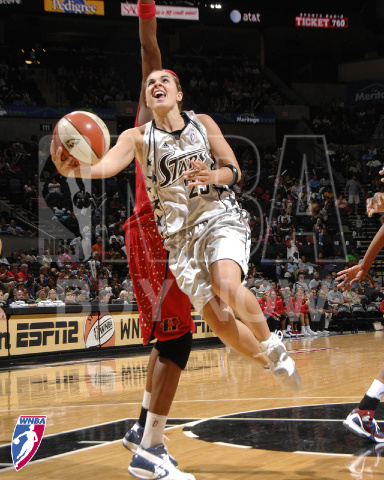
Hammon is a joy to watch. She’s tough, smart and a gorgeous shooter and has a kind of physical charisma that is more commonly associated with men than women. She saunters, she grins, she commands the court. Part of it is the way she doesn’t let her lack of stature (she’s 1,68/5-6) get in the way. Our rookie point guard Lelani Mitchell (1,65/5-5) kind of reminds me of Becky though (as yet) she has none of that charisma. There are many reasons to be a Hammon fan.

What’s most interesting to me about Becky’s decision to play for Russia is the economics of it. The money in women’s basketball is not in the US, right now it’s mostly in Russia. Hammon will be moving up from being a popular player on the winning CSKA team to being on the national team. There will be more endorsements and thus a lot more money.

We’ve all heard about women making 70% of what men make in the same jobs. But women in the WNBA earn about 1% of those in the NBA. Indeed, the worst-paid player in the NBA makes twice as much as the best-paid among the women. And, perhaps more astonishing, there are dozens of male players who make more than the total league-wide payroll of the WNBA.

(Photo credit: Gregory Bull, AP)

That’s a huge disparity and it’s the reason why the majority of the women play in more than one league. The WNBA in the (Northern) summer and Russia or Israel or Italy or wherever in the (Northern) winter. And many of the USians have non-American passports to get around the rules about the number of foreignors on a given team. Taurasi has an Italian passport, Sue Bird an Israeli one and as of the beginning of this year Becky Hammon has a Russian one.

I think part of the anger and discomfort around Becky’s decision is that in the past players who’ve come to play for the US or Australia (to cite the countries I know about) have come to escape oppression and to live a better life and earn WAY more money. The idea of the latter happening in reverse is startling. It plays on our fears of globalisation: the good jobs are moving overseas, along with the real economic power.

I’m sad that Becky never got the chance to play on the US Olympic team. Like Voepel I think she earned that opportunity last year when she turned in the best performances of her entire career (though sadly for San Antonio not New York). She came in second to Lauren Jackson in MVP voting and yet the US Olympic team still wasn’t interested. The US team has a ridiculous amount of talent to choose from. I don’t think Hammon’s absence is going to make much difference to Team USA, but I do think it will make a big difference to the Russians. I suspect that’s something else Donovan’s mad about.

Athletes don’t have a long shelf life. Hammon’s already 31. She has at most six or so playing years left. And then what? Earning as much as you can while you can and saving it in preparation for the many, many years of your life when you’re not playing is smart. Even if it means playing for a country not your own.

If it’s okay for countries like Australia and the US to add last minute “Australian” and “American” players then it should be okay for it to happen in reverse.