Category Archives: Reading

Giving up

How long before you give up on a writer that you once loved? Or a TV series you adored? Or film director? Or actor? Or band you loved? How many dud books, TV eps, movies or songs before you say, “That is it. I’m never spending money on you again?”

Or do you never give up and keep hoping against hope that they’ll regain form?

I’d tell you who this was apropos of, but then I’d have to kill you.

Dope, proofs, hoops, words

Today is going to be insanely off-the-charts busy so instead of the long and thoughtful post on the meaning of the “sublime” that I’ve been working on I’ll

  • recommend Sara Gran‘s Dope what I recently read and loved. Imagine a noir 1950s novel if it was written much more spare, set in New York, and narrated by an ex-(teetering on the edge of non-exness) junkie prostitute who now makes a living boosting jewellery. Not going to tell you another thing about it. Just that it’s short, there’s not a word out of place, and it made me cry. (Mind you Qantas ads make me cry.) Read it immediately!

    Any of you read any read-immediately books you’d like to recommend? Dope was recommended by Marrije. Thank you!
  • and exhalt in the page proofs of Magic’s Child what arrived. It looks like a real book! All typeset and stuff! So purty! So far the proofer has spotted a minor plot oopsie (someone not having something and then somehow out of nowhere having it) and reminded me once again that I’m the world’s worst punctuater. All she does is shift my commas around and remove and add semi-colons. Bless her! And sigh on my inability to ever understand the simple comma.
  • boast of my squeaky wheelness. I wrote to one of my favourite blogs, women’s hoops—twas a mournful letter whingeing that they hadn’t blogged the Aussies winning the World Championships and here’s how they responded. Bless ’em!
  • The ABC has this fabulous wordmap project where they’re trying to map the regionalisms of Australian English. It doesn’t take a second to add regionalism of your own. My problem is I’m not at all sure where I picked up the words I used. I had no idea “grouse” was more of a Victorian word. I’ve never lived in Victoria. Only New South Wales, the ACT and Northern Territory. I reckon tellie, books, and radio must muddy the waters of pinning down regionalisms more than somewhat.

And now I roll up sleeves and get to work.

More on banned books week

Us Asif! authors have been chatting more than a little about the whole books-being-banned situation and we don’t always agree. Some of us do think there are books that are inappropriate for kids. For instance, I would not be totally wild about a ten-year-old reading the Marquis de Sade.

On the other hand, when I was ten I picked up Henry Miller’s Tropic of Cancer (I blame my parents!) and promptly put it back down ’cause it was not only gross, it was really really really boring. I read it again in my late teens and had the exact same response. I imagine the ten-year-old me would have had the same response to the Marquis. As a kid, much like the kid in The Princess Bride, I skipped all the kissing bits. Boooring!

nullMost of us Asifers agree that there are books that kids shouldn’t be reading, but none of us can agree on what those books are or what the magic age of being able to read “adult” stuff is. I read and loved Alexander Durrell’s Alexandria Quartet at an early age, along with a slew of other “inappropriate” books. I think it had no ill effects on me (others may disagree).

The problem with the banning of books in the US of A is that there are different rules in every state. Hell, there are different rules in every school. In a lot of cases individual principals (head masters) and school librarians are removing books from shelves, or not ordering them in the first place.

Now, obviously school librarians need a certain amount of discretion. They have budgets. They can’t buy every book and it’s their job to buy books that are appropriate for their students. You can’t do that without making judgements.

The school librarians and principals are the ones on the frontline. They’re the ones dealing with parental complaints. They’re the ones looking at catalogues and deciding what to order. If their school is in a particularly conservative area they might see a book titled Sex Kittens and Horn Dawgs fall in love listed as a middle grade book and decide that ordering it just isn’t worth the grief, no matter how tame the content.

As it happens that’s exactly what’s happened to Maryrose Wood’s book despite it being as pure as the driven snow and its title being the raunchiest thing about it. And yet the title fits the book to a tee. Should her publishers have called it something else? Should people read books before they rush to ban ’em?

Is banning books ever a good idea? How about just limiting access? There are some kids who are horribly freaked out by books. I babysat for this one little boy and if I read him stories that were even a teeny tiny bit scary he would not be able to sleep for a few nights. When he was a little older and reading on his own, Grimm’s fairy tales deprived him of sleep for weeks. He wasn’t ready for it and was a much happier and saner kid when he stuck to sport and pony books.

But there are young kids who adore the scary stuff. Why should they be deprived of their reading pleasure cause some other kid is scared by the same books? Kids mature at different rates. One size really does not fit all. And besides, that kid I babysat for—he self-regulated. He stopped reading the fairy tales after the first two. Every time he decided a book was scary he stopped reading. I suspect a lot of kids do the same thing.

So usually it’s not a question about what a kid does or doesn’t want to read; it’s about what their parents do or don’t want them to read. And, yes, parents have every right to do that. But they do not have every right to regulate what all the kids at their child’s school can read.

And, frankly, I worry about parents who are that controlling. When I was in primary school one of my friends was not allowed to read any books her olds deemed sexist or racist. So she read those forbidden books (mostly by Enid Blyton) over at my place and we’d pretend to be members of the Famous Five (with huge fights over who got to be George) or pretend we were in boarding school at Mallory Towers and have midnight feasts (though sadly we never managed to stay up till midnight for them).

Forbidding her those books and not allowing her to watch television did not protect her from racism or sexism. It just made the forbidden items more desirable. It’s incredibly hard to control the cultural artefacts your child comes into contact with and even harder to control what they make of them.

I understand the impulse, but that doesn’t make it a good idea. (I also understand why authors feel compelled to respond to bad reviews.) I also wonder what exactly is the harm that parents think their child will contract from reading books they deem “inappropriate”. Is it a bid to put off having awkward conversations? To protect the child from how foul the world is? Is it an attempt to mould your children in your own image? (Good luck with that, by the way.)

What do you lot reckon?

Changeling

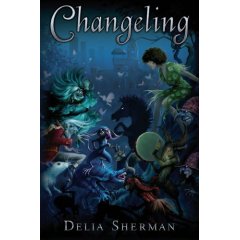
Delia Sherman’s latest book, Changeling, is a middle grade fantasy that doesn’t resemble anything else I’ve ever read.1 It has many recogniseable elements: fairies, changelings, mermaids, dragons, New York City, but they’ve never been brought together like this before.

Delia Sherman's ChangelingSherman’s New York City is unlike any NYC I’ve read about.2 She’s transformed it into “New York City Between”—a wonderland populated by fairy folk and characters from well-known children’s stories like Eloise—and she’s done it in a way that keeps the city entirely recogniseable and yet utterly different. Central Park is just as easy to get lost in, Wall Street is just as crazy busy, but it’s run by the dragon of Wall Street. If you know NYC at all well you’ll be delighted, no matter how old you are, and if you don’t know the city it doesn’t matter. Changeling stands up on its own.

I hesitate to say it because the word has such a bad wrap, but Changeling is utterly charming. I was entranced by Neef and her New York Between from the very first page. I can’t wait to read more about both of them. Here’s to it becoming a series of many, many more books!

If you don’t believe me, check out these other folks who loved it as much as I did.

  1. Except her earlier short stories set in the same world. []
  2. I would love to see the complete list of magical New Yorks. I bet it’s really really long. A truly complete version would have to list Dawn Powell’s New York as well as Eloise’s. []

Good writing, bad writing

This whole defying Margo thing has led to much thought (which I usually try to avoid) and several long excellent convos about writing—especially the one I had yesterday with the glorious Holly Black1—about the ins and outs of writing advice, the different aesthetics of writing, etc. etc. So I decided to write a long and elaborate post, but, today I am tired and lazy. So instead I offer my quick and dirty method of becoming a fine writer.

    1. Look at writing you admire. Figure out what exactly is being done that you like so much. Is it the deployment of $100 words? Of adjectives? The way the rhythm of the writing reflects what’s happening? Employ said techniques in your own writing.

    2. Looks at writing you despise. What exactly about it is shitting you? Is it the deployment of $100 words? Of adjectives? The way the rhythm of the writing doesn’t reflect what’s happening? Avoid such techniques in your own writing.

    3. 2 is easier than 1.

Let me know how it goes!

Anyone else got any quick-and-dirty advice?

  1. How come talking about writing is always so much more fun than actually writing? []

Easy writing

A while back Carbonelle argued that writing the kinds of books Meg Cabot writes is easier than writing Scott Westerfeld books. That is, that books set in the “real” world that are more-or-less formulaic are easier to write than ones that require scads of world building. (Carbonelle, please jump in if I’m mangling your argument!)

I disagreed and facetiously said that world building is a piece of piss. And then an annonymous commenter wanted to know if I was serious. And I never got around to answering on account of having to finish my latest book. (So annoying when my job gets in the way of blogging. Grr.)

So now that you’ve all forgotten about it I respond:

Yes and no. On the one hand, I think many people wrongly assume writing formulaic fiction is dead easy. Personally I find it heaps easier to write a world buildery sf or fantasy novel than a Meg Cabot kind of book.

And I know this for a fact. When I was fifteen I heard that someone’s mum’s best friend’s sister had written a Mills & Boon romance in about fifteen minutes and been paid zillions for it. I could do that, I thought. I’d read a couple and not been that impressed. How hard coud it be?

So I wrote off to Mills & Boon for their guidelines and started typing. After a week in which I manage to type a few pages (which mercifully have been destroyed) I gave up. It was too hard. I didn’t understand the genre. Afterall I’d only read a few. I couldn’t do what I’d been so dissmissive of. Writing a romance that works for the very knowledgable romance audience is really hard.

Agents and editors get reams of romances, chick lit, crime, sf, fantasy and other genre mss. across their desks all the time. They pass on the vast majority because it’s really hard to nail (tee hee) even the seemingly simplest formula (girl meets boy–what could be easier?). Some of the most seamlessly entertaining books are the hardest to write. I can’t think of anything I’d find harder than writing a book that is meant to be a comedy. Unintentional humour? Easy. On purpose? Oh oh.

The problem with writing realist books (and I mean that in the broadest sense from most of Meg Cabot through to Alice Munro et al) is that at least some of your audience knows the instant you get it wrong. They’ve been to New York/high school/McDonalds; if you describe it wrong they’ll be closing your book.

When you invent your own world you can’t be faulted that way. You can just make it all up. Do no research at all, not even sticking your head out the window to see if the light really does shine off the street like you just described. You can totally wing it! Easy as pie. (Of course I know heaps of fantasy and sf writers who do all sorts of research. The fools!)

There isn’t a genre or type of writing that’s inherently easy. I can’t write short stories despite endless attempts at the form. I find writing novels much, much, much easier. When I say that to short story writer friends they don’t believe me. And who knows? Maybe it’s not true for them. (Though secretly I think they’re lying.)

As various people have said all over the place and particularly in that comment thread, some books come fast, some books come slow. Some are easy to write, some a nightmare. I doubt that Meg Cabot finds every single one of her books a breeze; I know that Scott doesn’t.

Flowers in the Attic

There’s a very popular book1 out there that’s badly written and has a dumb plot and a central character without a particle of gumption. Almost eveyone I know has read it and they either adore it or feel the same way I feel about it.

I admit that the people who love this book have kind of been driving me crazy. How could they think it’s well-written when it’s riddled with cliches and purple prose? How could they relate to the most passive protag of all time? How could they reread this godawful book over and over again? Have they all gone mad?

Then I cast my mind back to my first year of high school2 and the book me and all my mates were obsessed with: Flowers in the Attic by the prolific-even-when-dead V. C. Andrews.

Let’s see:

  • Riddled with cliche? Check.
  • Purple prose i.e. why use one adjective when you could use many? “Long, grim, dreary, nightmarish days”? Check.
  • Passive protag? They do remain in the attic an awfully long time without making a break for it . . .
  • Stupid plot? Do I even need to type check?

And yet I loved that book and read it over and over again and talked about it with all my friends. At the time I thought V. C. Andrews was one of the best writers ever. I knew many adults didn’t think so, but what would they know?

Flowers in the Attic has coloured how I think about plot, characterisation and story for many years now. I don’t think it would be overstating it to say that without Flowers I would not be the writer I am today. (Yeah, I know, for better and for worse.)

I often say that you can learn as much—if not more—from bad writing than from good. It’s much easier to see what’s going on when something is badly written, and to figure out how not to do that. Bad writing pulls you out of the text over and over again.

But when I was compulsively reading Flowers I thought it was a work of genius. Nothing short of being shaken would’ve pulled me out of that book. I wasn’t learning the what-not-to-do lessons; I was learning about how to use melodrama, suspense and betrayal. Lessons that have come in mucho handy while writing the Magic or Madness trilogy.

If I could go back in time I would not tell the twelve-year-old me to put Flowers in the Attic down and back away from the table. So why do I feel compelled to tell people how bad this other book is every time it comes up? Who’s to say they aren’t learning a whole bunch of cool things about story telling from it? Or seeing other stuff that I’m completely blind to?

On the other hand, I haven’t reread Flowers since I was fifteen maybe it’s not as bad as I suspect it is . . .

  1. Do not try to guess the name of the book. I will not tell you. The point of this post is not to trash a fellow writer. []
  2. In Australia high school starts in year 7 so I was twelve when afflicted with V. C. Andrews love. []

The privilege of knowing Ellen Kushner

This seems to be the year of books being published what I have a vested interest in of such proportions that the fact of them being in print makes me all teary.

First there was Julie Phillips‘ long-awaited Tiptree bio, later there will be Yvette Christianse’s just-as-long-awaited debut novel Unconfessed, and right now there is Ellen Kushner‘s The Privilege of the Sword.

I’ve been a Kushner fan since 1988 when her first book, the unspeakably wonderful Swordspoint, helped get me through a tedious illness. My friend, Jane Pritchard (bless you, Jane!), loaned it to me along with a whole stack of other excellent books, but Swordspoint was the only one that I reread instantly. It’s been a touchstone ever since.

At the time it never occurred to me that one day I would meet Ellen and we’d become friends and I’d wind up staying in her and Delia Sherman‘s home in Boston. Which I did for the first time in 1999 and was instantly hit with women’s troubles. Gah!

When I’m miserable one of the things that cheers me up most is being read to. It’s a sign of just how at home Ellen & Delia made me feel that I demanded they read to me. Ellen dug out her abandoned sequel to Swordspoint and started reading me the adventures of Katherine whose uncle the Mad Duke Alec (one of the heroes of Swordspoint) forces her to learn swordfighting just because it amuses him to do so.

I was spellbound, completely lost in her story, and forgot all pain. Ellen kept reading until her voice was hoarse and there was nothing left to read. It was magical.

Here we are in 2006 and that book has finally been published. In its finished form The Privilege of the Sword is even wittier, more adventure packed, and exhilarating than I remember (which is saying something because that early draft was damned fine). I want to be Katherine when I grow up. Or possibly her uncle. Or maybe both.

Do yourself a favour and hie thee to your nearest book shop or library and grab a copy for yourself. You’ll love it. I promise!

Stoush! Stoush! Stoush!

The elegant variation—with what appears to be a straight face—says that adults reading teen books is yet another sign of the end of times, or to quote him, that “yet another stone of the great edifice of Grownupland has been gleefully kicked out from underneath us”.

A most entertaining stoush results. I’d love to jump in but I gotta finish my latest contribution to the destruction of adulthood. But you lot feel free. Just play nice: no glassing or brass knuckles and keep it above the belt.

Via the stoushly Gwenda Bond and Cecil Castellucci.

James Tiptree, Jr.: The Double Life of Alice B. Sheldon

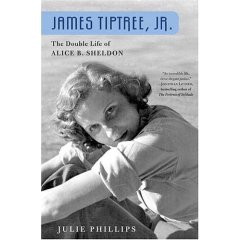
At long last Julie Phillips‘ superlatively brilliant biography of Alice Hastings Bradley Davies Sheldon/James Tiptree, Jr./Raccoona Sheldon is out. Alli (as Alice was known) was endlessly fascinating. She was the child of adventurers who waltzed her around Africa and India as a child. She grew up to be an artist (before quitting cause she didn’t think she was good enough), joined the military during World War 2, worked for the CIA, ran a chicken farm, became a Ph.d in psychology, as well as two different science fiction writers: James Tiptree, Jr. and Raccoona Sheldon. Quite the cv.

Julie’s biography more than does justice to Alli Sheldon. It’s beautifully written and exhaustively researched. There’s not a false note anywhere. Julie’s written the book I wanted to write. Literally.

Back in 1996 I’d almost finished my Ph.D. thesis (The Battle of the Sexes in Science Fiction). I’d also already figured out what my next project would be: a bio of Tiptree. I had the seed for it in the chapter on Tiptree from Battle. I wrote to my friend, Gordon Van Gelder, who was then an editor at St Martin’s Press, and asked if he thought there’d be any interest. He replied instantly to say not only was there interest but he’d just signed up such a book that very week. A journalist named Julie Phillips was going to write it.

I cried.

And then I weasled info about Julie out of Gordon. He sent me her Tiptree article from the Village Voice. It was excellent, which was a relief (Alli’s in good hands), and a bit of a bummer (she’s not going to drop the ball so that I can step in and take over). We started corresponding and wound up sending each other all the Tiptree material the other one didn’t have. My chapter on Tiptree got a whole lot better; Julie went on to spend a total of ten years researching and writing the Tiptree biography. And we became friends.

I could not have produced the book that Julie did. For starters I don’t have that kind of stamina: ten years exclusively on the one book! I’d die. Nor do I have her awesome research skills. (I’m good at archival material, not so good at getting reluctant folks to agree to interviews, let alone drawing them out.) Plus it turns out that I’m much happier writing fiction than non-fiction. (Making things up is so much easier than researching them.)

Julie’s also a gorgeous writer who knows how to stand back from her material. Julie lets Alli speak for herself. Her commentary about Alli’s life are more musings than conclusions. She gives the reader space to draw their own. (I can think of several biographers I wish would do the same!)

I’ve read The Double Life through various different drafts, each better than the last. The final version is one of the best biographies I’ve ever read. Do yourself and favour and get hold of a copy immediately.

Yvette Christiansë

A dear, dear friend of mine, Yvette Christiansë, will be publishing her first novel, Unconfessed, later this year. I just realised that I’ve known Yvette for more than fifteen years now and have been admiring her writing for even longer. (My first coming across her brilliant poetry is a long story that I’ll reserve for Unconfesed‘s official publication date.) Anyways, I’ve been waiting for her first novel for ages and now it’s almost here.

While we wait for November to roll around, the 1 August issue of Kirkus Reviews has a starred review of Unconfessed, which drips with praise, culminating in this fabulous pull quote:

    A gorgeous, devastating song of freedom that will inevitably be compared to Toni Morrison’s Beloved. But it deserves to stand on its own.

How amazing is that? I’ve known a lot of fine writers in my life, but Yvette is a genius on a whole other level. While you’re waiting for Unconfessed to come out treat yourself to her extraordinary collection of narrative poems, Castaway. You won’t regret it.

Tell me stuff (updated)

You are correct that I have not been blogging much or responding to comments like I usually do or even responding to email a whole lot.

The reason is that I’m on a deadline (yes, the same one, yes, it was moved again, yes I really have to meet this one) and am working my arse off. (Oh, how I miss my arse!)

In the meantime I think you lot should entertain me. Here are some questions:

  1. Does anyone have any recs for best brunch place in NYC?
  2. Who’s going to be the first Australian to win the Tour de France (no, it doesn’t have to be this year)?
  3. What’s the best book you’ve read lately?
  4. I just read Out by Natuso Kirino. Loved it. Can anyone recommend a recent crime novel that’s sort of like? I don’t like mysteries—that is I prefer crime books where you know who done it and it’s the whys that are the thing. So I want something all psychologicy. (My fave crime writers are Patricia Highsmith and Jim Thompson.)
  5. Where do I go to buy buttons in NYC? (Yes, that’s right I still haven’t gotten them.) (Oh, and by “buttons” I mean those things that can fasten clothes.)
  6. Is anyone else following the New York Liberty this year? Testing times, eh?
  7. Apparently I need some kind of formal wear, you know, like a dress. Anyone got any recs for cool interesting designery shops in NYC?
  8. What’s your favourite Elvis song and why?
  9. Without googling explain the difference between the Australian and New Zealand flags. Which is lamer?
  10. What new-to-DVD movie should I get to reward myself when I finally meet the deadline?

Thanks! Hope you’re all having a fab weekend (what’s left of it), that all your deadlines are being met and you don’t look at Monday morning with too much dread. As soon as my deadline is finished I promise to be a good blogger again.

Update: bonus question:

Riemannia‘s question here reminds me that I’ve been wondering what you call those metal door thingies that you see all the time here in the footpaths of NYC. You know, that when you open them reveal stairs that lead down into the basement of shops and restaurants and bars. Do they have a name? They aren’t grates so what are they?

Tiptree biography

Julie Phillips has a brand-spanking new gorgeous website to promote her forthcoming unbelievably brilliant biography of James Tiptree, Jr. Go check it out! And order that book. Seriously it’s one of the best biographies I’ve ever read.

She’ll also be reading here in NYC:

Date: Wednesday, July 26
Place: KGB, 85 E. 4th St., NYC.
Time: 7:00 – 9:00 pm

I’ll be there. Hope you all can come too.

And now Italy!

Even while I’m away at a convention good news arrives: Magic or Madness and Magic Lessons just sold to Mondadori, the biggest publisher in Italy. Woo hoo!

I’m especially excited because I met the editor, Fiammetta Giorgi, in Bologna and she was not only elegant, cool and fun, but also had great taste. We talked for ages about our favourite young adult writers such as Holly Black and Diana Wynne Jones. And now I’m going to be part of her Dark Magic series. Yay!

Mondadori also publishes Scott, so we’re now published by the same company in the US of A (Razorbill/Penguin), Australia (Penguin), France (Editions du Panama), Brazil (Editora Record) and now Italy. How cool is that?

Magic or Madness has now sold in eight different countries and Magic Lessons in six.

The goddesses of the CCBC

Scott and me were taken out for lunch by the lovely women of the CCBC, Hollis, Katy, Megan and Merri. We talked graphic novels, manga, YA books and censorship and much fun was had.

My favourite moment was Megan or Merri’s (I’m jetlagged and can’t remember which) anecdote about a twelve-year old asking to borrow a newly arrived library book because the cover so appealed to her. The book was M. E. Kerr’s Deliver Us From Evie. Evie of the title is a seventeen-year old lesbian; the girl wanting to borrow the book was from a very conservative rural family. So the school librarian looked at the girl desperately keen to read the book and imagined the outrage that would result when her parents found she had read such a book and hesitated. Is this worth my job? she wondered. But she gave the girl the book because it’s not her job to say what the girl can and can’t read. If the girl’s parents didn’t like it and raised a fuss the librarian would deal with it then.

Sure enough next morning when she got to work there was the girl waiting for her. “I have to talk to you about that book.”

Oh no, thought the librarian. “Well,” she said. “What did you think?”

“It was the best book about farming I’ve read in my entire life. Thank you so much!”

It’s a lovely example of what is so often forgotten in debates about what children and teenagers should and shouldn’t be allowed to read: people don’t always read books in the same way.1 Sometimes kids (and adults) don’t even notice the stuff that is outraging others. Me, I still can’t figure out how Harry Potter encourages Satan worship . . .

I left lunch with many other ace anecdotes about being on the frontlines in the battle against censorship (which I will ruthlessly exploit for Saturday’s panel on Banned & Censored books) as well as lots and lots of reading recommendations. It was very inspiring. Thank you, all. You’re goddesses!

  1. When I was still in primary school I read The Alexandrian Quartet by Alexander Lawrence [I’m jetlagged, okay?] Durrell. One of the the books is called Justine. I loved it, but whoooosh did a lot of it go soaring over my head. I certainly didn’t notice any of the sex. []

Plot disturbances

I should so not be writing this post. Too much to get done before we leave Monday. No time! Aaarggh.

However, Gwenda’s writing a quest novel and thinking out loud about whether she can skip the whole boring refusing-to-take-up-the-call part. Also known as “but I don’t want to be a vampire Slayer!”

In a fantasy novel the odds of the protagonist not taking up the call to destroy the one true ring or whatever are pretty non-existent. If they say “no” then book is over, or it becomes something else which is most definitely not a quest novel. So why should the writer spend too much time on that part?

I equate refusing the call with the passage of disbelief. And, indeed, the two often go together: the protag is told, “You were created to destroy this one true ring and in doing so you will save the world!” Protag’s response: “There’s a one-true ring? I’m the chosen one? What now?”

Passages of disbelief can also be really tedious. I pick up a book called, let’s say, Zombie Apocalypse from Hell and am faced with endless setup chapters where the character blithely go about their day squabbling with spouse/children/boss, engaging in other banal and boring activities just so the reader can get to know them. Meanwhile all signs point to the undead walking the streets and eating brains. But the stupid characters don’t recognise said signs, oh no, they keep coming up with lame so-called rational explanations. Yawn. Have they not seen the cover of the book? It’s called Zombie Apocalypse from Hell for Elvis’s sake! Wake up and smell the putrefying flesh! Can we get to the apocalypse already?

One of the things I loved about Buffy the Vampire Slayer was how quickly and wittily they got through the different characters’ disbelief, culminating with Oz discovering the true nature of Sunnydale and saying, “Actually it explains a lot.”

Do I think writers can skip the refusal of the quest/passage of disbelief? Absolutely! I love books that start media res. Whoosh—straight into the action. Good writers can build character and action at the same time. Funny that. They convey their protag’s ambivalence about the role they’ve been thrust into whilst the character is busying saving the world. Two birds, one stone.

On the other hand, sometimes the passage of disbelief/refusal of the quest is the best part. Shaun of the Dead becomes a lot less interesting after they realise that zombies are real. The opening where the two ambitionless, slacker Londoners get on with their stultifying everyday lives (drool in front of tellie, slouch off to work, buy crisps, fight with girlfriend and/or flatmate) in the midst of the spreading zombie apocalypse is the best pisstake of and homage to zombie movies I’ve ever seen. I laughed so hard I wept.

In Magic or Madness I set up the passage of disbelief scenario a little differently by giving the protag a mother who’s always specifically denied magic’s existence. Reason’s been brought up knowing about magic, but negatively. And although it’s almost a hundred pages before Reason is hit with solid evidence that magic is real, it’s only thirty pages later that she accepts the existence of magic.

I guess that adds up to 130 pages of disbelief, which should make any hardened fantasy reader completely ropeable (sorry!). Fortunately she’s the only deluded point-of-view character. I guess I’m saying it’s cool to take a long time with a disbelief pasage if there’s other stuff going on.

To tie this more closely to what Gwenda’s talking about: one of the main things the writer has to balance is the gap between the reader’s knowledge and that of the characters. Afterall, the protag can’t actually look up at the top of the page to the title of the book (Zombie Apocalypse from Hell ) or chapter (Eat more brains!). Unlike the reader they’re not privvy to the back-of-the-book blurb (“In this scintilating debut all hell breaks loose as Chandler Hammer does battle with hordes of zombies with only her pet dog, Misty, and son, Dopey, by her side”)—they have to figure stuff out for themselves, but in a way that doesn’t bore either writer or reader into a coma.

Nothing easier . . .

Con artists

You know how in Hollywood movies con artists are usually sexy, or interesting, or secretly kind of good guys, or all of those things (think The Grifters, Paper Moon, The Sting etc. etc.) and most of the people they scam are greedy bad people anyways, so it doesn’t really matter? When I watch those movies I’m completely sucked in, and on their side, and want them to win.

In real life, not so much. Cause, you see, scam agents and publishers are also con artists. They prey on people who are ignorant of the publishing industry and desperately want to have their work published and read. I was once ignorant of publishing and desperate to become a real author with a real published book. If I’d come across one of these scams back then I bet I would’ve fallen for it. Many otherwise smart people have.

Falling for a con isn’t about how smart you are. It’s about how much you know. It’s many years now since I’ve known enough about publishing to be immune to the kinds of scams that are regularly exposed by Writers Beware and Predators & Editors.

But on many things I’m easy to fool. If someone tells me something my instinct (like most people’s) is to believe it. I’m endlessly tricked by my friends and relatives—curse them. And April’s Fool’s Day? Gah. For starters, I’m a freelancer, so I never notice what day it is, besides most April Fool’s day gags consist of telling people something that could be plausible. What’s so dumb in believing them? There’s so many implausible things in the world that are true. You know, like Tom Cruise being a sex symbol, and people actually believing that American Beauty and The English Patient are good movies, and that Bring It On and Resident Evil 2 are bad. Excuse me?

I’ve almost been conned in NYC, but fortunately I was with a more knowledgeable person who recognised a scam (whatever it was—I still don’t know) coming.

I even understand the impulse to trick people—there’s an element of the trickster in every fiction writer. I’m just saying it ain’t that hard, nor if you’re doing it to trick money out of folks is it glamorous, noble, sexy or any of the other things that Hollywood likes to make it seem. You don’t even have to be especially smart to do it. That particular scam consists of the scammer advertising for unpublished writers and then when they send their writing the scammer says it’s fabulous and for a fee will represent the writer. Easy. All the scammer needs is for the unpub’d writer to be ignorant of the fact that good agents don’t charge fees and especially not in the multiples of a thousand.

Of course, it’s not just Hollywood that glamorises scammers. There are lots of really excellent crime books out there from the point of view of grifters. I just read Lawrence Block’s The Girl With the Long Green Heart (thanks, Naomi) and I really enjoyed it. But something happened as I read it, I started thinking about things from the griftee’s point of view. Even though—as is usual with these stories—he was a thoroughly nasty piece of work because he was greedy and thought he was gaming those who were gaming him. At which point it’s hard to see which way’s up ethically speaking. Who’re worse the people who make a living gaming people illigetimately? Or real estate speculators etc who game people legally? The grifters point at the griftees and say it wouldn’t happen to them if they weren’t so greedy. But isn’t greed for money one of the key motiviating factors of the grifter?

My head hurts.

There are lots of movies and books I enjoy whose ethics are beyond questionable. Gross Point Blank anyone? In which the hero is a guilt-free paid killer. And yet the audience is expected to be barracking for him to wind up with the girl. Which I always do even though I’m sure that were it real life and not a perverse fairy tale the first time his girl annoys him he’d off her without thinking twice.

And my point would be?

Dunno. Oh, hang on, yes I do. My point is that fiction ain’t life and that Writer’s Beware and Predator’s & Editors are doing stellar work and I salute them.

Plagiarism

I adore Meg Cabot, not only is she a fine writer who’s as witty and brilliant as Dorothy Parker, but she also has a heart as big as the ocean, and is wiser than any owl you care to name. I only read her books for the first time last year. I confess that I’d thought she wouldn’t be much chop because I was underwhelmed by the Princess Diaries movie. How stupid was I?

Anyway, on Lili‘s advice, I read her two All-American Girl books and loved them! Very smart, wryly funny, and subversive. My three favourite things. Then I discovered her blog and became even more obsessed. Meg Cabot is a genius. Case in point is a recent post that has been linked to all over the place because it is such a sensible response to some of the insanity that has been written about the recent plagiarism case.

All you need to know is that Meg Cabot is one of the writers that the author of How Opal Mehta Got Kissed, Got Wild, and Got a Life has been accused of stealing from.

Here’s my favourite bit:

    After I got over being mad at Carol—and her parents, and the art show committee, and the art teacher, and all the other Carol types and THEIR parents and promoters that I’ve encountered since—all I felt (and still feel, to this day) was sad.

    Not just because I’d lost a friend (which, of course, I had. When I got back to Bloomington, even though I felt super, duper sorry for Carol, on account of her being such a lost soul, I found I just couldn’t be friends with her anymore).

    No, I felt sad because none of those people—but most importantly, Carol–were ever going to understand that the coolest part of creating something–like a picture, or a story, or a song–isn’t how fast you do it, or how young you are when you created it, or how many art shows it’s put into, or how much money someone eventually pays for it.

    Because the truth is, if you’re patient, all of that–the art shows, and the money, and everything else–will come along eventually. Those things aren’t really what’s important.

    What’s important is that when you create something original (i.e. NOT TRACED), it’s something YOU made, that speaks from YOUR heart, and no one else’s. Even if it’s just a dumb drawing of a princess, it’s YOUR dumb drawing of a princess, NOT ANYONE ELSE’S.

    And there’s something totally great about that—way better than art shows. Even better than money.

    And what makes me sad is that that’s something Carol and everyone like her will never, ever understand.

How classy is that?

A couple of my writer friends (one in Australia and one in the US) have been deeply freaked by the plagiarism scandal because the writer’s defence is that she has a photographic memory and both of them have photographic memories. I don’t think either of them has a thing to worry about simply because

    1) they’re both really good writers who work at their craft
    2) they’re aware of the issue

Number one is key. As Meg Cabot says the way you get good at drawing princesses is by drawing lots and lots of princesses. Unsurprisingly that’s the way you get good at anything. You do it over and over and over again. When you’re a beginning writer your influences are right there on the surface; as you mature they sink deeper down and become harder to identify.

Any writer who is working at their craft is not going to wind up plagiarising. Only a small percentage of any good published book remains the same as the first draft. Any unconscious borrowings by those photographic memories will have been reworked so much that very little resemblance remains in the final product. She’ll be right. Honest.

In my experience the folks who are most worried about committing a writing and/or publishing sin are the ones least likely to do so. Whenever there’s a discussion about the need to discourage bad writers a whole slew of really good ones get discouraged.

The plagiarisers of this world, like the princess drawing tracers, are going to continue blithely on their path creating nothing new and so getting none of the rewards of creativity. My two friends may needlessly worry about plagiarism, but you know what? They create something new and delicious almost every day. I’m with Meg Cabot on who we should be feeling sorry for.

Die, puppy, die! (not)

Why is violence towards animals a deal breaker for so many readers? Miss Snark won’t represent writers who kill off animals in their books. More to the point she won’t even read such books. No matter how good. I’ve heard the same sentiments from many others.

Now, don’t get me wrong—despite the subject header—I don’t want any puppies to die. Big or small, I like dogs. And even if I didn’t, I am against people being horrible to any animals. Even really annoying ones. (Though, yeah, I do eat them from time to time. Not dogs. I have never knowingly eaten a dog.)

Back to my question: Why is violence against animals in books a deal breaker when violence against humans is not?

Someone told me recently (hi, Harriet) that it’s because animals have no choice. I pointed out that many people who are murdered in books have no choice either. But I do think the choice thing has something to do with it. Because it’s definitely not that people don’t care about other people being murdered, or otherwise having violence inflicted upon them. Perhaps it’s that we’ve read much more of that kind of violence. Crime is a whole genre where you can depend on violence being visited upon at least one person in the course of a book.

And it’s not like these same readers aren’t upset when a character they’ve bonded with gets offed or is harmed in some way, but it’s not a deal breaker. It’s not something that means they will put the book down and back away. Why is that?

Violence towards animals in books is not the only deal breaker. I know several parents who can no longer read books about missing children. I’m not sure I have any deal breakers. I’ve read books where the depiction of sexual violence really really upset me. But if it’s a necessary part of the plot and the book doesn’t suck, I’ll read it.

What are your deal breakers? What are the things in books that you find too upsetting to read?

Aaargh!!! (updated)

Sometimes I read an article so relentlessly stupid that the only thing I can do is rant.

Today Cassandra Clare sent me a link to such an article. Let me quote the most enraging part:

    What this unfortunately driven young woman’s rather sad little story suggests is that one of the major reasons other young people don’t read books is that most of the stuff published for children and adolescents is abysmal, self-regarding trash. Part of the fault rests with the packagers such as Alloy and in the way they do business. A larger part of the problem stems from publishers’ misguided belief that kids want to read about people just like themselves, living lives just like their lives. Dead wrong.

    If these publishers looked to their own childhood memories rather than a spreadsheet, they’d recall that young readers, more than any others, want to be transported and shown not just other lives but whole worlds utterly different from their own. Witness the wild popularity of fantasy and science fiction among the very same kids who display the very same sensibility in their choice of video games. What could be more dispiriting than going into your room in search of escape, solace or pleasure, opening a book and reading a story about someone just like you hemmed in by the same four walls?

    The conditions that have alienated so many young people from reading are hardly unique to publishing. They’re common to other forms of entertainment and news media, where the creativity and idealism of the founding personalities have been subsumed by corporate ownership. It happened long ago in the film industry, and the tormented director or abused screenwriter is now virtually a cultural archetype. It has happened to all but a handful of the country’s broadcasters and newspapers.

I call bullshit. Lots of teenagers want to read about people like them, lots don’t, and some of them want to be transported as well as read about teenagers like them. It”s not an either/or. Very few things are. Some of those transporting books also happen to be about teenagers like them. And for your information, Mr LA Times know-nothing-about-YA reporter man, many of the bestselling books (and manga and graphic novels) for teens are fantasy or science fiction. The very genres whose reason for existing is to impart that good ole sense of wonder.

There are many, many, many wonderful books of all sorts being published for, and read by, teenagers. Cassandra, who sent me the article, writes some of it, so does Margaret Mahy, Ursula K. Le Guin,, Diana Wynne Jones, Holly Black, Scott Westerfeld, Elizabeth Knox, John Green, Libba Bray, Cecil Castellucci, Jonathan Stroud, Sonya Hartnett, E. Lockhart, Audrey Couloumbis, Laura Whitcomb and too many more to name. I cannot keep up with all the amazing YA being published each year.

And this may surprise you, Mr LA Times reporter man, but some of the books published through packaging houses are really good. Scott Westerfeld’s Midnighters series is a good example, as is pretty much anything written by Maureen Johnson, not to mention the very amusing Raisin Rodriquez books by Judy Goldschmidt.

When I compare the quality of the adult bestselling fiction to the kids and teen bestselling fiction it’s the adult fiction that loses out. I feel sorry for the adults who are still reading some of the dreck on that list when they could be reading bestselling books by Libba Bray or Jonathan Stroud.

Okay, I’m going to go read a Jaclyn Moriarty book to remove the stain on my eyeballs from that stupid article.

P.S. Yes, I have conflated YA and children’s, but so did Mr Smelly Reporter Man.

Update: Of course, Cassandra said it all more succinctly and way more wittily here. If only I’d noticed that first I coulda just directed you there. And somehow I managed to miss Cecil’s post as well. Gah.

Dans Les Griffes reviewed + what I’ve been reading & seeing

Blandine Longre, the editor of the French literary magazine, sitartmag.com, just sent me the link to a lovely review of Dans les griffes de la sorcière, the French version of Magic or Madness. From what I can tell from babelfish it looks like Anne-Judith Descombey’s translation is a very good one indeed. Thank you! This is the first review of any of the translated versions of MorM. Colour me excited!

To reward myself for sending off the first rewrites of MorM 3 on Friday I’ve been reading whatever I want to read! Woo hoo! And seeing some movies. Namely V for Vendetta—most entertaining, though what accent was Natalie Portman doing?—and last night Night Watch. Wow. Oh my Elvis. It’s gotta be one of the coolest looking films I’ve seen in ages. (Well, aside from this more-beautiful-than-a-mangosteen Hong Kong film I saw chunks of on Singapore Airlines: The Promise. That was brain breakingly gorgeous—can’t wait to see the whole thing.) Not only is Night Watch beautiful it’s also fabulous. A kind of grungy, well-acted and written Russian Ghostbusters crossed with Ludmilla & Russalka and Buffy the Vampire Slayer. It made me so very happy.

I also finished reading the first volume of Jonathan Stroud’s Bartimaeus Trilogy. Loved it. I especially loved that it’s completely standalone. That’s right: first volume of a trilogy and yet the story comes to a conclusion. There are no loose ends, no cliffhanger, just lots of story conclusioney goodness. Good on ya, Mr Stroud. (And, yes, I know I left the first volume of my own trilogy a bit up in the air. I’m writing about Stroud as a reader, not a writer, okay? In other words: do as I say, not as I do.)

I also love the ethical wobbliness of the two protags, Batrimaeus and Nathaniel. And the excellently done world building, especially the footnotes. Have I mentioned that I love footnotes? And it’s a cracking, hard-to-put-down read. My only complaint is that there coulda been a few more explosions. Wouldn’t have to be heaps more, just two or three . . .

Yesterday I read five novels. Graphic ones. Y’know what I like most about ’em? That I can read five in a day without breaking into a sweat. Blissful. I’m kind of new to graphic novels and manga and shall report in a later post. But so far I’m having fun. Feel free to hit me with more recommendations. So far I’ve liked Fables and Scott Pilgrim best. But The Runaways is fun, too. More to the point I haven’t disliked anything yet, though I confess I haven’t started on the manga yet. But I will! (Thank you Holly, Rachel, Mely, and Will.)

Newtown is, indeed, twelve kinds of awesome

Came across this completely randomly *cough* *cough*. (I mean would I waste time with the likes of google, blogpulse, technorati, ljseek, icerocket or feedster? Please!) It gave me twelve kinds of pleasure.

First up someone getting into the Magic or Madness trilogy enough to want to figure out their Sydney setting—Newtown—and look at maps and photos. How cool is that? And then linking me to the Whitlams, who are an ace Sydney band. Even cooler. (Though I don’t know them and I very much doubt whether they know me. So no cahoots at all.) The Newtown photos Purple Primate links to are fabulous. If I wasn’t already home I’d be so homesick. And they’re making me regret having shifted from Newtown to Surry Hills. What was I thinking?

Here are some of my faves:

    The cemetery as taken from the park that Tom piggybacks Reason across in the first book. The trees are in the cemetery. By the way that’s not an evil tower: it’s the spire of St Stephen’s Church.Here’s another view of the Moreton Bay fig tree on the front cover of Magic Lessons. It’s taken from the street so you can see the wrought iron gate and fencing.

    When we lived on Chelmsford St we used to walk through this tunnel all the time. Sadly, “Piss Tunnel” is a pretty accurate name. It’s very eerie and every time I walk through I’m not entirely sure what I’ll find on the other side.

I couldn’t find any photos that gave a sense of how narrow the streets are or of what Esmeralda’s house looks like. Maybe I’ll have to take ’em myself.

The other pleasure of this post was the speculation in the comments about who would wind up with Tom, Reason and Jay-Tee. That’s right they were shipping my book! Colour me very happy. But I’m not saying a word about what happens, except that one of those comments might possibly be right. Or not. I’ll never tell!

My Conjure Schedule

Heh hem. Tis a bit late given that the con has already started, but here’s where you can find me at Conjure in Brissie:

    Sat 1 pm: Once More With Feeling (Joss Whedon panel)
    Chair: Ron Serduik. Justine Larbalestier, Lucy Zinkiewicz, Nicky StricklandSun 4 pm: The 16-year-old Writing Drill Sergeant
    Chair: Jenny Blackford. Ian Irvine, Anita Bell, Simon Higgins, Justine Larbalestier

    Mon 1 pm: Those were the young years: Juvenilia Readings
    Chair: Rob Hoge. Kim Wilkins, Sean Williams, Justine Larbalestier, Scott Westerfeld

I’m most looking forward to the last panel. I have stuff going back to when I was eleven, but unbeknownst to me my lovely mother has a whole folder of my writings going back to when I was seven or so. She dropped it over last night. And oh my Elvis—it’s hilarious! Seriously, Scott and me was reading it out loud to each other and weeping we laughed so hard.

His juvenilia doesn’t go back so far, but fortunately is also excellent for the making of laughter. Especially the bits that are cleverly coded so his mum couldn’t figure out what he was talking about. I bet Sean and Kim will also have some splutterers. What larks we’ll have!

Writer’s Block

There’s an article in the SMH about writer’s block by Catherine Keenan—which draws a lot from Zachary Leader’s Writer’s Block, which I will superstitiously never read. I mean what if it’s contagious? Anyway the article is full of lots of ace anecdotes, but what I liked best about it was the accompanying illustration:


Simon Letch (Click through on the link and you’ll learn just how dangerous a life illustrators in Australia lead.)

How cool is that?

Now I must get back to my own writing bouyed by yesterday’s excellent news, and last night’s fabulous food and champagne (thank you, Jan & John—you are the best!) and with my ears stoppered against any hint of writerly blockage . . .

Two More Good Books

The Misadventures of Maude March by Audrey Couloumbis is the best western I’ve read in years. I’d tell you stuff about the plot, but it’ll be a lot more fun if you just read it and don’t peek at the cover flaps. I will tell you that it involves (not always successful) cross dressing and bankrobbing, and that it made me giggle quite a lot, and I cried at the end. I should point out, however, that I cry easily. So my crying at the end of a book indicates that

a) the book had a sad ending, or

b) the book had a happy ending, and/or

c) the book was really, really good and I was bummed that it ended.

The Misadventures of Maude March was really, really, really good.

Following on from your excellent book recommendations I picked up the one rec’d book that was handy: A Certain Slant of Light by Laura Whitcomb. Thank you, Little Willow, for the suggestion. ACSL is one of the best ghost love stories ever—better even than The Ghost and Mrs Muir which I bonded with at a very early age and have never stopped adoring. This book also made me cry. It’s so beautiful and touching.

Also religious. The protag believes deeply in God and with reason: She’s dead and knows for a fact that heaven and hell and limbo exist. I love the worldbuilding in this book. I love the way Whitcomb makes it all work. Often ghost stories leave me wondering what the ghosts can and can’t do and why. Not this one. Beautiful, believable and, well, haunting. I loved it.

Posted: NYC 11:16PM, 19 March

Through a Brain Foggily

Thursday went to the Bronx Library Centre and got to hang out with some very smart, very interesting teenagers. Hey Melanie! Hey Elizabeth! Hey Rachely! Hey Rachell! Hey Melodie! And hey the girl with the lovely French name that I can’t remember! (Sorry.) And we talked books and writing and Midnighters and Uglies and it were fun.

And just as wonderful was the fact that Carol, who’s (I think) the head of Young Adult Services for the Bronx Library Center, is from Trinidad and loves cricket! So we got to talk about Brian Lara and Dwayne Bravo. A brief cricket moment in the midst of a desert of non-cricketness. Which is why I haven’t mentioned the highest scoring one-day match of all time in which Australia scored 434 and thus had the game in their pockets only to be outscored by South Africa. Holy crap! How is that possible? (And, you know, poor bloody bowlers—must’ve been the flatest, uncrackedest, giving-nothingest wicket of all time.)

But I digress, libraries wonderful, librarians wonderful, teenagers who come to library events wonderful.

That night we caught up with some of our YA novel writing compatriots and talked shop, gossiped, and decided whether trolls are human or not.

Today was the Books of Wonder reading. We read with newly minted superstar, Marcus Zusak, who courtesy of an appearance on Good Morning America, has been at number one or two on Amazon.com since Friday am. Oh my Elvis! He was charmingly overwhelmed by the fuss and the long queue of adult women wanting him to sign Book Thief for them.

Also appearing were Linzi Glass, author of The Year the Gypsies Came who I’d heard all about from Little Red School House librarian, Karyn Silverman, and Sarah Durkee whose middle grade book, The Fruit Bowl Project sounds utterly charming. We were on the girls table together and thus got to natter muchly about this and that. Very genial.

The event was a lot of fun. Always fab to meet new writers and the audience was fabby too. Lots of friends (thanks, guys, for the support!), not to mention all the folks I don’t know. Oh, and it was such a treat recognising these two brothers from Queens who were at our last Books of Wonder event and just as they did then asked smart cool questions. Yay, them.

Best of all, as usual, were the wonderful staff of Books of Wonder. Peter Glassman, the owner, is always fabulous. He’s so genuinely enthusiastic about books for kids and teenagers. It’s infectious. And it’s always a pleasure to hang out with Sara and Elena. Librarians and booksellers = the world’s best people.

So it’s as well we had to run from Books of Wonder to the New York Public Library for the 77th Annual Exhibition of Books for the Teen Age where Chris Crutcher gave the most wonderful speech about censorship and writing for young adults. He is my new hero.

And now I’m crawling into bed to sleep for many, many, many hours.

Posted: NYC, 9:30PM, 18 March

Lots of Books

Rather than thinking about all the people I’m not seeing here in NYC because I’m home in bed, I’m focussing on the upside of this endless flu: reading. In the past few weeks I’ve read scads and oodles and many, many more books than I normally do. Here are the ones I most enjoyed:

    Wild Seed and Fledgling by Octavia ButlerWild Seed was one of the first Butlers I ever read. It made me a fan for life. I was little worried it wouldn’t stand up to my memories of it. Shouldn’t have. Doro is still the creepiest villian ever. Butler makes you understand why he does what he does. You almost want him to succeed. Ack! This book is about everything (power, slavery, gender, sex, race, colonialism) plus there’s a shapeshifter and a psychic vampire. Aside from monkey knife fights and airships, what more could you ask for?

    Fledgling is not one of Butler’s best, but it’s still one of the most compelling vampire novels I’ve read. My disappointment with it was that it ended too soon. It didn’t feel finished. Or, at least, it reads like it’s set up for a sequel that’s not going to come. I confess I cried thinking about that. (The shocking proofreading also made me want to cry. I lost count of how many missing articles and prepositions there were. There ought to be a law.)

    The Queen of Cool by Cecil Castellucci

    I read this on the plane from San Francisco to NYC. I finished before they started the movie. It’s a beautiful and elegant morality tale. There’s not a single word wasted. Libby the queen of cool learns to rethink just what cool is and what friendship can be. Hmmm, that makes it sound kind of preachy which it isn’t. I was dead impressed by the way Castellucci took a largely unsympathetic protag and made you love her. I loved the glorious Tina, too. (Can she have her own book, too, Cecil? Please?) I just wish it had been much, much longer.

    The Foundling by Georgette Heyer

    This has to be the least romantic of all Heyer’s romances. The romance plot probably doesn’t add up to even ten pages. I love that she got away with doing that! And that she has a hero who’s short, not particularly good-looking, and loves to please. I wish a film version of this had been made with a young Jayne Mansfield in the role of the foundling. Also best unrepentent villian ever.

    Fly on the Wall by E. Lockhart

    I believe this was just officially published yesterday so you can run out and get a copy immediately. (Or at least in the US you can.) A funny sharp examination of sexual politics in high school from the point of view of a girl who’s magically been transformed into a fly. Just gorgeous. Move over, Mr Kafka!

    The Thief, The Queen of Attolia and The King of Attolia by Megan Whalen Turner

    I thought on this reread of The Thief and The Queen of Attolia I’d be able to savour them, not rush to find out what was going to happen next on account of knowing what’s going to happen next. No such luck. Every single time I get caught up in the story and wind up reading until the book is finished and then greedily snatching up the next one. I was still shocked by every twist and turn. I still cried at a certain shocking event in the second book. Does The King of Attolia live up to its brilliant, genius, best-books-ever predecessors? Yes it does. There were less surprises because even a dumb reader like me has learnt after the first two that stuff will not be as it seems. Doesn’t matter, really. These are books that can be read and reread and they just get better. Sigh. Wish I could write like Turner. She is a goddess.

What books have youse lot been reading and loving of late? I’ll read pretty much anything (well, except cosies, can’t stand ’em). So fire away with recommendations.

Posted: NYC, 2:50AM

Ideas, like butterflies, are free

I was out doing errands t’other day (including a visit to the Tax Office to get my German contracts stamped—thank you, Niki). At one of my stops the fact of my being a writer came up and the bloke behind the counter said, “Really? You know, I have this great idea. If I give it to you, and you write the book, you can keep half the profits.”

My mouth opened. My mouth closed. See, I’ve heard other writers talk about non-writers making that offer, but I’ve never actually had it made to me so I didn’t have an answered prepared. I stammered something about being grateful for the offer, but that I have a tonne of ideas of my own, thanks all the same.

Ideas are no big deal. I have a gazillion ideas every day. Oodles of the little buggers. But without labour an idea is nothing. Unless I sit down and type for several months and turn a bunch of ideas into a book, those ideas are worthless. Their only value is in what’s done with them. Lots of people have ideas for books; not that many write them.

Scott and me were talking about the inflated value many people give ideas. And Scott wondered if that was partly behind the ever-growing insane obsession with copyright (like the Canadian Red Cross trying to copyright the Red Cross symbol). And the notion so many people have that ideas can be stolen. That rewriting an earlier story is somehow plagiarism (that’s right, Shakespeare was a plaigarist, and James Joyce, Jean Rhys, and just about any other writer you care to name).

Some are unable to make a distinction between riffing on something and stealing. If someone were to write a book about a girl who a finds a door that leads from Sydney and New York City and has adventures. I would not be bothered. Not unless the characters bore an uncanny resemblance to Magic or Madness and large chunks of the book were word-for-word the same as mine. Plagiarising means to take some one else’s work and pass it off as your own. Taking credit for someone else’s labour is wrong; riffing on someone else’s ideas is what writers/comedians/artists/musicians etc. etc. do. That’s their job.

Which leads me to Cory Doctorow’s fabulous post on BoingBoing about the publishing industries ludicrous efforts to stop Google’s fabulous Book Search which would make said riffing so much easier. What he said.

The Value of Our Labour (updated)

I’m on a discussion list for people who write novels for young adults. Right now we’re talking about total strangers who ask authors to critique their unpublished novel without any sense that this is a big ask. One writer was asked to critique 25 short stories yet the person sending the stories admitted she’d never even read this writer’s work. Ah, excuse me? Another said they were “the future of young adult literature” and would you crit the novel attached? Again without a hint that they’d even read the author’s work. “You have published book, therefore you must want to read my unpublished book and make it published book, too.”

Ah, in a word, no.

Every year my writer friends (pub’d and unpub’d) send me about five early draft novels to read and critique. Not very many, is it? Just five a year. And yet, I’ve never managed to read all of them. Not once. And these are novels by dear friends whose writing I adore.

Just last week I critiqued a friend’s novel. It was only 55 thousand words long. Very short for a novel. It took me about fourteen hours. And that was a very clean, beautifully written novel. When they’re less clean it takes much, much longer.

Critiquing a novel is not at all the same thing as curling up in a comfy chair to read a book. You have to concentrate, make notes, and re-read many sections several times to figure out what the problems are. It’s hard work. Most of the people I critique for also do the same hard work for me.

Most writers don’t write full time. Their time for writing is precious to them and eked out in between their day job and looking after their families. Critiquing a stranger’s work eats into writing time. Hell, critquing your friends’ work eats into writing time. It’s a big commitment and not one that most of us are prepared to make for a stranger emailing out of the blue who doesn’t know our work and can’t spell our name right.

I’m lucky, writing is my full-time job but even so I struggle to make the time to read and crit my friends’ work. I have my own writing to do, and rewriting, and checking copyedits, proofs and the ARC. There’s all the subsidiary publicity work like doing interviews, keeping your website up to date, not to mention all the admin of contracts1 and the vast ocean of email. If I were to say yes to everyone who asked me to critique their work I would have no life.

I’m not saying you can’t ask your favourite author to critique your work. I’m saying that you have to understand exactly what it is you’re asking for, and why, nine times out of ten they will say no. I have writer friends who almost always tell me no when I ask. Or say yes and never get around to it. That’s cool. I do the exact same thing.

Put it this way: would you ask your friend the mechanic to fix your car for free? Maybe you would—I admire your chutzpa—but would you ask a total stranger mechanic the same thing? I didn’t think so.

Update: Following on from the comments on this post, Mely wants to know how you get better at taking criticism.

  1. I have German contracts mouldering away because they need to be stamped by the Australian Tax Office and I haven’t figured out how to find the address of the nearest ATO office. Maybe my inability to find this straight forward info is because the whole thing reminds me that I haven’t done my taxes yet . . . []

On Hackery (inspired by Delany’s About Writing)

Samuel R. Delany’s book About Writing will not get out of my brain. I keep thinking about his concept of the usefulness, no, the essentialness of doubt (good! I got plenty of that), about how slavishly following the rules and working hard leads to aesthetic banality (the rules of good writing, not the rules of how-to-get-an-agent/editor—you have to follow those). And about being a hack.

Delany’s book made me feel like one (in a good way). His description of his own writing process, of how to write the absolute best you can, is a recipe for books that go through many, many drafts and take a long, long time to write, books that delve down into every doubt or dream you ever had. These descriptions are sensual and exhilarating and inspiring (if I hadn’t read his book I’d still be working on the draft of M! M! M! O! O! O!). As Delany goes through explaining every word choice, you marvel at not just his brilliance and talent, but at his unerring ability to explain this really, really difficult stuff (how’s that for a word choice!).

The book inspires and it also makes you think seriously and long about your own writing.

I’ve been a freelance writer since 1 April 2003 (excellent day to begin, no?). In that time I’ve sold four books, written four and a half, edited one. Deciding to make a living writing, meant deciding to tell different stories than I would if I had a stayed as an academic. Given that so far it’s earned me about US$1,200, and it took four years to research and write, books like The Battle of the Sexes in Science Fiction went out the window. I had to tell stories that enough other people wanted to read that publishers who could pay decent advances would want to buy them, and I had to learn to write faster. Much faster. I’m now on a two-books-a-year schedule.1

Every page of Delany’s book made me think about the central tension in my life between writing the best books I can and writing them quickly. How do I not become a hack?

I don’t have an answer.

I’m lucky that I write Young Adult books which are considerably shorter than say, Charlie Stross’ work. Magic or Madness and Magic Lessons are both about 65 thou words. In book form that’s 275 pages with a comfortable sized font and balanced amount of leading. But it’s still 130 thousand words of publishable prose a year.

I’m starting to think that—except for the lucky few—to make a living at writing is to be a hack. The best I can do is to write as well as I possibly can within the time restraints, and hope that one day I’ll be generating enough money that I can slow down. But I temper that hope with the knowledge that most people never do. I’ve already seen any number of writers around me write too fast and burn out. Scott was on a near three-book-a-year schedule and wound up with all sorts of health problems (and also nine very fine YA books). But still: too fast words eat up your body and your brain.

And while on a major deadline crunch—unless you have servants or a traditional wife—the rest of your life is falling apart. Housework doesn’t get done, or your taxes, or any of the other admin, you don’t see your friends, and lots of takeaway and delivery food and ramen noodles are consumed.2 When you finish you really should be turning to the next book before your editor’s notes come back at you. Because that’s one of the worst things about writing more than one book a year: the constant interruptions from the previous book. You do not—as a dear friend of mine imagined—write one book, send it off, and then leisurely write the next. While writing the next you’re also be working on the last. There are rewrites, checking copyedits, proofs, and galleys. I have no idea how those writing four or more books a year cope.

I’m hoping, some day, to have the time and opportunity to write both as slowly and as well as I want. To only go on to the next book when the last one is well and truly finished and as good as I can make it. In the meantime I strive to be the very best hack I can be!

How do all you other hacks manage?

  1. I have many writer friends who are writing many more books than two a year, who consider such a schedule luxury. []
  2. I am well aware that there are much harder jobs than being a novelist. This is the best, most fulfilling job I’ve ever had. Every single day I’m grateful I’ve had the opportunity to have a go at it. []

All over the place & a question

I have a question for sf/fantasy/horror etc readers. Who are the new feminist voices you’re most excited about? I’m hearing great things about Sarah Monette. And I know all about Lauren McLaughlin and Meghan McCarron. But who am I missing out on? Who now is writing books and stories that look at questions of identity, gender, sex, race, class in cool and interesting ways? Who talks about these issues in exciting ways on their blogs? Tell me!

I just heard that, Daughters of Earth, my feminist sf anthology will be out 1 May. Just in time for WisCon! Most excellent!

I’ve been working on a post for awhile now about all the fabby blogs about the publishing industry and the glories of Miss Snark et al. Fortunately for me Diana Peterfreund has beaten me to the punch so now I don’t have to bother. What she said.

I agree with Matt Cheney that Mister Boots is Carol Emshwiller‘s best novel and I can’t believe I forgot all about it when talking about the BBYAs. Why the hell wasn’t Mister Boots on that list? Why wasn’t it a Printz honoree? Everyone go buy a copy immediately. You’ll love it!

Books about Writing (updated)

As I’ve mentioned I recently read Samuel R. Delany‘s About Writing which is seriously very very good. One of the smartest, most inspiring books on writing I’ve ever read. It includes a piece on “thickening the plot” where he shows you precisely how he does it. The many moments where he goes through word by word pointing out exactly what isn’t working in any given passage are gorgeous (as are the pastiches he whips up for dissection). His advice to wannabe writers is harsh and honest and reveals heaps about his own writing life. The introduction—where he discusses the difference between “talented” and “good” writing—is worth the price of the whole book (as is the appendix, “Nits, Nips, Tucks and Tips”). In the intro he sets out the rules of good writing, it’s the usual suspects: “use precise language”, “avoid the passive voice” etc. etc. and then Delany writes

If you start with a confused, unclear, and badly written story, and apply the rules of good writing to it, you can probably turn it into a simple, logical, clearly written story. It will still not be a good one. The major fault of eight-five to ninety-five percent of all fiction is that it is banal and dull . . . However paradoxical it sounds, good writing as a set of strictures (that is, when the writing is good and nothing more) produces most bad fiction.

Delany is such an extraordinary writer that reading him musing at length on his profession is beyond pleasure and off into a whole other realm. His book made me realise how far I still have to go to become the kind of writer I want to be. I’m a mere beginner at the published writer game, there’s still oceans for me to learn (especially about punctuating conversation!—see the section on same in the Appendix). A sobering and incredibly useful realisation. How many books force you to look close and hard at what you do for a living? The book has fuelled my own writing and left me hungry for more brilliant books on writing. Books as good as Delany’s.

So far I’m not doing great on finding such a book. Right now I’m reading Sol Stein’s Stein on Writing but compared to the Delany it seems kind of anaemic. I suspect that this is because, unlike Delany’s book, the Stein is aimed at beginning writers and also because what I really want to be reading is more Delany on writing.

I’ve been asking around for recommendations and so far I have From Where You Dream by Robert Olen Butler, Writing the Australian Crawl by William Stafford, A Dangerous Profession by Frederick Busch, and The Art of Fiction by John Gardner on my list. Anyone read ’em? Whatcha reckon?

Update: Just to be clear all the books in the following paragraph are books I’ve already read. There’s no need to keep recommending Stephen King’s On Writing!

Other books on writing I’ve read and enjoyed are Flannery O’Conner’s Mystery and Manners, Patricia Highsmith’s Plotting and Writing Suspense Fiction, Stephen King’s On Writing and Ursula Le Guin’s Steering the Craft. The books I enjoy most are not how-tos, but personal accounts of a writer’s relationship to writing. I’d love to hear of more.

PS I know this post should have been all exquisitely writ and that, but I got a book due Tuesday and I’m saving my pretty sentences for Magic! Magic! Magic! Oi! Oi! Oi!!

Green Man Review of MorM

I got up all ready to start turning my sketchy draft of MorM 3 into something a whole lot better. Before starting I thought I’d have a quick squiz at the email, just in case there was something important (you know like a foreign language sale, those always start the day off marvellously well). Of course, the fact that it was Saturday in the US of A and Sunday here made that vanishingly unlikely. Instead I found one of the most blush-worthy reviews so far, which is almost as good as a sale for starting the day off humming.

It’s written by an online friend of mine, Rachel Manija Brown. I very much enjoyed her memoir, All the Fishes Come Home to Roost. However, reading her other reviews I don’t think she’d’ve pulled her punches had she not liked my book.

Here’s a quote:

Magic or Madness takes place in Sydney and New York City, and both are drawn with such vivid detail that, to a reviewer who knows New York (as Reason does not) but not Sydney (as Reason does) that both cities become equally alien, equally disconcerting, and equally enticing. Larbalestier captures the culture shock that an unwary traveler can fall victim to when even countries where English is spoken can seem impossibly different from each other, and where even that English can sound like a foreign tongue. This is the first fantasy I’ve ever read that gets the effect of having a character transported to Elfland without ever leaving the fields that we know.

Green Man Review

Right then, now I roll up sleeves and dive back into the world of MorM 3. I’ve got nine days to make it perfect. Wish me luck!

Me Quoted in the Chicago Tribune

I know it’s not the New York Times, but I’m pretty stoked. Especially as Pat Reardon has written a smart and interesting article about author photos and I’m quoted alongside the likes of Jane Smiley. Woo hoo! Here are my pearls of wisdom:

“When you’re really sucked into a book, it’s an incredibly intimate experience,” says Justine Larbalestier, an Australian science fiction young adult writer and historian. “You’re really in that person’s brain.”

As an author, Larbalestier is ambivalent about dust-jacket photos. She’s even tried, unsuccessfully, to persuade her publishers to go without her photo. But, as a reader, there are times she finds herself gazing at the writer’s image for answers. She did so recently while reading The Music of the Primes: Searching to Solve the Greatest Mystery in Mathematics by Marcus du Sautoy.

“It’s about maths, but the writing is passionate and beautiful,” Larbalestier says, “and I kept trying to reconcile the smug picture of the author with the elegance of the text.”

Mate, I hope Mr du Sautoy doesn’t come across it. I didn’t really mean smug exactly, the photo’s more, sort of, pompous. No! That’s worse isn’t it? How about self-satisfied? Or, um, I know, English. The photo looks very English. And, Mr du Sautoy, I really, really love your book.

Don’t mind me, I’ll get back to finishing my own book now.

I want a dragon!

I haven’t felt this way since I was a kid gobbling up the Anne McCaffrey books, but Naomi Novik’s Temeraire (His Majesty’s Dragon in North America) has led to a desperate longing for my very own dragon. It doesn’t even have to be a Chinese one. Honest. But I want one! Now!

I’ve been stuttering around, unable to settle on any particular book for a while, and those I have finished lately, I haven’t much cared for. Though it could well be me and not the book, cause the last such book is acclaimed up hill and down dale and those in the know say it’s a likely Printz award shortlister. Left me cold. Worse than cold: I was bored. And the ending made me want to throw the book across the room. Bleach! I’ve been trying to get purchase with Tale of Genji and keep failing miserably. I haven’t even been able to finish the Gideon Haigh I started and I know I like his books.

So it was with great relief that I started Temeraire and found myself immediately sucked into the story. The first time I looked up I was more than a hundred pages in. It’s a cracker. Rips along. It has battles and honour and (discreet) sex and dragons! Lots and lots of dragons! It’s set during the Napoleonic wars and it’s fabulous. The protag, Laurence, is the best stick-up-his bum hero ever. And I won’t tell you anything more, except to say that you should really, really, really not read the cover copy because it gave away a couple of key plot points I’d’ve been much happier not knowing. It’s the first in the series, but who knows when the next two books are going to be published here (her website doesn’t say) and there’s no way I can be expected to wait. I want more. Now!

Bookshops and the Signing thing

Wow, thanks to everyone for sharing all their writers’ humiliations. Apparently I’m not alone!

This post is for the bookseller who wrote to tell me that if I went to her bookshop I could sign whatever books I wanted.

On the same day I had my less than stellar experience at a chain I also visited Galaxy, Kinokuniya, Gleebooks and Better Read than Dead. All of them had many copies of Scott’s books and all told me that Uglies in particular is flying off the shelves. And they all had the Oz version of Magic or Madness and were very keen on me signing them. At Galaxy I didn’t even have to ask. Bless Galaxy. They rolled out the books, handed me a pen, and told me how well MorM‘d been doing for them. There was also mention of the possibility of Scott and me doing events for all of these shops. Way to make you feel wanted. Lovely!

I also figured out that I’ve been shopping at Galaxy for at least fourteen years! Oh my Elvis! That’s longer than some of my readers have been alive! And I’ve been a regular customer at Gleebooks for even longer . . . They’re two of my fave bookshops in all the world and have been incredibly good to me as both customer and now as author.

I have to admit though, that the whole signing thing is weird. I always feel like a loon asking people in bookshops if they want me to scribble on their books. It seems such an odd thing to do: “Deface your stock, Ma’am?” Though, of course, I’m very happy to have books by my favourite writers defaced, and treasure my two signed Dorothy Dunnett’s (Caprice and Rondo and Gemini).

Other than that initial awkwardness—“Hi, I’m Justine Larbalestier and, er, you seem to have some of my books. I was wondering if you wouldn’t mind if I, um, signed them for you”—other than that I really like going into bookshops and chatting with the staff. For one thing, they’re mostly really into books. Surprising that, eh? And once I’ve gotten the self-promotery thing over and done with (quick as poss) I can ask about their favourite YAs and rave about mine (I talked up Haitani’s A Rabbit’s Eyes big time at Kinokuniya). Alliyx at Kinokuniya is a huge Scott Westerfeld and Holly Black fan so it was quite a treat to goss about their books. Interesting how much easier it is to push someone else’s work than it is your own.

I’d never been to Kinokuniya before. It’s amazing. I don’t think I’ve seen that much manga in one place. And the design and architecture section is huge! So’s the young adult section. In fact the whole bookstore is vast and full of bubbly helpful staff and way too many books that I lust after. And, yeah, they had my book, too. I wonder if I’ll ever stop being thrilled by seeing my book in shops? I hope not.

So, yes, Ms Bookseller-who-wrote-me, my chain bookshop experience was an anomaly.

Last Day of 2005

Woo hoo! Another year gone! A fridge full of champagne and yummy food! Who could ask for anything more? (Well, it would be nice if we didn’t both have books due 3 Jan . . . )

I see that many in blogland (and elsewhere) are summing up their year, taking stock, making resolutions for 2006 and etc. I’ve already skited enough about my achievements this year. It’s been a bloody brilliant year personally. I just want it all to keep on keeping on.

I’m aiming to write two books (both of which I’ve already started) in 2006 and sell one (two would be nice, but I don’t want to jinx myself). I also plan to spend the majority of the year in Sydney, cause now that I’m home I just want to stay. And I really, really, really want to get tickets for the Sydney Ashes test. Ideally for every day of play. If anyone has a cunning method of getting said tickets, or is a member of the SCG—I’m am so up for offering you huge bribes! Whatever you want you got it!

Best book I read this year: Walter Mosley’s The Man in My Basement. I just made my parents read it too and they were also blown away. It’s the most powerful, moving examination of evil, of race and gender, and what it is to be human I’ve ever read. But rest assured this ain’t just philosophy and ethics; it’s a scary arse story that’s completely unputtdownable.

Books I’m most looking forward to: The Night Watch by Sarah Waters and Elizabeth Knox’s Dreamquake the sequel to Dreamhunter, and frankly it just can’t get into my hands soon enough!

Hope you lot have a fabby new year, too. And achieve everything you want to achieve. I’m going to get started on the champers now. Happy new year!

Settling in

Slowly, very, very slowly, and not that surely, I’m settling back into life in Sydney. I have some bookshelves, though no where near enough to cope with all my many, many books. But for the first time in almost three years I can sit and gaze at my first editions of Geek Love, Wide Sargasso Sea, Fireworks, Black Glass and The King Hereafter and all my other beloveds and try to figure out which to re-read first. I’m very, very tempted to start with the Lymond books.

Right now a whole bunch of LJers are reading The Tale of Genji. Having just unearthed my never-read copy I’m very tempted to read along with them. So very tempted . . .

Sadly, the third Magic or Madness book is due scary soon and I’m not exactly on top of it. I have fifty thousand words. Remember? Pretty much the same fifty thousand words I had at the end of my San Miguel sojourn. Not good. But maybe The Tale of Genji will be inspiring . . .

A Rabbit’s Eyes

Because I hate packing more than anything in the whole world, I’d like to tell you about the best book I read this year, A Rabbit’s Eyes by Kenjiro Haitani, published by the ubercool Vertical Books. And also because I’m anxious that I’m not packing when I really, really should be packing I’ll keep my comments brief.

A Rabbit’s Eyes is unbelieveably good and strange and very hard to describe. Told from the point of view of a brand-new, eager-to-be-good teacher, it’s all about this kid, Tetsuzo, who doesn’t speak and breeds flies (not houseflies though, they’re dirty). It’s wry and touching and I hate to say it—heartwarming, but in a totally non-vomitous way. It’s not like anything I’ve ever read before. In the best way, I never knew where the story was going. As soon as I finished I went back to the beginning and started over and it was even better on a second read. I love this book.

Go get it!

I go pack now.

Oh my! Oh no! (updated)

I swore to myself that I wouldn’t do it, that I would resist, that to give in and look at the trailer for the latest version of Pride and Prejudice would just make me ropeable at worst, sad at best. Keira Knightley as Elizabeth Bennett? Ack! Yeah, I know there are worse actors out there, who’d be even more ludicrously miscast, but it doesn’t make her any less of a crap choice.

I’m not a Knightley fan. I know it’s not her fault, but I’ve never forgiven her for becoming the famous one after Bend it Like Beckham, when it was the luminous Parminder Nagra who stole that movie, not Knightley. Now Nagra’s on ER and Knightley’s everywhere. Where’s the justice?

And let’s just say I didn’t have high hopes that the folks what made Love, Actually were going to do right by Miss Austen. But watch the trailer I did, only to discover that it’s more shockingly awful than the one for the 1940 Greer Garson Pride and Prejudice. At least that one (and the film) can be excused because of its camp value. This one, well. Is the film a satire of bad historical adaptations? I really hope so. Throughout Darcy looks incapable of keeping his shirt on, Elizabeth Bennett is shrill, and in two of the scenes it looks like the two are about to go the tongue! Bloody hell! Did the film makers even read the book?

And you know what? Elizabeth Bennett was not a woman ahead of her time. She was very much of it, shocked by sex before marriage, with no ambitions for herself other than becoming the wife of a good man. I could go on but it’s been said much better here.

Still, seeing the trailer was a very good thing—my loins are now well girded against seeing the actual movie. The thought of it goes well beyond shudder territory.

Update: Just to make it clear—I am no Jane Austen purist. My favourite adaptions of her work are Amy Hackerling’s Clueless (1995), Patricia Rozema’s Mansfield Park (1999), and Gurinder Chadha’s Bride and Prejudice (2004). Hah, all directed by women. I never noticed that before.

Cool links (Updated)

1. Me and Scott just joined a most excellent group called AS IF! Authors supporting intellectual freedom. It’s a bunch of writers of young adult fiction, including folks like Holly Black and a host of other amazing writers, who’re fighting the good fight against book banning and other attempts to control the content of books for young adults. The blog lists all the members and our first action. Yay us!

2. Novelist Nicole Galland is following the path of the fourth crusade (which never reached the holy land) as research for her third novel and she’s blogging it in a most entertaining manner.

3. Claire Light just wrote a very fine piece on Rosa Parks and how her story has been distorted over and over again.

4. Magic or Madness got a B for morality! Joking aside, I really like this review, especially the third paragraph. That’s exactly what I hoped I was doing. It’s always a lovely feeling to be understood. I think the trilogy is very moral (and in that site’s scheme of things a B is a good grade), but no one else is going to be able to see that until they’ve read all three, which is one of the many problems with trilogies: you don’t know the whole story until you’ve read all the books. Things that may seem one way in the first book could well be totally transformed by the last book.

The review is on Refracted Light: A Christian perspective on fantasy. I was impressed by the site. The reviews are thoughtful and include warnings about content Christians might find offensive (Phillip Pullman’s His Dark Materials, for example, gets an F for morality, but an A- for writing). I think people should be warned about books they might be offended by (I can think of a tonne of books I wish I’d been warned about!), but like the other members of AS IF! I don’t believe books should be banned. Sites like this are a smart alternative to the book-banning strategy; rather than trying to suppress information they’re trying to provide it. Yay them!

Update: Coalescent posts about the site and there’s much discussion. Though, not enough people seem to be noticing that most of the reviews are pretty smart.

ball go fast

One of the freebie books I picked up in Atlantic City is The Believer Book of Writers Talking to Writers. In the intro it mentions that one of the interviews was conducted at a cricket match. So what did I do next? I leafed through every interview until I found that one, which turned out to be Adam Thirlwell talking to Tom Stoppard. But, here’s what a cricket tragic am I—once I got to the interview I skimmed impatiently through discussions of how Stoppard conceives and writes his plays, of Ionesco and Sappho and 9/11 and blah blah bloody blah, trying to find where they talk about the cricket being played in front of them.

I was beginning to think very poorly of Thirlwell and Stoppard. Very poorly indeed. How could you be at a match and discuss all sorts of arty farty blather, but not the actual cricket? How is that possible? For the love of Keith Miller!

Fortunately after pages of blather they finally get to the point, Stoppard applauds—“Oh that’s a just beautiful shot”—but then, horrifyingly fast, they reveal themselves as non-Cricket tragics. Thirlwell fails to discuss said cover drive and Stoppard says that:

Cricket seemed more or less pointless to me if you weren’t actually a wicket-keeper . . . It’s partly to do with the fact that every ball is frightening, if you’re keeping wicket, because there’s a good chance that you’ll have to deal with it if the batsman doesn’t. And, as you know, when it comes to catches being offered, probably three out of five go to the wicket-keeper, generally. So you feel that there’s a lot of responsibility on you, and one is constantly frightened of publicly shaming oneself—by dropping an easy catch or missing an easy stumping—which of course happened to me all the time, but nevertheless that’s what I liked doing.

While I, too, am fascinated by the wicketkeeper, I’m shocked that anyone could disparage all other fielders. I mean to say! What about the slips cordon? Silly mid on? Long leg? I’m not sure I feel quite the same way about Tom Stoppard now . . .

Atlantic City? No, thanks. (updated)

I don’t want to rubbish a whole city, especially when I was only there for a few hours, but Atlantic City is an erky perky bleah of a place. Friends warned me it was a shithole—I had no idea they were being kind. It’s ugly, full of the most hideous buildings ever built and populated by zombie gamblers, who are served by an army of twelve-year-old incompetent staff. Once you’re inside one of the casinos it’s almost impossible to get out again. All signs lead to more gambling areas. I’m convinced that hell will be nothing but Atlantic City casinos.

This is heresy for an Australian, but, I hate gambling. I love cards and I’ll bet on them, but not with money. Never for money. Betting with money turns people into glassy-eyed zombies, and call me old-fasthioned, but I prefer my zombies in Romero films, thank you very much.

So why were we in Atlantic City? To attend the New Atlantic Independent Booksellers book fair, which other than its location in a hellspawn casino, was a lot of fun. We met the fabulous Penguin reps, Holly and Todd, who looked after us excellently well and told great publishing stories; we hung out with fellow YA writers, Maureen Johnson and Melissa Kantor; we both signed a bunch of our books, Peeps and Magic or Madness, and we snaffled up many free books. The gems of my pile—other than Maureen’s and Melissa’s books—were:

Small Steps by Louis Sachar, which is the sequel to Holes! Woo hoo! I have the sequel to Holes and you don’t! Ha! Ha! Ha!

The Weather Makers by Tim Flannery. I adore Flannery. He’s frequently interviewed back home about science and enviromental issues and is the smartest, most interesting, and clearest explainers of such issues I’ve ever heard. He also writes really, really well. I can’t wait to read this one, not least because I know it’s going to help me understand what happened with hurricane Katrina.

Today, we go back to New Jersey:

7:00-8:30PM
Elizabeth Main Library
11 S. Broad St., Elizabeth
New Jersey

We’ll probably read and we’ll definitely chat and generally be our entertaining selves. We’ve only done one library event before but it was fabulous, so I’m really looking forward to this.

Oh, and if you’re from Atlantic City? My condolences.

Update: I am very stupid. I wrote a blog entry about casinos, but my spam filter is set to nuke any comments that contain the word “casino”. I apologise to anyone who had their comment nuked. You can post now. Though given the vast tide of casino spam I get your comment will go through to moderation, which I truly rooly honestly will check. Rooly soon.

Teen Read Week

Next week is Teen Read Week and me and Scott will be doing a bunch of readings and signings around the traps.

First up, the very day after we get back from Mexico, so expect us to be full of Mexican cheer (I plan to wear my Mexican cowboy hat and may do the entire reading in Spanish):

Sunday 16 October, 6:00PM
Justine Larbalestier
Bennett Madison
Scott Westerfeld
Barbès Reading Series
376 Ninth Street (at 6th Ave.)
Barbès Bar
Park Slope, Brooklyn
New York

I’ll be reading from Magic Lessons the sequel to Magic or Madness in a way that gives absolutely nothing away if you haven’t read the first book. I’ll also read a wee bit from a brand-new novel I’ve been working on. Scott will read from Peeps in his authentic Texan accent.

Monday 17 October
New Atlantic Independent Bookseller Association Trade Show
The Tropicana Resort & Casino
Brighton & The Boardwalk
Atlantic City
2:30-3:00: Scott signs 75 copies of Peeps in the author autographing area table #3.
They’ll also be giving away copies of Magic or Madness at the Penguin booth #204. Yay! Free books! I plan to snaffle up many (though not my own book, obviously).

Tuesday 18 October, 5:30-7:30PM
Scott reads at Books of Wonder
18 West 18th St
Manhattan
New York

Wednesday 19 October, 7:00–8:30 p.m.
Author Event:
Meet Scott Westerfeld and Justine Larbalestier
Elizabeth Main Library
11 S. Broad St., Elizabeth
New Jersey

So, it’s quite the busy week for us. Hope we get to see some of you.

OMG! Elizabeth Knox read my blog!

Okay, I admit it. I am a daggy, daggy fan. I discovered Elizabeth Knox last year courtesy of Delia Sherman and Ellen Kushner who gave me a copy of Vintner’s Luck, which made my head explode with pleasure. It had everything I want from a book: it was an historical featuring exquisite writing with lots of non-realist elements and it was wry-funny and smarter than Shane Warne on a cricket green. Just thinking about that book makes me happy. I haven’t been as excited about a new writer since I discovered Angela Carter and that was many, many, many years ago.

So imagine my over-the-top ecstatic joy when Elizabeth Knox wrote a comment on my blog! The one and the only. After recovering—OMG! Elizabeth Knox wrote a comment on my blog!—I began to write a response. Then I realised that her comment was buried under a post from the olden days. The whole world needs to know that Elizabeth Knox read my blog! Thus I have elevated it to this post. Elizabeth is responding to my saying that I loved her most recent book, Dreamhunter, but that it ends somewhat abruptly and there’s no indication anywhere on the book that it’s the first of two and what’s that about?

Hi Justine,

Thanks for the praise — it really puts lead in my pencil.

My Australian publishers thinking was this: dreamhunter would appeal to young adult and adult readers, fantasy and literary fiction readers, so a cover that gave no conclusive signals about genre would ensure it reached its widest audience. They explained all this to me. They decided, too, that Book One of Two or Book One of the Dreamhunter Duet (as it says on the UK edition) would give the game away. We talked about mentioning the One of Two thing on the back or in the blurb, then, well, my first copy turned up with nothing at all on it to indicate it was the first of two books. Needless to say I was a little alarmed.

But it isn’t the job of authors to make marketing decisions. I know that if I had to be responsible for those decisions I’d go bonkers

As for the cliff-hanger ending, it has nothing to do with marketing. Dreamhunter and Dreamquake are like one book cut in half. There’s a simple explanation for this. I set out to write the book intending it to be a work for young adults, in several parts. I got to the end of book one, Dreamhunter, and was still completely unsure whether or not I’d managed to produce a YA book, rather than something that was neither fish, fowl, nor good red meat. Part way through I had showed it to a fantasy editor at Randomhouse in the us, who assured me that, whatever it was, it wasn’t really fantasy. I gave it to my agent in London, who only knew that she liked it, not whether it was a YA book. I’m a reader of YA books. I know how they should read, and Dreamhunter worried me.

Anyway, Faber bought it, and an editor there gave me terrific advice about rewrites with the object of turning my dubious what-the-hell ms into a book for teen readers. It was only once I’d finished the rewrites that I had the confidence and experience to go on to finish the story (and to decide that it was two books, not three). The cliff-hanger ending wasn’t a problem for Julia, or to my editors in Australia. My US editor, Frances Foster at FSG, was uneasy about the precipitous tone but thought for a long time that a clear indication that the book was part one of two, and that two would be out only a year later, would take care of that. However, when she started line-editing (and read Katherine England’s review in the Australian magazine, Magpies) her worries came back and, since fsg are publishing a whole year after the UK and NZ/Australia, we had the option of transferring some of the beginning of Dreamquake to the end of FSG’s Dreamhunter—about five thousand words. The us edition does have a clearer sense of ending, and of the direction of the book. But I did need an editor to help me see the necessity for this.

No writer should ever underestimate the necessity of editors.

I heartily agree. My writing is so much better than it was before I was published and that’s solely because of the amazing editing I’ve had. Thank you Liesa Abrams and Eloise Flood!

What kind of advice did your Faber editor give you to make the tone more YA?

I agree that Dreamhunter doesn’t have the typical YA voice. (Don’t ask me to explain what I mean by that. I know it when I read it.) Like Margo Lanagan‘s Black Juice it could easily have been published as an adult novel. And like Margo’s book it works as literary and genre fiction. But that’s part of what I love about both books. It’s lovely to hear about editors being enthusiastic about those qualities.

You write in pencil?

I hope both books sell like hotcakes.
Garlic and Sapphires

In the vein of fiddling while Rome burns I read Ruth Reichl’s decadent account of being the restaurant critic for The New York Times in one gulp last night. Could not put Garlic and Sapphires down, no matter how hungry I got, how desperate to run out of the house and find the incredible food, and wine she describes.

I defy you not to get very very hungry reading prose like this, even if you just ate:

I took a bite and immediately forgot his knee. I forgot everything but what was going on in my mouth, the fish doing a little tango with crunchy strips of artichoke. The softness of the fish was sandwiched between layers of crunch—the artichoke on the bottom, bread crumbs on top, the flavors appearing and vanishing in a maddening way. I thought I tasted chestnut, and then it was gone, absorbed into the deep musky flavor of the wine.

Want. Now!

Her food critic m.o. is kind of insane and involves wigs, elaborate costumes and whole new identities in order to avoid being identified and thus sucked up to outrageously, with over the top service and food because, don’t you know, she’s The New York Times restaurant critic and thus more important, even, than the king of Spain.

Anyway her book is well-writ and funny and sad and all about food and wine. What more could you ask for?