Category Archives: Reading

Australian Writing—sucky or not? (Updated)

I dunno, but sometimes I reckon us Australians are just a wee bit too insecure about our doings. There’s been much debate around the traps about whether oz genre stuff now is as good as it used to be, or world beating, or in a crisis, or something. Sonya Hartnett (bless her) reckons it’s all crap (except her). I reckon she’s bloody good and so are other Oz writers (sticking to children’s/YA writers). But I also reckon they’d be fine writers were they born somewhere else (providing they got the same opportunities). Obviously, they wouldn’t be the same writers, but they’d still be excellent.

Hmm, dunno what I’m trying to say here. Go read a really good book, like, Peeps for example, which was written by an honorary Aussie (he’s a permanent resident and does a truly excellent Adam Gilchrist impersonation) . . . it being Peeps week and all.

Update: David Moles makes mock of me and my people.

Safe Reading

This made me giggle. Safe reading positions for reading a very, very, very heavy book: Hunger’s Bride, by Paul Anderson. Via Tinglealley. Caaf gives the book’s weight in weird USian measurements. I’m guessing a couple of kilos. Whatever it is, looks tough on the old wristies.

Now I want to write a really, really heavy book. Wonder how my editors will feel if I turn in the ms. of Magic or Madness iii and it’s, say, 200,000 words long? The first two were around 65,000, so clearly it’s time for a wristbreaker . . .

Definitions (updated)

In an excellent essay on fantasy Teresa Nielsen Hayden elegantly points out the problem with trying to define fantasy literature:

It’s hard to come up with a good definition of fantasy literature. It’s easy to come up with a definition that includes fantasy, but most such definitions also take in a lot of other kinds of storytelling. For instance, it has been observed that, in a sense, all fiction is fantasy. This is true, but it isn’t useful.

That’s why my favourite definition of science fiction is Damon Knight’s: “science fiction is what I point to when I say science fiction” (or something like that). Most of us know what we mean when we talk about a certain genre, trying to narrow it down absolutely, and get other people to agree with you is futile—way more trouble than it’s worth.

Update: What Knight said was something like this: “Science fiction is what we mean when we point to it”.

This an’ that

Read this article in the New York Times about art by the stolen generation. Gorgeous, gorgeous work produced under the most appalling circumstances.


The Picker Art Gallery
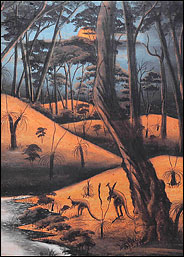
“Down to Drink,” by Parnell Dempster.

Australian young adult writers are conquering the entire universe. I was dead proud that Magic or Madness had already sold in five countries (USA, Australia, Taiwan, France, and Thailand), now I see that I’m underachieving. This article by Rosemary Neill is also startling because it’s so well-researched. It’s refreshing to read something in a mainstream news source about publishing and actually learn something. Via Yoof Literature (thanks, Lili!).

Speaking of research . . . Did anyone else watch the NBC so-called “news” report on the shocking new content of teen novels which aired Monday night? I watched it because R. A. Nelson who wrote Teach Me was interviewed. He spoke for about six seconds. The report consisted of people saying, “Look at the cover of this YA book!” Cut to cover of Gossip Girl or the like. “This book has shocking content! Should we let our children read books with shocking content?” Cut to a parent. “I’m shocked that my children are reading books with shocking content!” Cut to some random other person who is also “Shocked! Shocked by teen books with shocking content!” The 2 minute report ended with an admonition to parents to be wary of the shocking, shocking, shocking content of teen books.

I hadn’t watched “news” on television for ages and I gotta tell you I was shocked, shocked, shocked by the “content” of that report too!

Puce Redux

My friend, Ron Serdiuk, proprietor of the wonderous Pulp Fiction bookstore in Brisbane, just added this comment to the long ago puce thread. I think it worthy of elevation to a post of its own. He wrote:

I know that the historical origins were worked over and the flea blood/shit thang was put forward and everyone was fairly happpy with that and it seemed to be the end of the discussion . . .

but I don’t think that’s all there is.

I think the actual colour changed—and relatively quickly in hostorical terms—and became something else entirely.

Certainly now – according to Richard (source: decorator and paint charts) and Leanne (source: printers’ colour guides)—t’s either a cherry-ish red or an orange-y pink.

But even as far back as Heyer’s georgian setings I think it had already taken this road. whenever it’s used in her works it either—if used in the context of a male wearing it suggest dandyism or effeminacy—or when a woman is involved it seems to be vulgarity or a younger girl wearing something showy and inappropriate.

Neither suggest a sedate flea blood/shit purple-y brown to this little black duck.

I think we need a whole social history here. could be a great idea for a thesis . . . or maybe a popular history volume to supplement that wonderful book “mauve” from a few years back – (tho’ doubt one could find that puce made nearly as earth-shattering an impact as that aforementioned shade of purple! astonishing!)

One way or another, it aint over yet . . .

Says Justine: Interesting . . . there certainly aren’t many people who can carry off pinky-orange! Though I’m not sure I’d describe this colour as “sedate”.

Too Young to Publish—A New Musing

I’ve just put up a new musing. Yeah, yeah, it’s been a long time between drinks, but I’ve been busy, okay?

Too Young to Publish

Recently I’ve had a number of letters from teenagers wanting advice on how to get their novel published and wondering whether their age will make it harder for them to get it into print. Specifically, would they be discriminated against because they were only thirteen or fourteen or fifteen or sixteen or whatever?

The simple answer is no. When you submit a query letter to a publisher or agent you don’t have to tell them how old you are. You’ll be rejected or accepted on the quality of your submission.

Continue reading Too Young to Publish.

non sequitur

Just reading the 8 & 15 August issue of the New Yorker which includes Louis Menaud making the following assertion about Edmund Wilson:

When it came to most physical activities, he was inept. He did not, for instance, know how to drive a car.

Excuse me?

Many people do not drive cars. Some of them are highly ept at a whole range of physical activities. They have simply chosen not to learn how to operate the greatest killing machine of this century and the last. Any fool, ept or not, can drive a car. Takes a wise person to choose not to.

Georgette Heyer

I read Cotillion while on the recent London/Glasgow trip. Yes, that’s right in eleven days I was able to read only one book. That should give you a measure of how busy the trip was and how knackered I was at the end of each day.

Anyway. I was delighted by the response to my recent throw away comments on Heyer, but because I was on said trip with scanty interweb thingy connectivity I was never able to respond to the response. Sob.

In those discussions Harriet mentioned Cotillion as one of her favourites which spurred me to pick it up for a reread. I adore the book. But I didn’t always. On my first read as a teenager I found it a terrrible disappointment for the very reason I love it now: Heyer buggers around with your expectations, the hero isn’t who the teenage me wanted it to be. Why, he isn’t even in the petticoat line! She shows the reader exactly how selfish and awful a rake really would’ve been. The book is delicious and clever and subversive and funny and full of delight at messing with her own formula. Divine!

As are Frederica and Venetia. (And if I could stand to reread it I’d probably find the same of The Grand Sophy.) All those books were first published in the 1950s or early 1960s. Many years after The Black Moth was first published. By which time she must’ve been well and truly ready to mess around with the genre she pretty much created.

I’m dying to reread all her books in chronological order to see if this theory is even remotely true. Tragically, the rest of my Heyers are back in Sydney in storage. And more tragically I have many other books I actually have to read, not to mention the ones I have to write. Like this one and the final Magic or Madness book. Sigh.

Randomly

Georgette Heyer books remain most excellent on the umpteenth reread. On this occasion Venetia, Frederica, and Sylvester. Am unable to decide which I like better: Venetia or Sylvester. Right now am tilting towards Sylvester on account of authoress Phoebe’s roman a clef, the hero, Sylvester’s attempt to “mount” the heroine, and the truly appalling Sir Nugent Fotherby. But the sexy talk between Venetia and her Wicked Duke Damerel is hard to go past.

Can’t stop listening to Missy Elliot’s latest The Cookbook. Current fave: “We run this”.

The latest New Yorker has a gorgeous account of just how much Samuel Pepys (1633-1703) drank in a day:

At about ten o’clock, he would have his “morning draft”—usually “small” (or weak) beer, but sometimes regular beer or even wine. Cakes might be eaten with the draft, but dinner was the day’s main meal, then taken at noon, and, at least on some occasions, this was washed down with wine—possibly watered, given the volumes that Pepys records knocking back. During the rest of the working day, more wine might be consumed; Rhenish wine (sometimes sugared); “sack” (sherry or Spanish white wine); claret (red Bordeaux); “Florence” wine; “burnt” or “mulled” wine; wine flavoured with wormwood. He might also have further drafts of beer (traditionally hopped) or ale (traditionally unhopped), and specified as Margate, Lambeth, China, or Hull).

Fair enough. Drinking water back then was dangerous. I’d’ve been dead of cholera so very fast. I love me the taste of water. Especially New York City tap water which was unavailable to Pepys. Poor bastard.

It finally got hot here in NYC. I’m very happy.

And No. 2 Wins

There were many responses—thanks everyone—to my which-form-of-acknowledgments-should-I-go-with question, so rather than respond in the comments I’ll do it here. It’s my blog I can do it any way I want to. So, nyer.

I’m so thankful to the respondees that I’m thinking of adding an extra line to the acks:

And finally I’d like to thank Scott, Jeremyt, Claire, Barry, Gwenda, Ray Davis, Marrije, Richard b, Jonathan, Stephanie Burgis, the eagle-eyed and amazing Micole, David Moles, Shelly Rae, John Scalzi and Parker for telling me what form these acks should take, Janni for sitting on the fence, and Patrick Nielsen Hayden, Lauren and Jenny D for writing the dangerous minority opinion.

(For those of you wondering, nope, I have no idea who any of these people are. Honest.)

So, yes, being someone who always goes with popular opinion, I reckon it’ll be number two, and sand in the face to the dissenters Patrick, Lauren and Jenny D. Cause, you know, that’s what victorious marauding mobs do: they kick sand in dissenters’ faces. (Just close your eyes tight and you’ll be fine.)

Like Parker, I want both. The author’s acks for their gossip value, and also a credits page so you can figure out who designed the really cool dingbats, as well as who the coypeditor was (to either avoid or demand they copyedit all your future work). You do sometimes see editors and interior designers credited, but never copyeditors or publicists or proofreaders.

Jonathan writes: i’ve not written a novel, but there are a bugger of a lot of people who help with an anthology.

Speaking as someone who’s done both—there are a shitload more people you have to thank putting together an anthology than a novel. Relatively speaking writing a novel is a piece of cake.

In response to Patrick’s suggestion that I should: late in life, publish a tell-all memoir of such flamboyant magnificence that it eclipses all your work thus far.

I so don’t think so. Memoirs are hard work. You have to remember stuff and inadvertantly and advertantly (is that a word?) offend people, and get sued, hire lawyers, and, argh, no bloody way. I figure I’ll just keep my acks and dedications as fulsome as ever and if anyone feels like writing my memoir for me they can piece it together from aforesaid acks and deds. Piece of cake.

Gwenda wrote: What I loved best about Emily G’s column was the idea of critiquing acknowledgements and I must, sort of shamefully, admit that it was one of my favorite catty reviews ever. I’d far rather read catty reviews of acknowledgements than books.

You’re not saying that you’d rather read a catty review of acks than read a book, right? Cause that, Gwenda, is troubling. If you’re saying you enjoy catty reviews of acks over catty reviews of books, I’m with you. Unless the catty review is of a book I really really hated, or by an author I really hate, or by an ex (friend or lover) who was particularly mean to me, or by an English person (though not, Andrew, one from Nothern England), or someone who was once mean to any friend of mine ever, or by someone whose name is Rupert, Randy or Violet (I hate those names).

Those aside, reading a good vivisection of the acks page is indeed much more gratifying (except for the vague horror that perhaps you yourself have offended in just that way and could one day be on the receiving end of such an ack review). I very much enjoy a good mock of acceptance speeches and award ceremonies. “You love me! You love me! You really love me!” or how about, “I’d like to thank my agent, and God . . . ” You just have to adore the hierarchy in that little speech. Agent always comes first.

I confess that I have been obsessively reading, and yes, sometimes mocking, writer’s acks and deds for years. Ray Davis points to a wonderful dedication, Kyle Baker’s “This book is dedicated to whoever I’m going out with now.” I love it. I very much enjoy the good old “this book has been published despite the complete lack of support and obstacles put in my way by my family.” I’m paraphrasing several I’ve seen over the years. I giggle at certain over the top professions of love in the ack page. One stays with me. It appeared in an English language book, but is in a romance language and reads, “And to [name of beloved] I love you, so much, so much, so much!” And no the book was not a romance, it wasn’t even fiction, rather it was non-fiction of the driest kind.

Kathryn Cramer writers: I feel so naive. I thought acknowledgments were for finding out who really wrote ghost-written books.

Ah yes, all those books with this effusive ack: “This book would not exist without the research, editorial and all round amazing skills of [insert name]. Without you I’m nothing!”

Claire writes: of course, i’ve already received an offer of marriage from you, so i feel i’m already in the in crowd. so if you went with #1, i’d expect you to list me under “offers of marriage conditionally refused during editing process.”

Claire, sweetie darling angel, if I thanked every single person who refused my offers of marriage while writing and editing my books, the acks would be longer than the damn book. So won’t happen. Sorry.

Most Excellent Breaking News (updated)

Margo Lanagan, brilliant author of Black Juice and many other fine books now has a blog! Woo hoo! And a bloody superb one it is too! This news has made my day.

She’s even linking to some of her bad reviews and posing excellent questions such as: “Since when is ‘polished and clever’ the definition of good writing?” Since never, says I.

My only complaint is that so far she’s not enabling comments, thus depriving us all of the pleasure of welcoming her to blogland; and her of the pleasure of editing our comments (scroll down).

Update: as noted by Marrije in the comments, Margo has now enabled us all to get in amongst it with her and comment to our heart’s content. Yay!

Hiding the Trilogy and Unfinished Books

I just finished reading Elizabeth Knox‘s Dreamhunter (the English edition is called The Rainbow Opera) and I absolutely loved it. Couldn’t put it down. Fabulous worldbuilding, gripping plot, gorgeously realised characters, and, bloody hell, but Knox can write. It’s easily one of the best books I’ve read this year, or last year, or pretty much any year.

But.

Yes, I have a but. And it’s a but I suspected I was always going to have about this book, because the lovely Lili Wilkinson of the Centre for Youth Literature who sent me the book from Australia (it’s not available in the US yet) warned me that is has a cliffhanger ending and the sequel isn’t out yet.

No big deal, I thought. But now I’ve read that cliffhanger ending, and now I’m sitting here with no second Dreamhunter book to read and it’s driving me completely insane and filling me with rage at the publishing industry that would do such a horrible thing to me, an innocent reader! I mean not only am I in the midst of the worst narrativus interruptus of all time, but I don’t even know exactly when the sequel is going to come out. Only that it’s called Dreamquake and will be out next year. When exactly? Which bit of next year? The January bit or, shudder, the December bit?

And Dreamhunter is not a whole finished book. It’s cruel to launch it on an unsuspecting public in this form. Nothing on the cover, spine, or back indicates that it’s the first half of a duology. There’s no hint in the cover copy. Nothing in any of the front matter, not even in the back matter. Why?!

Well, okay, I’m being disingenuous. I know why. Because many publishing houses believe that the punters won’t buy book one of a series unless it’s by a known-quantity. Say J. K. Rowling, or Robin Hobb, or George R. R. Martin. While Elizabeth Knox is huge in New Zealand and her adult books have been (justly) acclaimed (go read Vintner’s Luck), Dreamhunter is being marketed as young adult, and in that area she is an unknown. Safest bet, think the publishing people who make these decisions, is to not let on too strongly that it’s just part one, otherwise the punters mightn’t shell out the money for it.

That’s kind of what happened with my book, Magic or Madness. Though the front flap copy does mention that it’s the first book of a trilogy, it’s not mentioned anywhere else. A fair few people have missed it, and been cranky that the book ends without wrapping up all loose ends. Not my fault, if it were down to me it would’ve had a great big 1 on the spine and mention of it’s triloginess on the back cover, but it wasn’t down to me, and thankfully, say the Penguin people, because they reckon that would have really hurt the sales. (And in my defense: there are lots of ways in which Magic or Madness stands alone. Dreamhunter just stops in the middle of the story, nothing resolved at all.)

So, shockingly sometimes the interests of the people reading a book and those of the people who produced the book don’t coincide. This leaves me, the reader, waiting ludicrously long amounts of time for the sequel to books that I foolishly read before their sequels are published. What to do in the meantime? Reread Dreamhunter many, many times. And pray that Knox doesn’t pull a Pullman on me with the sequel.

How the Future Isn’t

Mely has a lovely post detailing the future she’s sad we haven’t wound up with yet. Hint, it’s not the oft-touted Gernsback one. I’m with her on almost everything except immortality, which Scott has convinced me is a profoundly bad idea. Just imagine if certain world leaders never ever died.

I’d also really love a working transmat beam, because while I’m always saying I love travelling, I really, really, really, don’t. What I love is being somewhere else. If I could skip the whole many, many hours in a plane or whatever on the way to the somewhere else, I’d be dead happy.

Also I’d be very happy with food in patch or tablet form. I hate it when I just need food as fuel and there’s no time to enjoy it. I’d much rather down a pill and keep doing whatever I was doing and then, when there’s time settle in for that three hour sumptious feast accompanied by the very best wines, or a just-made-in-front of you taco from a market stall, or the bestest juiciest mango of all time. Also imagine how much easier pills or patches are to transport versus, say, grain. An end to world poverty, anyone?

And how about books in electronic form that are easy to read and don’t suck?

And, and, and . . .

Letters from the Past (Part 2) plus a Rant

Åka the proprietor of the blog, Läst och tänkt i annien dropped into translate:

Läst och tänkt i annien means read and thought in annien, where annien is my “idioverse”, the universe as perceived through my eyes. It is mostly about fandom, books, physics and strange or peculiar things.

I was reflecting over the fact that annien seems to be inhabited by so many more men than women (i’m a physicist and sf fan), and that maybe the books i read are likewise unequally populated. at the same time I happened to see the link to you from mumpsimus, and threw it in together with the other things. i also liked the first letter, but quoted asimov because it tied in better with the science and science fiction theme. I want to avoid too long quotes.

That was it, i think. Just ask if you want to know anything more.

Thanks for making these letters available! I have sometimes read or heard about what kind of discussions that occured in the magazines, and as a piece of history it is fascinating. Now I just want to read some old letter columns about the role of science in society and literature, to see what kind of opinions people had on that.

Thank you!

The letter columns of old sf magazines are wonderful, and yes, the role of science and literature does get debated. (Though by far the most common kind of letter merely rates the stories of a previous issue.) But even the most seemingly banal letter reveals a lot about the thoughts, feelings and ideas of the time. I found the letters columns of Astounding and Thrilling Wonder Stories the most active and interesting.

I’ve been hoping that since my book, The Battle of the Sexes in Science Fiction, was published there’d be more work on the culture of science fiction that goes into archives (public and private) looking at the letters and editorials in sf magazines as well as the stories and, as importantly, looks at the fanzines. So far, there still isn’t nearly enough. (Though if anyone comes across any such work—do let me know!) But I keep hoping.

Anyone doing work on sf is only doing half the job if they don’t look at sf culture. If you’re writing about sf now, that means you have to look at all the online debate not just published stories and novels. It’s what I encouraged the essayists to do for my collection Daughters of Earth.

But it’s difficult. Most scholars working on sf don’t have access to collections—there aren’t that many in the world—and most collections don’t have large (or any) holdings of fanzines. Private collections (particularly of fanzines) are even more inaccessible, often stored in the attic, garage, boxes under the house: all of which are unlabelled. Tricky. And on top of that many of those magazines and fanzines are falling apart. Particularly the ones from the war printed on inferior paper.

But it’s work worth doing and more to the point it’s fun. Reading those letters takes you back to a whole other world, one full of surprises, I wasn’t expecting to come across such strongly feminist letters in the pages of an sf magazine from the 1930s and yet that’s exactly what I found.

Letters from the Past

Over the past few days there’s been a remarkable jump in traffic to this page of my website. The letters reproduced there are from the late 1930s and debate the role of women in science fiction. I adore them. They’re funny, warm, silly and just plain gorgeous. A little investigation revealed links from mumpsimus, coalscent, swisstone and Läst och tänkt i annien (tragically, I don’t read Swedish, so I have no idea what that means and I don’t share my husband’s love of wacky google translations).

The commentators do seem to be remembering that Asimov was a kid at the time, just eighteen. And, by all accounts, he was a young eighteen with little knowledge of sex, theoretical or otherwise. Readers of these letters should also keep in mind that he was a possum stirrer of the first order, frequently arguing in the letter columns for the sheer joy of arguing. A type not entirely unknown in our equivalent of the letter cols of yesteryear—the comments sections of blogs.

It’s unsurprising that it’s Asimov the commenters focuss on, after all, he’s the big name, but the letter I find most moving is the first one, “five of a kind”, from a Naomi Slimmer of Russell, Kansas. It provides such a vivid window into her life back then. I wondered why none of the people posting and commenting about the letters had mentioned it. Then I realised that I hadn’t put the full text up. Woops. That is now remedied. Thanks to those linking and commenting for giving me the nudge to notice my oversight.

And a little extra treat just for those who read my blog. Here’s my favourite line from a letter to an sf magazine. For context—the letter was part of a debate about whether “sexy” covers and interior illustrations (i.e. scantily clad women) belonged in sf mags or were cheapening a clean and nobel genre:

“What’s wrong with sex inside or outside as long as the gal shows expression in her eyes?”
—B. W. Williams
Startling Stories January 1953, p. 136.

Saga of a Typewriter

I’ve been a fan of the lovely Ms Tingle Alley for some time now, but I think this is definitely one of her most gorgeous posts eva! And I speak as someone who can’t stand typewriters, though I do have a dim memory of my parents having a gorgeous red Olivetti one, and my longing to play with it, but that was before computers and word processing programs, without which I can’t even begin to imagine writing. And writing by long hand?! The utter utter horror of it!

Books of Wonder

Went into the fabulous Books of Wonder children’s bookstore today to drop off an arc of Scott‘s Midnighters 3: Blue Noon. (Yup, the final Midnighters book is that much closer to being a real book. Exciting, eh?) We were greeted with effusive expressions of happiness. I believe Sara snaffled the arc for first read. (I’ve just started my re-read, and, wow, does it crack along.)

It was meant to be a quick visit, drop off the arc, then hurry home to get some solid writing in before tonight’s game. But we ended up having a good old goss about which b.e.a. books we’d read and enjoyed: Totally Joe, Teach Me and Rebel Angels all got dissected (in a positive way!). We also raved about Valiant and because of Sara and Elena’s enthusiasm we walked out of the shop with copies of Looking for Alaska and The Boyfriend List (Elena’s favourite book in the whole wide world–right now). I’m now itching to go read them, but I should at least attempt to do some work today . .

This is why I love that shop so much. Everyone working there really, really, really knows books. They’re passionate, opinionated and enthusiastic and handsell their favourites like you wouldn’t believe. And they love talking books. I could go in there and swap opinions, get recommendations and natter for hours. Actually, what do I mean, “I could”? I just did.

I walked out of Books of Wonder in the best mood. I adore good books, and good book people, and good book stores. Happy sigh.

Okay, time to work now.

More B.E.A. Books

As I’m taking a break from copyedited pages for a moment, I thought I’d report on the other b.e.a books I’ve been reading. As instructed I have now read Teach Me, All the Fishes Come Home to Roost and am halfway through V for Vendetta.

They’re all amazing. I seem to be blessed by the god of picking up only good books. Yay me.

Teach Me is such a scorching read I thought my eyes would melt and dribble down my face onto the page. The book is so intense, captures so perfectly romantic obsession, teenage monomania (I’m not saying other age groups don’t get monomanical, I’m just saying R. A. Nelson captured that particular kind of monomania), and heartbreak that the book verges on being too uncomfortable to read. It’s extraordinary and will surely sell by the truckload.

All the Fishes Come Home to Roost is a wry smile of a book, which is incredible given that it’s a memoir of a truly appalling childhood. Rachel Manija Brown was dragged off to India to live on an ashram with her parents. At a very early age she realises she’s an atheist stranded amongst the obsessively godly. She’s also forced to go to the most hellish school I’ve read about in years, populated by brutal nuns who beat the students no matter what their behaviour: good, bad or indifferent. It’s also a lovely memoir of Brown’s reading history, from stirring histories of Indian heroes to fantasy, which she discovers after the following exchange:

“Have you ever read a book called Dragonsong? I think you’d like it.”

“No, but I like the title. Is it really about dragons?” I had been disappointed by Madeleine L’Engle’s Dragons in the Water, in which the dragons were boringly metaphorical.

Some of Brown’s reading history is almost identical to mine: Lots and lots of English boarding school books, mostly written by Enid Blyton. The colonical influence is still strong in Australia and India.

I don’t think either of these books come out till September, so if you weren’t lucky enough to snag them at B.E.A., you’ll have to wait, but they’re both totally worth waiting for.

The Good Old Days

Gwenda links this morning to a new blog set up to discuss sf and fantasy from the safety of annonymity. As Malcolm Reynolds would say, “I got no beef with that.” This is a very small genre, everyone knows each other and if you really want to say what you think perhaps annony-mouse is the way to go. I read through all of them, from most recent to first, and as Gwenda point out none of the posts put the boot in. It’s mostly when you should be voting/nominating for awards and discussions of stories/books recently read. Then I got to the first post.

Sigh.

Same old thing: back in the good old days sf was earth shattering . . . now, not so much.

Bollocks.

And I’m in a pretty good position to say bollocks because I’ve read through a vast deal of sf between 1927 and 1975, including at least one story from almost every issue of amazing and astounding during those years. Not to mention a fair amount since, right up to the year we are currently standing in. And you know what? There was an awful lot of dreck being published at the same time that Neuromancer, Dune, The Left Hand of Darkness, “Time Considered as a Helix of Semi-Precious Stones”, and “Houston, Houston, Do You Read?” first appeared. Stories and novels you never heard of because they have justly disappeared into obscurity.

Here’s something else that happens every five years or so in the letter columns of sf magazines (and now online): One generation starts mourning for the golden days of sf which was mostly when they were first excited and enthralled by the genre. They look back on the glories of Doc Smith and are horrified that anyone could compare him to Heinlein. And so on and so forth. This has been going on for a long time. Herodotus looked back with nostalgia on his good old days when, no doubt, the science fiction really, really rocked.

Right now there’s more sf and fantasy being published than ever before and some of it is absolutely amazing. I don’t think I’ve read more than a handful of collections that are as fine as Margo Lanagan’s Black Juice. If there’s any justice, then, like Left Hand of Darkness and the other classics named, Black Juice will last and last and last. So should Gwyneth Jones’s Life. Not to mention so much young adult fantasy literature being published right now. I’ve never felt so overwhelmed by how bloody high the standard of most of what I read is. Holly Black’s Valiant, Elizabeth Knox’s The Vintner’s Luck. I could go on and on and on.

The good old days are imaginary. Always were, always will be. Give it a rest.

This and That

Interwebby thingies I read and enjoyed today:

Tingle alley has some flittering thoughts about how fascinated she is by other writers’ acknowledgments here and here. Me too!

Some more Australian gloating about the coming Ashes series.

A cool review of David Levithan’s Boy Meets Boy.

Lesson learned today: sometimes google is definitely not all that, and a trip to the library is required. My attempts to find out more about the recording, publishing and reception of Bill Broonzy’s”Get Back (Black, Brown and White)” inspired by Josh’s comment here yielded close to nothing. Anyone out there got any leads please to let me know!

I finished up with the oz version of magic or madness—damn it’s hard to read through your own book a gazillion times. I honestly don’t think I can look at it ever again. But I’m dead pleased to be that much closer to having the book out in my own country! Now, back to the monster that is Daughters of Earth.

James Howe (updated)

In amongst all my book expo america booty was James Howe’s the misfits and totally joe. I read them yesterday. Yes, both of them. Wonderful, funny, heart-warming (in the non-chundery way). They had all the merits of fine writing and of shortness (oh, how I love short books!). They made me happy.

Particulary, the misfits on account of how it is influenced-like by the writings of mister damon runyon who I hear from a not entirely disreputable party is not without a certain amount of merit. if you haven’t already read them do so immediately. Well, except for totally joe which isn’t out till September—oh how I love b.e.a. booty!

Hmmm, what should I read next? Rachel Manija Brown’s All the Fishes Come Home to Roost, V for Vendetta or teach me by R. A. Nelson or Kelly Link’s Magic for Beginners? Life is good.

Update: Scott has posted an account of our day at the b.e.a so I don’t have to. What he said.

Geraldine McCaughrean: Genius Rewarded

I’ve just heard that Geraldine McCaughrean has won the contest to write the sequel to J. M. Barrie’s Peter Pan. This is astonishingly good news because Geraldine McCaughrean is a far better writer than J. M. Barrie ever was. McCaughrean is a genius. Every sentence she writes is pure gold. Here’s hoping that winning the contest and writing the wonderful book that she will, of course, write, is going to bring her the fame and riches she deserves.

And here’s hoping (double plus a billion) that her entire backlist of adult historicals are brought back into print. Although she’s best known for her children’s and YA (young adult) books, which are indeed all splendid, it’s her adult historical novels, The Maypole, Fire’s Astonishment, Vainglory, Lovesong and The Ideal Wife that blow me away. If I could write a book even a tenth as good I would be a very very happy vegemite. And if she would write some more, lots more, I’d be even happier. I’m sick to death of mentioning her adult books to people who are fanatic readers of historical fiction and them never having heard of her. It must end.

Here’s to a bloody brilliant writer getting the kudos and dosh she deserves.

Sydney, 19 March 2005

A Small Offering for the New Year

At the moment this is my favourite bit of dialogue:

"Is there anything you’re afraid of . . . apart from dragon hunters?"

"Dragon hunters are just men. It is iron weapons Danzi fears."

"So you don’t fear any creatures?"

The dragon was silent for a moment.

"There is just one creature dragons fear," Danzi said.

"What’s that?"

"Centipede."

"Centipedes?" Ping exclaimed. "Even I’m not afraid of centipedes."

"Centipedes crawl into ears. Find way to brain. Eat brain."

from Dragonkeeper by Carole Wilkinson, Black Dog Books, 2003.

Sydney, 7 January 2005

Judging Awards

As I write this I am home in Sydney, physically anyway. The jetlag thing is putting a glass wall between me and everything else; the world comes to me slowly and full of distorted echoes.

One of the pings that has gotten through is the winners of the US National Book Awards, and I got to thinking about awards and the judging process and the controversies that the major ones often seem to generate. I have been on the shortlist for three different awards and, more importantly, I have been a judge on a number of awards.

But first: I am so thrilled that Pete Hautman’s Godless won the young adult award. I loved it. Run out, secure yourself a copy and read it, people. Forget the young adult (YA) label—this is a book that should be read no matter how old you are.

Is Godless the best young adult title by a USian published this year? I don’t know because I haven’t read them all. More to the point, I haven’t read all the 180 books that were nominated for the YA award. This year I also loved Christopher Paul Curtis’s Bucking the Sarge and my husband’s Midnighters and So Yesterday and Katherine Hannigan’s Ida B: …And Her Plans to Maximize Fun, Avoid Disaster, and (Possibly) Save the World (which is really more of a kid’s than a YA book). There are also a bunch of books I’ve heard a tonne about that I haven’t gotten around to reading yet like Lois Lowry’s Messenger and Sharon Dennis Wyeth’s Orphea Proud. None of these books were on the shortlist, which means either they weren’t nominated (by their publishers) or the judges didn’t like them enough to list them.

Rarely is one book clearly superior to all other books published that year. It would be more useful if all these awards switched to publishing a list of five or ten fab books of the year. They could still have their big party of an awards’ night. The short list would be of twenty or fifty books and on the big night the select five or ten would be named. I know I can’t tell you which was the better book Godless, Bucking the Sarge, So Yesterday or Ida B. I loved them all.

Juried awards like the National Book Award are decided by a number of judges, usually five because that’s the perfect number. (Trust me, I was once on a jury of three and it sucked—two against three is no fair.) The judges read through all the nominees—all 272 if you happened to be one of the judges of the adult fiction National Book Award this year. The same group decides which five books should be on the final list and which of those should win. This can be a fraught experience.

When I was on the James Tiptree, Jr. Memorial Award (which was mostly an absolutely wonderful experience) we decided that we didn’t have to agree about the books on the shortlist (and mercifully we were not limited to just five), but that we did about the final winner. (The Tiptree Award is a particularly flexible award in that every jury gets to change procedure if they want. Other juries in other years, I’m sure, did it differently.) So our short list was an eclectic mix reflecting the various passions of the various judges.

Agreeing to the final winner was hard. Some of us were passionate about books that other judges despised, muttering, "Over my dead body does that book win." We had a veto and we exercised it, which meant we were left with books and stories that we all loved, but about which, perhaps, some of us weren’t as passionate as we were about other, vetoed, books.

Because that’s the thing about fiction that knocks you out; the book that you adore will always have the exact opposite effect on someone else. This is particularly maddening if you happen to be on a literary jury together. I happen to think American Beauty is one of the worst films ever made, but I know lots of reasonable, smart, interesting people who love it. Equally I am passionate about Dorothy Dunnett’s books, but you just have to read a few of the reviews on Amazon to know there are people out there who want all her books burned. Getting five people in a room and getting them to pick the best, frequently leads to compromises, to the award going to the book that some of the judges liked second best. We were lucky in the end all five of us was happy with our choices.

But as with every award ever, some people weren’t. This happens again and again with awards. People get invested in one book that year and when it doesn’t win it’s an affront to God and the natural order of things. It’s not. The answer to what kind of books win awards entirely depends on what kind of people are on the jury giving the award.

This year the five National Book Award judges for adult fiction came up with a list of books written by "five women from New York." There has been much bitching in The New York Times and elsewhere about the apparent same-sameness of their books (I have no idea if that’s true as I haven’t read them—I’m on a YA bender—but the plot synopsises certainly don’t sound that similar. I’m just cranky The Jane Austen Book Club wasn’t on the list). Shouldn’t there be more variety? Shouldn’t there be a limit on obscure books? Before all the publicity, none of the five had sold more than 10,000 copies and some less than a thousand (now the winner, Lily Tuck’s The News from Paraguay, is in Amazon.com’s top one hundred). Certain people argued that their low sales figures disqualify them from making the shortlist. Others have said that rewarding so-called "literariness" over accessibility is a slap in the face to ordinary readers.

What’s interesting about this year’s controversy is that instead of the usual argument about who got robbed (though there was some of that—poor Mr Roth) what’s being discussed is this—what are awards for? Pointing out good books to readers? Supporting the publishing industry by rewarding the books that they’ve poured all their money into via big advances and a large advertising budget? Rewarding the best books regardless of how obscure or how popular they are?

A shortlist is not just a list of the books the judges deem to be best, it’s also a list that says something about the publishing industry that year. It’s a message from a small group of people (the five judges) who are (usually) passionate about books to the wider publishing, writing and reading community (not to mention the media and wider population of people who don’t think about literature except when it gets in the news) and when it sparks such a debate and the kind of thoughtful commentrary I’ve been reading all over the blogsphere then that’s a very good thing indeed, regardless of who’s on the shortlist and who wins.

Sydney, 19 November 2004

Esteban el Centauro

I just finished reading a novel in Spanish, Esteban el Centauro
by Gilberto Flores Patiño (Atenas, Mexico, 1985). My first
ever. Admittedly it’s a very short novel: only 82 pages, coming
in at around 25,000 words. Barely a novella really. But as someone
who’s only managed to struggle through kid’s picture books, and
short simple stories and poems, it felt like a major achievement.
I read the whole thing through without an English translation by
my side. I read it and I understood it and it made me weep. I cried
and cried and cried and cried. And books hardly ever make me cry.
Except for Wide Sargasso Sea and Bridge to Terebithia
and Pride and Prejudice and In Cold Blood and,
okay, lots of books make me cry. But they’re all really good ones.
(Except for the really crap ones which make me cry for different
reasons.)

Esteban is the perfect book for someone with my level of Spanish who can’t cope with reading badly written exercises for people with my level of Spanish. It’s written from the point of view of a small boy, Esteban, talking to his constant companion, his wooden horse. (Hence the title Esteban the Centaur: half boy, half wooden horse.) There’s lots of first and second person (yay, my favourites). Hardly any subjunctive. Not a lot of new vocab, except for all the stuff to do with horses. And lots of repetition: "Because the sea is very big very big very big. Bigger than anything! It has lots and lots of water".

The clause structure is not complicated either, barely a "which" or a "who" in sight. It’s all this and then this and then this. Open any page and it’s littered with "ands", even more visible in Spanish because "and" is "y". An effect I will attempt to duplicate by using "&" in place of "and":

My mum & her friends & their girlfriends were walking & looking at the sand & they were picking up shells & one woman put a shell to her ear & she said she could hear the sea. Then I thought that the sea was talking & the voice of the sea came out of the shells, because all the señores & señoras & my mum were putting the shells to their ears & they started to laugh & say yes yes yes, I can hear it too. & because no one told me what the sea said, I looked for a shell & I put it to my ear, but I didn’t hear anything, & because they were all saying that they could hear the sea I thought that my shell was no good & I threw it away & looked for another & I still heard nothing & I looked & looked & looked, but none of the shells that I put to my ear had the voice of the sea.

I don’t remember the last time I read a story from a small kid’s point of view that so gorgeously captured the rhythms of a child’s speech, the endless stream of questions: "Who invents the words in dictionaries?" and their view from below—looking up at the grown-ups—trying to parse that strange adult world.

And to help my comprehension, Esteban el Centauro is partly set here in San Miguel. Esteban walks down streets I know, goes to Mama Mia’s looking for his mother, sits in the Jardin, looks at the Parroquia. Esteban’s childish eyes capture, too, some of the complex interractions between the Mexican and gringo inhabitants of this fine city. Something else I’m increasingly familiar with.

I’m not sure there’s another book in Spanish so perfectly designed for me. Following my teacher Alejandra’s suggestion, I tried Aura by Carlos Fuentes which also has the virtue of shortness, but it’s wham bam straight back to adult land: complicated structures, zillions of words I’ve never seen before. I can barely read a clause with even partial understanding. Fortunately my edition’s bilingual so I can cheat.

Still, I read a novel in Spanish! And I will keep trying to read others, the way I keep trying to have conversations with people, even though I stumble over verb conjugations, pronouns, masculine and feminine, and haven’t managed to fully erradicate my lisp. But if people don’t talk too fast or use too many unfamiliar words or phrases, I can understand them. And, on occasion, I can even manage a long conversation about tricky subjects, like the relationship between servants and their employers in San Miguel. I even had a shot at explaining cricket. Not recommended. But then I’ve never managed that successfully in English either. Amazing how many otherwise intelligent people fall apart when confronted with phrases like Hit Wicket and Silly Mid-Off. I shall never understand it.

San Miguel de Allende, 22 January 2004

Most Life Changing Reading

Seeing Angela Carter read her story “Peter and the Wolf” on the eve of my twenty-first birthday at the now-destroyed Harold Park Hotel in Glebe, Sydney. In one of the noisiest pubs in the world, you could’ve heard a pin drop. My favourite writer in all the world turned out to be the most wonderful reader in all the world. She was jaw-droppingly extraordinary.

A Reading at KGB

I have ambivalent feelings about attending readings. Don’t get me wrong, I love being read to. Particularly when I’m feeling miserable (say, with the flu, or women’s troubles, or the state of the nation). Listening to someone I care about’s voice transporting me away from my runny nose, my cramps, and little Johnnie Howard, is one of life’s great pleasures. Friends and lovers and, in the olden days, my parents, have indulged me on many occasions and read till their throats went hoarse (a heartfelt thanks to you all).

But readings as public performance, as sales pitch for a writer’s published work, are a different matter. I’ve been to many, many excellent, fabulous, life-changing readings but, still, the thought of attending a reading fills my heart with dread.

Public readings do not involve a comfy bed or sofa, and rarely include pillows or blankets. You cannot call for toilet breaks, or more wine, and you can’t ask for a reread because you really liked that bit, or were (momentarily) distracted. You cannot ask for an ending to be changed if it upset you (to this day I’m happy in the knowledge that Ivanhoe and Rebecca rode off into the sunset together).

Public readings also have the uncomfortable habit of revealing that a writer you have worshipped all your life has an unpleasant voice, or one that sounds just like that jerk Richard, who beat you up every day for a year in fourth grade, or worst of all has a perfectly pleasant voice, but can’t read out loud to save themselves.

They rush past the tragic moments, laugh at their own jokes, pause for applause that isn’t ever going to come, and mispronounce all the words with more than two syllables. They put on different accents for each character, all of them cringingly bad, particularly the Australian accent (note to all North Americans: don’t do it, don’t even try. Meryl Streep couldn’t do an Aussie accent, and neither can you).

No matter how brilliant a writer, you know you will never open one of their books, or hunt down one of their stories again for fear of having their dread voice in your head as you read. They kill their writing stone-cold dead.

That is what fills my heart with horror at the prospect of attending a reading. And there is no reading series I dread more than the KGB Science Fiction Reading Series.

KGB is not a large bar. More than twenty people and you start to find breathing an issue. The seats, if you can get one, are uncomfortable. There is a theatre upstairs that seems to specialise in loud thumping, yelling, running-up-and-down-the-stairs plays on Wednesday nights. Fortunately, the amplification has improved a lot since my first KGB in 2000.

Prior to April 2003 (and halelujah for April 2003!) KGB had smoke from floor to ceiling, even if it was just one person smoking a practically no-tar, no-nicotine menthol cigarette. Even now someone coming in from smoking outside is liable to smoke up the place just by exhaling.

An astute peruser of my website might have noted that I attend every KGB reading I can. Too true. Well spotted. Why attend, you might ask, if it’s so dreadful?

Because the bartender’s a sweetie who’s as quiet as a mouse during the readings, it’s just round the corner from where I live, and, well, okay, I’ve yet to go to a bad reading there.

Last night’s reading was no exception. I arrived fifteen minutes early to find the place packed way beyond capacity and no hope of a seat (perhaps because in their listing of the KGB reading, The Village Voice claims that Kelly Link has written the two best sentences of the last 10 years). There were lots of non-usual suspects which is always heartening.

I made the mistake of slipping out to the loo just before it began, thus ensuring that I spent the first reading in the hallway, sitting on the steps, scrunching out of the way for mad thespians running up and down the stairs, and catching the occasional snippet of reading from inside the bar.

Apparently Holly Black read a fairy tale set in the Phillipines about a girl who was trying to avoid getting rabies from some elves at a night market. Everyone I talked to who actually heard her story, said it was fabulous.

I timed my loo break better for Kelly Link‘s reading, and was able to sit at her feet, gazing up adoringly as she read a fabulously funny story about a girl trying to avoid getting rabies from nasty tattooed dog-owners in a small town located near a zombie city not far from the Canadian border. Much fun was had at the expense of Canadians (fine by me as long as she stays away from dissing my people). There were also lots of pyjamas. I love pyjamas. It was wonderful.

New York City, 19 June 2003

Researching The Battle of the Sexes in Science Fiction

(Talk given to the Friends of the University of Sydney Library on 19 August 2002)

I’m here to talk about the genesis of my new book, The Battle of the Sexes in Science Fiction. The book literally would not exist without Rare Books’s Science Fiction collection. And neither would the book I’m currently working on. In fact, neither would my career. Or at least my career would certainly have gone along a very different path.

The science fiction collection is built around Ronald Graham’s 1978 bequest of his extraordinary sf collection. He was an obsessive spending a vast deal of his fortune attempting to acquire every copy of every sf magazine or book ever printed. He came pretty close. Knowing that his family had zero interest in sf he bequeathed his collection to Rare Books. The existence of that collection is why I’ve been working on early sf for the last ten years. It’s a science fiction scholar’s dream. It’s all down there: the fiction; the criticism; the discussions; both amateur and professional. Reading through the pages of magazines and fanzines in the early days of sf I saw the sf community emerging.

I was first shown around Rare Books in, I think, 1991. I was in the final year of my honours degree and I had been toying with the idea of doing my Ph.D. thesis on fantasy or science fiction. What my Ph.D. was going to be about occupied my mind a lot as I procrastinated about writing the essays that would get me the marks that would allow me to actually do said Ph.D. Depending on the time of day or what I had just read my thesis was going to be about the reception of Elvis Presley amongst indigenous communities in Australia; the short stories of Isak Dinesen or Angela Carter or Tanith Lee or Kate Chopin or maybe Flannery O’Conner; or possibly on the use of nightmares in horror films.

Somehow, I really can’t remember how this happened, who it was that told me the collection existed, or who to see about it, but I went and saw Pauline Dickinson (the creator and then manager of the collection). I must have been really incoherent describing why I wanted to look at the collection because somehow she assumed that I wanted to look at the fanzine collection. I had no idea what a fanzine was. For those of you who don’t know a fanzine is an amateur magazines produced by science fiction fans which covered many topics, sometimes even science fiction.

Pauline pulled various fanzines out, talking about the Futurians and the Moonrakers, as though I should know who they were, mentioning names like Isaac Asimov and Arthur C. Clarke (at least I’d heard of them) as well as lots of many names that were completely new to me. She mentioned something called a staple war and other other puzzling things.

Pauline than showed me the science fiction magazines. I had only the vaguest notions about the history of science fiction. For me it was a genre made up of books. I had no idea that short story magazines had been crucial to its development. I had no idea that until the paperback boom of the 1950s, short story magazines had been crucial to almost all genres of writing, particularly in the USA. Here was Pauline, holding up the very first issue of the very first English-language science fiction magazine, Amazing Stories dated April 1926. I was, well, amazed. I knew then and there that my thesis was going to be about science fiction, and was going to be shaped by that collection.

1n 1992 as soon as I enrolled, I went to work. I was absolutely thrilled to discover that it was deemed more practical to give me a desk down in the collection, than for me to sit in the reading room filling in request forms for particular volumes. The majority of the collection is not catalogued, making it pretty difficult to specify what volume I wanted.

So there I was alone in a huge room with no windows, full of row after row of the various special collections–Victorian triples; a complete run of Playboy magazine, rare eighteenth- and nineteenth-century scientific texts; detective fiction; and then right at the end the many, many shelves of the science fiction collection: books and magazines and fanzines and my little desk and chair. I felt like a child let loose in a lolly shop.

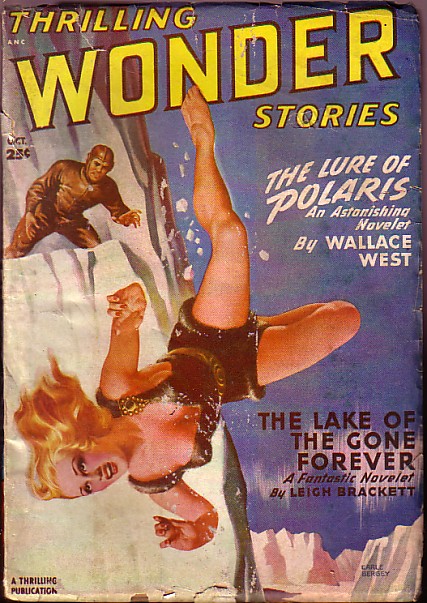
At first I had no system because beyond the general area of science fiction I had no idea what my thesis was going to be about. I read through early issues of Amazing and fanzines from the 1930s because they were what I had seen first. Then I read issues of magazines with titles like Planet Stories, Weird Tales and Thrilling Wonder Stories because they had the best covers.

I realised fairly quickly that I was far more fascinated by the letters and editorials than I was by the stories. Many of which are pretty unreadable by contemporary standards. The letters by contrast were often lively and engaging. They range from short letters which merely rate the stories, to discussions of scientific problems in the stories, to debates about the state of science fiction and the world, or perhaps just the state of the particular magazine. This letter from a 1947 Astounding Science Fiction is a good example:

The whole magazine is really something that science fiction can be proud of, something that you can show to the scoffers and say, "Since when is science-fiction tripe!" The recent atom-bomb stories are wonderful, frightening things, really not "astounding" at all, since they very likely could happen in another war….

BUT, Brass Tacks is the worst letter column published. It’s too short and doesn’t have half enough editorial comment on individual letters. Either you leave out Brass Tacks entirely, or you publish three or four long, highly technical letters from people who write in and dispute the accuracy of the meteorology, astronomical mathematics, electronics, or gunnery trajectory computation of the articles. Not always, of course, but more and more Brass Tacks is inclining towards the old Science Discussions. There’s nothing wrong with Science Discussions but it gives fans like me, who are majoring in history and English literature, a rather futile, behind-the-times feeling, as if our humble opinion is not wanted, aside from maybe a card rating the stories.

Reading the letters becomes addictive because there were often sequels. A controversial letter in one month would be followed up by many replies in later issues. Or sometimes a seemingly innocuous letter would set the letter writers off. Certain names would turn up over and over again. I found myself beginning to skip letters from some writers because they annoyed me (I know bad historian, bad) and impatiently looking for the letters of other regulars (known in the fan community as letterhacks).

It all began in Amazing Stories. The first science fiction magazine, with the first editorials and letter columns. This is where science fiction fandom was born. Those letterhacks started to write letters directly to one another. Easy to do as their full address was printed in the magazine. From writing each other letters they went on to forming clubs and printing fanzines and by 1936 putting on the first science fiction conventions.

Reading through the early issues of Amazing I saw the first appearance, in the editorials and the letters, of the notion that science fiction is not like other popular genres, that it is a literature of ideas. A literature about science, technology, progress. A literature that is good for you rather than being merely escapist.

Gernsback frequently points to the magazine’s educational mission declaring in the first issue that his magazine is not "the love story" or "the sex-appeal type of magazine [or] the adventure type”. The emphasis was strongly on the ‘science’ in science fiction: "[W]e live in an entirely new world. Two hundred years ago, stories of this kind were not possible.” Gernsback writes:

Not only do these amazing tales make tremendously interesting reading—they are also always instructive. They supply knowledge that we might not otherwise obtain—and they supply it in a very palatable form. For the best of these modern writers of scientifiction have the knack of imparting knowledge, and even inspiration, without once making us aware that we are being taught (First editorial, April 1926: 3).

Gernsback particularly loved to publish letters from readers who were led to study science by reading science fiction: One of his readers writes that the "science in most of the stories is an inspiration to me in my studies in electrical engineering” (Science Wonder Stories [October 1929]: 467).

I was utterly fascinated by this wealth of primary material. I was also out of my depth. I realised I was going to have to read some secondary material to help make sense of it all. In the midst of doing that I came across Joanna Russ’ 1980 article "Amor Vincit Foeminam: The Battle of the Sexes in Science Fiction” and suddenly my thesis, now book, was born.

In the article, Russ uses the term "the battle of the sexes" to refer to sf texts which are explicitly about the ‘Sex War’ between men and women. She discusses ten stories published in the USA between 1926 and 1973. Stories in which women have turned on men—literally battled against them—and taken over the world. Worlds in which women have been eliminated because they are no longer necessary in a male scientific utopia. In most of the worlds where women have taken there will be one brave man left who will find the one feminine woman left and together they will lead the world back to how it should be. The stories sounded bizarre.

Before I read the Russ article I had no idea there were such stories in science fiction. Yet because I was sitting reading this article down in Rare Books surrounded by the majority of the science fiction published in English between those dates 1926 and 1973, I was able to get up and find the original of each story on the shelves. The majority of the stories Russ refers to come from Sam Moskowitz’s anthology When Women Rule (1972) I was able to read the stories in their original context, with the editorial descriptions of them, blurbs about their authors, and readers’ responses.

It was clear that the sf community recognised it as a subgenre of science fiction and could name many other examples. Often berating a particular story for merely copying an earlier and not doing it nearly so well. Having read the stories in situ it was easy to find those other examples and I could read debates about the relationship of men and women taking place not just in the stories but in the letter columns and editorials of the science fiction magazines and in the fanzines. All of which gives a very different picture, a more complex one, than that set forth by Russ in her article. As I said access to this kind of material is historian heaven.

In one day I had read Joanna Russ’ article, most of the stories she refers to, as well as some letters in response to those stories. Because of my earlier random reading through other science fiction magazines I had already come across letters to the editor that dealt with the Sex War. I knew I had a wonderful topic.

One of the letters I had already seen was by the 18 year old Isaac Asimov supporting the idea that women and love (interchangeable items) have no place in science fiction. They’re interchangeable terms because according to Asimov and others, the only place for a woman in a science fiction story is as the love interest not as, God forbid, a scientist. In one letter, in support of another correspondent he writes:

Three rousing cheers for Donald G. Turnbull of Toronto for his valiant attack on those favoring mush. When we want science-fiction, we don’t want swooning dames, and that goes double. You needn’t worry about Miss Evans, Donald, us he-men are for you and if she tries to slap you down, you’ve got an able (I hope) confederate and tried auxiliary right here in the person of yours truly. Come on, men, make yourself heard in favor of less love mixed with our science! (Astounding Science Fiction [September 1938]: 161).

I read with interest the many replies of female—and male fans—who disagreed. That particular debate comes up in science fiction again and again. I had no shortage of material.

Sitting in Rare Books surrounded by thousands of sf fanzines, magazines and books I was able to follow the emergence of science fiction fandom and the science fiction community. The majority of academic work on science fiction either ignores or says very little about the importance of the science fiction magazines and of science fiction fandom. I believe the major reason for that is simply lack of access. If Rare Books did not have this collection, I doubt that I would understand science fiction in the same way that I do now. (Even if I had actually done a PhD on science fiction and not one on the reception of Elvis Presley amongst indigenous communities of Australia.) The majority of my information would have come from secondary not primary sources.

Rare Books is also where I first discovered the New York Futurians who are the subject of the book I am working on now. I discovered them one day when I had reached my limits of reading battle of the sexes stories. This happened every so often.

Here’s a plot synopsis of a typical sex battle story: "The Priestess Who Rebelled,” published in 1939 by Nelson S. Bond is the first in three stories about Meg, a priestess in a postapocalyptic matriarchal world. She meets a man, Daiv, who is unlike the soft, weak men who serve her people as breeding stock. He comes from the one unmatriarchal people left on Earth. Meg is on her way to see the Gods, this being the last rite before she becomes the Mother, head priestess of her people. The man, Daiv, tells her that her Gods are men and implores her to be his mate as she is very beautiful—though his first words to her are: "You . . . talk too much. Sit down, Woman!” (208).

Before Meg goes to see her Gods, Daiv kisses her, "the touching of mouths,” and she is swept off her feet but still determined to do her duty. She arrives at Mount Rushmore, which turns out to be the Place of the Gods, and sees that her Gods are in fact men: Jaarg, Taamuz, Ibrim, and Tedhi. Meg realizes that her sterile, unnatural, virgin existence need not continue: she can become Daiv’s mate and live happily ever after. She tells the priestess of her people:

It is no Man-thing, Mother. It is a Man; a real Man such as were the Gods! Not a scrimping parody like our breeders, nor a foul brute like the Wild Ones – but a Man. He is Daiv, my mate! (Bond 1940: 46).

As you can imagine reading stories like that everyday for several years can become a bit much. So every so often I would get up, prowl around the shelves, until something would catch my eye. Very early on two beaten up cardboard boxes did. They turned out to contain early Futurian fanzines, a few letters and some photographs. I’m pretty sure Pauline had pointed them out to me during that initial tour.

Although I recognised some of their names, Isaac Asimov, Frederik Pohl, and knew the Futurians were a fan group I still had only a vague idea of what science fiction fandom was. Reading their fanzines from the late 1930s/early 1940s was a lot of fun. They were funny, lively and engaging. I learned about the first ‘world’ science fiction convention held in New York City in 1939 in conjunction with the World’s Fair and about their feud with some of the members of the rival sf fan group, the Queens Science Fiction League, which led to four of the Futurians being barred from attending the convention.

I became obsessed and spent several days reading Futurian material. Their fanzines varied from one- or-two page notices which were circulated in their share households to full scale productions with artwork, stories, poetry and articles. I did not know as I read them that the Futurians were the most famous of all sf fan groups. Famous because almost everyone of them went on to a distinguished career within the field. Isaac Asimov, Frederik Pohl, Damon Knight, Judith Merril and James Blish were all Futurians.

The Futurians formed in the late 30s when a cadre of left-wing science fiction enthusiasts got together in New York City. They were aged between 14 and 21. They adopted the Gernsbackesque motto, "Save humanity with science and sanity”. Though unlike Gernsback there was a certain amount of tongue in cheek. Though not always, in 1939 Frederik Pohl had the following letter published in "Under the Lens,” the letter column of Marvel Science Stories:

Readers of your magazine will be interested in the new Futurian Federation of the World, an organization which will make strong attempts to enroll every science fiction reader in its ranks. It is not necessary to be one of the ten most popular fans to join The Futurians or to enjoy its organ; it is merely required that one have an active and alive interest in science fiction and in the future.

The official organ of the Federation, The Futurian Review, furnishes the most adequate and interesting coverage of what is going on in science fiction and allied fields of any fan magazine. Subscriptions to this paper are given free to all members of The Federation and can be obtained in no other way, but a sample copy, plus information on the club itself, may be had for 10c in coin of any country of the world sent to Frederik Pohl, Provisional President 280 St John’s Place, Brooklyn, New York (Marvel Science Stories August 1939: 108).

The drive to gather lots of other Futurians did not last very long. The group never exceeded twenty and by the early forties the desire to conquer the world and turn it into a Futurian Federation had vanished. They were happy just hanging together reading, writing, arguing.

Reading their fanzines as I did–with precious little context–raised more questions than answers. What I wondered was Ghod and Ghu? Who were the evil Quadrumvirate? What on earth were they raging a battle against?

Some of the answers to these questions I found in a fabulous amateur publication, The Fancyclopedia, published in 1944 by one Jack Speer which I found underneath one of the boxes of Futurian material next to the run of Wonder Stories. There was an entry on the Futurians:

Futurians – A group of New York fans, of whom Wollheim, Lowndes, Pohl and Michel have been the central figures. Others thot [sic] of as belonging to the group are Cyril Kornbluth, Harry Dockweiler, Chet Cohen, Dan Burford, Jack Rubinson, David A. Kyle, Dick Wilson, Isaac Asimov, Herman Leventman, Walter Kubilius and leslie perri.

The Futurians present a peculiar differentness in whatever sphere of fan activity they engage in, being, with some exceptions in each case, Bohemian in social practices Marxistic in politics, anti-Sykora in fan feuds, Michelistic in fanish whiterings, inclined fanarchistically with regard to general fan organization, given to vers libre in poetry, eroticism in literature, and decadence in all forms of art, and having taken part as a bloc in Progressive and Constitutional parties of the FAPA.

They emerged upon the breakup of the ISAA, and were the dominant faction in the Second Fandom, when they were called Wollheimists. When the GNYSFL broke up, they formed the FSNY in September 1938. With Pohl’s Futurian Federation of the World, the term "Futurian” became a common word for that type of stefnist. After the Quadrumvirs resigned from FAPA office, they became less active, but lived in various science fiction houses, and many graduated in time from author’s agents to editorships of some of the new pros, where they put quite a lot of their personalities into their magazines, and were noted for the number of Futurian authors appearing in Futurian-edited magazines (41).

This raised a whole lot more questions. Who’s Sykora? What’s the ISAA? I spent a lot of time flipping from entry to entry in the book before realising that I really needed to get back to reading about real Men and real Women and the battle of the sexes.

I did not forget the Futurians or their fanzines. I realised that this was a very interesting and weird group of people who had an enormous effect on shaping science fiction. I became even more determined to go back to them when I discovered how rare the fanzines were–a large part of the collection of Futurian papers in the Rare Book no longer exist anywhere else in the world.

So that’s how this book and the one I’m writing came about and how I’ve found myself transformed into a science fiction expert. I’d like to take this opportunity to thank the staff of Rare Books who since 1991 have been absolutely amazing. Thank you.