Category Archives: Writing life

Patricia Highsmith, Much Crazier than You

All writers fear they are a bit crazy. Some of them are. Obviously, I am at the hardly-crazy-at-all end of the crazy-writer scale, most other writers are much loopier than me. While that is clearly a fact, I confess that I have my moments of doubt. I have found just the cure for those moments of doubt: Patricia Highsmith.

I am reading the new bio, The Talented Miss Highsmith by Joan Schenkar. Oh my. Oh wow. Oh Elvis. Highsmith redefines the crazy end of the crazy-writer scale. I have a million different responses to this book, but one is relief. Cause no matter how crazy I might (rarely) fear I am, Miss Highsmith will always be much much much much worse. Because she’s not just crazy, she’s mean crazy. She’s curse-out-everyone-at-your-favourite-restaurant crazy. Throw-a-dead-rat-in-your-room crazy. You know, not even slightly charmingly eccentric.

*Heh hem* I must get back to it. Best bio I’ve read in ages. So glad I never ever met Highsmith.

But, yeah, if you’re feeling loopy, read this bio. You’ll feel much much better.

I’m Not Your Target Audience (Yes, You Are)

Much of the fan mail and comments I get from adults includes this phrase “I’m not your target audience” before continuing to say how much they enjoyed one or more of my books in (sometimes) slightly embarrassed tones. As if they’re a tad worried to find themselves reading and enjoying a book published for teenagers. How did that happen? they wonder. Does it make me less of an adult?

I understand the anxiety. Before I became a published YA author, I was unaware of how disdainful many adults are towards teenagers and anything that smacks of teenager-y-ness, such as books marketed at teenagers. Looking back, I now find it weird that I was unaware of this. Firstly, I once was a teenager. How did I manage to forget the way many adults treated me?1 Secondly, I stopped reading books for teenagers when I was twelve because I decided I was too good grown up for them. So, yeah, I seemed to have imbibed adult disdain for the things of childhood and adolescence at a very early age. Yet I got over it enough to forget such disdain existed until I started writing YA.

At which point, wow, did I learn it all over again.

So, yes, I understand why some adult readers of YA feel a bit apologetic about it. But, truly, you don’t need to apologise to me. I am very happy to be writing the books I write and to be published as YA. Every day I wake up and cannot believe my luck to be in such a fabulous genre.

Also it so happens that I don’t write for a target audience. When I’m deep in the writing I’m not thinking about audience, but about writing the best book I can. Unless by “target audience” they mean “subject matter”. Absolutely, adolescence is the central matter of my work. But that’s a subject of interest for those who are about to be adolescents, for those who are adolescents, and for those, like me and the readers who say they are not my target audience, who were adolescents. From the fan mail I see that my books are read by all three of those groups, which makes me very happy.

Or in other words: I happen to think that everyone is my target audience.

You’ve been warned. I’m aiming at YOU.

Heh hem. As you were.

  1. How come so many adults forget this? []

What Novel I Wrote Next

Searching for something else entirely, I stumbled across this old post from March 2007 where I asked my faithful readers to help me choose what to write next. I decided it would be fun to do an update. Fun for me, anyways.1

First on the list of possibilities is this one:

The compulsive liar book narrated by a—you guessed it—compulsive liar. Downside: will involve lots of outlining. I hates outlining. Plus it’s going to be so hard! Upside: whenever I mention this one folks get very excited.

Sound familiar? Why, yes, it’s the book I wrote next: Liar which published in September this year. As it happens it involved no outlining at all. But I was right it was hard. Much harder than I knew at the time. It also generated more excitement than I anticipated.

The other now completed item on the list was this one:

Try to write a short story. I’ve had a brain wave for completely transforming a story of mine that’s never worked into one that will. It involves making the ending not suck (why did I not think of that before?!) and setting it a couple hundred years ahead of where it’s set now. It involves no research. Downside: I suck at short stories. Upside: Not starting from scratch and may lead to an actual good story. That would be cool!

The story was “Thinner than Water”, which was published in 2008 in Love is Hell. You can find a bit more about the story here. Even if I do say so myself it is an actual good story. I’m proud of it. But it was many years work and I think I’ll be sticking to novels from here on out.

I don’t know why the 1930s book isn’t on that list. I was already thinking about writing it in October 2006. Though the specifics didn’t come together until a fortuitous conversation with Cassie Clare in 2007. (Thank you, Cassie!)

The other idea on that list I’ve made a substantial start on is this one:

Protag’s father goes missing presumed dead on account of he and protag’s mum very into each other. Mum is forced to take in a lodger to help pay the mortgage. She advertises for a female uni student but takes in a strange youngish man who has no visible means of support and yet pays the rent on time. He’s gorge and speaks a zillion languages but the seventeen-year old girl protag doesn’t trust him. Her twin brothers (eight years old) almost immediately fall under his sway. I could go on, but it’s just not very pitchable. Alas. Downside: Not very ptichable. Tis one of those books that’s clear in my head but takes months to explain. Sigh. Upside: tis very clear in my head.

I have, in fact, recently resumed work on it. Though as I am at work on many other things that does not mean the lodger novel will be finished any time soon.

Actually none of the other things I’m working on is included on that list. Mostly because I hadn’t thought of them way back then. Which just goes to show you that ideas really are a dime a dozen. Why, I just got a new one yesterday that I’m valiantly struggling against given that I already have four novels on the go. Five would be too many.

It was lovely looking at that list from almost two years ago and realising that in the intervening time I’d written two of them. Novels take ages and for me short stories take even longer. It will be many years before I write all those books. If, indeed, I write them at all. Most likely I’ll forgot about them and move on to other shinier ideas.

Because it’s not about the ideas, it’s about what you do with them. My barely sketched out idea of Liar from early 2007 does not invoke the completed book. There’s no mention of murder, no sense of what Micah is like, and no hint of why she lies. The book you write is never a perfect match with the imaginary book that was in your head before you began.

And now I must go and do some of that writing thing. Hmm, lodger novel? 1930s? Or that shiny new idea from yesterday . . . ?

  1. Hey, it’s the holidays no one’s reading this right now. []

More on Unhappy Endings

I started to respond to comments on the last post and realised it was turning into it’s own post. So, um, here it is.

Reading all your responses has crystallised something for me that I’ve been thinking for a long time: That there’s a gap between my expectations as a reader and what I do as a writer. The reader me desperately wanted a good ending1 for Lily Bart in House of Mirth and was furious with Edith Wharton for all the misery. Why, Wharton, why?!

The writer me though is unmoved by such readerly desires. I write the books the way they have to be writ. They have their own logic and I cannot force them to go where they don’t want to go. Trust me, I tried to force Magic’s Child to go in the direction I had planned for it. Wound up having to rewrite that ending a kajillion times until finally it was somewhere near where it was supposed to be. Yes, some readers are unhappy with it. Whatcha gunna do?

It fascinates me that, on the one hand, I can be angry with a writer for breaking my heart while, on the other hand, I’m more than happy to break readers’ hearts with some of my own stories and novels.

As a reader I would like to go back in time and force Edith Wharton to make it better for Lily Bart. Kind of a la Stephen King’s Misery. But, you know, without kidnapping or breaking ankles. But were I her I would tell me where to go. It’s not her fault I was under the misapprehension that she was the USA’s Jane Austen. Wharton wrote the best book she could with the ending that made sense given the world and characters she had created. My desire for the ending to be Pollyanna’d is my problem, not hers.

As a writer, nothing will convince me that we owe our readers anything other than the very best books we can write. And, we’ll be the judges of that, thank you very much.

As a reader, who just read a book she was not in the right space for, I think all you smelly writers can go rot in hell.

Yeah, sometimes it’s confusing to be me.

Thanks, so much for the wonderful comments on happy endings. It was lovely to see such a diversity of views.

  1. That good ending does not include Lily winding up with that spineless loser Selden, by the way. []

Last Night’s Event

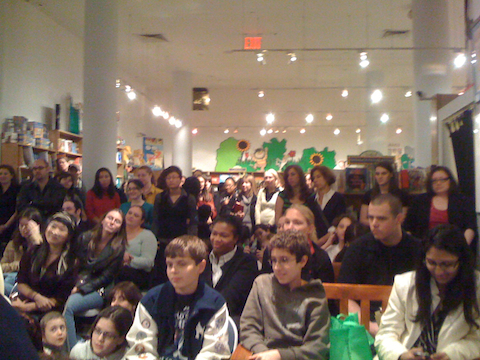
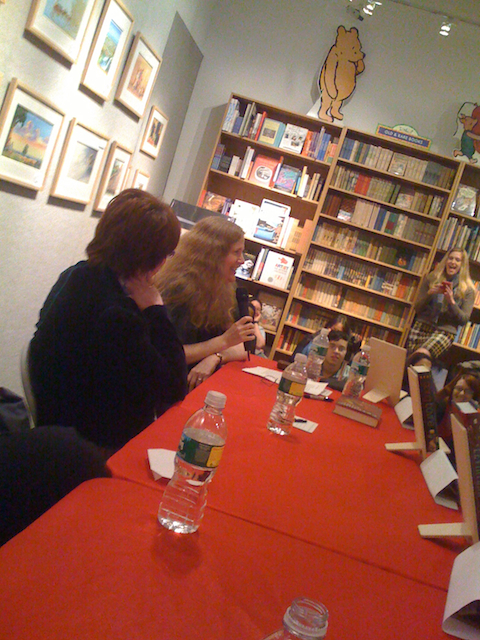
The event at Books of Wonder with Libba Bray, Kristin Cashore, Suzanne Collins, me and Scott last night was astonishing. Several people said they thought there were around 200 people there. I could not possibly guess from where I was sitting, but it did indeed appear to be many.

Here’s my bad fuzzy photo of the many:

It was pretty overwhelming to be on the bill with such popular writers, especially Suzanne Collins. For those who don’t know, her two most recent novels, Hunger Games and Catching Fire are currently, and have been for some time, numbers one and two on The New York Times bestsellers list, selling bajillions of copies a week. The Books of Wonder appearance was organised around Suzanne because it was her only signing for Catching Fire. I can’t tell you how grateful I am that Peter Glassman (the owner of BoW) thought to ask me to take part. Here’s Suzanne in action (with Libba Bray listening carefully):

I’d never met Suzanne before. She’s lovely, smart and gently funny. She, me and Libba had a fun conversation about the joys (meeting wonderful teens, booksellers, librarians) and travails (food poisoning) of touring. She’s also extraordinarily generous, giving up a big chunk of her presentation to talk in detail about how much she’d loved Liar, Fire,1 Leviathan and Going Bovine. Thank you, Suzanne.

I’d never met Kristin either and she also turned out to be lovely. I don’t know what it is about the YA world but almost all the authors I’ve met have been fabulous.2 It’s such a wonderful community to be part of.

It was only overwhelming at first then it quickly became relaxing. For most of my tour, I’ve done solo events with all the attention on me, but last night I could sit back and watch how other YA authors answer questions about how they come up with names, where they get their ideas, and which characters they like best.

Suzanne and Kristin were both so thoughtful and smart, providing little glimpses into how they work. They both have detailed maps of the imaginary worlds they’ve created. It sounds like Kristin’s world encompasses gazillions of countries and large swathes of time. Very Tolkienesque. Libba Bray remains one of the funniest people on the planet and I don’t just say that because she’s a dear friend of mine. As does Scott.3 Last night’s event made me want to stick to doing events with other people. Not just because it’s more fun for me, but also because it felt like the audience gets more out of it too.

What do you think?

One event I’m dying to do is me and Libba talking about unreliable narrators. For those of you who haven’t read Going Bovine you really should. We wrote Liar and Going Bovine at the same time and commented on each other’s early drafts. I can’t tell you how deeply eerie it was to discover we were both writing unreliable narrators and how many resemblances there were between our books even while they were also extremely different. Going Bovine is hysterically funny; Liar not so much. I think our two books work amazingly well side by side. Turns out I am not the only one to notice this.

Maybe some time next year we’ll be able to talk about our books, their unreliability, and how hard they were to write side by side. Fingers crossed!

  1. As Kristin said, “Look! Our books rhyme!” []
  2. Another contributing factor to why I never want to write for the grown ups: I’d have to hang out with the cranky adult literature authors. Ewww. []
  3. Yes, I know he’s my husband but he truly is hilarious. []

Writing Novels Easy, Making Films Hard

Today’s NaNoWriMo tip comes from Scott. Go check it out.

Last night we watched Bong Joon-ho’s The Host again, which is probably my favourite giant monster movie ever. If you haven’t seen it do so immediately! It more than stood up to a second viewing. We then watched the Making of The Host documentary, which was way better than those things normally are. For starters, they barely talked to the actors at all—always a very good sign. Pretty much every aspect of film making was covered: from the initial idea to the storyboards to sound design. Q: How did they create the monster’s voice? A: Painstakingly.

A lot of time was spent on the logistics of filming on location in sewers. Every cast and crew member had to have preventative shots. On account of they’d be working in raw sewage infested with parasites and rats and hideous diseases. Yum! The smell was overwhelming. Many of the cast & crew were barely able to keep from vomiting. They had to deal with the non-mixability of electricity and water. Yet there they were filming in a great deal of (raw sewage) dampness. Summer shooting meant they had to be alert to flash flooding. In winter the ice had to be scraped up before every day’s filming. What larks, eh?

The doco left me extremely grateful that I write novels. I can create giant monsters living in sewers without having to spend weeks and weeks in an actual sewer. I can write about winter from the comfort of summer. I can create pretty much whatever I want without having to change out of my pyjamas or worry about how much it will cost or whether it should be a physical or post-production effect or if it’s possible to get that many extras. Luxury.

And that’s why I write novels and don’t work in the film industry.

Hopes & Goals

I’ve been having a long-running conversation with a bunch of writer friends about our hopes for our careers. One of them has written a truly marvellous book, which comes out next year, and she’s been telling herself not to hope for too much. She’s trying very hard not to think about that book at all and to concentrate on the next one.

Which is of course what all writers should do: focus on the book you’re writing, keep on plugging, don’t get too distracted by what may happen next year with the book you’ve already finished.

Except that hope is precious. Hoping that your book will do well, that it will find readers, is not a terrible thing. I’m sure all writers hope such things for all their books.1

It’s only a problem when your hopes get in the way of your writing. When you’re so wrapped in how your book is going to do that you neglect to write the next one. Debut writers are particularly prone to this problem. Newsflash: one book does not a writing career make. If your first book isn’t the next Twilight, maybe the one after it will be, or the one after that. You’ve got time.2

But if you’re already writing the next book then hope away! Rehearse your interview with Oprah.3 Practice your Nobel Prize acceptance speech. I hoped that my very first book would be optioned by Hollywood.4 I have hoped that for each book I’ve written. And that once optioned the book would be made into a spectacularly brilliant movie that in no way buggered up the book I’d written.5 Yes, I have daydreamed about those movies and about what I’d wear to the premier. To date none of my books have been optioned. Doesn’t stop my hoping.

What? I like daydreaming. Sometimes that’s where my next novels come from.

Now, all of this may sound like I’m contradicting myself. For did I not say that I like to keep my goals realistic? Aiming to write in different genres rather than to be a bestseller. Yes, I did and I think you should to. It’s wise to have attainable goals that way you can, you know, attain them. But you can have goals and hopes.

In fact, I rather think that the two sustain each other.

  1. Well, unless their evil ex has wangled a percentage of the royalties. []
  2. I guess the more relevant newsflash is that there may never be a next Twilight but the point of this post is not to take away hope. []
  3. Is it sad that I’ve never done that? Though in my mind I’ve been interviewed by Romana Koval. []
  4. It was my PhD thesis. []
  5. Oh, and that the casting was entirely without white washing. []

Written from the Road

You know what I wonder about authors on tour?1

I wonder if they ever get sick of talking about themselves.

I mean, I know that authors are frequently the world’s most self-obsessed human beings, but even so gabbing about yourself all day long gets really really old. I think that’s why I like the Q & A sections of my events best. Because I get to hear what other people are thinking.

I had a wonderful event at a middle school in Seattle today. Small and intimate with about 15 girls and I was able to ask them questions and hear about their writing processes. It was my favourite part of the whole day.2

Because I am sick of myself I’d like youse lot to tell me something cool about yourselves.

Thank you!

Sleep now for tomorrow I must be up at the crack of dawn.

  1. You don’t wonder? Well, I’m going to tell you anyways. So there. []
  2. And today’s was a day when I got to meet Q, who is my favourite women’s basketball blogger. So it was a very good day. []

The Advantages of Being a White Writer

Disclaimer: I am writing about YA publishing in the USA. Although I’m Australian I know much more about the publishing industry in the US than I do about Australia. Or anywhere else for that matter.

I know that the title of this post is going to lead to some comments insisting that it’s not true that white writers have any advantages and that many white people are just as oppressed as people of colour. I don’t want to have that conversation. So I’m going to oppress the white people who make those comments by deleting them. I don’t do it with any malice. I do it because I want to have a conversation about white privilege in publishing. We can have the discussion about class privilege and regional privilege and other kinds of privilege some other time. Those other privileges are very real. But I don’t want this discussion to turn into some kind of oppression Olympics.

Damned if You Do, Damned if You Don’t, Redux

There were some wonderful responses to my post attempting to debunk the “damned if you do/damned if you don’t” canard. But I got the impression that some people understood me as saying that it’s fine for white people to write about non-white people and that any criticism for doing so is no big deal. Writers get criticised for all sorts of different things. Whatcha gunna do?

I did not mean that at all. I’m very sorry that my sloppy writing led to such a misunderstanding. I think the criticism a white writer receives for writing characters who are a different race or ethnicity, especially by people of that race or ethnicity, is a very big deal. We white writers have to listen extremely carefully. Neesha Meminger wrote a whole post about why in which she talks about how hard it is for many non-white writers to get published:

I know how tiring it is to hear over and over from editors or agents (who are, in almost all cases, white) that they “just didn’t connect with,” or “just didn’t fall in love with” the characters of a mostly-multicultural book. And, while I know these can be standard industry responses to manuscripts, the fact of the matter is that white authors are getting published. White authors writing about PoC are getting published—sometimes to great acclaim—while authors of colour are still not (in any significant numbers).

Mayra Lazara Dole makes a similar point:

Many POC feel you are stealing their souls. We’ve never, ever had your same opportunities. As an africanam friend would say, “the times of white people painting their faces black in hollywood are over.” Why don’t you sit back and allow us to get our work published while you keep writing what you know until we catch up? Shouldn’t it be about equal opportunity? If so, please consider giving us a chance to make our mark (about 90 percent of all books are written by white authors).

Now before you get your back up and start spouting about how you have a right to write whatever you want. Neesha agrees:

So, to my white brothers and sisters: certainly, write your story. Populate it with a true reflection of the world you live in. Bring to life strong and powerful characters of all colours. Do so with the ferocity of an ally and the tenderness of family. But please don’t be so cavalier as to shrug and say, “I did my best, and frock you if you don’t like it—plenty of your people thought I did a great job.” Take the criticism in as well. After the urge to defend yourself has passed, pick through the feedback and see if there’s some learning there. Because the reality is that masses upon masses of “our people” have absorbed toxic levels of self-hatred from the images and messages (and *inaccurate representations*) that surround us. Many of us have learned to believe that we are less than, not worthy, undeserving—and are simply grateful to be allowed to exist among you without fear.

So does Mayra Lazara Dole:

On the other hand, having been born in a communist country with censorship, please, write what you want, but just know that even though you have every right to write whatever you wish, you’ll hurt some of us. Many POC’s won’t be as forgiving, but some will. To some POC’s it will feel as if you are stealing from them . . . Don’t you want POC to write our own books?

So do I. Hey, all my books so far have had non-white protags (follow the link for my reasons why). Neither Neesha nor Mayra want to censor white writers, they want us to be very careful of what we do, and they want us to own it.

That’s what I’ve tried to do, but I haven’t always succeeded. Writing, thinking beyond my privilege, these are things I struggle with every single day of my life. I was not standing here from on high saying, “Here’s how to do it.”1 I was saying, “Here’s what I’m wrestling with.”

What are the advantages that white writers writing about people of colour have that PoC writers don’t have?

First of all (assuming that you can actually write) your odds of getting published are better than theirs.2 No, I don’t have statistics to back me up, but I have a lot of anecdotal evidence. Of friends and acquaintances who were rejected by editors and agents who already had their one African or Asian author. If you’re the only brown writer on a list than you have to be a lot better than all the other brown writers competing for that one slot. The hurdles that many non-white writers have to jump to get published in the USA are higher than they are for white writers.3

Here’s another big advantage: If you, as a white writer, produce an excellent book about people who aren’t like you odds are high that your ability to do so will be seen as a sign of your virtuosity and writerly chops, which it is. However, non-white writers rarely get the same response, even though it’s just as hard for them. I say that not just because I think all good writing is hard to achieve, but because every time you write a nuanced character who isn’t white you’re writing against a long, long tradition of stereotyped characters in Western literature. That’s hard to do no matter what your skin colour. And if you’re a writer working within in a different writing tradition and trying to make it succeed within the English-language novel tradition you’re doing something even harder.

I want to make it clear that I’m not saying that we white writers should feel guilty about any of this. Guilt is a pointless emotion. White writers who’ve written about people of colour and won acclaim and awards don’t have to hand their prizes back. That would change nothing.

What I am saying is that we need to be aware of our privilege and listen to criticism and act upon it. We need to do what we can to change things. The more novels with a diversity of characters that are published and succeed in the marketplace the more space there will be. The more people who can find themselves in books, the more readers we’ll all have, and the more opportunities there’ll be for writers from every background. Of course, it’s not just the writers who need to be more diverse, but everyone in publishing, from the interns to agents to the folks in sales, marketing, publicity, and editorial, to the distributors and booksellers.

There are many wonderful books by writers of colour. Read them, talk about them, buy them for your friends. Point them out to your editors and agents. Be part of changing the culture and making space for lots of different voices. The problem is not so much what white people write; it’s that so few other voices are heard. If the publishing industry were representative of the population at large we wouldn’t need to have this conversation.

  1. And I’m very sorry if it came across that way. []
  2. Yes, it’s hard for all people to get published. I know. It took me twenty years to do so. But add to that the prevailing notion in the publishing industry that books about people of colour don’t sell and it becomes even harder. []
  3. The hurdles they have to jump to have the time and resources to write in the first place are typically also higher, but that’s a whole other story. Don’t get me started on the differences I’ve seen on tour in the USA between predominately black schools versus predominately white ones. []

Damned if You Do, Damned if You Don’t

Lately, I have heard several published white writers express their trepidation about the idea of writing non-white characters. Some of them have mentioned that they feel they’ll get in trouble if they continue to write only white characters, but that they also feel they’ll get into trouble if they write characters who aren’t white cause they’ll bugger it up.

Damned if you do, they say, damned if you don’t.

To which I can only say, and I mean this nicely, “Please!”

What exactly are you risking? Who exactly is damning you? Which of your previously published novels have attracted no criticisms and no damnation? Cause that’s amazing. You wrote a book no one critcised? Awesome. Please teach me that trick!

Every single book I’ve published has displeased someone. I’ve been accused of promoting teenage pregnancy, homosexuality, and underage drinking. Every single one of my books has caused at least a few people to tell me that I stuffed various things up: my descriptions of Sydney, of NYC, of mathematics (absolutely true), my Oz characters don’t speak like proper Aussies, and my USians don’t talk like proper Yanquis. My teenagers sound too young or too old and are too smart or too stupid. I did my best, but some think that was not good enough.

That’s the risk you take when you write a book.

If you do not have the knowledge, resources, research, or writing skills to write people who are different from you, then don’t. People may well criticise you for that. They’ll also criticise you for having some of your characters speak their notion of ungrammatical English1. And for not having enough vampires. Whatever.2 Write what you’re good at. Lots and lots of writers pretty much only write about themselves and their friends. F. Scott Fitzgerald is a famous example. There are many many others. That’s fine. Own it. And do it as well as you can.

If you, as a white writer, decide to write people of a different hue to yourself then you should do your damnedest to get it right. But know that no matter how well researched your book, no matter how well vetted by multiple knowledgeable readers it is, there will always be people who think you buggered it up and misrepresented them. All you can do is write the best, most thoroughly researched book you possibly can. After all, don’t you do that with every book you write? You don’t write your historicals with Wikipedia as your only source, do you? Right then.

What should you do when you are criticised?

Listen. Learn. Even if you think they’re insane and completely wrong.

Figure out how to avoid the same egregious mistakes in your next book. But remember that your next book will also be criticised. That’s how it goes.

Do not have a hissy fit and say you’ll never write about anyone who isn’t white again. Do not insult those criticising you.

Say you, as a white American, write a novel with many Thai-American characters and a Thai-American reader criticises you for getting something wrong yet another Thai-American reader praises you for getting the exact same thing right. Who do you believe?

What do you do when two white readers disagree about stuff in your books? Do you assume that all white people are the same? Perhaps it’s time to stop assuming that all Thai-Americans are the same and have the same opinions and experiences. Thailand’s a big country with a wide range of ethnicities, religions, cuisines and everything else. The experiences of the Thai diaspora in the USA is going to be just as varied. Some Thai Americans will think you got it right, some will think you got it wrong. That’s how it goes.

Keep in mind that Thai-Americans writing about Thai-Americans are also criticised and told they get it wrong. No one is immune from criticism. No one is immune from getting it wrong for at least some of their readers. We all do it.

Writing is hard. No matter what you write about. You will be damned no matter what you do. But that has nothing to do with you being white, that has to do with you having the arrogance to be a writer, and publish what you write for other people to read. Your readers get to judge you. That’s just how it goes. Your job is to be a grown up about what you do and how people respond to you. That’s really hard too. Trust me, I know.

Thus endeth the rant.

  1. Trust me, I get that one all the time []
  2. I am SO over vampires. Except for the good ones. []

What’s Age Got to Do with It?

Why do so many people have an obsession with how old people are when they make art?

Hmmm. I think that sentence demands a bit more context. I keep seeing comments like, “OMG, Buffy is amazing and Joss Whedon was only in his early 30s when he first created it.” Or Arthur Rimbaud was one of the most influential French poets ever and he quit writing when he was 19!”

There must be something wrong with me cause I think, “So what?”

Either the art is good or it isn’t. Who cares how old the person was who created it? Doesn’t make it any better.

Not to mention that there’s an argument that the only reason people are still talking about Arthur Rimbaud is because he wrote all his poetry before he was nineteen. According to this argument his work was amazing for a teenager and that’s the only reason we remember him today. Well, that, and his truly crazy life, which makes for astonishingly entertaining biographies.1 And the fact that his lover, Paul Verlaine, was a one-man publicity campaign, who would not shut up about Rimbaud’s supposed genius.

*Heh hem* I digress. Is Buffy the Vampire Slayer amazing because Joss Whedon was only in his early thirties2 when he started working on it or is it amazing because it’s amazing?3 I say it’s simply amazing and Whedon’s age is irrelevant.4

If a book or a poem or a movie or a computer game or a painting or whatever blows you away why does it matter how old the person was when they made it?5 If they were 62 does it stop being amazing? How about 72? If they were only 20 does that make it more amazing? Why? Explain to me cause I don’t get it.

Some people write their best work when they’re young. Some when they’re old. Some when they’re middle aged. Some are pretty consistent throughout their career. Some, like Georgette Heyer, have mixed careers, dotted with marvellous and indifferent work throughout. No matter how old you are you can only do the best you can at that moment in time. Not to mention that no matter how old you are, what you think is your best work, others may think is your worst.6

I think what bothers me about this constant, “OMG this book is amazing! And the author was only 12!” is that it undercuts the idea that those of us who make a living writing (or creating other art) work really hard at and strive to improve. It feed into the myth of genius, of someone just producing great work full blown out of no where, without an apprenticeship, without any hard yakka, or learning, or improving. I happen not to believe in genius. I don’t believe art comes out of nowhere.

I do, however, understand the feeling of panic when you realise that, say, Georgette Heyer’s first novel was published when she was a teenager. By the time she was fifty years old she’d published close to 40 novels. Many of my favourite writers have prodigious and enviable outputs. Patricia Highsmith for one. I still haven’t read all her novels and short stories. Diana Wynne Jones has also published an astonishing number of wonderful books and they keep coming. Yay! On the other hand, Octavia Butler, Jean Rhys and Angela Carter have a relatively small volume of work. All of which I treasure and clutch to my chest. My favourite Jean Rhys novel, Wide Sargasso Sea, was published when she was in her seventies. If I can write half so well when I’m in my seventies, well, I’ll be very happy indeed.

I do envy writers like Wynne Jones and Heyer. I’ve published five novels, but my odds of writing another thirty-five before I turn fifty are, well, forget about it. Or even before I’m seventy. I’m not a super fast writer. I was able to keep up the one-novel-a-year pace for five years and in those years I was trying to write two a year. But next year there’ll be no new novel from me. I doubt I’ll ever write as fast as one a year again. But I have just as many ideas as I ever did. Sometimes I freak out realising that I may not live to write them all.7

But never for very long. Because, honestly, there are other things I’m more worried about not doing before I die. Like spending enough time with the people I love. Doing as much good as I can. Watching my friends’ children grow up. Eating more mangosteens. Stuff like that.

  1. I recommend the Edmund Wilson one. No, I haven’t read it. But, hey, Edmund Wilson. []
  2. And when did accomplishing something in your early thirties make you a prodigy? Please. []
  3. Except for those of who don’t think it was amazing. []
  4. Except for all of season seven, and too much of seasons four, five and six, which are the opposite of amazing. []
  5. For the purposes of this rant, I’m ignoring the fact that many works of art are not created by a single person—Whedon did not make Buffy alone—especially not movies or television or computer games. []
  6. I think the best novel I’ve written is the first novel I wrote. It’s unpublished. []
  7. You know when I’m not freaking out about this world I live in melting into the sea. []

In Which Me and Scalzi Lay Down the Law and then Realise that We’re Full of it

T’other day I was gasbagging with John Scalzi as I do when the writing isn’t going well and IM calls to me. We got to discussing as how we are frequently annoyed by reviews which dismiss a book because the reviewer did not like it but can give no reasons beyond saying that the book sucked. This is something that annoys many writers. We put in all that hard work agonising over every word and someone dismisses the book like this:

This book is bad. It sucked so much. Don’t read it.

Or even more frequently,

This book had golden retrievers in it. I really hate dogs. Also the mother washed her son’s mouth out with soap and the book was set in the 1980s. No parent has washed a child’s mouth out with soap since the 1950s. This book sucked. Don’t read it.

Not liking dogs does not make a book with dogs in it bad. And a belief that x didn’t happen in the 1980s does not make it so either. For the record: a boy I went to school with in the 1980s had his mouth washed out with soap by one of his parents. I hadn’t realised soap washing of mouths happened in real life until then. Why do so many people slide from their experience to “this is how the world is”?

Scalzi and me agreed that there’s a difference between personal opinion and whether a book is technically bad. Netherland is a well-writtten book that bored me into a coma.1 I happen to enjoy some of V. C. Andrews’ books—they’re train wrecks of bad writing and insane plotting. They’re practically a manual of how not to write. I love them.

Lots of what I like and don’t like is because of my personal tastes—I have a strong love of narrative:2 Netherland is almost entirely lacking narrative drive—and my political views often make it hard for me to like books that are egregiously racist or sexist no matter how superbly crafted.

So me and Scalzi decided that more reviewers need to separate their tastes from their personal judgements. So that they could upfront admit that the book was well-crafted and did everything it set out to achieve and then go to to talk about their personal reactions. Because personal reactions are fascinating. I’m constantly amazed by the variety of ways in which books can unintentionally turn readers off (or on). From the very common “I hate books where an animal is killed” through to the less common “I don’t like books set in spring”.

I’ve already been told by several people that they won’t be reading Liar because they hate unreliable narrators and/or they hate people who lie and don’t want to read about them. All of which is fair enough.3 I have zero interest in books about middle aged college professors having affairs with their students so I don’t read them. To be honest, I kind of hate all novels set on university campuses.4

So from now on, reviewers, can we have more separation of your little quirks and kinks from whether or not the book is good?

Thank you. I’m glad we’ve got that cleared up.

Of course, there’s a teeny tiny problem with this straight forward separation. Just a small one:

Very few people can agree on what good writing is.

I could give you a long list of all the writers I think are total rubbish and then give you a bunch of links to rave reviews and people saying what wonderful writers they are. Most of them are living though and their fans would kill me. So instead I’ll say that I think Patrick White is dreadful. He overwrites like you would not believe. A Fringe of Leaves is one of the most overwritten piles of dreck I’ve ever slogged my way through. It’s supposed to be written as if it were 19th century prose. It’s turgid and unreadable.5 Lots of people love A Fringe of Leaves and it’s considered a classic. I also have a major hate for the writing of Henry Miller and Ernest Hemingway. Both considered 20th Century masters. I don’t think either of them could write their way out of paper bags.

I have friends who say the same thing about Angela Carter and Jean Rhys.6

Could it be that notions of “good writing” also fall into the category of personal taste? I mean, yes, obviously, we’re taught to recognise good writing in school, university, at writing workshops, from parents, friends, critique partners, from the books we read. But we don’t all learn the same things or have the same teachers. I have heard people say that they don’t like books with too much description and that they consider that to be a sign of bad writing. I have ranted here previously about all the USians who are convinced that omniscient point of view is bad writing. Ditto using adverbs or verbs of utterance other than said.7

So what me and Scalzi are really saying is that we want you reviewers to separate out our notion of good writing (not your wrong version of good writing) from your personal tastes and start your reviews by admitting that our books are brilliantly written and that the only reason you don’t like them is cause of your personal quirks.

Hmmm, turns out we are being unreasonable.8 Not to mention that writers have no business telling reviewers how to review. Reviews are not for writers, they’re for readers.9

Um, never mind then. As you were.

Do me a favour though, the next time me and Scalzi are in total agreement about something, could you remind me that it’s a very bad sign and tell me not to blog about it? Much obliged.

  1. Mad Men is an excellently written and acted show that I hate with a fiery burning passion. []
  2. My love of narrative aligns me with genre fiction (YA, fantasy, sf, crime, romance, historicals) far more often than it does with capital L Literary fiction. Though obviously it’s not that clear cut: my shelves have many books that are classified as Literarchure, such as works by Angela Carter, Isak Dinesen, Shirley Jackson, Toni Morrison, and Dawn Powell. Capital L Literature also keeps rediscovering narrative. There’s been less rejection of genre (and thus narrative) in universities over the last forty years than there used to be. []
  3. Though I’ve already come across some reviews of Liar that begin “I hated this book because I hate unreliable narrators.” To which I can only say: Why did you read it then? The book is called LIAR. On the very first page she says she’s a liar! What did you expect? /rant []
  4. Except Diana Peterfreund’s Secret Society books, of course. And Kingsley Amis’ Lucky Jim. And those Diana Wynne Jones magical university books. Update: And Pamela Dean’s Tam Lin. Really it’s only realist university novels I hate. []
  5. Which I guess does make it like the worst of 19th century writing. []
  6. Obviously they’re totally insane. []
  7. I’ve had people accuse me of being a bad writer for writing things like “Scalzi and me” instead of “Scalzi and I” because they consider it bad grammar and do not recognise that I am going for an echo of how people actually talk and not how grammarians wish we did. It’s a battle I also have with copyeditors. []
  8. What a shock! []
  9. Yes, we’re both writers and readers but we’re attempting to tell reviewers what to do in our writerly capacity. []

The Right Questions

Most aspiring writers ask the right questions. I worry that my last post, which is an echo of many earlier posts, gives a different impression, so I feel the need to say it loud and clear: the vast majority of aspiring writers who contact me ask smart, sensible, interesting questions. It’s really only the ones who are more in love with the idea of being a writer than with actually, you know, writing who ask the wrong questions. Mercifully, they are massively outnumbered by the people who love writing.

During my events at the Melbourne Writers Festival I wasn’t asked any wrong questions. My audiences were smart and full of excellent questions. The encounter I blogged about was with an adult aspiring writer who button holed me after one of my events, not during, which makes me think they were aware of just how wrong their questions were.

That was my lowlight of the Festival, the highlight also happened after one of my events.

Isobelle Carmody invited me to have a coffee1 with her and some of her fans. They were a lovely group2 some of whom had been reading Isobel’s work for more than 20 years and know it better than she does. They run a couple of Carmody fan sites. At least two of them were aspiring writers. They were full of the right questions. Smart, technical, writing questions. Questions about rewriting, about juggling characters, about how Isobelle and I manage our writing schedules, about Isobelle’s books, about how we’re all fans, about publishing madnesses (of which there are so many). It was fun and intense and I came away deeply impressed by both Isobelle and her fans and feeling joyous about what we YA writers do and the effects it can have on our readers, including turning them into us.3 I was very sorry when I had to leave.

  1. Or in my case, water, because coffee tastes like death. []
  2. Whose names I have forgotten because I have the memory of a crushed gnat. Sorry! []
  3. One of us! One of us! One of us! []

Very Wrong Questions

Currently I am at the Melbourne Writers Festival and thus I am fielding many questions about writing and publishing. I noticed again that many of the questions unpublished writers ask are coming at it from the wrong end of the stick. Ally Carter calls this asking the wrong questions.

For instance, after yesterday’s event an adult came up to me and explained that they are an aspiring writer working on their first novel. They said they wanted my advice but the questions they asked really confused me:

What’s the best way to get started writing fan fiction?

How do you build up a following?

Should I be using wordpress, livejournal or blogger?

It took me awhile to realise what was going on. They wanted to know what to do to get a publisher’s attention. And they had decided the best way to do that was to reverse engineer other writers’ successes. Two of their favourite writers had started out as fan fiction writers and developed big followings. Another of their favourites was a blogger who had sold a novel they had first posted on their website.

The problem with that plan1 is that there only a handful of writers in the entire world who got published that way. You’d be better off buying lottery tickets.

Besides which, none of those writers did it on purpose. They wrote fanfic because they loved it. They blogged for the same reason.2 Because they loved it and were good at it they developed a following. None of them blogged and wrote fanfic in order to develop a following.3

I stood there, mouth agape, trying to figure out how to respond to these wrong questions. Should I tell this aspiring writer that they had the cart so far in front of the horse that the two were never going to meet?

Instead I asked AW a question:

Justine: “How many novels have you written?”

Aspiring Writer: Silence.

Justine: “Have you written one novel?”

AW: “Well, um, I’m halfway into my first one.”

Justine: “You don’t have a finished draft?”

AW: “No.”

I told the AW about how I started at least twenty novels before I finally finished one. I did not sell the first novel I completed. Or my second. I sold my third novel. I know many, many writers who sold their fifth, eight, or twentieth novel first. The majority of published writers did not sell the first novels they wrote.

I explained how bad it is for you to start thinking about marketing and promotion before you’ve even learned whether you can finish a novel. It will do your head in. It’s bad enough angsting about all that stuff when you do have published novels.

I think I got through to AW. I think I finally know how to get other wrong question asking aspiring writers back on to right questions. From now on I am going to ask them how many novels they’ve written.

  1. Okay, there are MANY problems with that plan. Starting with it being insane. []
  2. Many of them still do both. []
  3. How do I know? The writers in question are friends of mine. Yes, I know everyone. []

Why My Protags Aren’t White

I’ve been asked a few times why none of my protags are white given that I am white. (So far that question has only come from white people.) I thought I’d answer the question at length so next time I get that particular email I can direct them here.

I don’t remember deciding that Reason, the protagonist of the Magic or Madness trilogy, would have a white Australian mother and an Indigenous Australian father. I don’t remember deciding that Tom would be white Australian or Jay-Tee Hispanic USian. But I made a conscious decision that none of the characters in How To Ditch Your Fairy would be white and that Liar would have a mixed race cast. Why?

Because a young Hispanic girl I met at a signing thanked me for writing an Hispanic character. Because when I did an appearance in Queens the entirely black and Hispanic teenage audience responded so warmly to my book with two non-white main characters. Because teens, both here and in Australia, have written thanking me for writing characters they could relate to. “Most books are so white,” one girl wrote me.

Because no white teen has ever complained about their lack of representation in those books. Or asked me why Reason and Jay-Tee aren’t white. They read and enjoyed the trilogy anyway. Despite the acres and acres of white books available to them.

Because I don’t live in an all-white world. Why on earth would I write books that are?

I’m not saying my books are perfect. They’re not. If I could go back and rewrite them I would be much more specific about Tom and Jay-Tee’s backgrounds. Tom is just white. I’m specific about his bit of Sydney and about his parents’ occupations, but not about their or his ethnicity. White is not just one flavour. Nor do I go into any kind of detail about what kind of Hispanic Jay-tee is. Is her family from Puerto Rico? Mexico? Venezuela? Dominican Republic? All/none of the above? I say she’s from the Bronx but not where in the Bronx. It’s a big place. (Please forgive me, all my Bronx friends! Especially you, Coe.) As a result I was much more specific about Micah’s background in Liar. All mistakes and oversights in that book will be worked out in the books I’m writing now. The things I get wrong in those books will be fixed in the books I write after them. And so it goes . . . (I hope.)

Questions of representation were not foremost in my mind when I was writing the Magic or Madness trilogy. I’m a white girl who grew up in a predominately white country. Thinking about race and representation is something I have to make myself do because my life is not governed negatively by it as others’ lives are, like, say Prof Henry Louis Gates Jr.

It was the response of my readers that got me thinking hard about representation. Now those questions are foremost when I write.

Thus when I sat down to write How To Ditch Your Fairy I already knew none of the characters would be white. I also knew that I was writing a somewhat utopian world1 in which race and gender were not the axes of oppression that they are in our world. Female athletes having as strong a prospect of making a living at their sport as a boy is clearly not true in our world, but it is in the world of HTDYF. Nor is there any discrimination on the basis of race. But there is on the basis of class and geography. (I was not writing a perfect world.)

Not many people noticed, or if they did, they didn’t mention it to me, but I was dead chuffed by those who did. Thank you.

  1. In some ways it’s very dystopian. []

How Do You Judge Your Work?

Yesterday Maureen Johnson posted most excellently on the topic of judging yourself by numbers. She paraphrased a graduation speech by Bill Murray:

“Look, people thought I was going to be a huge failure, but then I got kind of lucky and made it. And I had and have lots of amazing friends, and we’ve seen each other’s careers go up and down. Take my advice: don’t go comparing yourself to other people. You will go insane. It’s pointless. Your fortunes may rise and fall, depending on all kinds of things you have no control over. Keep your friends. Never compare all the outward markers of success. Do what you love, because that’s all you really get and that’s all that matters and that’s all that will ever really work. And don’t be an as$h&^e.”

It’s doesn’t matter what game you’re in, judging yourself solely by external measures will do your head in. You are not a good writer because you get good reviews or because you’re a bestseller or a prize winner.

You can continue to work hard and write your best and yet stop getting good reviews1 and prizes and spots on bestseller lists. If you depend on those measures to determine your worth you are in for a world of pain.

As Mr Murray and Maureen say you have no control over that external stuff.2 Forget about it. You are not a better person cause you sell more than your friends. You are not a worse person because you’re never short listed for prizes. Concentrate on doing the absolute best you can in whatever field you’re in. Because if your eyes are only on the prize, all the joy and pleasure in writing (or whatever) will disappear.

If you do get lucky and your work is recognised, make sure you thank the people who gave you the time and space and support in order to do your absolute best: your family, your friends, your colleagues etc. etc.

Thus endeth the sermon.

  1. Or any reviews at all, which is much worse. []
  2. And if you did have control and could give yourself prizes and good reviews and huge sales, what would be the point? []

Fan v Pro

The discussion in the fanfic post got me thinking about the differences between writing to make a living, as I do, and writing solely for fun.

Many people in that thread talked about how writing fanfic was a learning experience that prepared them for becoming a professional writer. And there’s no doubt that that’s how fanfic has worked for many pros. However, the vast majority of writers of fanfic not only don’t become pros, they have no desire to do so. They write fanfic for a variety of reasons: fun, community, because writing is something they can’t not do and so on—they don’t do it as some kind of apprenticeship for becoming a “real” writer.

I know professional writers who also write fanfiction. So clearly it’s fulfilling a need that their paid writing isn’t. I also do a lot of unpaid writing. You’re reading some of it right now. Often I enjoy writing posts here more than writing novels.

Or, rather, I have a much less stressful relationship to this writing than I do to my novel writing because there’s not much riding on this blog, whereas my ability to pay my rent, buy food, stay in the profession that I love is tied up in the novels I write. Sometimes it takes awhile to push that stuff aside and just write. For me blogging is a relaxation; writing novels is an economic necessity.

Which is not to say that it can’t be fun. It can. I wouldn’t swap my job for any other job in the world. I love it. But it’s still my job and comes with all the stresses that any job has, including anxiety about losing said job.

Not everyone who spends a lot of time writing wants to be a professional writer. Frankly, I think that’s sensible. It’s very hard to make a living as a professional writer. Even if you do manage it’s just as hard to make it a sustainable career. I know lots of writers who’ve been able to support themselves for a year or two or four or ten but then demand for their work dwindle, fashion in the publishing world changes. In the 80s horror was huge, now not so much. YA’s big right now but who knows were it will be in ten years. Romance is pretty much always the biggest selling genre and yet it has the lowest advances. I know of romance writers with multiple bestselling books who only get around 20k per book.

The majority of pro novelists, who are making a living, write a book a year. Many write two or three or four a year. For many writers that’s an impossible pace to sustain and it can suck the fun right out of the writing. There are lots of reasons for not making writing your main profession. Most of the published writers I know are not full-time. Many of them claim to be happier that way.

When writing becomes your full time job it completely changes your relationship to writing. It becomes a business. You can’t wait for your muse to show up. You have to force it when you’re not in the mood. You have to meet deadlines. You have to think about whether there’s a market for what you want to write. You can’t just write whatever you feel like unless you happen to be lucky enough to have a market for what you feel like writing.

In which case you’re probably Nora Roberts. Lucky duck!

Literary Influences

One of the questions writers get asked fairly often is who their literary influences are. I rarely know how to answer that question. Mostly because it’s usually asked about a specific book. I have no idea what writers and books influenced How To Ditch Your Fairy. And the Magic or Madness trilogy was more influence by fantasy books that drove me spare than the ones I loved. The people asking the question tend not to want to hear about negative influences.

I suspect the people best positioned to answer the question are not the writers but the readers. I’m dreadful at spotting my influences.

SPOILER WARNING: The rest of this post is going behind a cut because I discuss literary influences on Liar and I happen to know that some of you are as nutty about spoilers as I am and don’t want to know even the tiniest bit about the book before you read it. Though I think identifying specific literary influences is way more that just a tiny bit spoilery. And one of the ones I’m going to talk about below this cut is MASSIVELY spoilery. (Well, in JustineLand. I have a much broader definition of spoiler than most people, which makes conversations with Sarah Rees Brennan and Diana Peterfreund difficult sometimes as neither seems to understand the concept of the spoiler at all. Bless them!)

You has been warned.

Ways in Which I Am Not a Proper Writer

The following are a list of reasons my fellow writers think I am mutant hellspawn who has no business being a writer:

  • I don’t care whether you spell it “okay” or “ok”.
  • In fact, I’m an indifferent speller and am not particularly bothered by that fact. That’s what spell checkers, editors and proof readers are for.
  • I don’t care either way about serial commas. It’s all fine by me.
  • I would much rather read a finished book than an ARC.
  • I can touch type. None of this two-finger nonsense.
  • Stationery shops bore me. I find hardware shops more interesting. Honestly, I’d rather watch paint dry than oooh and ahh over stationery. I don’t like paper. I don’t like pens.
  • I have zero interest in fonts. I only learnt the difference between san serif and serif very recently and I kind of don’t care. I think Helvetica is the most boring documentary ever made.
  • I hate coffee and thus can write without it quite easily thank you. Ditto for Coke or Pepsi or any of their equivalents. Caffeine does nothing for me and the stuff it’s in tastes bad. Yup, even chocolate.
  • One glass of wine and any ability I have to write is gone entirely. For me alcohol and writing do not mix. I am definitely no Dylan Thomas or F. Scott Fitzgerald. But, hey, there are many upsides to not being an alcoholic.

Go ahead, try and take my writer card away from me. You can’t have it!

I happen to know writers who don’t write in their pyjamas. Who don’t blog, who, in fact, hate blogs. There are “writers” who have zero interest in publishing gossip. There are even “writers,” and I hesitate to say this, who don’t use a computer to write.

They’re way worse writers than I am.

Just sayin’ . . .

The Goodness of Bad Reviews

Daphne over at the Longstocking blog was talking about the Worst Review Ever blog and mentioned her shock at the meanness of some of the reviews:

I’m actually a reviewer for Publishers Weekly and while I’ve read some things that were kind of poorly constructed, I’ve never had even an urge to be even half this harsh, not even secretly if I strongly disliked the book. Too much work goes into a book for anything to warrant this kind of nastiness and seriously nothing is so bad it deserves to be called “a candy-coated turd.”

I have condemned books in stronger language than that. When I hate a book, I really hate a book. I totally get writing such vicious reviews. In fact, that’s one of the main reasons I don’t write reviews and only discuss books on this blog if I love them: the knowledge that were I to write an honest review of a book I hate I would most definitely hurt other writers’ feelings, alienate their fans, and lose friends. Also the YA world is small and writing a bad review of another YA writer’s book leaves you open to charges of sour grapes. Life’s too short.

I say that as someone who has received very mean reviews. I know exactly how much it hurts. Reviews have made me cry and scream and kick my (thankfully imaginary) dog (poor Elvis, he knows I love him). But I believe people are moved to write such nasty reviews because of the intensity of their relationship with books. That’s awesome!

I feel that too. When I read a book I was expecting to love and it sucks I feel betrayed. When I read a book in a beloved series and the characters are suddenly transformed beyond recognition and there seems to have been no editing at all and the writing has gone to hell, I am OUTRAGED. I want to kick the editor and the author. On the scale of things, I think writing a mean review about the book is way better than assault.

Passionate reviews, good or bad, are fabulous. It’s great that people care enough to rant or rave about a book. I don’t think it’s unprofessional to vent your spleen at a book. Some eviscerations of books are wonderfully well written and a total pleasure to read. And some passionate raves about books are appallingly badly constructed. One of the reviews of my books that embarrasses me the most was a rave. An extraordinarily badly written rave in a professional location1 which so mischaracterised my book that it was unrecognisable. The reviewer clearly loved the book. They also clearly didn’t understand it. No review has annoyed me as much as that one.

On the other hand, my favourite review ever remains the one written by a punter on the B&N site which said Magic or Madness was like a bad Australian episode of Charmed. Makes me laugh every time I think of it.

An unprofessional review is one that attacks the author directly. But the problem is that most writers conflate themselves with their books so that many consider an attack on their work to be an attack on them. It’s really hard for us writers to be clear that the reviewer is calling our book “a candy-coated turd” not us. But learn it we must! Part of this job is having your work assessed by people who are not going to be kind. No one owes you a good review.

A site like the Worst Review Ever is an excellent place for authors with bruised egos to vent, but I really hope it doesn’t have a dampening effect on online YA reviewers. If you hate a book, say so. Figure out exactly what it was that bugged you about it and let rip. You’re doing all of us readers a service. Even if we totally disagree with you. One of the most useful parts about Twilight‘s success has been the vigorous debate all over the intramawebs about the book’s worth and effect on its readers. I’ve learned a lot from it. I’d really hate for reviewers worried about an author’s feelings to dilute their passion. Bugger the author’s feelings. You’re not writing reviews for them, you’re writing your reviews for us readers.

Readers, you (we) have the right to hate!

And also the right to change our minds at a later date when we read the book and discover it didn’t suck after all. Or vice versa.

Authors, you know what’s worse than a bad review? No reviews at all.

  1. I’m not saying whether it was online or off. []

Writing tickets

There’s a very fine line between promoting your books and writing tickets on yourself. It’s a moving line. What one person finds overly self promotery other people think is fine.

For instance, I was once told I had crossed the line because my Livejournal icons were of the front covers of my books. I thought that was nuts. I like the covers of my books. Why can’t I make icons out of them? Too pushy, I was told. It’s like you’re only on Livejournal to get people to buy your books. Someone else told me I shouldn’t mention my books on my blog because it sounds like I just want people to buy them and that’s the only reason I blog. On the other hand someone wrote wanting to know why there are no links to buy my books on this site. When I told them it’s because I think that’s pushy they said I was weird. (A definite possibility.)

I find it icky when authors blog about what voting awards (Hugo, Locus etc) they’re eligible for. To me it reads like they’re asking you to vote from them, which I find tacky. I mentioned this to some friends and they told me I was being crazy. That it is remiss of an author not to do that since the people who vote for these kind of awards often have no clue what’s eligible and like to be reminded. That it’s not about being self-aggrandising; it’s about giving readers information.

All these different takes on what constitutes being too self-promotery has led me to the conclusion that the only way to handle it is to do what you’re comfortable with. I am comfortable with icons of my covers. I am not comfortable blogging about good reviews of my work. (Or bad reviews for that matter.) Or skiting about being shortlisted or winning awards. (Not that it happens very often.) Because I honestly don’t think any of that has much to do with me. Reviews and awards are for readers not authors. I think the most important thing they do is help people find books that might otherwise have been overlooked. For me to engage with them is beside the point. So I no longer do.

I am comfortable (actually I’m ecstatically happy) blogging about the process of researching and writing my books, about the different markets my books have been sold into, the different covers the books get. All that fascinates me. As this is my blog I gets to write about it even if others think that’s too self-promotery.

What’s your take on all of this? I’d love to hear from authors and readers. What do you find too much? Are their authors you wish promoted themselves a bit more?

Quoting your own work

I was a little taken aback recently to meet an author who kept quoting their own work in support of their arguments. Seemed to me they were writing tickets. Um, really you’re quoting you to prove your points? Isn’t that redundant? Oh, look, I agree with me. How surprising!

But mostly I was weirded out because I couldn’t quote anything from any of my books even if you threatened to kill me if I didn’t start reciting stat. Who memorises their own books? I mean other than the writer I just met who does.

I put it to the test and asked a bunch of my writer friends if they could quote any of their work. Cassandra Clare and Robin Wasserman were easily able to rattle off opening lines of several of their books. Especially Robin who recited the whole opening paragraph of Skinned. Maureen came up with the opening of Scarlett Fever, which she happens to be working on right now.1 But she was also able to quote some choice lines of dialogue from less recent books. Scott can quote the opening of Uglies but, honestly, who can’t? I mean even I know that one.

But me? I cannot recite a single line from my own work.

So what about you other writers? Can any of you quote your own work? Can any of you recite beyond the opening lines? Am I a freak with the crappest memory ever?2 Do any of you think it’s kosher to quote yourself in a discussion?

Oh wait: “I have a parking fairy.” There. I quoted a line. Yay, me! Not sure what arguments I’ll win with it though.

  1. No, I can’t quote the opening of my 1930s book. It keeps changing, okay? []
  2. It is true that I’ve been known to forget names of characters in my book. My fans know my books way better than I do. []

Agents and Rejection

Last week writers were invited to vent about agents at the Bookends literary agency blog. I assumed it would be published writers ranting about their bad agent experiences. I have never experienced bad agentry, but I have heard some scarifying stories. However, it was mostly unpublished writers. Some of their complaints were totally legitimate and made a lot of sense. But many of them were, um, somewhat astonishing.

They mostly boiled down to aspiring writers not understanding what it is that agents do. They seem to think an agent’s job is giving them feedback on their work and teaching them the ways of publishing. That isn’t any part of an agent’s job. Agents who provide that kind of feedback are doing it out of the goodness of their heart.

Even more aspiring authors seemed to be convinced that the main part of an agent’s job is finding new clients.

No, the main job of any agent is to look after their existing clients.

Which involves negotiating deals in multiple territories, for audio, media, electronic rights etc etc. That’s a LOT of contracts. Then they’re dealing with problems that come up between publisher and author. Bad edits. Bad covers. Late payments. Late manuscripts. Inaccurate royalty statements. Client’s editor being laid off. Their imprint dissolved. Book remaindered within less than a year. No paperback edition of hardcover. Author going crazy and turning in a book written in crayon on vellum. Editor going crazy and demanding all characters be changed into echidnas. Etc etc and so on.

My agent, Jill Grinberg, starts work early in the morning and keeps going till late at night. I’ve sent her emails at 10pm her time and she’s gotten back to me instantly. She’s had phone calls with me at all sorts of ungodly hours because I am in Sydney and she in New York City. Remember, I am just one of her many clients and no where near her most successful.

Yes, agents want to find the next big thing. But their pre-existing clients come first and take up the majority of their time. Trust me, when you have an agent you will be glad that’s how it works.

I get how much rejection hurts. It took me twenty years to get published. There was a lot of rejection on the way. It frequently made me furious. I was enraged by form letters. (I am not just a number!) I was enraged by personalised rejections that detailed what was wrong with my work. (Why are they so stupid and blind?!) I was enraged when the rejections took ages to come or didn’t come at all. (Why are they torturing me?) I was enraged by quick rejections. (What? It takes seconds to decide my work sucks? They can’t have actually read it!)

But really I was angry about not getting published. I saw lots of crap on the shelves. My book’s better than that! Why wouldn’t they publish me?!

It’s great that I believed in my writing even in the face of all that rejection. I encourage you, too, to believe. But I also know that many of the people rejecting me were right. My writing wasn’t ready. One of the rejections that hurt me the most was by an agent who said they thought I had talent and originality but they just weren’t enthusiastic enough.

Reader, I cried.

I know now that that agent was right to pass. I have writer friends who were signed by agents who weren’t enthusiastic enough about their work. In each case—after much unpleasantness—they wound up with a different agent. Ever been out with someone who wasn’t really into you? Not fun was it? It’s even worse when you’re with an agent who’s not that into you. Because they’ve got your dreams and hopes in their hands and they don’t really care.

An agent who passes cause they’re not sufficiently in love with your writing is DOING YOU A FAVOUR.

I know that’s hard to believe. But a good agent is going to be with you for the long haul. You want them to believe in your writing as much as you do. That’s what I have with my agent. It is a wonderful thing. When you find an agent that’s what I want you to have too.

Going freelance, an embarrassing tale

I’ve been writing stories since I first learned how to write a sentence. But I did not become a full-time writer until 1 April 2003.1 In those many many years before I became a full-time writer I wrote in between doing other things. In between going to primary school, high school, university, and my various jobs. I’d always have at least two documents open when I was at uni. One was the essay I was supposed to be writing and the other was the story or novel I was writing on the sly. When the going got tough with one I’d switch to the other. Writing was something that I snatched time to do. It was my secret joy and I never had as much time to do it as I wanted.

A while back I solicited opinions on whether a friend of mine should go freelance or not.2 One of the interesting things mentioned in the comments was how hard the transition from part-time to full-time writer can be. Hope said:

She might find, disaster of all disasters, that when she quits and has all the free time in the world, that she can’t get any work done. If she is writing successfully now, it might be because the structure of her life encourages it. Sometimes, we get more done in 15 minutes, when we know that that is all the time we have, then we would if we had all day.

Garth Nix chimed in to agree:

When I first became a full-time writer in 1998, I actually wrote less over the next year than I had when I’d been incredibly busy with my day job.

Diana Peterfreund agreed:

Oh, and tell your friend that if she *does* quit, expect it to take a year or more to get into a professional schedule. It’s been that way for me and for a lot of writers gone freelance I know.

The rhythms of writing full-time are entirely different from writing part-time. When I went freelance the same thing happened to me. Suddenly I had all the time in the world and my writing came to a grinding halt. Procrastinatory habits of a lifetime scaled up to unprecedented levels. To the point where all I did was faff about. It was insane. I didn’t write a damn thing.

I did try. But I just couldn’t. I’m not sure what was stopping me. But it felt like fear. Here I was doing what I always wanted to do. But I was so completely terrified that I’d blow it that I . . . well, froze. Thus leading to the very strong possibility that I would fail at doing what I’d always wanted to do.

But then through pure luck I had a chance at a ghostwriting gig. Scott encouraged me to go for it, seeing as how I was doing nothing on my own projects. He thought it would be a good learning experience.

It was. But not in the way he was thinking.

Dear readers, I blew it.

I continued to faff. I missed deadlines. I wound up having to write the book in a matter of weeks. It was as good as a book can be that took two weeks to write. Hint: Not very.

I was given a kill fee, which was less than the advance. As in, I had to return part of the money I’d been paid.

My first professional writing gig and I blew it.

Not long afterwards I was given the opportunity to pitch my Magic or Madness idea. Miracle of miracles, Eloise Flood went ahead and bought it from the proposal. The ghostwriting debacle had left me ashamed and demoralised. This was my chance to prove to myself that I wasn’t a complete washout, that I could do this full-time thing. I had grave doubts.

I wrote the first draft of Magic or Madness in eight weeks and turned it in six months ahead of the deadline.3 It was a vastly better book than the ghostwritten one. At least partly because I’d written that poor broken shell of a book. I’d had a practice run at writing a YA. I told myself that the ghostwriting disaster was ultimately a good thing. Without it Magic or Madness probably wouldn’t have been as good.

That may be true but it doesn’t change the fact that I blew my first pro writing gig.

It’s taken me a lot longer than a year to learn how to write full-time. I think it wasn’t really until last year—2008—that I’ve exhibited anywhere near the kind of discipline necessary for this gig. I still faff but in a more controlled manner. I’ve not missed a deadline since Magic’s Child in 2006.

More importantly I’ve never again experienced the paralysing fear that almost nuked my career before it began. By the time I finished that first draft of Magic or Madness in January 2004 I knew I could do this full-time writing thing. I’d also learned it was a lot harder than I’d imagined.

I’m still learning. When I’m in writing mode very little can distract me. However, getting into writing mode remains a struggle. I seem to have lost the ability I had when I was a part-timer to write in between other things, to get a useful amount of writing done in short bursts. Now I need at least three clear hours and the first hour is often spent pushing past my resistance to writing. But it’s so much better than that first year. I’ll take it.

Happy sixth anniversary to me!

  1. Wow, this is my sixth anniversary. How bizarre. []
  2. She didn’t. []
  3. Which tragically meant they just moved up the publication date. []

Thinking time

Jenny Davidson links to a lovely article by David Hajdu where he talks about Riverside Park on the west side of Manhattan beside the Hudson river.1 I especially linked this bit where he writes about the thinking that goes into a book. I spend a vast part of my writing time figuring things out in my head, what if-ing, and just randomly musing. It all goes into the books. I adore reading people write about that elusive part of writing:

Since college, I have lived mostly on the Upper West Side, and I’ve done a great deal of work in Riverside Park. By work, I mean not just the labor of making sentences; I mean the different sort of effort involved in reading or listening to music that I want to write about. I had the author photos for my first two books (“Lush Life: A Biography of Billy Strayhorn” and “Positively 4th Street”) taken in Riverside Park, because the books were essentially made there. The park is where I did the musing that can be the most important part of writing.

Working in Riverside Park, one is reminded from time to time of the porous line between musing and daydreaming. My bench of choice faces the river, and I sometimes find the steady, endless rolling of the water lulling me to dreaminess. I like to think of this state as one conducive to epiphany, although it more often leads, in my case, to naps.

All so true. I can’t tell you how many times that wavering state where you’re not asleep but you’re not entirely in the here and now leads to insights and connections and ways to make the book I’m writing so much better.

It’s also very true that the same state can slide straight into sleep. As risks go that’s not a bad one. I quite like sleeping, me.

  1. For the New Yorkers, who are scornful of that description, may I remind you that many of my readers have never been to NYC and have no idea where or what the Upper West Side is. []

The Toughies

A few people have asked that I post some of my juvenilia. Here’s a story I wrote some time between the ages of eight and ten:

    A long time ago there lived a group of dragons that were called the toughies.

    Now the king of the country where the toughies lived had tried everything to get rid of them; he gave them maidens weekly, a million dollars (they put in that they couldn’t do much with it). At last he put forward a proclamation saying, whoever gets rid of the dragons will get a million dollars (they could do something with it).

    Soon everybody was trying to get rid of them, but all in vain for no one succeeded, ‘till a girl named Zantorria set out to kill the dragon who had killed her father. When she reached Tatooklia ( the place where the dragons live) she crept into their cave and saw 12 heaps of straw where 12 dragons lay looking very ill.

    Approaching them carefully she said “What’s the matter?”

    The first dragon stared at her and said, “We’re sick from eating too many people, they taste horrid”

    When the girl asked who killed her father they said he’d died naturally so she helped the dragons get better because they promised not to be bad and she lived with them for the rest of her life.

My plotting has improved somewhat since then . . .

Authors are humans! Yeah, right. Tell us another one.

I hate to be the one to say it, but my dear friend, John Scalzi, is telling lies. He claims that authors aren’t machines.

So, not true. We’re all robots. Every single one of us.

Especially Maureen. She is one of the screaming author models.

Scalzi, himself, is one of the lazy author models. I know this because I am too. Once or twice we’ve gotten through cons by swapping out parts. (There’s not always time to get a tune up in the middle of a busy con.) It’s one of the bonuses of hanging out with same prototype robots.

I hope that’s cleared things up for everyone.

Where to get your work critiqued

Several people have written asking if it’s not kosher to ask pros for help where can they get their work critiqued?

That’s a very good question with many answers.

For most of my years of being unpublished almost no one saw my work.1 Thus I did not improve much. But in the five or so years before publication I started swapping my work with other unpublished writer friends.2 What a difference having a few readers makes!

I was lucky enough to live in big enough cities that finding other beginning writers wasn’t too hard. (Sydney and NYC.) But I know many of you are more isolated than that. Or you’re too shy to admit that you want to be a published writer.3 For you I recommend online critique groups. Personally, I have never tried them because back when I was starting out they didn’t exist. But I know many people who’ve had great experiences with them. The Critters workshop for science fiction & fantasy is one I’ve heard good things about.

Anyone want to share their online critting experiences and/or recommend some good online worshops?

I also know many people whose writing lives have been dramatically changed by going to real life intensive workshops such as Clarion (also for sf & f) which operates in Australia and the US of A. Does anyone have other real life workshops to recommend?

Of course, something like Clarion lasts six weeks and isn’t free. Many people can’t afford that amount of time or money so it’s not going to be possible for everyone. Fortunately most online workshops are free.

And remember that crit groups and workshops don’t work for everyone and that they’re not all created equal. Just as some critique partners will work great for you and others won’t, and that may also vary from story to story.

Please chime in with any other suggestions and recommendations.

Thanks!

  1. For those who don’t know it took me twenty years to get published. []
  2. Here’s the story of how I wrote my first novel thanks to my wonderful critique partner Johanne Knowles. []
  3. It took me years to admit it to any but my closest friends and family. []

No, I won’t read your story (updated)

One of the hardest things I have to do is say no to the folks who write and ask me to read and comment on their work. In the last two weeks I’ve had five such requests. All for novels.

In the last week I finished reading exactly 0 novels. Let me repeat that: in the last week I finished reading no novels. Not a single one. Actually, it’s worse than that I haven’t finished a novel since January and it was a book I was asked to blurb.1

I get asked to read quite a few books every year. There’s the blurb books. Given that my career has been helped by other writers blurbing me, I always say yes to these requests. Yes, that is to reading the book. I won’t blurb a book unless I love it.

Then there’s all the novels I critique for friends. Right now I have six early draft novels on my hard drive. One of which I’ve had for seven months now. They are all wonderful writers whose work I adore reading. Not to mention that I owe them as they’ve all critiqued my own work. Yet here I sit with six unread mss, one unread blurb book, and dozens of unread 1930s novels.

Critiquing a novel requires a brain firing on all cylinders and lots of time.2 In its own way I find it every bit as challenging as writing. Given that I earn my living from writing, my own stuff gets top priority. At the end of the day if I have anything left over I start critiquing one of the backlog of novels. Though when a friend’s having a real emergency I’ll drop everything to critique for them. They’ve done the same for me often enough.

But lately I haven’t had anything left over. Rewriting the Liar novel has been the most challenging writing of my career.3 The research and writing of the 1930s novel takes up the rest of my time. Who knew trying to understand the Great Depression would be so hard? I guess my extremely sketchy knowledge of Economics has been a wee bit of a handicap.

And I have a life outside writing and reading. I know it sounds strange but sometime I go outside and, you know, do things. Often I do them with my friends and family. Also I cook, I clean, I buy groceries and pay bills. Life stuff.

That is why I say no to all outside critique requests. I simply don’t have the time or the energy. It’s also why there are so many posts about the writing process on this blog. I may not be able to help you directly, but maybe I can help indirectly.

Good luck with your writing!

Update: For those of you who’ve been asking how to go about getting critiqued I’ve written a few suggestions. Hopefully, there’ll be more in the comments thread as well.

  1. That is not usual. I’m a three-novels a week kind of a girl. But lately the majority of my reading has been non-fiction. This is what happens when you take on an historical project. []
  2. Depending on the length, it takes me a solid ten or more hours to read and critique a novel. []
  3. I took on an unreliable narrator and the unreliable narrator is kicking my arse. Mental note: never write an unreliable narrator EVER AGAIN. []

Questions I have been asked lately

These questions come from my email and from this blog. Cause I’m short on time I thought I’d just answer ’em all here:

Q: Don’t you think it’s wrong that Stephen King attacked Stephenie Meyer?

A: No, I don’t. I also don’t think he attacked her. Writers are allowed to not like other writers’ books. We’re even allowed to say so out loud. Saying you don’t think much of someone’s writing or their books is not an attack on them. Writers are not their books.

The only reason I don’t blog my opinion of books by living people is because I am a coward. Why I even got into trouble for admitting my hatred of Moby Dick and of a certain famous detective series. It’s not even safe to hate books by dead people!

Writers are crazy. And fans of writers are almost as lunatic. Truly. See what happens if you say anything against Angela Carter on my blog. Hint: I WILL KILL YOU DEAD.

Since I know just how bad we writers and fans are I do not engage. But I do not object to others’ bravery in doing so.

Sash asked: Sorry if you’ve already answered this somewhere, but are there any Brisbane appearances coming up??

A: No, there are no Brisbane events for me. You can find all my confirmed appearances here. I update it as soon as an event is confirmed. And I always announce any new appearances here on the blog.

I don’t choose where I go. All my appearances in Australia are organised by my wonderful publisher here, Allen & Unwin. My appearances in the US are organised by Bloomsbury. If you want me to appear in your town or city you need to bug them. Go to their websites and find the contact email address for publicity. Then write and tell them why you think I should go to your neck of the woods.

Q: I’m a published YA writer but many of my friends are literary writers and they sneer at me for writing YA. How can I get them to read my books and realise that YA is not crap?

A: You can’t. Just give up now. Nothing you can do or say will change their minds. Unless you start publishing capital L Literachure and win the Booker. And even then they’ll think it’s a fluke cause you’re really a YA writer. Or they’ll be impressed and congratulate you for finally having grown up as a writer.

What you really need is new friends. Preferably ones who read and write YA.

Jessica asked: “…the Australian press sometimes has a strange habit of always being about 15 years behind everyone else when it comes to realising that things like children’s books, graphic novels or genre fiction might actually have some validity or even readers.” I was curious about the Australian publishing industry in general. And since sometimes you talk about it (or Australian authors), I thought you’d be a good person to ask!

A: I guess my response would be: show me a mainstream press anywhere in the English-speaking world that’s realised that children’s books, graphic novels and genre fiction are important. The mainstream coverage of those areas is pretty woeful everywhere. I don’t think Australia’s any worse than the US or the UK. It’s just smaller and thus has less press so it probably looks from the outside like there’s less coverage. Thanks to Jason Nahrung The Courier Mail in Brisbane is especially good on covering all those areas.

Q: Are those birds on your blog real?

A: Yes.

Q: Whereabouts in Surry Hills are your new digs?

A: In the good part of Surry Hills where all the rainbow lorikeets are.

Ally asked: How easily are they [rainbow lorikeets] scared? (Like are they used to people)

A: They’re pretty used to people and being handfed. I don’t because there are signs all over the Botanical Gardens explaining why that’s a very bad idea.

Kelsey M. asked: Are you thinking of making the books [Magic or Madness trilogy] into movies?

A: Typically, writers do not make their own books into movies. I don’t know anything about how to make movies so I leave it to the experts. If a movie maker wanted to make my books into movies they’d have to negotiate with my agent for the right to do so. Currently no movie maker has been given the right to make a movie of the trilogy.

Q: From your blog it sounds like you’d prefer to stay in Australia and never go back to America. Is that true?

A: I cannot answer that question on the grounds that it will make my USian friends upset with me. Er, I mean, of course not. I am very lucky that I get to spend so much time in two such wonderful countries.

Q: Why aren’t you going on the Irish castle retreat with all those other YA writers. I thought some of them were your friends?

A
: Many of them are indeed friends of mine. I’m not going because I’ve heard the food in Ireland is really bad and that the castles are cold and damp. I fear that my friends will get pneumonia and die. If they haven’t already been killed by scurvy from eating nothing but potatoes.

No, I’m not jealous. Why would you suggest that? I’m sure they meant to invite me. The email probably got lost or something . . .

Turning points

Ages ago John Scalzi wrote about being sacked ten years ago and how it changed his life. It ties in (somewhat) with with what I have tried to say about luck, which also has a lot to do with writing novels.

Stay with me. It will all become clear.

Scalzi was telling a story about his life. He was shaping an event into a story and considering how that story might have been different if he had gone a different way. That’s how many of us write novels. As a long story with one or two (or many) turning points. What would happen if your character killed the bully tormenting her? What would happen if she didn’t? What would happen if she turned him into a toad? What would happen if she did that but had no idea she was capable of it until it happened?

Or it could be something really small in a butterfly-flapping-its-wings way. She gets a bindi in her foot and in pausing to take it out sees something she wasn’t supposed to see . . .

My big turning point was deciding which PhD topic to pursue. Doesn’t sound very earth shattering, does it? As I wrote here, it took me awhile to figure out what I wanted to write about:

Depending on the time of day or what I had just read, my thesis was going to be about the reception of Elvis Presley amongst indigenous communities in Australia; the short stories of Isak Dinesen or Angela Carter or Tanith Lee or Kate Chopin or maybe Flannery O’Conner; or possibly on the use of nightmares in horror films.

I wound up writing about the USian science fiction community (despite not being especially interested in sf), which led to doing research in the US of A. I’m not sure I would have visited the US of A if it wasn’t for my research and if I had I certainly wouldn’t have been hanging out with science fiction fans, writers, editors, and publishers. Now I live in the US half the year and am published there. I’m not sure that would have happened if not for my decision to not write about Elvis.1

If I were writing a novel about me2, I would definitely signal in some way that the PhD topic was a big decision. Indeed, when I tell my story, I talk about it like it was a huge moment. But at the time it really wasn’t. It was more of a oh-crap-I-don’t-know-it-all-looks-cool-oh-you-mean-there’s-a-useful-collection-full-of-primary-resources-here-and-I-could-get-going-straight-away kind of thing.

I’m sure many people have no idea what the turning points are until they look back at them. And depending on what happens to them after a particular turning point they may, in fact, decide on a different turning point when they tell their life story. I could have decided that it wasn’t the thesis topic choice that was the big moment, but getting the extra grant money that allowed me to travel to North America, or meeting the bookseller, Justin Ackroyd, who convinced me that I really needed to go to a real life science fiction convention, rather than just read about them. Or—actually there are dozens of other turning point candidates.

When you’re telling a story, whether it’s the story of your life, or someone’s else’s (imaginary or real) part of what you’re doing is highlighting particular moments and casting them as turning points whether or not your protag is aware of it. Turning points are a useful way of thinking about the structure of your book. As they are for thinking about the structure of your life.

  1. But maybe my life would’ve been even better if I’d written about Elvis. Who knows? []
  2. Which I wouldn’t, ’cause BORING. []

Tiny change + Japanese covers

Inspired by how much fun I’ve had with the month of writing requests I’ve decided to make a few changes around here. Basically I’m no longer blogging about stuff I think I should blog about. From now on I only talk about what I want to talk about.

I always figured that I had to let you know when my books get good reviews etc. even though I find writing those posts the most boring thing in the world. Not to mention embarrassing. I always feel like I’m saying, “Hey look at me! I’m fabulous!” My heart was never in it. Thus there will be no posting about reviews of any of my books unless the reviewers raises an interesting point I want to riff on. If you’re interested in that kind of thing you can find pull quotes for each of my books in their review section. I will continue to add them as they come in.

Note: My not blogging about reviews does not mean that I’m against other writers doing so. I’m not criticising any of you. I find some writers’ discussions of their reviews fascinating, some a train wreck1, and some unreadably dull. Just like blogging about any subject really. I would never blog about cakes and yet Cake Wrecks is one of my favourite blogs.

More and more readers of this blog are here, not because they like my books, but because they like this blog. So overall I will be blogging less about the publicity aspects of my career. Though I will continue to bitch and moan and be rapturous over my struggles and joys in writing those books.

I’ll also continue to let you know about upcoming events because otherwise how will I get to meet you? But you can always check here for details.

And nothing can stop me posting about other editions of my books. Because that’s my favourite thing about being a published writer: I has books in different languages and different covers! Bliss! Joy! Happiness! For example, my foreign rights agent, Whitney Lee, just sent me links with the Japanese covers of Magic or Madness and Magic Lessons and they’re fabulous!

I love that Reason is wearing the outfit I describe her wearing and that Tom is surrounded by fabric. It’s as if the cover designer had actually read the books! Made my day! Whatcha reckon about these covers? I still love the German ones best, but these are up there.

Speaking of great covers. Just wait till you see the cover for the paperback edition of How To Ditch Your Fairy. It’s the best cover I’ve ever had. Bless you, Bloomsbury!

  1. Though that’s still fascinating. []

Last day of 2008 (updated)

Yup, it’s my annual what-I-did-this-year skiting post. I write these mostly for myself so I can easily keep track. Hence the last day of the year category. Thus you are absolutely free to skip it.1

This year was exceptional. I’m still pinching myself. My first Bloomsbury USA book, How To Ditch Your Fairy, was published and seems to be doing well. I was sent on my first book tour, which was fabulous. It’s insane how much fun I had and how many fabulous schools, book shops and libraries I visited in California, Michigan, Missouri, New York, Ohio, Pennsylvania and Texas. Thank you to everyone who came to see me while I was on the road. It was a blast getting to meet you all! I loved hearing what fairies you all have!

Now this is going to sound like the acknowledgments page but bear with me cause I thanked my fabulous editor, Melanie Cecka in print, but not the wonderful publicity and sales and marketing folks because, well, I didn’t know them back then. Deb Shapiro is the best and funniest publicist I’ve ever worked with, Beth Eller is a genius of marketing, and all the sales reps who’ve been flogging the fairy book mercilessly across the USA are too fabulous for words. Extra special thanks to Anne Hellman, Kevin Peters, and Melissa Weisberg.

HTDYF also sold (along with the liar book) to Allen & Unwin in Australia. This is a huge deal because it’s the first time I’ve had a multi-book deal in Australia and A&U publishes many of the best writers in Australia, including Margo Lanagan, Garth Nix, Penni Russon and Lili Wilkinson. My editor and publisher, Jodie Webster, is a joy to work with. So’s Sarah Tran and Erica Wagner and Hilary Reynolds and everyone else on the Alien Onion team. Bless!

Both Bloomsbury and A&U seem even more excited about the liar book than they were about HTDYF. Which is a huge relief to me because, um, it is not the most obvious follow-up to the fairy book. Older, darker, scarier, completely different. Stuff like that. Here’s hoping that not too long into the new year I’ll be sharing the title, the cover, a sneak preview, and other such fabulous things.

The fairy book also sold in Germany to Bertelsmann, who published the Magic or Madness trilogy there and gave it the best covers ever. It was awesome getting to meet the two Suzannes: Krebs and Stark in Bologna. Thank you for believing in my book so strongly that you bought it when it was still in manuscript. I still can’t quite believe it.

Speaking of the trilogy it sold in Indonesia to PT Gramedia and in Korea to Chungeorahm Publishing, which means it’s now published in ten different countries and eight different languages. All of it Whitney Lee’s doing. It’s astonishing to me how well the trilogy is doing more than three years after first publication. Fingers crossed that will continue.

I also had two short stories published. A rarity for me. My last short story was published back in 2004. These two were the first I’d written since then. Short stories are not my thing. They’re so much harder to write than a novel. ““Pashin’ or The Worst Kiss Ever” appeared in First Kiss (Then Tell): A Collection of True Lip-Locked Moments edited by Cylin Busby and was universally declared to be the grossest story ever. “Thinner Than Water” is in Love is Hell edited by Farrin Jacobs. I’m proud of them both for very different reasons. But don’t expect any more. Writing short stories hurt my brain.

Last year I was wise and only aimed to write one novel in 2008. Just as well because that’s all I did this year no stories, no articles, nothing else. I wrote the liar book and began the 1930s book. It’s very clear that I’m a one-book-a-year girl.

I also mentioned in that one-year-ago post that I had three sekrit projects. The first is no longer a secret: the Zombie Versus Unicorn anthology that I’m editing with Holly Black, which marks the first time I’ve edited original fiction. Am I excited? Why, yes, I am. It will be out from Simon & Schuster in 2010 and we’ll be announcing our insanely excellent line up of authors in the new year. Truly, you will die at how great our writers are.

One of the other sekrit projects morphed into a solo project (the 1930s book) and I’m still hoping that the last of the sekrit projects will go ahead some time next year. Here’s looking at you co-conspirator of my last remaining sekrit project! You know who you are.

Next year will be taken up with writing the 1930s book and editing the Zombie v Unicorn antho. The 1930s book is the biggest most ambitious book I’ve tried to write since my very first novel set in ancient Cambodia. I’m loving the researching and writing. Immersing myself in another era is the most fun ever! I think my next ten books will all be set in the 1930s.

My 2009 publications. This is a WAY shorter list than last year:

    Update: Possibly September: paperback of How To Ditch Your Fairy

    September: the liar novel for Bloomsbury USA.

    October: the liar novel for Allen & Unwin.

Yup, just the one two novels from me and one a reprint. Sorry! You should also get hold of Cassandra Clare’s City of Glass when it comes out. It’s the final book of the City of Bones trilogy and the best of the three. I read it in one sitting on my computer.2 Then later in the year there’s Robin Wasserman’s sequel to Skinned. You know you want it! Yet another book I read in one go. Also on my computer. Think how much better it will be between actual covers.

Then there’s the three YA debuts I’ve been talking about by Peterfreund, Rees Brennan and Ryan. If you read no other books in 2009 make sure you read those three. I’m also dying to read the sequel to Kathleen Duey’s Skin Hunger, which was my favourite book of 2007.

Last, but not least, the old man has his first novel in two years, Leviathan, coming out in September. Fully illustrated by the fabulous artist Keith Thompson and better than anything else Scott’s ever written. I’m so proud of him and of this book. You’ll all love it. Seriously, it’s worth the price just for the endpapers!

I travelled way too much this year. Italy, Switzerland, Austria, Germany, the UK, France, Canada, all over the USA, and home to Australia. Again. Looks like the same for next year. I have no idea what to do about that. I guess when you try to live in two different countries at the same time that’s the price. Oh, and lots and lots of offsets. We try to be good.

This is where I usually say that I think the coming year’s going to be fabulous. But this year I’m not sure. The economic news back in the United States has been dire. Friends have lost their jobs, their editor, their imprint. It’s scary in publishing right now and it’s even scarier in many other industries. I really hope good governance in the USA will make a difference world wide. But I just don’t know. I had great hopes for the Rudd government and here he is botching the fight against climate change and trying to put up a filter for the internet in Australia. Ridiculous. Surely Obama’s government will not be so stupid.

Here’s hoping 2009 will see a return to sanity all around the world, but especially here in Australia.

Happy new year!
  1. I would if I were you. []
  2. Actually I was lying in bed. Whatever. []

The efficacy of book tours

I know some people are getting up in arms about Kevin Baker’s article in the Village Voice on book tours and sundry other matters but I think he makes some good points. For instance this bit:

For the likes of Stephen King or J.K. Rowling, for the writers of certain detective fictions, romances, teenage-vampire series, pet horoscopes, Star Wars novelizations, dog-buddy stories, celebrity memoirs, novels that have recipes in them, and other peculiar genres, the book tour is indeed a triumphal, rock-star road trip, complete with lines out the door and readers dressed up in costumes. For the rest of us, for those of us who just write, the book tour can be a lonely, disorienting experience, one that will tempt you to do any manner of ill-advised things.

Leaving aside the snotty implication that there are real writers and not real writers—it’s definitely true that book tours work much better for some genres than for others. Writers of YA and children’s books have a much better time of it because even if the book shop events are sparsely populated the school visits never are. Every time I had an event with five or less people,1 the next day I’d spend talking about books and writing with a few hundred keen students bursting with excellent questions.

For the writers of that endangered genre of adult literary fiction there are no school visits—from what I’ve heard it’s book shops or nothing. No matter how many times you told yourself it was building your career, a tour of nothing but tiny audiences, or no audience at all, would get very depressing.

I have a friend who writes in that genre. On one of her tours, when her latest book was on the New York Times bestseller list, she had several events where no one turned up. Not a soul. This boggles my mind. On Scott’s tour the lowest turn out was maybe forty. All the YA bestsellers I know who tour get crowds. Which makes me agree with Mr Baker that perhaps book tours just don’t suit his rarified genre. For some reason teenager readers will turn out while adult litfic readers won’t.

I wonder why? Do the readers of his genre dislike going to events at book shops? Do the writers of his genre insist on doing readings? Which really are—except for the most gifted readers—the most boring way of interacting with a book-loving crowd. In my experience of attending and doing book shop events, punters are much more interested in hearing writers talk about how they came to write the book they’re promoting, than hearing a chunk of it read out loud. They prefer to hear us tell stories rather than read them.

I read a lot of publishing blogs. It strikes me often that those who write and publish the litfic genre are way more depressed than those of us in other genres. Readership seems to be way down and they suffer from a conviction that their genre is the only important genre thus this loss of a “serious” readership strike them as a sign of end times. Maybe that’s another reason they have less successful book tours? They’re too depressed and thus too depressing.2

I don’t think the success of a tour is entirely about genre though. All the writers who tour well have had more than one successful book whether they’re Libba Bray, Ian McEwen, or Nora Roberts. They have a body of work that’s attracted a big readership. If Stephen King had toured for Carrie I’m guessing the turn out would not have been that impressive. One big book does not a fan base make. Several big books do.

So, yeah, the book tours which draw big crowds are all tours of big-selling, popular authors, who’d probably sell a lot of books whether they went on tour or not. It may be that single-author book tours are an outmoded way of promoting less well-known books and authors. Maybe it would work better to send a bunch of authors out together, especially if they know each other. Some of the most fun events I’ve seen have been like that.

Or maybe as Mr Baker suggests there are better, less soul-destroying, more innovative ways to get the word out about an author. I’ve been very interested in the various book trailers and so on. I have no idea how effective they are. I’m yet to buy a book on the basis of a trailer.

Seems to me that the tried-and-true method of getting large numbers of ARCs to influential people is still best. If they love it and start talking then bingo! you’ve got most excellent word of mouth. Which remains the most effective way to sell books, no matter what your genre. I mean isn’t a book tour just an expensive manner of trying to get word of mouth going? Isn’t that what all promotion of anything tries to do?

Now if only there were a little shop in Schenectady that sold “word of mouth” as well as “ideas” . . .

  1. Though truth be told some of the small events were the best of the tour cause they were made up of die-hard MorM or HTDYF fans or readers of this blog who had excellently curly questions. []
  2. Okay, my tongue’s a wee bit in my cheek on this one. []

Writers blogging

From the comments on the last post I get the feeling some of you think that I’m saying writers shouldn’t blog.

Au contraire.

Many of my favourite blogs are by writers. I love writers’ blogs! I love reading about their struggles with their writing, about their thoughts on craft, their battles with their psychotic neighbours, the zeppelins they build. I love learning how different most writers approach to writing a novel is from mine. In fact, later this week I’ll be posting a bit more about outlining versus winging it. Cause who gets tired of that topic? Not me!

I frequently encourage writer friends to start blogging. In fact, I feel a little swell of pride about certain writers’ blogs because I’m convinced my nudging them is part of why they started blogging. Go me!

There are a gazillion positive effects of blogging: direct communication with other writers and readers you wouldn’t otherwise meet, becoming part of communities,1 having fun, talking craft, encouraging everyone to try fresh mangosteens2 etc etc.

And, yes, if your blog entertains people there’s a chance that some of them will wind up buying your books. All I’m saying is that if that’s your sole motivation for starting a blog then odds are you will be disappointed.

It’s rubbish that starting a blog is an excellent way to flog books. The majority of brand new blogs have teeny tiny audiences. It takes ages to build one. And if all you’re doing is flogging your books you will never build an audience. Because a blog full of exhortations to BUY MY BOOK is pretty much the most boring blog in the universe.

Which does not mean that I don’t want you to buy my books. I do! But only if you want to and if you can afford it. But I’m just as happy with you borrowing them from the library. Support your local library!

Or not reading them at all
. Life’s short and there are many wonderful books. I totally get reading Dorothy Dunnett’s Lymond chronicles or King Hereafter or anything by Jean Rhys or Angela Carter or Jane Austen before you’d read my books. I’d certainly rather read them or Alice in Wonderland or way too many books to name than anything I’ve written.

Quite frankly I’m just as thrilled by the people who enjoy this blog as I am by the people who enjoy my books. The fact that there’s often no overlap between those two groups is awesome. It means I can amuse people who have zero interest in YA or fantasy but have a fascination for cricket or mangosteens or quokkas or any of the myriad other topics I crap on about.

Which is yet another reason I love blogs so much. They’re places where we can share and discuss our obsessions. There are few things more fun than that.

  1. Especially important if you live in a small town far from other writers. []
  2. Dried, juiced, tinned mangosteens are all abominations. The one true mangosteen is the fresh fruit. Which can now even be purchased (for a fortune) in the US of A. []

In which I repeat myself

Taking up blogging is one of the least effective things you can do to promote your book.

There, I’ve said it.

Don’t take up blogging cause your publisher says you should. Or because of John Scalzi. Yes, he’s sold tonnes of books and gotten heaps of fans because of his blog. He is the exception. Very few writers who blog have thirty thousand plus hits a day.

Scalzi’s been blogging for more than a decade. Ten years ago he had maybe a few hundred people a day reading Whatever. It took him years of consistently good and frequent blogging to build that audience.1

Much like building your writing career, really. Most novelists don’t have a huge audience after just one or two or three novels. It takes time. Blogging’s exactly the same. Would you rather put your hard work into your next book or building a blog that may or may not pay off for you in five or ten years time? If you enjoy blogging then, sure, go ahead.

Blogging can help promote your book when it’s other people’s blogs talking about it. A mention on boingboing or Whatever or [insert name of popular blog here] can definitely help. Even a whole bunch of smaller blogs all talking about your book can have a cumulative effect. But basically that’s just good old word of mouth. The elusive and incredibly desirable thing that sells so many things.

I have no idea how you get that going other than to write the best book you can and hope your publisher gets behind it.

If you don’t want to blog please don’t! And please don’t blog solely to promote your books. Do it if you enjoy it. Do it cause you have something to say.

Thus endeth this oft repeated rant.

  1. And all those other authors with insanely popular blogs? Most of them were already popular—like, say, Meg Cabot—before they started blogging. Not because of their blogging. []

One more thing

One more thing that I think some wannabe published writers don’t understand. Being a professional writer means having homework ALL THE TIME. (Thanks to Jennifer for pointing this out.) And when your homework comes back covered in red you have to do it over. Sometimes you have to do it over multiple times. And then your homework gets checked again by several other people (copyeditor, proofreader) and then you have to look at it again.

It’s like the worst homework ever. Homework that NEVER EVER ENDS.

I’m just saying . . .

Perfecting your craft

A large part of being a writer—whether you’re published or not—is working to improve, to perfect your craft. One of the biggest obstacles for many beginning writers doing that is that they sometimes get so obsessed with getting published that they forget about the writing.

It took me twenty years of striving to make my first professional fiction sale. I know how you feel—I felt it. I was desperate to get published and that’s part of why it took me so long. I kept getting distracted from perfecting my craft. From writing and writing and writing and rewriting and rewriting and rewriting. From reading and studying the best (and worst) writers I could. I was more obsessed with seeing my name in print than I was with becoming a better writer.

I didn’t figure that out until I was in my thirties. Co-incidentally that’s when I started getting published.

Once I became a published writer I spent even more time perfecting my craft. When you’re a pro you start getting editorial letters and dealing with copyeditors and proofreaders. All of whom work to make your books as good as they can be by, yes, pushing you to further perfect your craft.

If you think that perfecting your craft is some annoying thing people who don’t want to publish you tell you just to keep you out of print, you’re wrong. They’re telling you because it’s at the heart of being a writer. No publisher worth their salt publishes a first draft. Those professionally published books, even the ones you hate, were edited and rewritten and copyedited and proofed.

If you are unprepared to work to make your book better and to improve your writing skills then maybe you don’t really want to be a writer?

Privacy and blogging

Boingboing links to a dead interesting piece on facebook and privacy. It’s something I think about a lot. Well, not facebook, which I currently avoid as actively as I avoid twitter, but privacy and blogging.

Because it happens frequently that my ideas about privacy and those of others do not line up. Fer instance, I never blog about the stuff I hold to be private, which includes most of what’s going on with me offline, except as it relates to my writing career, and even then I share only what can be publicly shared. Thus you don’t hear about my selling a new book until the contract is signed. Which means an interminable wait between my knowing that a book is sold and my telling you. Whereas I have seen writers blog the very first offer.

It goes the other way too. I blogged about how much I earned last year because I think it’s important that wannabe writers are acquainted with just how little a reasonably successful full-time writer earns.1 I know several writing bloggers who are appalled that I shared my income. I also blog sometimes about when the writing is not going well. Again there are writing bloggers who think that’s way too private to ever share.

But that side of the privacy issue is easy. We bloggers blog what we want to blog. We’re in control. If we think something’s too private for blogging then we don’t blog it. What we don’t have control over is what our friends and family choose to share in the comments thread. I have had friends bring up stuff I consider deeply personal in comments. I delete those comments. But even so, sometimes those comments are up for quite awhile before I see and destroy them. *Shudder*.

Less egregious are the friends and acquaintances who use comments to say, “Hi, how are you doing? We should get together.” I write and say, “Hey, you have my email address. I love you but what are you doing putting stuff like that in a comments thread about the end of publishing as we know it?”

It feels to me like an etiquette breach. If we haven’t seen each other in ages and you want to reconnect—email me. There’s a contact form on every single page of this blog. Here’s a rule of thumb: if you post in comments something that is of no interest to anyone but you or me then it should be an email, not a comment.

My blog is my public face. It’s a place to discuss a wide variety of topics—books, writing, publishing, Elvis, mangosteens, quokkas and so on and so forth. I expect people to stay on topic and the vast majority of folks do. Tis why I love my blog. The people who comment here seem to have the exact same notions of blogging etiquette that I do. Bless you all!

Note: I am not saying this to remonstrate with anyone. When my friends do this I call them on it and they apologise and never do it again. They are quick learners. Or, you know, tolerant of my eccentricities. Just as when I do stuff that bugs them they call me on it and I attempt never to do it again2. It’s a beautiful thing.

However, I keep being made aware that many, many, many others don’t think about blogging in the same way I do. They are surprised when I mention my feelings about this. They think I have a major stick up my arse. “If you want to keep your life private,” they ask, “why do you blog?”

There are many people who live their entire lives online. They share. In my opinion they massively overshare. But, hey, it’s their blog they can do what they want with it.3 Some also mark their blogs as a place with an in crowd, who can talk personally with the blogger, and whose comments always get a response. When the blogger in question has a public career as a writer or an artist or a musician or what have you I wonder how appealing that makes the blog to potential readers. Do they feel shut out? I know I am never tempted to comment on such a blog.4

What do you lot think? Am I a fuddy duddy? No, don’t answer that! What are your thoughts about privacy and blogging? How do you feel when a personal discussion takes place on a blog that you went to cause you like the blogger’s music or art or writing?

  1. Sure some earn heaps more, but not many. []
  2. Though sometimes I fail cause I am not as quick a learner as they are. []
  3. And I confess that there are some extremely personal oversharing blogs that I’m deeply addicted to. []
  4. I try hard to make this blog as inviting and non-in-group-y as I can. In the olden days I would respond to almost every comment. Sadly, I am no longer able to do that. Though I am still more likely to respond to comments by people I don’t know than I am to comments by the known. []

On the back of your sound advice

I have decided that I will do all future signings my way and ignore Scott’s advice entirely. The only people who can tell me to hurry up when signing is whoever is running it. So there, Scott!

I hasten to add that crazy long signings are not a regular occurrence for me. They pretty much only happen at places like NCTE or TLA or on school visits. If I had lines like Scott gets routinely I would probably study how he gets through a line speedily while also managing to chat to those he’s signing for. He is a master. He does in fifteen seconds what takes me a minute.1

Thanks so much for your responses. They will keep me strong next time I have a long signing!

  1. This could be because he’s a USian and I’m an Aussie. On the whole USians move faster than Aussies. I have no idea why. []

Question for those who like to get their books signed

Scott and me are having a wee bit of an argument. He thinks I sign too slow on account of I like to chat to everyone and make my dedication as personal as possible. He thinks that’s fine with a very short queue but when the line is long you owe it to the people standing in line waiting to go as fast as possible.

The argument arose because I had a big line at NCTE1 on account of the lovely Professor Nana talked very enthusiastically about How To Ditch Your Fairy. Bless you!

In my defense

  1. Where I was sitting I couldn’t see the queue so I didn’t know how long it was.
  2. English teachers are interesting and I wanted to know what grades they taught and where they were from.
  3. Just signing a book is boring. I like to talk to people and figure out why they want their book signed.
  4. Scott is a hardened pro; I’m still a (relative) newbie.

What do youse lot think? Would you prefer an author who rushes to make the line go quicker? Or would you prefer an author who takes the time to chat with everyone?

  1. National Council of Teachers of English []

Whingeing about writing

Recently me and some of my pro writer colleagues have been asked why we are always complaining about writing, and, the follow-up question: if it’s such a horrible job why don’t we get a better one?

Good question! Here are some of the answers:

  1. Whingeing is fun. Writers in particular are totally addicted to it. We can’t not whinge.
  2. Writers are boring. We don’t get out much so we don’t have much to talk about other than writing, which is one of the least interesting things ever. “Hey, guess what, guys? Today I typed! A lot. Like, I typed maybe 2,000 groupings of letters.” If we whinge about it we figure it sounds a bit more interesting. We don’t get another job because we’re boring and writing is boring: we belong together.
  3. Boasting about how you have the best job in the whole world is rude and skiteful and makes rational people want to chunder1 or kill you. “Look at me! I am so blessed and lucky! Why today I typed. A lot! I think I typed maybe 2,000 groupings of letters. I think I arranged them really well! Go me! Also I did that wearing pjs. And no one at work was mean to me. Because I work at home! Where the ice cream is. My life is perfect!” Oh, shut up, already. It is better to whinge than to skite.
  4. Writing is really hard. It makes writers bleed from the eyeballs. Demons take up residence in our brains and sip on our cerebrospinal fluid. But if we told you how it really was—how there are tiny goblins—trained by our evil publishers—that hold open our eyelids and slap our fingers back on to the keyboards thus making sure we never miss a deadline and keep churning out publishable product—you would never believe it so we just whinge about the lesser aspects of writing hell. We don’t get another job because we can’t. The contract with our publishers mean we are indentured slaves until we die.
  5. Writing is dead easy. Seriously all we do is sit around and type, luxuriating in our pyjamas, and ordering our minions around, while we feast on champagne and caviar. But if we let everyone know that then too many people would want to be writers. Thus, der, we pretend it’s really hard. “Ow, my brain! It burns! Too many groupings of letters today! I suffer!”

I hope that makes it all crystal clear. I live to answer your questions. And, um, write books. Like the one that’s due next Friday fer instance. Should get back to that. Or sleep, possibly. If the clanking pipes allow.

Oh, and also, what Maureen said.

Later!

  1. Or as me and a bunch of my friends used to say “muntah material”. We were studying Indonesian. Don’t ask. []

Deadline: Next Friday

I am currently not answering my phone or text messages, responding to emails or IM invites, or answering the door. All forms of communication are turned off. I am incommunicado until next Friday1 when the rewrites of the Liar book are due.

Rewriting the Liar book is all I am doing right now. It is the beginning and the middle and the end of each day. It doesn’t matter how much I want to play in my brand-new, shiny, shiny 1930s novel, or how much I want to gallivant about town, I’m not allowed.

I will probably still blog. If I don’t blog my head explodes. But I am unlikely to respond to your gorgeous comments. Though I will read and cherish them as I always do. Of course once I’m finished with the rewrites I head to Texas.

Right then, back to the grindstone goes me.

  1. Or, um, possibly next Monday. []

Who am I kidding?

I was going to finish up one of my long-promised posts on writing, which I’d planned to encourage all those NaNoWriMo types. Something on how to get going, or characterisation, or how to push forward even though your plot died.1

But who am I kidding?

Like everyone I know my concentration has been totally shot by the US election. I’ve been writing and rewriting the same sentence of the Liar novel for the last three weeks. This afternoon when all our attempts to work failed, me and Scott went and phone banked. The Bowery Hotel was overrun with volunteers, using their own phones to make calls to people all over the country,2 telling them where their local polling station is, giving them a phone number to call if they need a ride.

Last election I knew maybe two people who volunteered and I thought that was amazing. This year I have friends working for the Obama campaign in California, Florida, Kentucky, Nevada, New York, North Carolina, and Pennsylvania. There’s a whole YA for Obama site. Here in NYC it’s all anyone is talking about. At my hairdressers, at the gym, in the laundromat, at our favourite cafes, at the cheese shop, everywhere!

I cannot wait for tomorrow. I cannot wait till there’s a result—a good result. Because then I’ll get my brain back. Fivethirtyeight doesn’t need my constantly refreshing it anymore and I suspect the Liar novel would like me to work on more than one of its sentences.3

Let it end now, please.

If you’re USian go forth tomorrow4 and exercise your democratic right: vote!

  1. Write like the wind! []
  2. Particularly battleground states like Indiana and Ohio. Wow, they must be sick of all those phone calls. Though I gotta tell you all the people I spoke to were lovely. Chock full of enthusiasm and rearing to vote if they hadn’t already. []
  3. You’ll be shocked to learn the Liar novel has more than one sentence. There’s at least a few dozen. Possibly more. []
  4. If you haven’t already. []

Too interesting

I’ve been trying to diagnose my current writing woes. While, yes, there has been an insane amount of admin, travel, and the site disasters of the last two days1 have not been helpful, but they’re not the cause, they’re just hindrances.

This is my current theory:

The world I’m living in right now is much more interesting than any world I could write.

I can’t look away from the election. From the world financial crisis. From all the crazy stuff that’s going on.

Is anyone else having the same problem?

  1. Plus now having to look for a new webhost []

It’s just wrong

Even though I am much better at writing novels than I’ve ever been before it’s still insanely hard. Actually, it’s MUCH harder than it used to be when I didn’t realise how hard it was. Why? It makes NO sense!

Right now, stuck in the middle of rewriting the Liar novel, I have the distinct sense that I’ve exceeded my skill set. I simply don’t have the writerly chops to get this book to where it needs to be. Yet tragically, the only way I can get to the level of skill I need to be at is to, well, rewrite this book.

Did your head just explode? I know mine did.

To make me feel better I think you should all go to Holly Black’s blog and vote for her to watch Shaun of the Dead. She is afraid of zombies and attempting to conquer her fears. Let’s make her do it! Her other options, quite frankly, are deeply lame.

You will watch Shaun of the Dead, Holly, oh yes, you will!

Dream Sequences

Riddle me this:

Why do I so often think that a dream sequence will solve my plot problems when as a reader I hate dream sequences?

Gah!

Yeah, I just deleted the dream sequence.

Money, writers don’t have none, Part the millionth

I keep coming across wannabe writers who believe that writing is an easy way to make heaps of money. Nope.1 Your odds of being paid good money to write novels year after year are vanishingly small. Most published writers aren’t.

I cannot emphasise this enough: If you don’t love writing don’t try to get published.

Let’s get specific:

While on tour I was asked how much money I make. Since I’d done my taxes not long before I was in a position to say exactly how much I made in the US financial year of 2007:2 $29K. And that’s gross.3

It’s also the most money I’ve ever made from writing. But there’s no guarantee I’ll have as big a year this year or next or the year after that.

Twenty-nine thousand dollars doesn’t put me in the top percentage of earners in the US or at home. But it does put me up the top for writers. Like I said, most published writers don’t earn enough money to make a living. They’re lucky to make $5k a year from their writing. That’s why most published writers have other jobs.

Writing is an insanely tenuous profession. Even when you’re published there’s no guarantee that every bookshop will stock your books. I’ve had chains skip various books of mine. But even if every bookshop in the universe has your books on the shelves there’s no guarantee anyone’s going to buy them.

Every single day the vast majority of people are busily not buying my books.

That’s a writer’s life right there.

Forget about the latest six or seven figure deal some debut novelist scored. They’re the exceptions, a teeny tiny fraction of all writers. Odds are that those highly paid debutantes won’t earn out. The reporting about their huge deal may well be both the first and last reporting about their publishing career. They won’t be alone in not earning out: lots of writers don’t.

Did I mention you have to really love writing to be in this game?

Just as well I do, eh?

  1. On both counts but I’ll focuss on the money today. []
  2. Note to Oz readers—their financial years are calendar years. []
  3. In both meanings of the word! []

Another moment of clarity: copyeditor edition

I finally figured out why I always often get into mega fights disagreements with my copyeditors.

Eureka!

Thus far all my novels have been in first person or limited third. I view these as the colloquial points of view and write them to mimic the character’s speaking voice as much as possible. That way, if I do it right, the reader will feel like the protag is talking to them because the language I use is conversational.

And there I fall into arguments with many copyeditors (not all of them—certainly not YOU). They wants everything to be gramatically correct and conform to house style. I wants for it to be colloquial, flowing, rhythmic language. Sometimes that means flouting conventional grammar rules and house style.

And leads to stet wars.

I also don’t believe that any one word is inherently “weak”. I do not believe there are “weak” adjectives or verbs or nouns. Or anything. Even words like “good” or “nice” have their place. Their use reveals a tonne about the character saying them.

There are very few grammar rules or commandments that I think are always and for all time. I is all about context. One of the reasons I love the English language so much is on account of how crazy flexible it is. I can bend and twist it. Sometimes make it go SNAP and BANG and BROKEN. But it always bounces back good and nice.

It’s the job of copyeditors to disagree with me. Which is for the best. Having them query my language messing, forces me to check that I’m doing what I think I’m doing, and that it actually works.

I can’t believe it took me so long to figure out why me and they is so often at loggerheads. It’s because our jobs be quite different.

Which is a good thing. Excellent even.