

Another reason I’m not answering email
Because I’ve spent the ENTIRE MORNING on hold with AT&T. And people wonder why I HATE the phone.
Because I’ve spent the ENTIRE MORNING on hold with AT&T. And people wonder why I HATE the phone.
Maureen Johnson has surpassed herself with this post on the importance of honest sex education. Go read it.
I’ve been thinking about the Bechdel-Wallace test which comes from this twenty-year old comic strip. A movie or book pases if:
1. It has at least two women in it,
2. Who talk to each other,
3. About something besides a man.
I’m very proud that all my books pass the test. But then so do the books of the majority of women writers. And I can think of quite a few YAs by blokes that pass. It’s Hollywood movies that really suck at this test. To such an extent that if you were to apply it you would see very few movies.
It depresses me that twenty years on the test is still an accurate criticism of Hollywood. In fact, there are probably fewer Hollywood movies that pass the test now.
One of the many things I love about The Middleman is that it passes the test. Wendy Watson (Dub Dub) and her best friend, Lacey, talk to each other often about a range of subjects. So do Dub Dub and Ida. I will miss them now that what I hear is the last ep of the season has aired. I haven’t watched it yet though: SPOIL ME AND DIE.
I can’t tell you how relieved I am to hear that rumours of the show’s cancellation have been much exaggerated. Phew!
If you haven’t been watching it do so. You’re missing the best show ever!
Maybe this is just me, but if I was selected for an honour solely because I’m a woman, I would be less than thrilled. In fact, I was once asked to contribute to an anthology because they didn’t have enough stories by women. I said no thanks.
The WNBA has handed down the suspensions for Tuesday’s brawl. I know many are unhappy about the lenience towards Candace Parker in particular. But for extremely selfish reasons I am very very very glad. Because this means I get to see her play on Friday. Woo hoo!
What’s making me cranky is the total absence of anything said about the abysmal refs. Where’s their punishment?
Update: Though I’ll admit I am very nervous about Leslie and Parker being so rested before we play then in the Garden.
I just watched a hard fought game between the LA Sparks and Detroit Shock that ended in a real fight. The ending was horrible with three players and one coach ejected and, I’m sure, lots of unwelcome attention from the press which ordinarily completely ignores the WNBA. Gosh, maybe now even the New York Times will cover a game.
I was most shocked by Detroit Assistant Coach Mahorn, who is male and well over 7ft tall 6ft 10inches, pushing over Lisa Leslie. He needs to be suspended for the rest of the season. You do not touch the opposing team’s players ever. Under any circumstances.
But mostly I blame the referees. There were several incidents leading up to the fight between Parker and Pierson. Cheryl Ford should’ve been T’d up. So should Coach Laimbeer. And Candace Parker. The officials let things get out of control. They let the nasty atmosphere boil over into violence. Can the refs be suspended for the rest of the season? I’d like to see that.
And now several players are going to be out for a bunch of games. Plenette Pierson, Candace Parker and Delisha Milton-Jones for sure and most likely Muriel Page and Deanna Nolan as well. Not to mention Cheryl Ford getting injured trying to keep Pierson from attacking more LA players.
I hate this crap. This is not why I follow the WNBA. If I want to watch people brawling I can watch the thugby (otherwise known as Rugby League) or the NBA. The New York Liberty plays the LA Sparks on Friday. It’s not going to be as good a game without Parker and Milton-Jones.
And all because the officials couldn’t put a lid on Laimbeer and Ford and Parker. When a coach is screaming abuse at you, when players have to be held back, when players are going after the ball long after the whistle is blown—T them up. And if they do it again—throw them out. As I saw tonight that aggressive nastiness spreads.
I really hope this is the WNBA’s first and last brawl.
The Live Long and Marry auction has topped $30,000 46,000. Wow. That’s just astonishing. Thirty thousand dollars! Forty-six thousand dollars!
For those who are curious: the winning bid to have me name a character after you (or something) went for $225. (Gulp.) So the biology teacher in my next novel, who already had a Japanese name, is now named Yayeko Shoji after the bidder’s mother.
Great name, huh? I’m very pleased it worked out. I was worried I’d wind up with an unusable name, you know, like BrushWithDeath Mergatroid. But it worked out perfectly. Happiness for everyone.
Here’s hoping that this nasty anti-love initiative to strip people of the right to marry is defeated.
If you would like me to name a character (or something) after you in my next novel you’d better hurry up and bid. I mean, if you can afford it. The bidding is now at—I swear I am not making this up—US$150.
You have until one minute past midnight on 15 July USA Pacific time to place your bids.
There are also many other amazing things up for auction. Including a map that Tamora Pierce put together for her book Trickster’s Queen. The bidding for it is currently at US$175. Personally, I think it’s worth more.
There are also all sorts of fabulous goodies over there: care packages from all over, baked goods, an astonishing array of most excellent things and services. Some haven’t been bid on! Some are going for silly cheap! You should get over there and bid!
All money goes to fight those who are against love and want to stop gay and lesbian marriage in California.
Garth Nix is full of wisdom. He has written a very smart and wise and passionate argument against parallel importing. I agree with every single word.
Basically there are plans to allow booksellers to import foreign English-language editions of books into Australia without restriction. The argument is that this will bring down the heinous price of books. Australian books really are insanely expensive. I’ve seen mass market paperback for more than AU$20.1
However surrendering the Australian market is NOT the way to fix that problem. As Garth writes
I am surprised there is support for an “open” market in Australia because it would be no such thing. It would actually be a “surrendered” market. The entire publishing world still works on the basis of territorial copyright and it will do so for a long time to come, despite electronic editions and the Internet, of which I will have more to say down the page. This is particularly the case with English-language publishing. The USA and the UK have actually been strengthening their respective book copyright regimes, not surrendering them. What is “open” about Australian-published books not being able to be sold in the USA or the UK, but American, British or any other English-language edition from anywhere being able to be freely sold here?
Internet retailers would be able to sell books much much cheaply than real world booksellers because they don’t have to worry about attracting passing customers and thus can have their operations out in the much cheaper boondocks. Unlike the real world booksellers who not only pay higher rents but have to make sure their book shops are well-kept and inviting to customers. They also have to pay more staff. And the bigger the internet retailer—like Amazon—the easier it would be for them to sell books cheaper and wipe out all competition. Parallel importing would be a disaster for local booksellers. Just as it would be a disaster for local publishers.
It would also make it a lot harder for Australian writers to get published:
But besides the Australian publishers and booksellers, you know who would really be affected by a Surrendered Market? Beginning authors, like I was, twenty years ago, when my first book was published by an Australian publisher, and sold by Australian bookshops. That same beginning author, in a brave new world of a Surrendered Market, would likely have only small presses to go to here, or needs must go straight into competition against every English-speaking author in the world who wants to be published in the USA or the UK.
The majority of Australian writers will tell you how difficult it is to get published overseas. The introduction of parallel importing means that will be their only option.
Like Garth I am not speaking from narrow self-interest as the introduction of parallel imports is unlikely to have much of an affect on my career because I am primarily published out of the USA. But Australia is my country and I care passionately about developments that will dramatically reduce the number of Australian books in the world.
I have friends who have not been picked up by publishing houses in the US and the UK because their books are “too Australian” and not sufficiently “universal to have appeal outside Australia”. Whether that’s true or not (I can think of any number of extremely Oz books that have been published to great success in the US) it is true that if you are mainly submitting to a foreign market it will affect how you write. Killing off the local Australian publishing industry is going to kill off many uniquely and wonderfully Australian voices.
I think that will be a disaster.
Scalzi riffs on the absurdity of the extremely wealthy and privileged Lady de Rothschild accusing Barack Obama of being “elitist”. The comments thread is most excellent and raises lots of interesting questions.
Like what does “elitist” even mean? And what does it mean when applied to Obama as it has been so often this year?
Educated? When was the last time there was a US president without a university degree? Or a serious candidate for that office without a high school diploma?
Rich? Pretty much everyone accusing him of it is much richer than he is. McCain is, Hillary Clinton ditto, and Lady de Rothschild very very much so.
I am very puzzled by the whole thing. I’m pretty sure that Obama is the only one of that lot who ever had a food stamps dinner.
Do they just mean they think Obama is smarter than them? Better dressed? Sexier? What?
Am I an elitist? I have a PhD. So do both my parents. I make a living writing books. I have been known to eat caviar and drink champagne. But I bet not nearly as much as some of the folks who are calling Obama an elitist. I’m definitely considerably poorer than any of them. Obama included.
Why wouldn’t you want the head of your country to be educated and smart and the best person for the job? If you’re looking for a surgeon to operate on your child you don’t pick someone you’d like to have a beer with. Surely your country deserves that much care?
Since when was being amongst the elite of your profession a bad thing?
The whole thing is an enormous puzzle to me.
What do you lot reckon? Are any of you elitists? Elite? Drowning in elitism? Speak your piece!
There’s an auction going on over in the wonderful world of LJ to raise money
for the fight against the California initiative which will legally destroy existing same-sex marriages and ban any further ones. If the initiative passes, it will write discrimination into the state constitution, annull existing marriages, and make Mr. Sulu cry.
You can find more information about the auction here. There are some amazing items being offered for auction, not just jewellery and other objects but services. Writers offering to write a story for you, or to critique your own writing. Trust me that is a very big offer.
Sadly, I don’t have time to offer anything like that. Or I could offer but it wouldn’t happen till 2042 or something.1 But I would like to support the cause because I believe in LOVE! George Takei and Brad Altman finally being allowed to get married after being together for more than twenty years? Well, it made me very teary indeed. And I’m not even a Star Trek fan.
My offer: I will name a character (or something) after you in my next novel.
You can go bid on it here.
Update: I forgot to say that bidding ends on 15 July (USA time).
I just read a couple of short articles by Bev Clark about what it’s like living in Zimbabwe right now. It reminded me of pretty much every end of the world book I have ever read:
Yesterday, Joseph, a 12-year-old boy arrived at my office door. He was hanging limply over the railing staring at me with blank eyes. His mother had been a regular visitor, coming once every two weeks for a handout to keep her going in this country with over one million percent inflation. Her thin body was wracked by AIDS. Last week Zanu PF militia tried to force her to go to a rally. She refused. They broke her leg. Her compromised state made it impossible for her to survive. So her orphan son has carried on the visits that his mother started.
Even simple stuff like going to the toilet is difficult now:
Almost every day the office block is powered by generator. It’s seldom that we can rely on the Zimbabwe Electricity Supply Authority (ZESA) to provide services. Water is a luxury too. Turn on the taps and not much happens. Because toilet paper can’t be found in regular supermarkets and stores, the building administrator has demanded that all office workers bring their own toilet paper to work. Trouble is it’s hard to find so the next best thing to wipe your bum with is The Herald newspaper; a fitting use for Mugabe’s vile, daily news distorter. But that of course leaves the toilets blocked.
Remember with the rate of inflation—a million per cent—toilet paper—if you can find it—is expensive. A New York Times article by Michael Wines from early May asks,
How bad is inflation in Zimbabwe? Well, consider this: at a supermarket near the center of this tatterdemalion capital, toilet paper costs $417.
No, not per roll. Four hundred seventeen Zimbabwean dollars is the value of a single two-ply sheet. A roll costs $145,750 — in American currency, about 69 cents.
The price of toilet paper, like everything else here, soars almost daily, spawning jokes about an impending better use for Zimbabwe’s $500 bill, now the smallest in circulation.
Imagine what it’s like shopping with that kind of inflation and daily fluctuations in prices Bev Clark writes that
[t]he last time I went shopping it took me longer to pay for my few purchases than to shop for them. The swipe machines have a limit of Z$9 billion. So go figure if you want to buy a small packet of meat, which at today’s price is, Z$151 billion. Yesterday I bought a chicken for $26 billion. It looked rather strange. All bent and buckled but I bravely bought the bird needing a change from my usual beans and rice. I left it out last night to defrost and I must say that in the cold light of day it’s a bit of a sight. I threw it in the pot anyway.
She was lucky to get the chicken:
I wandered around the near empty aisles for a while checking out the near empty shelves. At the fresh meat counter a variety of Zimbabweans picked up and put down punnets of budget beef unable to afford even the bits of fat and bone trying to pass for a potential square meal.
Too many people in too many places in the world are already living in an apocalypse.
There’s a fascinating article in The New Yorker, “The Itch” by Atul Gawande. It’s all about what causes itching, how we experience it, and what happens when it goes horribly wrong. HORRIBLY WRONG.
The case the article revolves around is so gross that I had to stop reading for awhile. Me, who is a connousieur of grossness, who is proud of how gross my story in the First Kiss anthology is. And yet I feel compelled to share. Since I am a good person I will share after the cut.
WARNING: If you are easily grossed out DO NOT continue reading. If you have ever had shingles DO NOT continue reading. I am not kidding about this warning.
…
Don’t you think it would be great if there was a way to have all the windows open in a storm on a hot summer’s night without having lashings of rain soak the place?
Le sigh.
Who hates coffee? I know I am not the only one who thinks it tastes like black puddle water. Step up and share the hate!
Warning: All declarations of coffee love will be deleted. No one here cares.
Apropos of Becky Hammon playing for Russia comes this article from The New York Times about all the foreign nationals that are playing for the US Olympic squad:
Marching into Beijing Stadium under the American flag this August will be a kayaker from Poland, table tennis players from China, a triathlete from New Zealand, a world-champion distance runner from Kenya and a gold-medal-winning equestrian from Australia.
Though I am shocked, SHOCKED to my core, that an Australian would desert our fine country to play for another nation especially when they’re a good shot a gold medal. How are we going to keep coming third in the Olympics despite our small population if the big countries steal all our Olympians? Huh? Way to take your tax-payer funded training and give the benefits to the peoples what didn’t pay those taxes!
Um, what was I saying? Oh, yeah, if it’s fine for the US to have representatives from other nations than it’s fine for USians like Becky Hammon to represent a different nation. And, er, I guess that goes for Australia too, what’s had any number of foreign nationals represent it over the years.1
Tasmanian marsupial lives that is. Scientists back home have discovered that marsupials really really really don’t like dingo pee. They avoid it like the plague which means that farmers and the forestry industry can stop poisoning wildlife in order to protect crops. Spray the wee around and the critters stay away and the crops grow unmolested. Everybody wins.
Apparently it also makes a really lovely perfume.1
There’s controversy right now in US women’s basketball because an American player, Becky Hammon, is going to play for Russia in the Olymics. The coach of the US Olympic squad, Anne Donovan, has called her a traitor. Others have different views: like how can Becky be a traitor when she was never asked to try out for the US squad despite putting up MVP (most valuable player) numbers and being one of the best guards in the world?
Mechelle Voepel writes a very smart and nuanced article about the furore:
It’s all fascinating to me on a lot of levels because it has made me think about so many things: what the Olympics really are, the ways the world has changed in my lifetime, the difference in thinking between “generations,” the bizarre economics of global women’s basketball . . . and, not least by any means, the amazing cult of Becky Hammon.
There are Hammonites:
The Hammonites are made up of these folks (Group 1), who include lesbians and straight guys. That Hammon effortlessly projects a confident, playful, tough-gal swagger is just more fuel for that fire.
Also among Hammonites are people (Group 2) who aren’t in the “Becky Babe Watch” mode but simply admire Hammon for her tenacity and fearlessness as a player, plus fondly see her as being like their daughter or granddaughter or niece. And lastly (Group 3), there are youngsters who just want to “be like Becky.”
The Hammonites are united in their belief that 5-foot-6 Becky always is underestimated—going back to her Colorado State days, her “undrafted” status (although it was because she got out of college in 1999, the year the ABL players were drafted into the WNBA) and her being “ignored” by USA Basketball.
I’m not sure where I fit in there. I don’t have a crush on Hammon, I don’t feel like she’s my daughter or niece, and I don’t want to be like her, but I admire her play. As a New York Liberty ticket holder I watched her play for years and get better and better and better. I certainly agree that she’s been consistently underestimated. in fact, Voepel leaves out what to me was the most egregious underestimation: Liberty coach Adabato never making her a starter, despite her earning it over and over again. She became a starter after he was fired and replaced by Patty Coyle.

The day I found out Hammon had been traded to San Antonio I almost cried.
Hammon is a joy to watch. She’s tough, smart and a gorgeous shooter and has a kind of physical charisma that is more commonly associated with men than women. She saunters, she grins, she commands the court. Part of it is the way she doesn’t let her lack of stature (she’s 1,68/5-6) get in the way. Our rookie point guard Lelani Mitchell (1,65/5-5) kind of reminds me of Becky though (as yet) she has none of that charisma. There are many reasons to be a Hammon fan. 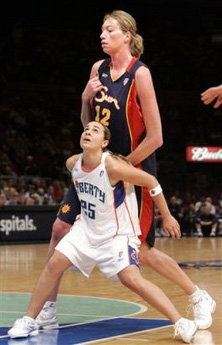
What’s most interesting to me about Becky’s decision to play for Russia is the economics of it. The money in women’s basketball is not in the US, right now it’s mostly in Russia. Hammon will be moving up from being a popular player on the winning CSKA team to being on the national team. There will be more endorsements and thus a lot more money.
We’ve all heard about women making 70% of what men make in the same jobs. But women in the WNBA earn about 1% of those in the NBA. Indeed, the worst-paid player in the NBA makes twice as much as the best-paid among the women. And, perhaps more astonishing, there are dozens of male players who make more than the total league-wide payroll of the WNBA.
(Photo credit: Gregory Bull, AP)
That’s a huge disparity and it’s the reason why the majority of the women play in more than one league. The WNBA in the (Northern) summer and Russia or Israel or Italy or wherever in the (Northern) winter. And many of the USians have non-American passports to get around the rules about the number of foreignors on a given team. Taurasi has an Italian passport, Sue Bird an Israeli one and as of the beginning of this year Becky Hammon has a Russian one.
I think part of the anger and discomfort around Becky’s decision is that in the past players who’ve come to play for the US or Australia (to cite the countries I know about) have come to escape oppression and to live a better life and earn WAY more money. The idea of the latter happening in reverse is startling. It plays on our fears of globalisation: the good jobs are moving overseas, along with the real economic power.
I’m sad that Becky never got the chance to play on the US Olympic team. Like Voepel I think she earned that opportunity last year when she turned in the best performances of her entire career (though sadly for San Antonio not New York). She came in second to Lauren Jackson in MVP voting and yet the US Olympic team still wasn’t interested. The US team has a ridiculous amount of talent to choose from. I don’t think Hammon’s absence is going to make much difference to Team USA, but I do think it will make a big difference to the Russians. I suspect that’s something else Donovan’s mad about.
Athletes don’t have a long shelf life. Hammon’s already 31. She has at most six or so playing years left. And then what? Earning as much as you can while you can and saving it in preparation for the many, many years of your life when you’re not playing is smart. Even if it means playing for a country not your own.
If it’s okay for countries like Australia and the US to add last minute “Australian” and “American” players then it should be okay for it to happen in reverse.
Like Scott, I was intrigued by Emily Gould’s article about blogging. She’s a beautiful writer and her experiences are fascinating. I was a little frustrated by the article, though, because I kept hoping that she would push further past the anecdotal to the broader implications. What does it mean to be internet famous? How does that vary from regular famous? How has our world changed because of blogging? And why is it so often female bloggers who get such insane volumes of hate mail?
I was quite shocked by the ferocity of the comments responding to Gould’s article. One thousand two hundred and sixteen of them and most of them astoundingly nasty. Many of them seemed to boil down to: how dare she be young, talented, and pretty?
For me, one of the most disturbing aspects of the internet is the ease with which people can go on the attack. Hate spreads faster than light now. And even relatively unfamous people like Emily Gould can be the brunt of it. I have many blogger friends who receive hate mail and comments from total strangers. Some of them in astonishing numbers.
The whole thing makes me much less comfortable with my own celebrity hatred. See, I’ve always found hating famous people really cathartic. Rather than hate someone I know—cause we all know how uncomfortable that can be—I aim faux hate at random actors. Like Michael Douglas and Jack Nicholson. I don’t do it actively: no hate mail or anything like that. I just say mean things when they’re on tellie and boycott their movies.1
It’s one of the many few disagreements Scott and I have. Scott thinks hating famous people is stupid because these are people you don’t know and it’s a distraction from the people you do know and the real things in your life. He thinks that’s a bad thing; I think it’s a good thing.
Except that I’m not sure I do anymore. Seeing my friends get cyber stalked and harassed via comments on blogs and emails, well, it makes me not just sad and unhappy for my friends, but really uncomfortable about having strong feelings about strangers. Because people you don’t know are strangers. Some people seem not to get that about bloggers. Just because you read their blogs, no matter how intimate that feels, it doesn’t make them your BFF or even your enemy. They’re just someone whose blog you read.
Jack Nicholson, even though he is exceptionally annoying, especially in his role as an LA Lakers fan,2 is not my enemy. He’s never done anything to me. He has no idea who I am. I hereby vow to quit hating him. It’s going to be tough, but I think I can do it.
Now if I could just get all those trolls and writers of hate mail to take the same vow and quit harassing bloggers who annoy them. Hint: it takes a lot less energy to simply not read bloggers who piss you off than it does to keep attacking them. Funny that.
About why YA is so big right now is that there’s been a demographic bubble—a mini baby boom—and that it was all those kids who made Harry Potter huge and are now making YA huge. Suzanne mentions this theory in the comments to this post.
I have no idea if it’s true or not. As I mentioned, I’m feeling really research lazy this week.
But let’s imagine it is true for a moment. What happens when these mini-baby boomers grow up? Is that the end of YA? They move on to adult fiction and the field contracts just as the picture book and middle grade fields have contracted. And a whole bunch of us start trying to crack into other genres. Just as a whole bunch of writers are now busily switching to YA.
On the other hand, the current YA boom seems to have brought in many adult readers and quite a few of the teen readers seem to keep reading YA even as they hit their 20s. So maybe the good times will roll for a little while longer. If not the forty years I’m hoping for.
I know some librarians read this blog occasionally. Well this is for you.
A play called “The Future Australian Race” is being performed in Melbourne at the State Library until this Friday. It sounds absolutely fantastic so if you can get there to see it, do so!
And for those of us no where near Melbourne there’s a podcast of The Book Show interview with the two playwrights Bill Garner and Sue Gore, who are both delightful. The play is about the relationship of Marcus Clarke, one of Australia’s first writers and the author of For The Term of His Natural Life and Sir Redmond Barry, the man who is best known for sentencing Ned Kelly. The two men met at the State Library of Victoria in the mid 19th century, where Barry was the head librarian and Clarke the sub-librarian.
The two men could not have been more different. Barry was a maker of lists. No, that’s too mild a way of putting it. This is a man, who before going on a long trip, made a list of every single item in his house down to the last teaspoon, who kept lists of every thing he ate, and every time he had sex (!). Clarke was not so much of a list person. According to Garner and Gore he’d start writing a list and quickly drift of into a line of poetry. The first historian of the State Libarian called him a “bad librarian,” as Gore and Garner put it: someone who’s “untidy and doesn’t keep a good catalogue.”
Listen to the podcast. It’s hilarious and fascinating. And if you can get to the play please do and report back on what it’s like cause I’m dead cranky I can’t go.
I’m now thinking of the librarians I know and I’m sorry to say quite a few of them are bad librarians. Messy, messy messy.
Current estimates say that in the wake of Cyclone Nargis 100,000 people have died and a million are homeless.
I’ve been trying to figure out where best to donate to make sure that the money actually goes to the people struggling to survive in Burma. Most people are saying that UNICEF and the UNHCR are the best bets seeing as how the UN is one of the few agencies getting aid into the country. So that’s what me and Scott have done.
If anyone else knows of other organisations who are able to get in and help, please let me know in the comments. Thanks.
Update: Lots of people have been suggesting Avaaz which is apparently getting the money directly to monks in the effected areas.
In the latest New Yorker, Malcolm Gladwell talks about ideas being free-floaters and how as a result many things get invented over and over again.
He never quite says the obvious: that ideas are nothing unless you can do something with them. And then he conflates the having of an idea with actual creation:
You can’t pool the talents of a dozen Salieris and get Mozart’s Requiem. You can’t put together a committee of really talented art students and get Matisse’s “La Danse.” A work of artistic genius is singular, and all the arguments over calculus, the accusations back and forth between the Bell and the Gray camps, and our persistent inability to come to terms with the existence of multiples are the result of our misplaced desire to impose the paradigm of artistic invention on a world where it doesn’t belong. Shakespeare owned Hamlet because he created him, as none other before or since could. Alexander Graham Bell owned the telephone only because his patent application landed on the examiner’s desk a few hours before Gray’s. The first kind of creation was sui generis; the second could be re-created in a warehouse outside Seattle.
Well, sure, but heaps of people could (and do) get the same ideas as some great musician or writer or artist. Getting an idea is not the same thing as creating the work of art. Lots of writers have told the exact same stories. Many composers have written variations on particular folk tunes.
It’s not the idea; it’s what you do with it.
This is one of the reasons most writers (and other artists) never know what to say when asked “Where do you get your ideas?”
Because it doesn’t really matter.
The idea is the least important part of writing a novel. You can have the best idea in the history of the universe but if you don’t do anything with it or you write a crappy novel out of it? Well, then it wasn’t that great an idea, was it?
No matter what your field—science, engineering, the creative arts, cocktail making—ideas are in the air for the grabbing. All you has to do is the hard part:
Turn them into something real.
Like David Sedaris I am an ex-smoker.
I started smoking when I was twelve. I’d just seen Rebel Without a Cause and thought the way James Dean held a cigarette was the coolest thing I’d ever seen. I wanted to do that. I wanted to be like him.
So I started smoking. For awhile I smoked Rothmans because they were featured on the cover of one of The Jam’s albums—a band I was way into but none of my friends had even heard of. But I soon moved on to unfiltered Camel cigarettes because they came in such cool packets—I smoked Gitanes for the same reason—and because I was sick of having to explain to people about The Jam.
I was such a cool smoker that I could blow smoke rings. Not lame, see-it’s-kind-of-a-whispy-circle ones, but the real thing. I could also, while in my brief roll-your-own phase, roll cigarettes with one hand. Not very good ones, but recognisably cigarettes.
I quit when I was fifteen after being shown a gruesome anti-smoking film at school that included smokers smoking out of holes in their throats, smokers with limbs removed because of smoking-induced gangrene, smokers’ lungs drippy black tar, and wizened low-weight babies being born because of their smoker parents.
None of those images got me to quit.
Oh, no, it was the very brief mention of how smoking makes you ugly: stains your teeth (I’d started to notice that), shrinks the capillaries under your skin causing premature wrinkling (close up of a twenty-five year old with lots and lots of lines around her mouth—even at fifteen I knew twenty-five wasn’t that old), causes your hair to thin, and your eyes to redden, eventually turn yellow and fall out of your head.
If I kept smoking I would turn into a hideous crone!
Quitting was dead easy given that I’d never liked the taste of tobacco and had the extreme good fortune not to have gotten addicted. I’d solely been attracted by the Hollywood movie cool-osity of cigarettes. But smoking did not transform me into a dead American male from Indiana, did not give me one iota of his coolness. I’d gone through three years of a habit I didn’t much like for nothing but yellow teeth, wrinkles and eyeballs that could soon depart my head.
Needless to say the fifteen-year-old me was very cross indeed and became the most vehement anti-smoker you can imagine, which is pretty much where I remain. Especially after seeing people, such as my grandmother, die painful smoking-caused deaths.
I have rejoiced as more and more cities and countries implement smoking bans. Our recent and glorious tour of Europe was especially fabulous because now even places I thought would never do it—France, Germany, Italy, the UK—have brought in excellently stringent smoking laws.
The glorious spread of non-smoking laws has made the countries that have yet to comply more and more intolerable. It was shocking in Austria and Switzerland to see people smoking pretty much wherever they wanted to. Especially as they mostly wanted to smoke in my face at restaurants.
I have now decided that I am only going to countries where smoking is banned in public spaces, or, at the very least, in restaurants. Sadly, this means I can’t visit Spain, which I’ve been wanting to return to for years and years. Sorry, Lawrence. There’ll be no China, India or Russia in my near future. Bulgaria is also off my list. In fact, smoking is so insanely out of control in Bulgaria that I have a suggestion:
Why not declare Bulgaria Europe’s smoking country? Then all the other European nations can ban smoking completely and their smokers can move to Bulgaria, where they can happily smoke in cinemas, hospitals, or anywhere else that takes their fancy. Burma can be Asia’s. Though China’s so big you’d probably have to give over a whole province for the smokers. Maybe two.
The US is also on the big side. Maybe it needs a designated smoking state. Dunno what state it should be, though definitely not New York or California. What do you lot reckon?
Australia doesn’t really have the population to support a whole smoking state. Plus every one of her states and territories have fabulous bits; I couldn’t in good conscience give any of them to smokers. But I am willing to cede them Fort Denison, though we’d have to tow it further out to sea so their fumes don’t get blown back into the city. Just think future school children would never be forced to visit Fort Denison again.
We’d all win!
This is one of the biggest selling songs at home right now, despite only being available for purchase online (but, sadly, only if you’re in Australia):
For context the apology by Kevin Rudd and Paul Keating’s Redfern Spech:
Here is the original song by Kev Carmody and Paul Kelly:
I so wish I was back home . . .
I have never played Dungeons & Dragons. I had never heard of Gary Gygax until he died last week.
I write fantasy and I have never written a novel that was secretly a book version of my D&D campaigns. That’s because I never had any. What’s more none of my writer friends have ever done that either. Even those who do play D&D.
I do not dispute that Dungeons & Dragons has had a huge influence on role playing and video games. I’m less convinced of its impact on fantasy books. So unconvinced that the next person who claims that all fantasy writers—really? all?—are deeply influenced by Dungeons & Dragons gets violence committed upon their person by someone mean and cranky I will hire for the purpose.
It’s simply not true. Fantasy is a huge field. Vast and wide. I’ll buy that some High Fantasy has been influenced by D&D, but not anywhere near the scale of the J. R. R. Tolkien influence. That man made High Fantasy. I’ll even go as far to say that D&D is more influenced by Tolkien than High Fantasy is influenced by D&D.
I am not knocking D&D. Some of my best friends play it. I’d even let my sister marry a D&D player. But me? I’m not a role-playing kind of girl. I’m just saying that the people making these vast claims for D&D are the ones most influenced by it and perhaps don’t have sufficient perspective. There really are plenty of fantasy writers who’ve written books entirely outside the land of D&D. Oodles of them!
Not all fantasy writers are geeks.1 I even know a few non-geeky science fiction writers. Shocking, but true.
The speech that Kevin Rudd delivered at Parliament house yesterday was even more moving than I could have imagined. I cried. I never thought this would happen during my life time. I’m so full of hope for the future I feel like I could burst.
Here’s the whole thing: the four minute apology and then the twenty minute speech. It’s really worth watching all of it.
Part 1
Part 2
Part 3
Thanks to everyone who’s written to me from home and elsewhere. It’s wonderful to discover that yesterday’s historic events had an impact outside Australia. It was a great day.
Back home in Canberra the prime minister is making this historic apology on behalf of the Parliament and the Government of Australia:
Today we honour the Indigenous peoples of this land, the oldest continuing cultures in human history.
We reflect on their past mistreatment.
We reflect in particular on the mistreatment of those who were Stolen Generations—this blemished chapter in our nation’s history.
The time has now come for the nation to turn a new page in Australia’s history by righting the wrongs of the past and so moving forward with confidence to the future.
We apologise for the laws and policies of successive Parliaments and governments that have inflicted profound grief, suffering and loss on these our fellow Australians.
We apologise especially for the removal of Aboriginal and Torres Strait Islander children from their families, their communities and their country.
For the pain, suffering and hurt of these Stolen Generations, their descendants and for their families left behind, we say sorry.
To the mothers and the fathers, the brothers and the sisters, for the breaking up of families and communities, we say sorry.
And for the indignity and degradation thus inflicted on a proud people and a proud culture, we say sorry.
We the Parliament of Australia respectfully request that this apology be received in the spirit in which it is offered as part of the healing of the nation.
For the future we take heart; resolving that this new page in the history of our great continent can now be written.
We today take this first step by acknowledging the past and laying claim to a future that embraces all Australians.
A future where this Parliament resolves that the injustices of the past must never, never happen again.
A future where we harness the determination of all Australians, Indigenous and non-Indigenous, to close the gap that lies between us in life expectancy, educational achievement and economic opportunity.
A future where we embrace the possibility of new solutions to enduring problems where old approaches have failed.
A future based on mutual respect, mutual resolve and mutual responsibility.
A future where all Australians, whatever their origins, are truly equal partners, with equal opportunities and with an equal stake in shaping the next chapter in the history of this great country, Australia.
Today I am proud to be Australian.
Sometimes it really sucks to be so far from home . . .
Imitation of Life by Fanny Hurst was published to great success in 1933, made into a film in 1934, and then again in 1959. All three are a fascinating window on race in the USA. Fascinating and deeply depressing.
The movies are kind of an obsession of mine. Particularly the contrast between them. So much changed in those intervening 25 years, and so very little. David Kehr in today’s New York Times describes the films thus:
Douglas Sirk’s 1959 “Imitation of Life” is among the most closely analyzed films in the Hollywood canon, a Lana Turner soap opera
turned into an exercise in metaphysical formalism by Sirk’s finely textured and densely layered images. Less well known is John M. Stahl’s first film version (1934) of this Fannie Hurst novel about the complex bond between an enterprising white businesswoman (Claudette Colbert) and the black woman (Louise Beavers) who becomes her housekeeper and supplies the secret formula for pancakes that becomes the basis of Colbert’s character’s empire.
That was the year that Hollywood began seriously to enforce what had been the largely toothless Production Code, which, among its many nefarious effects, would result in the near disappearance of socially engaged films for the next two decades. But Stahl’s “Imitation of Life” still benefits from the frankness and skepticism of the early Depression years. Though hardly free from stereotyping, it stands today as perhaps the most powerful Hollywood film about race until the civil rights movement of the 1950s.
Hardly free from stereotyping is right. The black characters are happy with their place in the world. All but the housekeeper’s daughter, Peola, who is so light-skinned she can pass for white. Yet in both films her decision to do so seems inexplicable. The black people are all happy. Why would you want to pretend to be one of the tormented white people? Look how hard the white man’s burden is!
If you were an alien watching the movies you’d be scratching your head trying to figure out what was so very terrible about being black. In neither film are there any cafes with signs saying “Whites Only.” The black characters never have to sit at the back of the bus. There’s no mention of slavery, lynchings, or the civil rights movement.
There is one horrible scene of racism in the 1959 version, but it plays out as though racism is just that particular person’s problem, not anything systemic. The most you get in the 1934 version is the kids at school looking shocked when they discover that Peola is passing. Their reaction shot lasts less than five seconds.
One of the things that puzzles me most is that in 1934 a black actress was cast in the role of the daughter who passes as white, but in 1959 she was played by a white actress. What’s up with that? Were there truly no light-skinned actresses of Fredi Washington’s (pictured above) calibre around in the 1950s? Colour me doubtful.1
I find the 1934 version more powerful because it doesn’t lose its focus on racism; the 1959 movie winds up being largely about Lana Turner’s scandal-ridden life, specifically her daughter killing her mobster boyfriend. David Kehr is spot on about the final scene of both movies:
Like the Douglas Sirk version, Stahl”s “Imitation of Life” climaxes with a lavish funeral procession. But what Sirk turns into a triumph of coolly expressive visual style becomes, in Stahl”s version, a sustained march of silent protest against a system as unjust as it is deeply ingrained. The film seems unable to put a name to the monumental grief it depicts with such devastating force.
That’s a large part of the problem with boths films: they are about systemic racism and injustice, but they cannot name them. Both films are exercises in avoidance, shame, and lame liberal justifications. What fascinates me is their inability to articulate the bleeding obvious: It is unjust that the black woman who makes the white woman’s life of money and privilege gets so little for it. It is unjust that the black woman’s daughter cannot get what she wants unless she pretends to be white and then when she does that she is punished.
Both films are clear that the problem lies with Peola for trying to be something she is not. Her passing is what is at fault, not the system of racial inequality that makes passing as white an attractive path.
But most of all neither of these films are about Peola or her mother: They’re about the white woman. Claudette Colbert in the first film and Lana Turner in the second. I’ve always longed for it to be remade with the focus squarely on the black woman with the miracle pancake mix.2
Happy Super Tuesday to all you USians living in those states. Vote well! I bet Peola would be happy to see a black man in the running, but sad to see how much racial and sexual inequality still exists. But we can change that, right?
Frozen New York. Or rather a couple hundred frozen people at Grand Central. Wish I’d seen it.
Ireland has gotten rid of plastic bags:
In 2002, Ireland passed a tax on plastic bags; customers who want them must now pay 33 cents per bag at the register. There was an advertising awareness campaign. And then something happened that was bigger than the sum of these parts.
Within weeks, plastic bag use dropped 94 percent. Within a year, nearly everyone had bought reusable cloth bags, keeping them in offices and in the backs of cars. Plastic bags were not outlawed, but carrying them became socially unacceptable—on a par with wearing a fur coat or not cleaning up after one’s dog.
Why can’t everywhere else in the world manage the same?
Scott and me have taken to walking around with flip and tumble bags. They’re bags that roll up into smallish balls. They’re most excellently convenient. I carry ’em in my handbag so I never have to resort to a plastic bag. (Via boingboing.)
Just wanted to add my voice to the zillions declaring that John Green is not a pornographer. Well, at least, not the John Green who wrote Looking for Alaska. There may be another one somewhere who is. I can not speak for all John Greens.
Maureen says it best:
In case you have never read Looking for Alaska, I’ll tell you what happens in the scene that likely caused the drama. Pudge, the main character, has one of his first sexual experiences in the book—and it does not go well, largely because neither he nor the girl he has with really have any idea what they are doing. It is a funny scene which shows just how awkward some of these moments in life can be. But it does have some sexual interaction in it, albeit of a very poor quality. It has human body parts.
Having discussed this scene many times with John, I know he finds these complaints to be ridiculous. Because that scene in Looking for Alaska? It’s pretty much the opposite of pornographic. It’s fumbling and embarrassing and hilarious. It’s not cool. It’s not slick. You don’t read it and think, “I want to do something JUST LIKE THAT.”
John Green tells the whole story—the book is being taught to eleventh graders who need a signed permission letter from their parents and it’s the parent of a ninth graders who’s trying to stop John’s book being taught at all—and defends himself most excellently and wittily here. If you want to help here’s what you can do:
There are many supporters of the book among teachers, administrators, librarians, and the school board in Depew.1 To help them, I’m asking people to email letters of support for the book at sparksflyup–at–gmail.com.
Also, if you live in Depew, the book will be discussed at the Depew Board of Education meeting on February 5th at the Depew High School Auditorium at 7 PM.
I’m writing one right now.
The death of Heath Ledger got me thinking about all my favourite teen movies seeing as how he was in one of my faves: Ten Things I Hate About You. And because thinking about fabby teen movies is more fun than thinking about talented people dying. I love ’em—almost as much as I love YA.
Here are my off-the-top-of-my-head favourites:
Bend It Like Beckham
Better Off Dead
Bring It On
Clueless
Dirty Dancing
Drumline
East of Eden
Ferris Bueller’s Day Off
Flirting
Ginger Snaps
Gregory’s Girl
The Incredibly True Adventure of Two Girls in Love
Looking For Alibrandi
The Lost Boys (added because of reminders in the comments)
Mean Girls
Rebel Without A Cause
Saved
Say Anything
She’s All That (mostly for the dance sequence at the end)
The Sure Thing
Ten Things I Hate About You
The Warriors
The Year My Voice Broke
You may notice that I have omitted the John Hughes oeuvre. That is because I had the misfortune of rewatching Breakfast Club, Sixteen Candles, and Pretty in Pink recently. And, to be kind, I will simply say they do not stand up.
What are your faves? And why?
In the vociferous arguing about the ins and outs of who behaved worst over the second test etc etc there are people implying that criticising the Australian cricket team is unAustralian and whingey.1
Please! I love my country, I love cricket, but when the men’s team behave like dickheads they should be called on it.
People who play sport at a professional level are not exempt from the social contract. No one is. Writers (to pick a random example out of the air) shouldn’t behave like dickheads either. Recently I was at an award ceremony where the speeches of the winners were generous and moving. All but one. This one person got up to accept their award without a gram of graciousness. Their speech was about the importance of their book and the judges’ perspicacity in picking it as the winner. That speech left me not wanting to read anything by that writer. I don’t even want to meet that writer.
Very few people in this world achieve things without considerable help; acting like you did it all on your own is graceless and rude.
Ponting’s and the rest of the team’s arrogance and inability to admit that they ever do anything wrong makes me ambivalent when Australia wins test matches. Don’t get me wrong. I love for Australia to win, but, well, I love it a lot more when they’re gracious in victory.2
So, yeah, this debate isn’t just about cricket. It’s about how people should behave. How we should treat the people around us. There’s a reason that photo of Flintoff offering commiserations to Brett Lee has become so famous. It captures a moment of perfect grace:

Getty Images
Especially when it’s a manuscript intent on giving me paper cuts or in the form of a card.
There. I’ve said it: I hate Christmas Cards. Do not send me any.
To be honest I’m pretty much against anything that shows up in my mail box that isn’t a cheque or a contract or a magazine I subscribe to.1 And really why can’t all of these be done electronically? Why do banks charge wire transfer fees? Transferring money from account to account is now one of the simplest processes in the world. Why can’t I sign my contracts electronically? Why can’t I subscribe to all the magazines I love in non-dead tree form? Why do people keep sending me postcards? I hate ’em and they go straight into recycling.2 I’d much prefer to see jpgs of your holiday—you know photos you actually took yourself.
I hate the endless catalogues that I never signed up for, the entreaties from political parties, and furniture companies, and car dealers and all the rest of them. Junk mail is a blot on the landscape, chewing up whole forests of trees.
I love trees! Keep them in their non-paper form!
I hate junk mail even more than I hate the spam that attacks my inbox. At least there are filters I can employ to keep the number manageable. I have contacted certain catalogue senders multiple times asking to be taken off their list. It makes not a lick of difference. If I manage to get rid of one several more are there to take its place.
I no longer give my address to anyone if I can avoid it. I will no longer join any organisation that insists on having my snail mail address. If they can’t communicate with me solely by email then I am not interested in being a part of their antiquated tree-killing organisation.
I travel a lot and no postbox in the world is big enough to be left to its own devices while I’m away. Thus complicated arrangements have to be made to ensure the postbox does not overfill and explode. If people didn’t send me mountains upon mountains of paper I didn’t want those arrangements would not be necessary.
The only truly acceptable use for paper is the making of books. Those I love. But as soon as there’s an integrated iphone-like device that works as a really good ebook reader I’ll be using that to read while I’m on the road. At home I’ll be snuggling up with a good ole dead-tree product book like I have since I was knee-high to a grasshopper. No ebook reader will ever smell as good as a book.
Stupid paper. I kick it.
When I started this blog I was very definite that I wasn’t going to blog about politics or religion. I’d seen too many flame wars, too many blogs overrun by indignant trolls. My blog, I decided, was going to be sweetness and light and avoid incendiary topics.
But then the John Howard regime finally fell and I couldn’t contain myself. And, you know, what? I’ve gotten not a single troll. The discussions generated by my political musings have been thought-provoking, fun, and, most unexpectedly, my traffic is up. Who’d’ve thunk it? I love youse all!
I now feel free to blog about whatever the hell I want to blog about. If any trolls show up I’ll just nuke ’em.
That said, I’m facing a whole series of dread evil deadlines over the next month. So my promised posts on how to rewrite1, curing insomnia, my favourite manga, manhwa and graphic novels will prolly all have to wait.
In the meantime I’ll try to keep posting but may not be as substantive as I’d like.
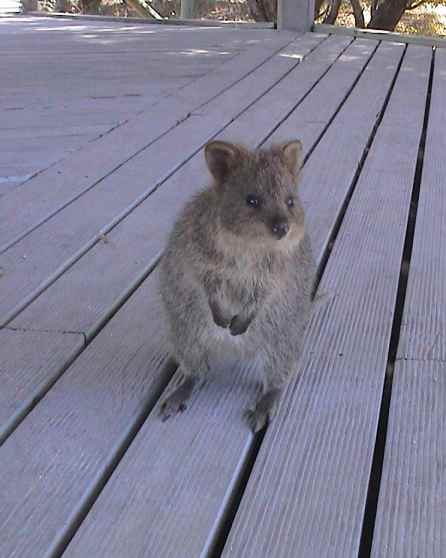
So here, have another quokka:

If I could have any pet at all I’d have a quokka.
I once heard Tim Flannery say in a radio interview that they make excellent pets and that we would be doing them a favour by bringing them into our homes. Flannery reckons that a sure fire ticket to species survival is domestication. You don’t hear much about cows, horses, cats, dogs or pigs being on the verge of extinction, do you?
So there you have it. I wants a quokka.
Not really.
For all the papers are touting the enormity vastness hugeness snufflufflagusness of Labor’s win back home I think it’s important to remember that the gap between Labor1 and the Coalition is not that big: 41.59% of voters gave the Coalition their first preference and 43.9% gave it to Labor. Then there’s the 7.57% who voted for the Greens and the 1.97% who gave Family First the nod. In fact the only places where there was a genuine landslide for Labor was at certain polling booths in the Northern Territory. Indigenous voters gave Labour more than 90% of the vote. Hmmm. I wonder why?
But in most of Australia, there are people around you who did not vote the way you did. Who do not agree with you and are not happy right now. I kind of think it’s important to remember that. They’re feeling now what we were feeling over the last eleven-and-a-half years.
That said, here’s what I hope the new government does over the next three years:
And lots of other stuff I can’t think of right now. Like can I have a Vivienne Westwood ballgown?
Do I think it will really happen? All of it? Prolly not. But some of it’d be good. I reckon, anyways.
In Australia voting is compulsory. Everyone is expected to do it. Basically that’s because everything back home is geared towards making voting as easy as possible. Over here in the US of A it often seems to me like everything is organised to make voting as difficult as possible. What’s up with that?
In Australia if you don’t vote you pay a fine. Some people routinely pay the fine. Others who don’t want to vote register their dissatisfaction by filling out their ballot wrong or donkey voting. Often by scrawling a message across the ballot. Usually their message is a bit on the rude side. That’s fine. They’ve done their democratic duty. They showed up. The percentage of people who donkey vote is pretty small.
Some people object that many people are too stupid or ill-informed to vote.
Sure, I respond. But who’s going to make that determination? I kind of think what you just said is stupid and ill-informed. Should you be banned from voting? I think liking certain books by certain unnamed writers is stupid and ill-informed. Should they be banned as well?
Others say that voting should only be for the people who care passionately about the issues. When voting isn’t compulsory then only those who really care vote.
The problem with that is many of the people who really care are kind of crazy. Fanatics even. Who wants to live in a country where it’s mainly the fanatics voting?
Non-compulsory voting also leads to campaigns to stop the people you think will vote against you from voting. See: Florida and Ohio. It also leads to doing everything you can to get people you might be able to persuade to vote for you to the polls. Sometimes this is done in less than honest ways.
So you USians can give us limited terms and we’ll give you compulsory voting. You might also want a spot of preferential voting1 and weekend voting. Or at least have a national holiday. Also you could probably lose the Diebold voting machines. Other than that you’re good.
It wasn’t until I’d lived outside Australia for awhile that I realised just how anti-intellectual my homeland is. One of the worst things you can be back home is a “wanker” which more times than not is used to refer to someone who thinks too much. Oh, the horror!
At most of the schools I attended it was far better to be good at sports than at schoolwork and no one ever admitted to studying hard. “Oh this? I only started it ten minutes before it was due. Don’t know what the teacher was thinking giving me such a good mark.” Roll of eyes.
I’m still not sure what we were afraid of. Well, yes, the scorn of the other students—no one wanted to be seen as a swot. But why? Why was a love of ideas and learning scorned? What’s wrong with being smart?
At the time, I never questioned it. I barely even noticed it. It was just the air I breathed. Hiding that you were smart, underplaying your intellectual achievements, that was just what you did. Or tried to do. Some of us were crap at it. We were the wankers.
During John Howard’s eleven-and-a-half-year reign the anti-intellectualism grew. When I went through school we were taught about the dispossession of the original inhabitants of Australia by the English invaders; I keep meeting people much younger than me who were not. I keep meeting Australians who cannot comprehend that admitting Australia was invaded does not wipe out the achievements of those invaders, those early settlers. You can be an invader and you can be a brave settler. At the same time.
In The Guardian Richard Flanagan, a Tasmanian novelist, reflects on the Howard legacy:
In the wake of his defeat the attacks on Howard’s legacy will turn ferocious, but at their heart will be an unease, a ritual exorcism of something deeper that Australians would perhaps rather not admit. For a decade Howard’s power had resided in his ability to speak directly and powerfully to the great negativity at the core of the Australian soul—its timidity, its conformity, its fear of other people and new ideas, its colonial desire to ape rather than lead, its shame that sometimes seems close to a terror of the uniqueness of its land and people.
Its conviction that real life is going on somewhere else.
What Flanagan says is true. And it’s also not true. The tension between the two is a lot of what it means to be Australian. I think of how proud I was when Paul Keating gave the Redfern speech so many years ago. My pride, too, in John Howard’s immediate introduction of gun control laws following the Port Arthur massacre back in 1996. The horror I felt as the babies-overboard scandal was unfolding. Not to mention Tampa. And, of course, Howard’s continuing promotion of racism and intolerance: in the last days before the election he declared that the two things he was most proud of were the undoing of political correctness in Australia and renewing Australia’s pride in its Anglo-Celtic heritage. What of those Australians who do not have an Anglo-Irish background? What of the indigenous peoples of Australia? The immigrants from all over the world? What of their extraordinary contributions to Australia?
I don’t believe that each nation has a particular character. Or that all Australians are the same. Yet I cannot deny what Flanagan says about the Australian soul (whatever that is). We are a nation deeply suspicious of education and learning, who have produced an astounding number of prominent intellectuals, scholars, scientists and writers. Who, more often than not, go elsewhere to pursue their careers and contributions to learning and knowledge.
I am extraordinarily relieved and happy that John Howard is gone. I can’t imagine that Kevin Rudd will continue Howard’s legacy of anti-intellectualism, racism and intolerance. I could be wrong though. Those things existed before Howard took up the Prime Ministership and they’ll continue to exist long after him. It remains to be seen whether the new government will be as dedicated to improving the intellectual and moral climate of Australia as Howard’s government was to destroying it. The promise to say sorry is a good start.
But governments have come in before promising much and then delivering little. We’ll see, won’t we?
There’s a lot I don’t like about the US political system, but there’s one thing they have absoluately right: No head of state should be in power for more than eight years.
I think John Howard has demonstrated this truth as did Robert Menzies before him and Margaret Thatcher and Tony Blair in the UK.
I agree with George Washington that any one person staying in power for too long starts to stink of monarchy.1 It leads to corruption and to the one person believing that they are more important than party or country. This is not a good thing.
I would love Australia to adopt four-year terms and also a provision that says no one can be elected to the office of Prime Minister for more than two terms.2
So today is a big ole USian holiday where at some point you’re all supposed to give thanks for all the stuff that’s making you thankful. It’s called—wait for it—Thanksgiving. We have no equivalent in Australia. Though we do have, Australia Day, where we commemorate the successful invasion of Australia by white people. As you can imagine the indigenous population consider it to be a day of mourning.1 The USian Thanksgiving has an equally complicated history.
But all that aside, I love the idea of a day given over to thankfulness. Here’s what I’m thankful for:2
What silly little things are you all grateful for?
By the way, I’m not at all sure this understanding [about money] goes up to the CEO’s office; how can it, when that CEO can be handed sixty million dollars just for quitting? Someday I must tell you the story of the famous exec who said, “Why not make this character middle-class? Let’s say he makes $300,000 a year—” and the writers all stared at him.
That’s right the folks who are keeping the writers from having a fair cut of the work they create think $300 grand a year for one person is a middle class wage. Words completely fail me. It’s like those people who crap on about the outrageous amount male basketball players earn but don’t say a word about the insane earnings of the people who own and run the teams and leagues. An athlete’s career is short and physically dangerous.2 Execs get to keep on raking it in when they’re old and grey.
You really have to wonder at a world where it’s the executives around the creative folks who make the obscene amounts of money while most of the creatives are grateful to be paid at all.
Now, to be clear I am not referring to the producers or any of the other staff who are currently out of work because of this strike. That’s right, this strike means lots of people, not just writers, are going to be without pay for the duration. And most of those people—unlike the writers—don’t have a strike fund to keep them going. Not that the big bosses up top give a damn about any of them.
I believe I’ve ranted enough.
I was asked today why I say sorry so much.1
It’s true. I do say it a lot. I say “Sorry!” even if I am not even slightly at fault: like when, say, someone has bumped into me, or spilled something over me. I say sorry for pretty much everything. Even when I’m not at all sorry. Mostly when I’m not at all sorry.
As to the why of all those sorrys. I used to think it was just me. That I have this weird sorry-saying nervous tic. But I now know it’s cultural. I say sorry all the time because I am an Australian girl.
I realised this when I was living in Spain and one of my friends there blew up about it. She yelled at me that if I said sorry one more time it would drive her insane.2 That I could keep my “sorrys” and my “thank yous” and “pleases” and shove them [somewhere unpleasant]. She never wanted to hear them ever again. After that it became a joke between us. Every time I slipped up I would say—you guessed it—sorry. She would glare at me and then I would say sorry for saying sorry for saying sorry.
The Spanish, I learned, do not say “sorry”, “please” and “thank you” a million times a day.
When I went back to Sydney I noticed—for the first time—that I was not alone. Pretty much every woman I know says sorry just as much as I do. More even. It was quite the revelation.
I have since noticed that many English women suffer this malady. And quite a few USians—especially the ones from the South.
I have no idea what it means. But I have dark suspicions.
I’ve been thinking about all the various awards out there for writers under a certain age and realising that I’m not sure I think such awards are a good idea. I figured it was just a case of me getting older and crankier. But it’s more than that.
I’m all for encouraging people who only have a book or two under their belt. I’m just not convinced that a first novel by someone who’s 23 has more intrinsic worth than a first novel by someone who’s 56 or 83. If we’re going to encourage new writing why does there have to be an age limit?1
Tayari Jones author of the brilliant Leaving Atlanta2 agrees with me. What’s more she’s put her finger on something else insidious about such awards:
I now am wondering if these lists are inherently biased in terms of socio-economic class. Think about it. Most of what anyone, not just writers, accomplish at a young age has much to do with that person’s family background. It takes a few years for the boot-strappy among us to catch up with the accomplishments of the silver-spoon crowd.
Why shouldn’t these lists of new writers be determined by the author’s publishing history? I know that “Best New Writers Who Have Published Two or Fewer Books” doesn’t have the same ring of “Best New Writers Under 30,” but it makes a whole lot more sense.
“Best New Writer” has a great ring to it.
A most enjoyable opinion piece in yesterday’s New York Times by Mike Males concludes:
What experts label “adolescent risk taking” is really baby boomer risk taking. It’s true that 30 years ago, the riskiest age group for violent death was 15 to 24. But those same boomers continue to suffer high rates of addiction and other ills throughout middle age, while later generations of teenagers are better behaved. Today, the age group most at risk for violent death is 40 to 49, including illegal-drug death rates five times higher than for teenagers.
Hah! So I move that we start looking closely at what baby boomers are reading. Time to start banning Tom Clancy, John Grisham and Ken Follett books. Clearly those books are leading the most vulnerable and impressionable age group—the baby boomers—into further irresponsibility.
Do any of you play World of Warcraft or similar games? Do you have a Second Life? Wanna tell me about your avatar? Is it like you? Not like you? Do any of you have an avatar of the opposite sex? Anything else you want to tell me about your avatars?
Thanks!
Someone calling themselves Mony made this comment on my last post:
How can someone who so irresponsibly condones teenage pregnancy get on her high horse about other writers?
Now, obviously there are several logical problems with that statement. But they’re so obvious I won’t bother to address them. However, the comment does raise something that comes up A LOT for YA writers. The idea that if we write about something we approve of it.
Thus Holly Black and Ellen Hopkins in their searing acounts of teens using drugs are all for drugs, E. Lockhart approves of Broadway musicals, Chris Lynch approves of rape, and Stephanie Meyer approves of vampires. And, I, of course, having written of a teenager getting pregnant clearly think that’s a fabulous idea.
Except that I don’t. Nor do Holly Black or Ellen Hopkins condone drug use; Chris Lynch rape or Stephanie Meyers vampirism. (Though I suspect that E. Lockhart really does like Broadway musicals. Repent, Emily! It’s not too late.)
We’re writers. We write about people, things, worlds, situations, acts we don’t approve of all the time. There is an argument about the existence of God in one of my books. One of the characters believes and the other is an atheist. If the mere act of writing something means I believe it then I must be profoundly schizophrenic. A character of mine is brilliant at mathematics and loves it; I am not and I hate it. Another character hates all fruit and vegetables; I love them.
I am not my books. No author is. Not unless they’re writing autobiography and even then that’s only a part of their life and a part they’ve massaged to turn into a good story.
YA writers depict the lives of teenagers. Some teenagers take drugs, many have sex, some get pregnant, a few kill other people, and some themselves. These things happens in the real world. How does writing about them in a novel make us responsible for these activities or just as bizarre approving of them?
We YA writers try to write about teenagers as honestly as we can. Even when our books also features vampires and dragons and magic and Broadway musicals. It would be dishonest to leave out the parts of teen experience that some adults are uncomfortable with.
Many of my characters do things I disapprove of and make decisions I think are deeply unwise. But if they didn’t they wouldn’t be themselves and I wouldn’t have a story to tell. Without conflict there is no story. There’s a reason that dishonesty, misunderstandings, and villiany are so frequent in novels: They create conflict which creates story.
I see my duty of care in writing for people who are not yet adults like this:
That is what I set out to do in all my novels.
I really love libraries and Librarians too and I was wondering what do I need to do, besides talk to my librarian, to become one? I am going to be his aide this year but I don’t think that’s enough. Any advice or ideas?
Now I know at least a few librarians read this blog. Can you give Hillary! some guidance? I’m pretty sure she’s from the US of A. You have to get a degree in library studies, right? I know that’s what you need in Australia.
From my casual observation there seems to have been a big growth in the number of specialist teen librarians. Is that right? On the other hand, I keep reading about libraries closing from lack of funding. Are there plenty of jobs out there? What are librarians paid? Is it as low as it is for editors1?