Category Archives: New York City/USA

Slave economies

In New Orleans I saw men in orange jumpsuits being watched over as they worked by a man wearing a blue coat with the word Sheriff on the back.

Today’s New York Times explains what I saw. Turns out that Louisiana is the one state in the United States that allows private citizens to use prison labour:

    At barbecues, ballgames and funerals, cotton gins, service stations, the First Baptist Church, the pepper-sauce factory and the local private school—the men in orange are everywhere.Many people here in East Carroll Parish . . . say they could not get by without their inmates, who make up more than 10 percent of its population and most of its labor force. They are dirt-cheap, sometimes free, always compliant, ever-ready and disposable.
    . . .
    The churches, too, are grateful beneficiaries. “They sent me prisoners for a month” for menial chores at the First Baptist Church, said Reynold Minsky, also chairman of the local levee board. “All completely free,” Mr. Minsky added. “It’s a real good deal. Everybody is tickled.”

They’re also used at a local private school where the school’s principal, Morris Richardson, said, “We try to provide their lunch for them.” Makes you wonder what the prisoners are eating at their other jobs.

How is this economy sustainable? The unskilled work is being done by prisoners for free. The poor people who aren’t in gaol can’t find any work. How are they able to support themselves and their families?

Some would have to steal to survive, and then if they’re busted, they’re sent to gaol to join the ever-expanding pool of free and/or dirt cheap labour that so tickles Reynold Minsky. And repeat.

Them that’s got shall have . . .


If you don’t have a login for the Times go to bugmenot.com and get one.

Names & titles

Over at Miss Snark’s some folks get all snooty when agents address them by first name. I find their crankiness weird and am wondering if it’s a generational thing or because (as another commenter says) I’m Australian and we’re less uptight more relaxed than USians.

Personally, I’m more squicked when people insist on using a title with my name. My name is Justine Larbalestier, it’s not Ms Justine Larbalestier, certainly not Miss or Mrs Justine Larbalestier and you’re risking life and limb if you ever use Mrs Scott Westerfeld, though FYI Scott adores being called Mr Justine Larbalestier.

If you must use a title the correct one’s actually Dr, which I’m not wild about either, but at least I earned that one after almost four years of blood, sweat and tears (oh, yes, tears, lots and lots and lots of tears).

But how to negotiate this web of correct name/title useage? Even though I think it’s fusty and weird to want to be addressed by a title I also don’t want to offend anyone (not unintentionally anyways). So what are you supposed to do when some folks will spit the dummy if you don’t use a title, and others if you do?!

Here’s my cunning solution: echo how they sign off. If they sign off Dr Massively Stuckup, then you respond thus:

    Dear Dr Massively Stuckup

And sign off how you would prefer to be addressed:

    Cheers,

    Notuptightatall

Simple, eh?

But what to do if you’re the one writing the first letter? If you have a mutual acquaintance ask them. Otherwise play it safe. In the US of A I would use title plus full name (unless I can’t figure out whether they’re a sheila or a bloke or whether they have a phd or not in which case I’d use full name). In Australia I use full name sans title. Then I wait for the reply and adjust my salutation accordingly.

Aren’t you lucky to have me here to solve all etiquette problems?

Many people make book

Today Scott and me went into the Penguin offices to meet some of the people who sell, market and publicise our books. We ate yummy cheese, humus, tabouli, dolmades, grapes and strawberries, drank good (Aussie) wine and talked publishing.

We writers mostly work on our lonesome but we’re actually part of a team. A really big team. I have a lot of contact with my editors, Eloise Flood and Liesa Abrams, and some with the rest of the Razorbill team (especially Andy Ball and Margaret Wright), but much less with the other people who work on my books. Frankly, I’m not always sure what the folks in the other departments do. So it’s fabulous to meet the people from online marketing and discover that they’re starting to work on author podcasts. Would the two of us be interested in doing one? Would we be interested? Is the Australian men’s cricket team going to destroy England in the next Ashes? Yes, they are, and yes we’d love to do a podcast.

I was fascinated to hear just how much work goes into wrangling authors for big events like BEA (Book Expo America) and the big ALA (American Library Association) conferences. Wow, are we authors a pain! Collectively, I mean. Imagine trying to get many different authors to various different places in the space of eight or so hours. Not fun, eh? And even before we get to an event they’ve logged hours and hours making sure we’re available, organising us to get there, and setting up our schedules. A publicist’s (for BEA) and marketer’s (for ALA) work is never done.

We learned that at the last ALA meeeting they had put a two minute limit on kids giving testimonials about three particular authors cause they were so enthusiastic they’d have gone on for hours otherwise. One was Stephanie Meyer (author of Twilight and New Moon), the other one was someone really famous I’m ashamed to say I’ve forgotten, and the third one was—wait for it—Scott!! How cool is that?

It was also lovely to have people from non-editorial departments asking when they’ll get to see the third Magic or Madness book because they’d enjoyed the first two so much they were dying to read the final book in the trilogy. They work on many, many, many books every year, reading all them is impossible, so it’s a real compliment when they make an effort to read yours.

To recap: me author part of big team of editors, sellers, marketers, publicisers and others. (Though I’m still not entirely clear on the diff between selling and marketing. Anna explains how it works at Tor, but I get the feeling it works a bit differently at Penguin. One day I’ll understand, one day. . .)

WisCon is over; now I namedrop

The combination of jetlag and a cold meant that I did not get as much out of this year’s WisCon as I normally do. But everybody else seemed to be having an amazing time. There were a great many people there that I didn’t even get a chance to say hello to like Suzy McKee Charnas, Patrick Nielsen Hayden, Jay Lake, Kelly Link, Sharyn November, Nisi Shawl, Helen Pilinovsky and I hardly had a conversation of any length the whole weekend long.

But I did finally get to meet Cherie Priest and she was just as fabulous as expected. More, even. (Thank you Liz Gorinsky for arranging it—lovely to see you, too!). As well as the elegant and charming Geoff Ryman (apparently he has a blog but I can’t find it—feel free to hit me with the URL) and the amazing Deb Stone who fights the good fight against book censorship for the American Library Association and is my new hero.

I also had the pleasure of introducing my best friend in the whole world,1 Ron Serdiuk, to all my lovely WisCon friends. Naturally he is now many more people’s best friend in the entire world. Seriously, to know Ron is to love him. But I saw him first, okay?

I did manage to catch up properly with Krissy and John Scalzi, as well as Doselle and Janine Young, Ellen Kushner, Delia Sherman, Nalo Hopkinson, Charlotte Boynton, Lauren McLaughlin, Andrea Hairston, Pan Morrigan, Ama Patterson, Shana Cohen, Lawrence Schimel, Ellen Klages, Caroline Stevermer, Claire Light and Holly Black (who is such a darling that she visited me in my room while I was gathering strength to get past my dread lurgy and go out and face everyone). Not to mention Julie Phillips, whose superlatively brilliant biography of James Tiptree, Jr. will be out later this year. It’s one of the best biographies I’ve ever read and I read a pretty early draft. Imagine how gobsmackingly awesome the final version is going to be.

It was also fabulous to see great big piles of my first (and only) anthology, Daughters of Earth, selling like hotcakes. A number of people had already read it and were very enthusiastic. Yay! Josh Lukin’s and Andrea Hairston’s essays were both mentioned in terms of gushing praise. Their essays are indeed very fine as are all the essays in the collection. There’s no way I’m picking favourites!

The wonderful folks of Dreamhaven donated a copy to be sold at next year’s Tiptree auction. (I recommend them as an online purveyor of all fine sf and fantasy books. And yes they still have more copies of Daughters.) I managed to get Samuel R. Delany, Ursula Le Guin, Vonda McIntyre, and Pamela Sargent (!!!) to sign near mentions of them in the acknowledgments, as well as the signatures of contributors Brian Attebery, L. Timmel Duchamp, Karen Joy Fowler, Andrea Hairston, Joan Haran, Pat Murphy, Lisa Tuttle and Kate Wilhelm. Elvis wept, eh? It better go for a decent amount next year.

I only managed to hear Gwenda Bond, Karen Meisner, Lauren McLaughlin, Claire Light, Scott Westerfeld, Christopher Rowe, Richard Butner and Gavin Grant read, which is to say I attended two different reading sessions. They were all fantastic and funny and weird. What more can you ask for? Well . . . I would’ve loved to have heard Carol Emshwiller or Samuel R. Delany or Ursula Le Guin or Vonda McIntyre or Jane Yolen or Kate Wilhelm or Karen Joy Fowler or Ama Patterson or Geoff Ryman read as well. I hear they were all incredible.

And it would have been nice to go to some of the panels people were raving about like the shapeshifting one and the one on enjoyable trash. I hear Micole Sudberg stunned everyone with her stupendous intellect, humour and wit. Mental note: must not get sick and spend way too much time napping in my room. At least I wasn’t alone in my illness.

Most moving moment: When Susan Vaught signed over her $1,000 cheque for winning a Carl Brandon Award to the Carl Brandon society. So generous! Such a classy gesture! I’m buying her book, Stormwitch as soon as. I hear it’s as wonderful as she is.

Now I go to bed.

P.S. I have no idea how any of my panels went. Sigh.
P.P.S. Too tired to paste in links to all the abovementioned folks.
P.P.P.S. I am massively behind with email. Sorry!

  1. I have a number of best friends in the whole world. []

Feminist Utopia panel

As me, Nalo Hopkinson, Scott and Ellen Klages walked from our hotel to the Wisconsin Historical Society Auditorium the heavens opened up. Best. Storm. Ever.

Well, except for the little detail that we were on our way to give a panel and wound up soaked through and knowing that our audience had been at least halved. Thank you so much to the eighty or so brave, brave souls who made it.

I think it went well, but I was wet, jet-lagged and concentrating hard on moderating so I can’t be sure. Go read Sarah Monette’s excellent account.

I can say that I was dead pleased that we didn’t just pat ourselves on the back and talk about how fabulous WisCon is (which it is), but also addressed some of the tensions around race and class that aren’t talked about nearly enough. And, indeed, once again we managed to raise the issue of class and then back the hell away from it. Cause, you know, scary!

And now on with the rest of WisCon!

Con artists

You know how in Hollywood movies con artists are usually sexy, or interesting, or secretly kind of good guys, or all of those things (think The Grifters, Paper Moon, The Sting etc. etc.) and most of the people they scam are greedy bad people anyways, so it doesn’t really matter? When I watch those movies I’m completely sucked in, and on their side, and want them to win.

In real life, not so much. Cause, you see, scam agents and publishers are also con artists. They prey on people who are ignorant of the publishing industry and desperately want to have their work published and read. I was once ignorant of publishing and desperate to become a real author with a real published book. If I’d come across one of these scams back then I bet I would’ve fallen for it. Many otherwise smart people have.

Falling for a con isn’t about how smart you are. It’s about how much you know. It’s many years now since I’ve known enough about publishing to be immune to the kinds of scams that are regularly exposed by Writers Beware and Predators & Editors.

But on many things I’m easy to fool. If someone tells me something my instinct (like most people’s) is to believe it. I’m endlessly tricked by my friends and relatives—curse them. And April’s Fool’s Day? Gah. For starters, I’m a freelancer, so I never notice what day it is, besides most April Fool’s day gags consist of telling people something that could be plausible. What’s so dumb in believing them? There’s so many implausible things in the world that are true. You know, like Tom Cruise being a sex symbol, and people actually believing that American Beauty and The English Patient are good movies, and that Bring It On and Resident Evil 2 are bad. Excuse me?

I’ve almost been conned in NYC, but fortunately I was with a more knowledgeable person who recognised a scam (whatever it was—I still don’t know) coming.

I even understand the impulse to trick people—there’s an element of the trickster in every fiction writer. I’m just saying it ain’t that hard, nor if you’re doing it to trick money out of folks is it glamorous, noble, sexy or any of the other things that Hollywood likes to make it seem. You don’t even have to be especially smart to do it. That particular scam consists of the scammer advertising for unpublished writers and then when they send their writing the scammer says it’s fabulous and for a fee will represent the writer. Easy. All the scammer needs is for the unpub’d writer to be ignorant of the fact that good agents don’t charge fees and especially not in the multiples of a thousand.

Of course, it’s not just Hollywood that glamorises scammers. There are lots of really excellent crime books out there from the point of view of grifters. I just read Lawrence Block’s The Girl With the Long Green Heart (thanks, Naomi) and I really enjoyed it. But something happened as I read it, I started thinking about things from the griftee’s point of view. Even though—as is usual with these stories—he was a thoroughly nasty piece of work because he was greedy and thought he was gaming those who were gaming him. At which point it’s hard to see which way’s up ethically speaking. Who’re worse the people who make a living gaming people illigetimately? Or real estate speculators etc who game people legally? The grifters point at the griftees and say it wouldn’t happen to them if they weren’t so greedy. But isn’t greed for money one of the key motiviating factors of the grifter?

My head hurts.

There are lots of movies and books I enjoy whose ethics are beyond questionable. Gross Point Blank anyone? In which the hero is a guilt-free paid killer. And yet the audience is expected to be barracking for him to wind up with the girl. Which I always do even though I’m sure that were it real life and not a perverse fairy tale the first time his girl annoys him he’d off her without thinking twice.

And my point would be?

Dunno. Oh, hang on, yes I do. My point is that fiction ain’t life and that Writer’s Beware and Predator’s & Editors are doing stellar work and I salute them.

In praise of WisCon

In less than two weeks (gulp) me and Scott will be attending WisCon the feminist science fiction convention in Madison, Wisconsin. I’ve been attending since 1996, I’ve read there, been on panels, been a part of the auction (mostly as a spender of money, but once as one of Ellen Klages’ lovely assistants) and have worked as part of the organising committee— I’m biased.

And yet strangely I’ve come to take it for granted. So much so that my not being able to attend next year (prior engagement to be part of something awesome in Australia) didn’t really phase me. Then I read Sheree Thomas’s eloquent explanation of why she loves WisCon and all of a sudden I’m miserable that I’m going to be missing next year’s WisCon even as I get ready for this year’s.

Sheree loves it so much she’s urging people to attend:

    What I really want to do is encourage you to check out WISCON, because if you don’t never go to but ONE science fiction conference in your big, beautiful life, then let it be, let it be WISCON 30, because this year is going to be amazing.WisCon takes place annually in downtown Madison, WI over Memorial Day weekend (May 25-30) at the Concourse Hotel. It’s considered “The World’s Leading Feminist Science Fiction Convention,” and is attended by a lot of cool and interesting women and yes, men (got to say that because some folk see ‘feminist’ and read ‘man hata’ and ‘crazy’) . Now, I ain’t saying there ain’t no crazy folk there (LOL!), I’m just saying that all kinda folk flow through and it is a celebration of science fiction work. This year, they invited back their previous Guest of Honors, including Samuel R. Delany, Ursula K. Le Guin, Nalo Hopkinson, Jane Yolen, Pat Murphy, Pamela Sargent, Vonda McIntyre, chile, I could go on and on.

    And they got damned good child care, too! For real, with Legos and robots n’ shit! I mean really, what kinda feminist gathering would it be without an excellent program track for young readers?

The bad news is that this year’s WisCon is sold out. That’s right, you can put your name on the waiting list, but unless there’s a whole slew of last-minute dropouts you won’t be attending. But don’t let that stop you from going to next year’s. I’ve heard a little rumour about who the guests of honour will be and, well, let me tell you, stellar is the word.

This year’s is going to be unbelievablely fabulous. I was at WisCon 20 and I’ll never forget it. That weekend changed my life. But even the worst WisCon is a million times better than any other convention or conference I’ve ever been to. If you have any interest in genre or feminism or exploring new and old ideas WisCon is the place for you.

Flying foxes at dusk

I’m sitting at my desk watching the flying foxes make their nightly voyage out from the Botanical Gardens. Hundreds of bat silhouettes against the darker-by-the-second sky.

Have I mentioned how much I love this flat? How sad I am that we’re leaving?

Well, bugger that! I refuse to give into melancholy. Here’s the view I’ll be enjoying soon:


© good friend, brand-new father, and all round artistic genius Robin Cave

That view’s not so bad as all that, is it? Even if there are no flying foxes, or rainbow lorikeets, or ibis, or cockatoos . . .

Feeling Halfway Human

I am no longer a troll! The phlegm begins to depart! A brand new day!

I’m convinced it was the last few days of wall-to-wall YA author/librarian/bookseller-related activity that returned my health to me. See? Books are good for you and book people, too. Yay!

Today an HSBC courtesy cab zoomed me all the way from Otto’s to dropping my lunch companion off on the upper east side (but not the posh bit, honest) and then across to pick up samples of the new business cards—very fetching, indeed, they are—and then back to the East Village. All in a snug, warm cab, driven by a smart and loquacious driver who used to work for the Children’s Bookstore in Chicago and knew all about the Bologna book fair. Sometimes I adore New York City.

What else? I did a typing test via the lovely Dr E. I type 92 words per minute, though it drops to 56 words per if you want accuracy. Phooey on accuracy. (I believe that’s the first time I have ever used the word “phooey”. I’m proud. Very proud.)

My FAQ is updated as is my bio and various other bits and pieces of my website. Please do have a squiz and point out any problems. I have also added an essay from Daughters of Earth: Mary Papke‘s essay about Pamela Zoline’s story, “The Heat Death of the Universe”. Enjoy!

Posted: NYC, 22 March, 7:36PM.

Through a Brain Foggily

Thursday went to the Bronx Library Centre and got to hang out with some very smart, very interesting teenagers. Hey Melanie! Hey Elizabeth! Hey Rachely! Hey Rachell! Hey Melodie! And hey the girl with the lovely French name that I can’t remember! (Sorry.) And we talked books and writing and Midnighters and Uglies and it were fun.

And just as wonderful was the fact that Carol, who’s (I think) the head of Young Adult Services for the Bronx Library Center, is from Trinidad and loves cricket! So we got to talk about Brian Lara and Dwayne Bravo. A brief cricket moment in the midst of a desert of non-cricketness. Which is why I haven’t mentioned the highest scoring one-day match of all time in which Australia scored 434 and thus had the game in their pockets only to be outscored by South Africa. Holy crap! How is that possible? (And, you know, poor bloody bowlers—must’ve been the flatest, uncrackedest, giving-nothingest wicket of all time.)

But I digress, libraries wonderful, librarians wonderful, teenagers who come to library events wonderful.

That night we caught up with some of our YA novel writing compatriots and talked shop, gossiped, and decided whether trolls are human or not.

Today was the Books of Wonder reading. We read with newly minted superstar, Marcus Zusak, who courtesy of an appearance on Good Morning America, has been at number one or two on Amazon.com since Friday am. Oh my Elvis! He was charmingly overwhelmed by the fuss and the long queue of adult women wanting him to sign Book Thief for them.

Also appearing were Linzi Glass, author of The Year the Gypsies Came who I’d heard all about from Little Red School House librarian, Karyn Silverman, and Sarah Durkee whose middle grade book, The Fruit Bowl Project sounds utterly charming. We were on the girls table together and thus got to natter muchly about this and that. Very genial.

The event was a lot of fun. Always fab to meet new writers and the audience was fabby too. Lots of friends (thanks, guys, for the support!), not to mention all the folks I don’t know. Oh, and it was such a treat recognising these two brothers from Queens who were at our last Books of Wonder event and just as they did then asked smart cool questions. Yay, them.

Best of all, as usual, were the wonderful staff of Books of Wonder. Peter Glassman, the owner, is always fabulous. He’s so genuinely enthusiastic about books for kids and teenagers. It’s infectious. And it’s always a pleasure to hang out with Sara and Elena. Librarians and booksellers = the world’s best people.

So it’s as well we had to run from Books of Wonder to the New York Public Library for the 77th Annual Exhibition of Books for the Teen Age where Chris Crutcher gave the most wonderful speech about censorship and writing for young adults. He is my new hero.

And now I’m crawling into bed to sleep for many, many, many hours.

Posted: NYC, 9:30PM, 18 March

NYC appearances

No rest for the wicked. Here are the details of the NYC leg of the Justine & Scott world tour shamelessly promoting our latest books, Magic Lessons and the third Midnighters Book, Blue Noon. If you’re a teenager you can find us in the Bronx on Thursday. On Saturday we’ll be at Books of Wonder where teenagers and non-teenagers alike can attend.

Hope to see you there!

Thursday 16 March, 4:00 PM
Meet the Authors
Justine Larbalestier & Scott Westerfeld
Bronx Library Center Teen Advisory Group
Bronx Library Center
310 East Kingsbridge Road
The Bronx, New York

Saturday 18 March, Noon-2PM
Great Teen Reads!
Sarah Durkee, Linzi Glass, Justine Larbalestier,
Scott Westerfeld and Markus Zusak
Signing at Books of Wonder
18 W. 18th St
New York, NY

Posted: NYC, 12:12PM, 12 March

Apologies & Updates

Sorry for the silence. My excuses are many and covered in mucus and jetlag. Which led to my inadvertantly consigning a number of thoughtful posts to spam purgatory. My apologies. Please comment again. I hope to be non-mucus laden and competent any day now and am much less likely to nuke future comments.

While I lay sweating, coughing, swelling and dripping mucus, the wonderful Deborah Biancotti was making additons to my website to accommodate the imminent (and in San Francisco, at least, actual) arrival of my second novel, Magic Lessons the sequel to Magic or Madness. Feast your eyes here and here. You can even read the first two chapters. She’s also created a new section for the soon-to-arrive anthology, Daughters of Earth. Thank you, Deb! And thank you, Cat, for designing such a beautiful cover.

Do take a squiz at both and let me know what you think. The Daughters site still has some content to come, but all the design work is done.

The events in San Francisco at Borderlands and Books Inc went very well. Scott was a star (he even read for me!) and I coughed a lot. And Jude (Borderlands) and Jennifer (Books Inc) took wondrous care of us. Thank you! Thanks so much to everyone who came. I hope I didn’t give any of you my dread lurgy.

I go sleep now.

Posted: NYC, 2:30AM

Ideas, like butterflies, are free

I was out doing errands t’other day (including a visit to the Tax Office to get my German contracts stamped—thank you, Niki). At one of my stops the fact of my being a writer came up and the bloke behind the counter said, “Really? You know, I have this great idea. If I give it to you, and you write the book, you can keep half the profits.”

My mouth opened. My mouth closed. See, I’ve heard other writers talk about non-writers making that offer, but I’ve never actually had it made to me so I didn’t have an answered prepared. I stammered something about being grateful for the offer, but that I have a tonne of ideas of my own, thanks all the same.

Ideas are no big deal. I have a gazillion ideas every day. Oodles of the little buggers. But without labour an idea is nothing. Unless I sit down and type for several months and turn a bunch of ideas into a book, those ideas are worthless. Their only value is in what’s done with them. Lots of people have ideas for books; not that many write them.

Scott and me were talking about the inflated value many people give ideas. And Scott wondered if that was partly behind the ever-growing insane obsession with copyright (like the Canadian Red Cross trying to copyright the Red Cross symbol). And the notion so many people have that ideas can be stolen. That rewriting an earlier story is somehow plagiarism (that’s right, Shakespeare was a plaigarist, and James Joyce, Jean Rhys, and just about any other writer you care to name).

Some are unable to make a distinction between riffing on something and stealing. If someone were to write a book about a girl who a finds a door that leads from Sydney and New York City and has adventures. I would not be bothered. Not unless the characters bore an uncanny resemblance to Magic or Madness and large chunks of the book were word-for-word the same as mine. Plagiarising means to take some one else’s work and pass it off as your own. Taking credit for someone else’s labour is wrong; riffing on someone else’s ideas is what writers/comedians/artists/musicians etc. etc. do. That’s their job.

Which leads me to Cory Doctorow’s fabulous post on BoingBoing about the publishing industries ludicrous efforts to stop Google’s fabulous Book Search which would make said riffing so much easier. What he said.

All Around the World . . .

Looks like 2006 is going to be the year of jetlag travelling for me and Mr Westerfeld. I just updated our appearances pages and it was quite a shock. Brisbane! Bologna! New Orleans! Barely two weeks goes by without us chooffing off somewhere and that’s with only the rock-solid confirmed events listed.

Not that I’m complaining, it’s fantabuloso being asked to do so many different events. And I’ve never been to New Orleans before. How fascinating is that going to be? Very.

In other news: I continue to be very very glad that I am in Sydney, not New York City.


Hiroko Masuike for The New York Times

And Australia thrashes Sri Lanka in the second final. Andrew Symonds gets his first ODI century in Australia and put a lock on his status as biggest Australian yob hero since Boonie. Well, except for Shane Warne, and, oh, never mind. We loves you, Symonds!

Here’s hoping the third final will be a lot closer and not merely a matter of who wins the toss and elects to bat. Oh, how I miss the test cricket . . .

Hating Cities

I will never understand all the Melbournites who despise Sydney, some of them folks who’ve never even been here. Seriously, I’ve met Melbournites who sneer with disdain at the mere thought of stepping foot in Sydney. The horror they say!

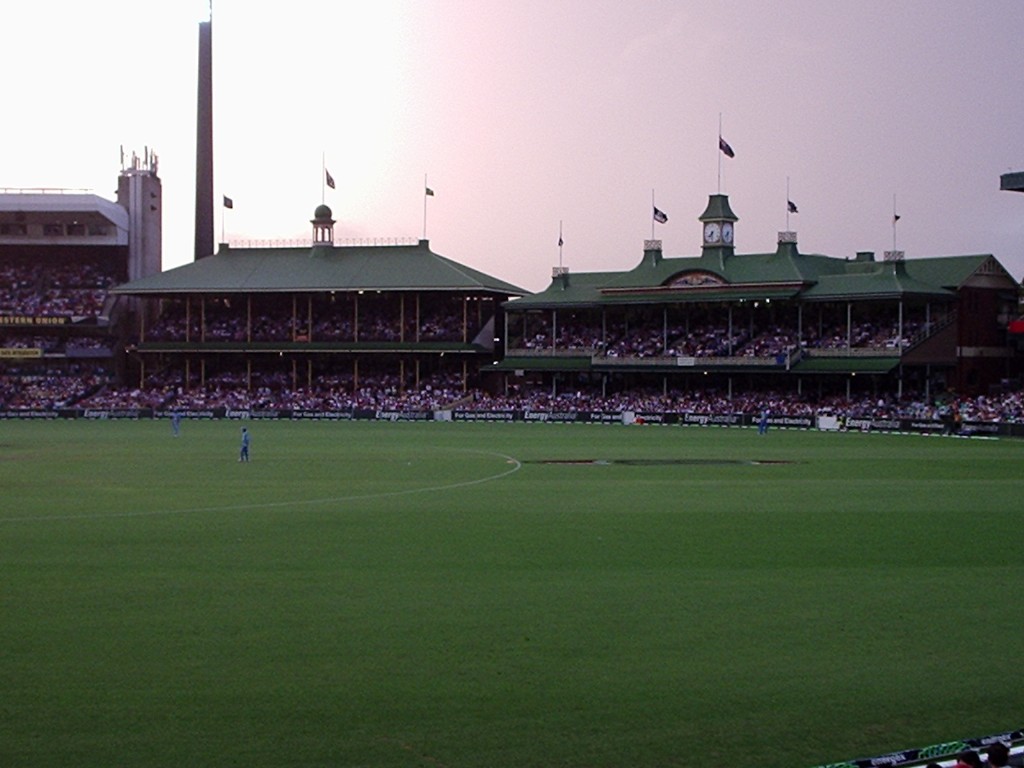
Me, I’m from Sydney. I love it, but I also have a whole lot of time for Melbourne. Melbourne has better licensing laws and thus better bars than Sydney, a better art and live music scene, and (mostly) better clothes shopping. Melbourne has trams. And what is not to love about trams? But Melbourne has little of Sydney’s breath-taking physical beauty, doesn’t have her beaches, or national parks, or fairies, er, I mean ferries, actually I mean both. It doesn’t have the wonderful bike path all the way from Newtown to the beach. Melbourne is, well, kind of dreary looking and its winter is unendurable. Nor does it have many of my favourite restaurants in the world the way Sydney does but, hey, the food is plenty fine in Melbourne too. And, please, do not give me the sacred MCG thing. There’s only one truly beautiful test-hosting cricket oval in Australia and it’s in Adelaide. And anyways my heart belongs to the SCG.

But who am I kidding? I was born here. I’ve spent the majority of my life here. I am completely biased about Sydney.

I’m not asking Melbournites to start loving Sydney. I’m just asking them to be a little reasonable about their over-the-top hatred. There are other cities out there that are actually worth hating (like, you know, um, another Oz city that I will not name because I have friends who live there what will be offended). Sydney ain’t one of them. And while I’m at it, Adelaiders, quit hating Melbourne, okay? You’re just being silly and why hate them when their MCG is ugly and your Adelaide Oval beautimous? You should pity them.

For me to work up a real forth of city hating, it has to be either a) a city I spent a miserable few years of my childhood in, or b) a city where you can’t get around if you don’t drive. Where the public transport and pedestrian access sucks. For this reason I perfectly understand why so many folks in the US of A loathe Los Angeles. Without a car in L.A. you are totally buggered. You have to beg rides from all your friends and are reduced to the status of a helpless child. But you know what? That’s true of almost every city in the USA, which is one of the reason I love NYC and San Francisco so much, they’re perfectly navigable by public transport and in Manhattan you can go wherever you want by shank’s pony. Plus, you know, there are so many places in both cities you’d want to go.

I used to hate London, because every time I’d visited the food was vile and expensive, it was gray, cold and raining (even in “summer”), and the people were obnoxious and rude. On my most recent trip the food was still expensive but it was excellent, the weather was endurable, and I only had one rude encounter, so now London’s in my good books. It certainly passes with flying colours the good public transport and pedestrian getaroundability rule. (Thanks to Niki, Lauren and Andrew for showing me the non-sucky London.)

Cities are who you know. The people who take you in and show you their town. I’ve had wonderful times in Dallas and Austin, Texas neither of them pedestrian friendly. I adore Toronto and it sure ain’t pretty. I’ve enjoyed Brisbane, Rome, Madrid, Bangkok, Jakarta, Dunedin, San Miguel de Allende, Davis and Lisbon—all of them because the people there were amazing and went out of their way to show their town to me. I imagine that even L.A. with the right people in the right light could be kind of okay. And now that my sister‘s moved there I guess I’m going to find out.

Or maybe not. There’s still that bloody car thing.

Done and away and over and off and like that (Updated)

I just pressed the send button, and now Magic! Magic! Magic! Oi! Oi! Oi! is winging its way across the Pacific, and then across mainland USA, all the way to Hudson Street in New York City. Except that, you know, technology, being what it is, my baby is already there. Freaky, eh?

I can now watch the Sri Lanka v South Africa One Day International in good conscience. Who am I barracking for? Sri Lanka, natch. But it would prolly be more interesting for the competition if South Africa won. But, frankly, without Makhaya Ntini South Africa just ain’t that interesting. Even if Sean Pollock does look uncannily like my husband.


Sean Pollock aka Scott Westerfeld (original source)

Can I just say that I love the extreme slow mos? Beautiful.

I have now worked way more than 20 days straight on finishing MorM 3. In that time I also achieved the following:

    wrote the first 500 to 1,000 words of three other novels.

    exchanged many many whingey emails with Holly Black moaning about our novels-in-progress.

    was waited on hand and foot by my most excellent husband.

    resisted reading the second Temeraire book which Naomi Novik so kindly sent me (so. very. difficult.).

    was given a first edition hardcover copy of Steve Waugh’s autobiography by my wonderful Australian publisher, Laura Harris (Something else to resist reading).

    chewed my finger nails way beyond the quick (ewwww! Do you know how many times I’ve sworn I would stop that? Aarrghh!)

    read the last five chapters of my novel to Scott at least three times. Fortunately for him, each time they were completely different!

    wrote five different endings to the novel (two of them so shockingly bad I didn’t read them to Scott).

    watched the first ten episodes of the second series of Battlestar Galactica. Thank you Sean Williams! Thank you Cat Sparks and Rob Hood!

    watched all of Ultraviolet. More thanks to Cat & Rob!

    completely failed to arrange accommodation in Bologna.

    realised that there is no sport on earth remotely as wonderful as cricket.

And now I fall asleep on the couch watching Sri Lanka defeat South Africa. Yea verily, this is the life!

Update: South Africa won! Wowzer.

Happy New Year!!!

How about this for a good omen on which to start the new year? My friend Shana noticed Magic or Madness in the window of one of the best children’s bookshops in the world, Books of Wonder in New York City:

And what’s more—it’s right next to The Very Hungry Caterpillar! This is going to be a very good year, indeed. (Well, for me, anyway, here’s hoping it will be for the rest of the world, too. And, yeah, I’d swap for the world to be better off, but, you know, I don’t think it works like that.)

Oh, and one last thing: Scott Lynch (whose lj I just discovered via matociquala) also had a good year—he became a firey.

Happy new year!

ASIF! hits PW

The newly-minted organisation ASIF! (Authors Supporting Intellectual Freedom) has just gotten coverage in the source of all publishing news , Publishers Weekly.

We also now have our mission statement:

AS IF! champions those who stand against censorship, especially of books for and about teens.

I’ve never had a mission statement before. I feel very superhero-y all of a sudden. Yay us! Maybe we need capes?

In Praise of the US Postal Service

I hear many USians complain about going to the post office and about the US postal system generally. I’m here to say you’re wrong. You lot have one of the best postal services in the world. It’s way cheaper, faster and better than the postal service of any other country I’ve been in.

I enjoy going to the post office on Fourth Avenue and Eleventh St. Most of the people who work there are lovely, have a sense of humour, and go out of their way to tell you the cheapest and/or fastest way to send things. And the woman who delivers our mail? A goddess. I’ve never ever seen her in a bad mood. She calls everybody “boopy” or “booboo” and is always smiling and cracking jokes. Whenever I run into her I know I’m going to have a really good day.

So stop your whingeing people. The rest of the world doesn’t have it so good as you lot. All hail the USPS!

Busy

I was asked yesterday what I’m looking forward to when I get back home. I answered, “cricket, warm weather, and seeing my family and friends”. But, obviously, not necessarily in that order. It occurred to me today that I’m also looking forward to not being so busy or surrounded by so many busy, busy, busy people.

New York’s just like that. You invite people to a party here and a bunch of them won’t even respond: they won’t say they’ll be there, they won’t say they can’t make it, and then they won’t show up. It’s not because they hate you. It’s just because they’re busy, overwhelmed, drowning. And when I’m here I wind up just as busy, just as behind with everything, unable to get all my work done, see all my friends, do all the cool things that I’ve heard rumours can be done in NYC.

It’s not that we’re not busy in Sydney. I’m a feelancer. My workload’s pretty much the same wherever I am. It’s not that I don’t have lots of busy friends there—hey Kate! It’s just that, I don’t know, busy is bigger in New York City. Wider. Denser. Hungrier.

Sydney’s slower, calmer, and much more relaxing. I can’t wait to get back there.

I’m so miserable

I can’t do this. I can’t do freezing cold weather. I can’t. We just walked four blocks through icy wind and some sleet and it makes we want to curl up in a ball and cry and cry. I’m never ever ever staying this late in the Northern hemsphere. From now on at the very very most it’ll be June to September.

As Elvis is my witness I will never be cold again!

Yummy Yuba

Last night I tried fresh yuba for the very first time and it were sublime.


photo swiped from this site

I also ate the best edamame I’ve ever had (fresh and smoky), sake (unfiltered milky goodness), and chestnut icecream (words fail me).

The meal ended twelve hours ago, but I’m still in heaven just remembering all the flavours: eel stuffed with fresh tofu, skirt steak cooked in miso with enoki mushrooms, black sesame ice cream.

Food is good. Life is good.

ball go fast

One of the freebie books I picked up in Atlantic City is The Believer Book of Writers Talking to Writers. In the intro it mentions that one of the interviews was conducted at a cricket match. So what did I do next? I leafed through every interview until I found that one, which turned out to be Adam Thirlwell talking to Tom Stoppard. But, here’s what a cricket tragic am I—once I got to the interview I skimmed impatiently through discussions of how Stoppard conceives and writes his plays, of Ionesco and Sappho and 9/11 and blah blah bloody blah, trying to find where they talk about the cricket being played in front of them.

I was beginning to think very poorly of Thirlwell and Stoppard. Very poorly indeed. How could you be at a match and discuss all sorts of arty farty blather, but not the actual cricket? How is that possible? For the love of Keith Miller!

Fortunately after pages of blather they finally get to the point, Stoppard applauds—“Oh that’s a just beautiful shot”—but then, horrifyingly fast, they reveal themselves as non-Cricket tragics. Thirlwell fails to discuss said cover drive and Stoppard says that:

Cricket seemed more or less pointless to me if you weren’t actually a wicket-keeper . . . It’s partly to do with the fact that every ball is frightening, if you’re keeping wicket, because there’s a good chance that you’ll have to deal with it if the batsman doesn’t. And, as you know, when it comes to catches being offered, probably three out of five go to the wicket-keeper, generally. So you feel that there’s a lot of responsibility on you, and one is constantly frightened of publicly shaming oneself—by dropping an easy catch or missing an easy stumping—which of course happened to me all the time, but nevertheless that’s what I liked doing.

While I, too, am fascinated by the wicketkeeper, I’m shocked that anyone could disparage all other fielders. I mean to say! What about the slips cordon? Silly mid on? Long leg? I’m not sure I feel quite the same way about Tom Stoppard now . . .

Wow

So, last night we got to hang out with the smartest group of folks I’ve hung out with in an age (and I hang with much smartness, let me tell you). At the Teen section of Elizabeth Library, New Jersey, we read a little bit, we told anecdotes, got asked very smart and very funny questions, I got to talk Spanish, and afterwards we got to eat great pasta and drink good wine and enjoy more ace conversation.

I read from my great Australian cricket mangosteen Elvis fairy novel, which I feared would tank with the seventeen-year-olds, but they laughed harder than the Brooklyn audience. Yay! I finally wrote something that cracks people up. And some of them knew about cricket. One guy plays it with his Pakistani neighbours. How cool is that? And many loved basketball and knew about the WNBA, not just the NBA! Heaven.

Scott read from Pretties which kind of tanked, and then from Peeps, which went over huge guns. He read about toxoplasma and there was much speculation about who has the parasite and who doesn’t. (Don’t know what I’m talking about? Then you’ll have to read the book, won’t you?) So many of them had read at least one of Scott’s books. One had read all of them and was full of smart questions. I made Scott do his Donald Duck voice and it slayed them best of all (he can harmonise with himself—next time you see him, just ask—he loves to perform on command). There was a queue of people wanting to have their photo taken with Scott. How fab is that?

And at the end, the library gave everyone a copy of one of my books (they had a choice of Magic or Madness or Magic Lessons—yup, Penguin genorously gave them a whole stack of galleys) and one of Scott’s many books. Though some tried sneakily to take two of Scott’s books. The competition over copies of Peeps was intense. We signed for all of them and thus got to talk one on one to everyone. Great idea, no? It was fabulous fun and I want to do it again.

Have I ever mentioned how much I love libraries? And librarians? And people who love libraries and librarians? No? Well, I really, really, really do.

Atlantic City? No, thanks. (updated)

I don’t want to rubbish a whole city, especially when I was only there for a few hours, but Atlantic City is an erky perky bleah of a place. Friends warned me it was a shithole—I had no idea they were being kind. It’s ugly, full of the most hideous buildings ever built and populated by zombie gamblers, who are served by an army of twelve-year-old incompetent staff. Once you’re inside one of the casinos it’s almost impossible to get out again. All signs lead to more gambling areas. I’m convinced that hell will be nothing but Atlantic City casinos.

This is heresy for an Australian, but, I hate gambling. I love cards and I’ll bet on them, but not with money. Never for money. Betting with money turns people into glassy-eyed zombies, and call me old-fasthioned, but I prefer my zombies in Romero films, thank you very much.

So why were we in Atlantic City? To attend the New Atlantic Independent Booksellers book fair, which other than its location in a hellspawn casino, was a lot of fun. We met the fabulous Penguin reps, Holly and Todd, who looked after us excellently well and told great publishing stories; we hung out with fellow YA writers, Maureen Johnson and Melissa Kantor; we both signed a bunch of our books, Peeps and Magic or Madness, and we snaffled up many free books. The gems of my pile—other than Maureen’s and Melissa’s books—were:

Small Steps by Louis Sachar, which is the sequel to Holes! Woo hoo! I have the sequel to Holes and you don’t! Ha! Ha! Ha!

The Weather Makers by Tim Flannery. I adore Flannery. He’s frequently interviewed back home about science and enviromental issues and is the smartest, most interesting, and clearest explainers of such issues I’ve ever heard. He also writes really, really well. I can’t wait to read this one, not least because I know it’s going to help me understand what happened with hurricane Katrina.

Today, we go back to New Jersey:

7:00-8:30PM
Elizabeth Main Library
11 S. Broad St., Elizabeth
New Jersey

We’ll probably read and we’ll definitely chat and generally be our entertaining selves. We’ve only done one library event before but it was fabulous, so I’m really looking forward to this.

Oh, and if you’re from Atlantic City? My condolences.

Update: I am very stupid. I wrote a blog entry about casinos, but my spam filter is set to nuke any comments that contain the word “casino”. I apologise to anyone who had their comment nuked. You can post now. Though given the vast tide of casino spam I get your comment will go through to moderation, which I truly rooly honestly will check. Rooly soon.

Another late night post

On account of tomorrow we is off to Atlantic City for the book fair and then to Philadelphia to stay with the fabulous Liz Gilbert this is another hasty late night post. Not that it’s so very late, it just feels like it on account of Scott and me did our debut Brooklyn readings tonight at the Barbes Bar. Many of our friends came (yay them!) and there were actual total strangers (yay them, too!). Twas a blast. For the first time ever I actually enjoyed reading. How bout that? Scott read great in his Texan accent and Bennett Madison was most funny, too.

Highlight of the night: the youngest member of the audience coming up to me to tell me that she loved the bit I read from my as-yet-unfinished great Australian YA cricket fairy mangosteen novel. She told me what her fairy is and those of various members of her family. Then when I said I didn’t have a fairy, she said, “Yes, you do! You have the good-story fairy.” Isn’t that lovely? I was so touched I almost got teary. Sadly, I was too over-energised from reading to remember her name, but if you’re reading this: thank you! It meant a lot to me.

Back in the US of A (briefly)

After a month of no motorised transport there was a vast deal today. Cars, planes, taxis. We went from San Miguel to Mexico City to New York City. We are tired. Tomorrow there will be trains: to Brooklyn and back (see previous post). The day after that buses to Atlantic City. It’ll be broom broom broom all the time. I will pine for walks on cobble-stoned streets.

Since I promised Cherie that I’d blog every day once I left Mexico. I’m blogging at this late hour despite fatigue. How good am I? Say thank you, Cherie. Also tomorrow seems to be too chockers for blogging so I thought I’d sneak it in early.

Things that i achieved in San Miguel:

photos of hummingbirds
grew actual fingernails
50 thousand words of final Magic or Madness book
Scott and me arranged mercy killing of one tiny, tiny, very hungry, very lame kitten (I’d tell you more but I’d start crying)

Things that have happened in the world in my absence that aren’t horrible and tear-inducing:

Australia thrashed the World XI in one-day fixtures and look well placed in one-off six-day test, mostly on account of the glories of the spin twins Warne and MacGill

My sister had her time working on King Kong extended—Yay!!!

I’m sure there were other things but I’m too tired to think.

Sleep now.

Teen Read Week

Next week is Teen Read Week and me and Scott will be doing a bunch of readings and signings around the traps.

First up, the very day after we get back from Mexico, so expect us to be full of Mexican cheer (I plan to wear my Mexican cowboy hat and may do the entire reading in Spanish):

Sunday 16 October, 6:00PM
Justine Larbalestier
Bennett Madison
Scott Westerfeld
Barbès Reading Series
376 Ninth Street (at 6th Ave.)
Barbès Bar
Park Slope, Brooklyn
New York

I’ll be reading from Magic Lessons the sequel to Magic or Madness in a way that gives absolutely nothing away if you haven’t read the first book. I’ll also read a wee bit from a brand-new novel I’ve been working on. Scott will read from Peeps in his authentic Texan accent.

Monday 17 October
New Atlantic Independent Bookseller Association Trade Show
The Tropicana Resort & Casino
Brighton & The Boardwalk
Atlantic City
2:30-3:00: Scott signs 75 copies of Peeps in the author autographing area table #3.
They’ll also be giving away copies of Magic or Madness at the Penguin booth #204. Yay! Free books! I plan to snaffle up many (though not my own book, obviously).

Tuesday 18 October, 5:30-7:30PM
Scott reads at Books of Wonder
18 West 18th St
Manhattan
New York

Wednesday 19 October, 7:00–8:30 p.m.
Author Event:
Meet Scott Westerfeld and Justine Larbalestier
Elizabeth Main Library
11 S. Broad St., Elizabeth
New Jersey

So, it’s quite the busy week for us. Hope we get to see some of you.

You Must Listen to This

“Rampage” is one of the best radio documentaries I’ve ever heard.

Over the last few years Australian war artist George Gittoes has been documenting the war in Iraq through the music of the conflict—the sounds being listened to and made by US troops in Iraq. Now he’s travelled home with the soldiers and found himself in a whole new war zone—America.

Miami specifically. In his previous documentary, Soundtrack to War (chunks of which were used in Michael Moore’s Fahrenheidt 9/11) one of the soldiers he followed, Elliot Lovett, said that Iraq was a doddle compared to where he lived in Miami. Gittoes followed him home and discovered that it was true.

Listen to it here.

Silences

It’s been quiet around here for several reasons. Mostly Hurricane Katrina and the aftermath. Despite reading John M. Ford’s excellent advice, I’ve been following all the news and like everyone else getting angry and upset. I really hope the disaster will lead to everything being done that needs to be done: rebuilding the wetlands, rebuilding New Orleans as a place for all her now former residents, and making sure that the response to any future hurricanes or anything else will never be so slow ever again.

Then all my tedious deadlines. The proofs of Magic Lessons and the paperback version of Magic or Madness need checking, and, of course, the third and final book in the trilogy needs writing, given that it’s due 30 December and I haven’t started yet. I was six months early with the first book. I really hope my editors remember that.

That’s why next Tuesday we’re off to San Miguel de Allende in Mexico for a month. Where we hope to get lots and lots of writing done in a house that is free of the distractions of the internet and television.

In the meantime I’ve gotten to see Cassie type the last words of her very first novel. Very impressive given that some of us were doing more gossiping than writing that day. Okay, that would’ve been me gossiping with myself. Scott and Holly were typing almost as furiously as Cassie. I wish they were both coming to Mexico too. Surely their diligence will rub off on me eventually . . .

Thinking about something else, anything else

Margo Lanagan reminds us all to be careful of the words we use. Just so! For me ’twas a timely reminder as I am perusing the proofreader’s pass of Magic Lessons and making more changes (mostly deleting “just”. Aaargh!)

Jim McDonald made me laugh with his lessons learned from British folk ballads. I’ve been a tad obsessed with ’em since I was a wee lass.

Gwenda points to this incredible exhibition of spirit photography currently on in NYC. Given our deadlines and imminent trip out of town, the odds of my seeing it are not good. Hell, we don’t seem to be able to get it together to see our friends here . . . Must not sign up for more than one book a year!

Eyewitness accounts

Boingboing has been linking to many heartwrenching accounts of the aftermath of Katrina. This one captures some of the intense anger many people are feeling. It’s also an account of local people in Texas doing whatever they can to help.

Texans are well-known for their generosity. It’s grand to know that they’re already demonstrating those qualities to the newcomers. (Scott’s family are all from Texas so I’ve experienced that warmth and kindness first hand.) Here’s hoping government at local, state and federal level will more than match the generosity of the people.

Scott’s uncle is a principal at a downtown high school in Houston. A few days ago Katrina had already given them 15 new students and he was already fielding calls from Louisiana teachers looking for jobs. It’s going to take a lot of money and resources to help Houston and the other cities accommodate all the folks from New Orleans and elsewhere. Here’s hoping they get everything they need.

Garlic and Sapphires

In the vein of fiddling while Rome burns I read Ruth Reichl’s decadent account of being the restaurant critic for The New York Times in one gulp last night. Could not put Garlic and Sapphires down, no matter how hungry I got, how desperate to run out of the house and find the incredible food, and wine she describes.

I defy you not to get very very hungry reading prose like this, even if you just ate:

I took a bite and immediately forgot his knee. I forgot everything but what was going on in my mouth, the fish doing a little tango with crunchy strips of artichoke. The softness of the fish was sandwiched between layers of crunch—the artichoke on the bottom, bread crumbs on top, the flavors appearing and vanishing in a maddening way. I thought I tasted chestnut, and then it was gone, absorbed into the deep musky flavor of the wine.

Want. Now!

Her food critic m.o. is kind of insane and involves wigs, elaborate costumes and whole new identities in order to avoid being identified and thus sucked up to outrageously, with over the top service and food because, don’t you know, she’s The New York Times restaurant critic and thus more important, even, than the king of Spain.

Anyway her book is well-writ and funny and sad and all about food and wine. What more could you ask for?

The Gulf

When the tsunami hit we were in Sydney. Psychically, Indonesia, Thailand, the whole of southeast asia, just doesn’t feel very far away from Australia. They are our neighbours. Yet the tsunami hit, thousands of people died and we ate our breakfast of mangoes, bananas and passionfruit, granola and yoghurt like always. Sure we cried, followed the coverage, donated money, but our life in Sydney was unaltered. We thought about other things, went out with our friends, laughed.

Now New Orleans is destroyed, hundreds are dead in Mississipi and Louisiana but life in New York isn’t any different. We’re in the same country, but we’re miles and miles away, here water is plentiful. We’ve cried at the coverage, donated money, but our life is just the same. Tonight we’ll watch the second playoff game between the New York Liberty and Indiana with friends. I still want the Liberty to win. I’ll scream at the tellie when there’s a bad call from the refs. I’ll yell happily when we score.

I don’t know what I was expecting. I don’t even know what I’m saying.

Tipping

The 5 September issue of the New Yorker has an informative piece by James Surowiecki on tipping. Apparently it didn’t become widespread in the US of A until after the Civil War and some states were so appalled by it they even banned the practice. Who knew?

There’s just one problem with the piece, he claims that Australia and Japan are countries where they don’t have tipping. Now, I don’t know about Japan, but it ain’t true about Australia. Tipping isn’t as widespread back home as it is here (thank God!), but tipping wait staff in restaurants is standard. Though unlike the USA, you don’t have to tip if the service sucks; and unlike New York City, 20 per cent is an epic tip, not de rigeur.

I hate tipping. I never know how much I’m supposed to give or to who. Taxidrivers? Yes. The lovely woman who delivers the mail? No. Huh? It’s so random! I hate the stress of going to the hairdresser and not knowing how much it’s really supposed to cost. I just wish people would charge me up front and leave out the guessing game. I hate the moment of handing over the tip. I feel like I’m trying to bribe someone. The whole thing is too bloody stressful. I wish people were simply paid decently and weren’t dependent on customers to make a living.

Thus endeth the rant.

This an’ that

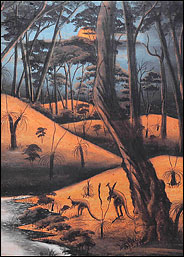
Read this article in the New York Times about art by the stolen generation. Gorgeous, gorgeous work produced under the most appalling circumstances.


The Picker Art Gallery
“Down to Drink,” by Parnell Dempster.

Australian young adult writers are conquering the entire universe. I was dead proud that Magic or Madness had already sold in five countries (USA, Australia, Taiwan, France, and Thailand), now I see that I’m underachieving. This article by Rosemary Neill is also startling because it’s so well-researched. It’s refreshing to read something in a mainstream news source about publishing and actually learn something. Via Yoof Literature (thanks, Lili!).

Speaking of research . . . Did anyone else watch the NBC so-called “news” report on the shocking new content of teen novels which aired Monday night? I watched it because R. A. Nelson who wrote Teach Me was interviewed. He spoke for about six seconds. The report consisted of people saying, “Look at the cover of this YA book!” Cut to cover of Gossip Girl or the like. “This book has shocking content! Should we let our children read books with shocking content?” Cut to a parent. “I’m shocked that my children are reading books with shocking content!” Cut to some random other person who is also “Shocked! Shocked by teen books with shocking content!” The 2 minute report ended with an admonition to parents to be wary of the shocking, shocking, shocking content of teen books.

I hadn’t watched “news” on television for ages and I gotta tell you I was shocked, shocked, shocked by the “content” of that report too!

Too Young to Publish

Recently I’ve had a number of letters from teenagers wanting advice on how to get their novel published and wondering whether their age will make it harder for them to get it into print. Specifically, would they be discriminated against because they were only thirteen/fourteen/fifteen/sixteen or whatever?

The simple answer is no. When you submit a query letter to a publisher or agent you don’t have to tell them how old you are. You’ll be rejected or accepted on the quality of your submission.

Being young can be an advantage in getting published. I was first published when I was nine. A short poem in The Newcastle Morning Herald (now The Herald). My mother sent it in and it was published with my age listed. While the poem was clearly a work of genius, odds are that if I hadn’t been nine, it wouldn’t have been published. As it happens I was more embarassed by the publication than I was proud. The kids at school teased me non-stop for the rest of the year. Happy days.

Up to the age of 15, I had a number of other poems and stories published. Without motherly intervention even. Every one of them with my age beside my name. After that, nothing of mine was published until I was in my thirties.

What happened?

Another simple answer: I started competing with adults. I stopped listing my age and started sending to more grown up venues. My work was not as good as that of the grown ups. I didn’t find my way into print again until I was way past my child prodigy days.

The teenage me was cast into deep, dark despair by this. On my seventeenth birthday I had a midlife crisis. There I was seventeen years old and still no novel published! I was a complete and utter failure! What was wrong with me?

Another easy answer: I wasn’t good enough yet and I wouldn’t be good enough until I’d learned to write and rewrite and rewrite again. Until I got past thinking my first drafts were perfect and that rewriting involves a wee bit of chipping at the surface of a story. It’s much, much harder than that. And, I’m belatedly learning, more fun too.

If you’d have told me back then I wasn’t good enough and had a lot more to learn about writing I would not have believed you. Actually come to think of it, people did tell me back then. But they were polite about it saying that I had a "great deal of promise" and a "bright future ahead". Blah, blah, blahdy blah. I didn’t want to hear it. I wanted to be published immediately! Before I hit twenty-one or, worse, thirty and was too decrepitly old to enjoy it.

Now, of course, I’m incredibly grateful that no one did me the disservice of publishing me back then. I’ve kept a lot of my juvenilia and, well . . . it shows promise.

I have a couple of friends who were not so fortunate. They were first published in adult venues when they were still teenagers. Both of them are horrified that their learning and growing as a writer has been done so publicly and that there’s nothing they can do to make all that evidence of early missteps go away. They both wish they’d spent more time honing their craft and less time desperately trying to get into print.

But how do you hone your craft?

Read a lot. Write a lot. In that order. There are very very few good writers who aren’t also good readers.

Never send off a first draft for publication. Even though the temptation to do so is enormous. I mean you wrote a complete draft! A whole poem/story/novel! It has a beginning, a middle and end! The sense of accomplishment is enormous you can’t wait to show your work of genius to the rest of the world.

Resist that feeling.

Wait a few weeks after writing something, then reread it, rewrite it (and I don’t mean just fixing typoes), then give it to some people you trust for comments. (Not your parents. Most’ll just tell you it’s wonderful no matter what.) If you have friends who read a lot give it to them. Or to a teacher you trust. Give it to as many people as you can think of. Trust me, most of them will not get back to you with comments.

Ask the ones who read it to tell you when they got bored. Ask them to tell you the plot. This is a great way to figure out if your readers are reading what you think you wrote. It’s amazing how often they aren’t.

When they get back to you with all their comments, rewrite it again. Many of the comments will be intensely annoying and boneheaded and will make you want to end the friendship with the idiot who said them. Resist your urge to do so. Resist the urge to tell them how moronic they are. Also resist the urge to cry (I still haven’t quite mastered this one). Instead look for parts of your story/poem/novel that all readers had problems with. Figure out how to fix it. Most likely the solution you find won’t be the one they suggested. (Later on when you’re published you’ll find this also applies to your editors.)

Learning to take criticism is one of the major prerequisites of being a professional writer. Once your work is accepted for publication, your editor will criticise what you have written and ask you to rewrite it. Usually many, many times. And after it’s gone through all those rewrites she will often forget to tell you good it is. There will be few gold koala bear stamps. Your editor’s primary concern is to get rid of that which sucks. It should be yours too.

Just as important: don’t get too caught up in the praise your readers offer you. If your readers only have good things to say about your manuscript, enjoy it, but then be suspicious. Very few pieces of writing are perfect first go. (I rewrote this essay several times and then gave it to Scott to read and it could still stand a bit more rewriting.)

Once you’ve made your manuscript as good as you can possibly make it—if it’s a novel that should take months, maybe even years—then and only then do you send it out for publication.

But how do you get a novel published?

With great difficulty. Getting published is very, very hard no matter how old you are. Most novels never find their way into print. Even really good ones.

Ian Irvine outlines the whole process in his essay, The Truth About Publishing (the link’s in the menu on the left). I strongly advise reading the whole document through to the end. It’s depressing, but it’s also very very useful. I wish I’d read it back when I was fifteen.

Good luck. Do not despair when you are rejected. Welcome to the club. There isn’t a writer in the world who hasn’t been rejected. Many, many times.

New York City, 13 August 2005

The Hebrew translation is here.

For those young writers who are angered by this please read my clarification.

How to Get an Agent

Of late I’ve been receiving quite a few emails asking me how you go about getting yourself one of those mythological creatures known as the literary agent. It’s a question frequently asked of most published writers. You should also take a look at Ian Irvine’s the “Truth about Publishing” which explains how the publishing system works (be warned: it’s depressing).

The short answer is that there is no one way to get an agent. Luck and hard work both play their part. But first you have to figure out whether you’re ready for representation. Don’t even think about pursuing agents until you have a finished novel. And make sure that novel is as good as you can possibly make it. Then make it a whole lot better. Rewrite and rewrite and rewrite and then rewrite some more before you send it to anyone. And, yes, this does apply to you. And yes it applies to non-fiction proposals too. Even though you don’t need a completed book you do need the best proposal you can possibly write.

When Scott got his first agent he didn’t know any other writers or anyone in science fiction publishing. His first step was to find out which were the best agents representing adult science fiction. He did this by looking at the acknowledgments pages of his favourite writers, as well as looking up agents in the various writers’ guides available at the time. (You’ve got it much easier these days; you can use Agent Query.) He then spent a whole week writing the perfect query letter, before sending it out to every suitable agent. (That’s important: do not be sending your YA cheerleader novel to someone who only handles adult non-fiction.) He received only one request to see his novel. He sent it and she signed him up. Let me reiterate, at the time Scott had no connections, knew no one in literary publishing, indeed, he’d never met an agent before. This is the traditional method for finding an agent and it still works. But remember that query letter has to be good. Agents get hundreds and hundreds of queries a week.

I got my first agent because I like people. I always have. I frequently wind up in conversations with total strangers in the queue for the loo, at bars, restaurants, parties, wherever. Meeting new people is one of my favourite things in the world.

So my first agent? It was 1999, I had just flown from Sydney to NYC (via LA) to spend six months in NYC researching the New York Futurians for my post-doctoral fellowship. I arrived at JFK knackered out of my mind and found myself in the longest queue for cabs I’ve ever seen. The woman in front of me asked where I was heading. I said Manhattan. We agreed to share a cab. We got talking. Turned out that she was a writer too. A real one with a published book and eveything. Once in the cab we were already fast friends. Then the cab got stuck in traffic and it took almost two hours for us to get into the city. By the time we finally parted ways I felt like I’d made a friend for life. But as usually happens we never saw each other again.

We didn’t forget, though, and almost a year later I received an email out of the blue from a friend of Pang-Mei’s. She was starting up a new literary agency and Pang-Mei had described my Futurian project to her. She was intrigued and wondering if I had representation. She asked to see samples of my work. I sent them to her, she signed me up.

Before she emailed me, I’d already made an effort to get an agent for my first (written) novel (which to this day hasn’t sold, though it’s come close a few times). At the time I had no professional fiction publications (not even a haiku) and precious few of any other kind. My manuscript was rejected by three different agents. One in Australia, two in the USA. At the time I thought the novel was as good as I could make it (maybe it was) but I’ve since rewritten it several times and it’s much much better now. Did I send it out too soon? Probably.

All three of those agents represented friends of mine. They agreed to look at my novel because said friends had recommended it. I did not need to write a formal query letter. (To this day I have never written one and hopefully I never will.) Having that connection meant that my manuscript was read and that I got a prompt response. Two of the agents even took the time to sit down with me to explain in detail what they thought was wrong with the novel. (An exquisitely painful experience—let me tell you—at the time I wasn’t used to criticism. Years of living with Scott has since hardened me.)

But did my connections get me an agent on that occasion? No, they did not. Unless an agent likes what you’ve written and thinks they can sell it, they will not take you on as a client. Not even if you’re best friends with J. K. Rowling. It’s that simple.

The common theme here is being connected. But how do you get connected? I did it by going to science fiction conventions and meeting lots of writers, other aspiring writers, editors, agents, publishers and fans. All of whom were full of gossip about the publishing industry and books and writers and who the best agents and editors are. After going to two or three conventions I was connected in a way I’d never thought possible. I’d had conversations with some of my favourite writers in the whole world. It was dizzying.

Without even intending to I was laying groundwork for my own fiction publishing career. (Remember though the most important groundwork for a writing career is to write and write and write.) But let me put it in perspective. None of this was instantaneous. I attended my first convention in 1993. I finished my first novel in 1999. I got my first agent in 2000. My first (non-fiction) book was published in 2002. My first professional fiction sale came in 2003 (the Magic or Madness trilogy to Penguin/Razorbill). My first novel was published in 2005. Not exactly greased lightning.

The not-intending-to part is important. Over the years I’ve seen ambitious aspiring writers go to conventions and try to make as many connections as possible as quickly as possible. I’ve seen them rock up to parties and just happen to have the manuscript of their novel in their bag, ready to hand over to the first agent or editor they talk to who expresses interest. Not a good look. Desperation and naked ambition make people on the receiving end nervous.

So, am I recommending that you go to conventions to make connections but pretend that you’re not? No. I’m saying that if you’re even vaguely a people person going to a convention or festival or other gathering of writers who write stuff similar to you (horror conventions if you write horror; romance if you write romance; sf for science fiction and fantasy; writers’ festivals for mainstream) you’re going to meet at least one or two like-minded people and become friends. After more than ten years involvement with the sf community, nearly half my friends are part of that community. The most important thing I’ve gotten out of attending conventions is friendship, becoming part of a community that extends over many continents. I have sf friends in Argentina, Australia, Canada, France, Japan, the Netherlands, Spain, the UK, and the United States (and I’m sure I’m forgetting some countries).

That many of these friends are writers, editors and agents is secondary, but, yes knowing them wound up making it easier for me to become a published writer. (But remember, some of them weren’t any of those things when I first met them.) I’ve been invited to contribute stories to an anthology just because I happened to be in the room with the editor who was talking about it. Most themed anthologies aren’t open submission, you have to be invited, and to be invited editors have to know who you are. If you’re unpublished—as I was at the time—it’s damned hard to get the invite. So far I haven’t had a story accepted for one of those anthologies. Like I said, being known gets your foot in the door, but it doesn’t get you published unless the editor loves what you’ve written. Established writers with many published books still get rejections.

The best panel I attended at WisCon this year was Common Questions for Pros. It featured the diametrically opposed Robin McKinley and Scott Westerfeld. In good spirit they disagreed about how to write (Robin: in one big, compulsive, mind-destroying burst; Scott: in the same place, at the same time, every day, with the goal of writing a thousand words), as well as about how to go about getting an agent, or published. Scott spent a lot of time talking about the community in a similar vein to what I’ve written above. Robin McKinley kept making the point that if you prefer the life of a hermit, if you can only handle people in small doses, then the becoming-connected route is not for you. You can, she insisted, get published without knowing a soul in the industry. After all she managed it. (So did Scott.)

I totally agree (and for the record, so does Scott). I’ve seen people at cons schmoozing because that’s what they think they should be doing and looking utterly miserable in the process. If you don’t like talking to strangers then don’t do it.

Here’s something else Scott and Robin McKinley agreed about: the writing is the thing. No matter how connected you are, if your writing doesn’t cut it then you will not be professionally published. Your writing must always come first. There’s no race to be published. I swore to myself that I would have my first novel published before I was thirty. It didn’t happen and I’m glad (though that’s definitely not how I felt at the time). Right now I’m a much better writer than I was at thirty. I hope that like Ursula K. Le Guin and Carol Emshwiller I’m going to be an even better writer in my seventies and eighties. That’s one of the great things about being a writer: there’s no use-by date.

Good luck.

New York City, 4 July 2005
Books of Wonder

Went into the fabulous Books of Wonder children’s bookstore today to drop off an arc of Scott‘s Midnighters 3: Blue Noon. (Yup, the final Midnighters book is that much closer to being a real book. Exciting, eh?) We were greeted with effusive expressions of happiness. I believe Sara snaffled the arc for first read. (I’ve just started my re-read, and, wow, does it crack along.)

It was meant to be a quick visit, drop off the arc, then hurry home to get some solid writing in before tonight’s game. But we ended up having a good old goss about which b.e.a. books we’d read and enjoyed: Totally Joe, Teach Me and Rebel Angels all got dissected (in a positive way!). We also raved about Valiant and because of Sara and Elena’s enthusiasm we walked out of the shop with copies of Looking for Alaska and The Boyfriend List (Elena’s favourite book in the whole wide world–right now). I’m now itching to go read them, but I should at least attempt to do some work today . .

This is why I love that shop so much. Everyone working there really, really, really knows books. They’re passionate, opinionated and enthusiastic and handsell their favourites like you wouldn’t believe. And they love talking books. I could go in there and swap opinions, get recommendations and natter for hours. Actually, what do I mean, “I could”? I just did.

I walked out of Books of Wonder in the best mood. I adore good books, and good book people, and good book stores. Happy sigh.

Okay, time to work now.

Expensive Cities

So I spend most of my time in two top 20 most expensive cities in the world: Sydney at number 20 and NYC at number 13. Tokyo and Osaka top the list.

Of course, it’s the real estate prices that do it. Both cities can be damn cheap to eat in, and to buy clothes, and a host of other goods and services. Most expensive leg wax I ever had was in Madison, Wisconsin. Cheapest: right here in NYC. It wasn’t very good, but.

via Vertical Books

Mid-Career Writers

For the last few years Pat Murphy has organised a closed session at WisCon for writers who are in the middle of their career and need a space to talk about the issues that involves. The first problem in doing this was deciding what exactly a mid-career writer is. They decided that you have to be five years out from your first professional sale to attend.

Scott Westerfeld went to the first two workshops and got to discuss Secret Writers’ Business with some of my favourite writers in the entire world. Afterwards he and many of the others were red eyed and seemed to have this new and amazing bond. I confess I felt a pang of jealousy, but I knew I didn’t belong in that room. At the time of the first workshop I’d published a non-fiction book and had one semi-pro sale of a short story. Now, I’ve sold three novels, one of which has been published and I still don’t belong in that room.

Pat Murphy has now come up with a much better definition of a mid-career writer: someone who’s had at least one book remaindered. Ouch.

This WisCon I was involved in several conversations about the problems of being a mid-career writer usually with a bunch of writers who’d all been in the game much longer than me. In one conversation I started burbling on with first-novelist enthusiasm about the business cards I’d printed up, visiting bookstores, and other bits and bobs I’ve been doing to promote Magic. Their eyes glazed over. "Stuff business cards," their body language said. They started to talk about what to do when you’re remaindered, or when you’re told that you’ll have to change your name if you want to sell books for more money. Oh, I realised once again, I am not a mid-career writer.

Here’s why a closed discussion is necessary. People at my stage of their career just slow the conversation down. First-time novelists just don’t get where the mid-career writer is at. Neither do writers who are unpublished. Every time published writers try to discuss the problems with their publishing career online someone comes along (often way more than one person) and flames them. "You should be grateful to be published at all!" "I know loads of brilliant writers who can’t even get an agent!" Blah, blah, blah. Look at the vitriolic attacks on Jane Austen Doe.

I was in my thirties when I started making professional sales. I started sending my stories and poetry out when I was fifteen. I know just how hard it is to get published. I know several unbelievably talented writers struggling to get their work into print. That’s a problem. It just happens to be a different problem to those that mid-career writers have. It’s also a problem if your advances and sales are going down with each successive book (despite them being the very best books you can write). Writers in that position need to be able to talk to their peers without gormless first novelists burbling on about business cards or frustrated unpublished writers bitching at them.

I have a couple of friends who have been very successful with their careers and are now getting big advances, being pursued by Hollywood, sent on book tours, the works, and guess what? There are problems involved with success. The two most successful writers I know have barely been able to write a word in the last year. The amount of publicity they have to do for their publisher has increased by a factor of ten, as has the amount of mail they get, and books they’re called on to blurb. They’re barely home. They’re exhausted. They’ve forgotten what their families look like. But they can’t complain because the most common response they get is: "I wish I had your problems!" which is the same as saying shut up.

Supporting yourself as a writer is a difficult, fraught business with all sorts of different problems at every stage. If you say as an unpublished writer, "I don’t want to hear about your problems! You’re published! I have nothing!" you’re cutting off your nose to spite your face. If you go on with your career, one day the problems of a mid-career writer will be your problems. The book that you have slaved over that is as good a book as you can make it, will die in the markerplace, will be remaindered. When that happens I doubt that you will consider yourself lucky to have been published at all.

So it’s probably worth listening—without envy—to those whose careers are further along than your own.

New York City, 2 June 2005

Looking for an Agent: Progress Report

I’ve had a number of emails on the agent question, some from folks wondering how the search is going, wishing me luck or offering advice, and others wondering what on earth it is agents do anyway.

Thanks for the advice and agent suggestions and all the good wishes. Much appreciated. Here’s the answer to the two questions:

1) How’s the search going?

Not too foul. Nice lunches have been consumed, meetings have been held, there has been much talk of the future, of our careers, where we want to be headed and how best to get there. I’m starting to get a little weary of saying the same things over and over (Make me a star! Give me a career like Philip Pullman’s!). But fortunately the agents we’ve been meeting have been less tedious. Each one has been different and not one of them has been even a tiny bit creepy. I don’t know about you, but I’ve long been brainwashed by Hollywood into thinking all agents are unscrupulous and evil. Though, come to think of it, those were mostly Hollywood agents.

None of the seven agents we’ve met have done anything to get themselves crossed off the list: they’re all smart, interesting and fun to hang out with. I’m hoping I get to stay friends with the ones I don’t choose. (I wonder what the etiquette on that is? Christopher?) Every single one of them has met all eight items on my list. They all take the same percentage, offer the same services, go to the same important book fairs around the world. The more agents I meet the harder making a decision becomes. So I’ve decided that I’ll go with the agent who loves my adult novel (an historical set in twelfth century Cambodia) and my young adult books. That should narrow down the field some!

2) What on earth does an agent do to earn that fifteen per cent?

They act as a bulwark between you and your publisher. I negotiated my contract with Penguin/Razorbill myself, which was really awkward because Eloise Flood, Razorbill’s publisher, is a good friend. I don’t ever want to be in the position of bargaining with a friend again. An agent won’t be embarrassed about asking for more money, or to keep control of the movie rights, or the foreign rights, or whatever it is you want.

And your agent should know to ask for stuff you didn’t even realise you wanted. Agents have been negotiating with editors for longer than you. They know what scary clauses in a contract have to be crossed out. They know which publishers will do what for which writers and thus how to get you a better deal. Hell, agents understand contracts which already puts them a long way ahead of me. My eyes glaze over before I’ve hit the end of page one. (In my defence: contract pages are really long.)

A good agent knows which editors are actively hunting for which kind of books. They know who’d be right for you at all the major houses and most of the boutiquey, hip ones too. It’s their job to know all this. It’s a lot harder for a writer to be up on all that stuff, thus unagented books typically don’t get seen by as many editors and don’t get as good a deal.

If your publisher does something you’re unhappy with a good agent can fix it for you, or at least find out what’s going on and smooth things over. Just having someone run interference can be worth the 15% alone. Sometimes your publisher want to change the terms of the contract by, say, cutting one book into two, or publishing a book in paperback when they’d said it was going to be hardcover (neither of which has happened to me). That’s when you need to have someone who’s got your back to talk to, figure out how best to handle it, and then, best of all, go handle it for you.

Not only do agents understand contracts, they also understand royalty statements, which have to be the most incomprehensible things I’ve ever struggled and failed to understand. Trust me, I’ve really really tried, because your royalty statement is the statement that tells you how well your book is doing. They’re important! A good agent can spot when they don’t make sense, figure out what happened, and extract the outstanding money from your publisher. Useful, eh?

They also take you out to lunch at yummy restaurants and gossip with you. Yeah, yeah, I have friends I do that with too, but a) they don’t pay, and b) they’re not your agent so it’s not nearly as cool. "La, la, la, here I am at this fancy pants restaurant with my fancy pants agent. Look at me!"

To sum up: having an agent is all about looking cool.


New York City, 23 May 2005

Looking for the Perfect Agent

I recently parted ways with my agent. It was very amicable. She was, and is, a wonderful person, a great agent and a good friend. I’d have no qualms recommending her. She’s dedicated, smart and very good at what she does. But for all sorts of reasons it didn’t work out. So now I’m looking for a new agent.

Gulp. Much much easier said than done.

First of all there’s the researching, asking people in publishing—writers, editors, publishers, publicists etc. etc—about all the agents they know. Who does what? Who’s looking for new clients? Who handles Young Adult? Adult fiction? Both? Genre? Non-fiction? Who has a client list that I’d fit in with? Then there’s approaching them and seeing if they’re interested. Then meeting them. Then deciding who to go with.

Fortunately I’m not doing this alone. Scott is also in the hunt for a new agent. He’s gone agentless for several years and has decided that it’s time to have someone else take care of the parts of being a writer he’s least fond of (negotiating deals, checking contracts etc. etc.) and that it’s worth giving 15% away to have them do it. Even though we mightn’t go with the same agent, we decided to look together so that we could compare gut reactions, and point out cool career achievements the other one forgot to mention. "Scott just won an Aurealis." "Justine just got nominated to the BBYA list." (Always easier to have someone else toot your horn for you.)

While deciding which agents to approach we put together a list of what we wanted from an agent. Here’s mine (Scott’s was a lot less mushy):

Someone who

  • I can trust;
  • understands and enjoys my writing;
  • has long-term plans for my career and can give me advice on what projects to pursue next and how and when;
  • is based in New York City and on a first-name basis with most of the editors and publishers here. NYC is, after all, still the centre of publishing in this country. And also so I can see them face-to-face during the northern summer when I’m here. (I also plan to get myself a Sydney agent to handle my Australian career.);
  • knows the business inside and outside. Not just the people, but how the strange arcane business of publishing works;
  • responds to my calls and emails promptly;
  • understands and loves young adult fiction;
  • understands and loves genre fiction.

Not that huge a list really, and yet . . . It’s such a strange relationship, that of agent and writer. Some end up being psychologist, social worker, mother, father, editor and banker to their clients as well as everything I listed. I don’t want any of that. I got plenty of people in those roles already! But I do want someone I feel is looking out for me and will fight to protect my 85% as much as their 15%.

So ever since we got back to NYC we’ve been meeting with agents. All of whom have been lovely. Seriously, we haven’t met a one we haven’t liked. Still I’m not sure that liking your agent is the most important aspect of this particular relationship. My previous agent was the first agent to ask me. At the time I was unpublished and had been knocked back by the two agents I’d approached (one in Sydney, one in NYC) and could not believe my luck. It’s much much much harder getting an agent when you’re unpublished. It turned out that I liked her a tonne, but even so that wasn’t enough for our agent/writer relationship to be what we both wanted it to be.

The meetings, mostly lunches, have been very very weird. It’s like a first date except that . . . actually, no except, it’s exactly like a first date, right down to them bringing you a present (not flowers—much better than that—books! which is how I got to read Holly Black’s brilliant and amazing Valiant so early). It’s awkward and tense and exhausting. Just like a first date you’re wondering whether they like you, whether you like them, whether you’ll be good together, whether this has a future. You’re analysing everything they say and don’t say. Why did they pick this particular restaurant? Why this part of town? Why did they dress that way? Should you have dressed this way?

Still, it’s early days, we have the whole summer to decide and already we’ve both met an agent we’d definitely feel more than comfortable with. We both have high hopes it’ll work out okay.

In the meantime, if anyone out there who is an agent, or has an agent, has any thoughts on this peculiar, yet incredibly important relationship in a writer’s life I’d love to hear from you.

Wish us luck in our search!

New York City, 12 May 2005

Australian versus US English

Pardon me while I geek out about the diversity of the English language.

One of the cool things about writing a trilogy populated by Australian and US characters, and attempting to use both vernaculars, has been coming across differences between Australian and US English. Yesterday, while defining "bitumen" for the glossary of Magic Lessons, I learned that not only do USians not know what "bitumen" is, they don’t call a road made from bitumen a "sealed" road. I don’t know why but it had never occurred to me that a sealed road could be called anything but a sealed road. Apparently they call them paved roads. Huh.

This is weird to an Australian because "paving" is something you do to garden paths, or around swimming pools, not to roads or streets. Unless they’re made of cobble stones and frankly, I’ve not come across many cobblestoned streets in Australia.

Here’s the Macquarie Dictionary (Australia’s premier dictionary—I adore it) definition of "sealed road": a bituminised road. (That’ll explain everything to a bewildered USian.) And of "pavement": 1. a walk or footway, especially a paved one, at the side of a street or road. 2. a surface, ground covering, or floor made by paving.

Naturally enough, Webster’s and the American Heritage Dictionary don’t have a definition of "sealed road". But here’s how the American Heritage defines "pavement": 1.a A hard smooth surface, especially of a public area or thoroughfare, that will bear travel.

Not the same are they? To "pave" something in the US can include laying out asphalt on a road. The Maquarie Dictionary definition of "to pave" is you have to be laying out tiles, stones, bricks, the stuff that we refer to as "paving". It took many minutes of incomprehension between me and Scott before we sorted it.

I also had a US character say, "He wants in to the house". My editor queried it. I didn’t understand what the problem was, so I asked Scott, who changed it to "Looks like he wants to get into the house." To my ears that sounds too formal, but apparently in US English "to want in" can only mean that you want to be included, as in "Jo wants in on that bank robbery". In Aussie English "wanting in" can mean both wanting to be included and wanting to be (literally) inside.

At one point another of my US characters said that they were "made to go" there. Once again my editors cranked out the red pen, and once again I was confused. Turns out that to a USian if you say that you were "made to" do something, it means that you were created for the purpose of doing that thing, not that you were forced to do it. In Australian English we have both meanings, so that "I was made to write the first great Australian, feminist, monkey knife-fighting, cricket & Elvis novel" can mean either that you were created for the purpose of writing such a novel (which I was) or that that you were forced to write it (which I could be if someone would pony up the dosh).

I also learned that US English doesn’t include "a dog’s breakfast", "demountables", or "unco". Which made me sad for US English, until I remembered some of their great words and expressions, such as "write me", "geek out", "sketchy" and my all-time favourite: "discombobulate". Best word ever!

New York City, 2 May 2005