Best of the year list

Magic Lessons just made a best book of the year list. The insideadog (inky) favourites of 2006. Woo hoo! I’m particularly gratified because poor wee little Magic Lessons has not been getting the critical love that Magic or Madness did. Despite it being the better book. At least I think it is. And I wrote so I should know, right? (Oh, hush!)

What’s more the insideadog list is fabulous! (Not surprising given what a fabbie site it is.) Of the fourteen books on it I’ve read and adored eight* (obviously not counting Magic Lessons). I can’t remember the last time I saw a list I was so simpatico with. I am now going to run out and get the books on it I’ve not already read. You should too.

What young adult books do you think have been overlooked this year? Or not just YA—what were your favourite critically and/or popularly unappreciated books of 2006? Is there a book you’ve been going on and on about that seems to be flying under everyone’s radar? Speak up!


Nick & Norah’s Infinite Playlist by Rachel Cohn & David Levithan
Looking for Alaska by John Green
We Are the Weather Makers by Tim Flannery
Notes from the Teenage Underground by Simmone Howell
The Betrayal of Bindy Mackenzie by Jaclyn Moriarty
Dairy Queen by Catherine Gilbert Murdock
Temeraire by Naomi Novik
Peeps by Scott Westerfeld

a tip for toilet designers

Ya know, toilet designer people, when folks go to the loo they do not want to be reminded that they’re going to die. How come you lot don’t realise that? What is your problem? Why do you keep designing dunnies that bring Edgar Allen Poe to mind? Is premature burial really the theme you were going for?

If it isn’t then here are my tips for what to avoid:

  • Do not use all dark wood materials
  • Do not make the toilet teeny tiny
  • Have windows, or, you know, at least gaps above and below the doors
  • Dim lighting is also a no no. Romance is not what most of us are looking for when we’re on the bog
  • Red lighting also not fabbie for the toilet experience
  • Also piped music of people screaming and hearts beating should be avoided

You think I’m exaggarating, don’t you? Nuh uh. The last few posh restaurants I went to in New York City, London, Bangkok and Sydney all featured dunnies that would have scared the living crap out of me (which I guess is sort of the point, but still!) if I were claustrophobic. They were wood panelled and so dark I could barely find the loo, let alone the loo paper.

One of them had the added charm of featuring a whole series of i.q. tests as to where the doors to the cubicles were, how to get the soap dispenser and taps to work, and how to find the exit. Just the kind of larks we’re all hoping for in a dunny.

Way to go, toilet designer sadists people.

I don’t know about you, but if there’s one place in the world that I want to be bright and clean and functional and in no way reminiscent of premature burial or i.q. tests for rats—it’s the dunny.

Delany advice writ little

I’ve just discovered a magical thing that makes my writing go good.

Here’s how my writing days used to go: Read email. Read blogs. Be racked with guilt and read the first paragraph of what I’d written the day before. Reel back in horror. Decide that I need to research exploding magnets. Research exploding magnets. Read two paragraphs of what I’d written the day before. Take out the recycling. Realise that I need to go and buy more toilet paper. Read a wee bit more of yesterday’s horror. Bite my fingernails. Realise that the latest issue of Runaways or Nana or Scott Pilgrim or whatever else has caught my fancy is out. Go buy it. Possibly read it.

Eventually be so racked with guilt that I finish the read through and start writing. The writing goes slowly and horribly: I put words together that have either been together way too often or have never been together for extremely good reasons. If it’s a good morning I will eventually hit my stride and keep writing till I get to the end of the new scene or chapter or sequence of events.

Because I am very very very thick I only recently figured out what my problem is. No, not laziness. Well, not just laziness. It’s the writing till I get to the end of a scene or chapter or sequence of events that’s the problem. It means that every morning I am facing a (sort of) blank page and must figure out how what happens next happens before I can start stringing wrong words together.

Recently my writing day was interrupted as I hit my stride. (Damn the lure of restaurants with their yummy food.) I stopped writing in the middle of a scene. Next morning when I started again I was instantly back in my novel and writing full steam ahead because I knew exactly how to finish the scene. Now, obviously it wasn’t the first time I’ve done that, but it was the first time I decided not to stop writing until I was in the middle of another scene.

That’s right, I deliberately stopped in the middle of stuff.

And then the next morning—you guessed it—writing continued to be easier and less procrastinatory than usual because of not having to begin the day by having to figure stuff out and generate momentum.

This is a minature version of what Samuel R. Delany does when he finishes a novel and immediately starts the next one. I always thought he was a bit mad on account of when I finish a novel all I want to do is drink champagne (or fine Aussie sparkling) and dance in the streets. But doing it at a scene-by-scene level is a fab way to write.

I think part of why I have always doggedly stopped my writing day at the conclusion of chapter or scene or event sequence is because I was afraid that I would have forgotten where I was going next morning. It’s a justified fear as I have a crap memory. I am forever having genius ideas in the middle of the night, which if I don’t write down or wake up Scott and tell him about them, I completely forget. I guess I was afraid I’d forget where the scene was supposed to go.

Also writing to the end of a scene or chapter is somewhere definite to aim for. It’s a natural place to stop. But having to face the (sort of) blank page every morning, having to figure out a cool opening chapter sentence, and how to lay out the scene is an overly gruelling way to start each writing day. For me, anyways.

I’ve been doing the stop-in-the-middle-of-a-scene thing for a week now and it sure is working fabulously. I’m still stringing wrong words together but I’m doing it with a lot less angst. Sometimes writing can be fun!

Email Hassles

It’s just come to my attention that something screwy has been happening with my mail for the last six weeks or so. If any of you have written to me in that time and I have not responded odds are I never got it or you never received my reply. If it’s important or interesting or cool please resend.

At our new abode we do not have wireless intramanet access. This is a very good thing as I’m already getting more writing done than I do when I have the inertnetsy at my beck and call. (Or am I at its beck and call? Hmmm.)

However, it also means that I’m not getting through my mail (that which I’ve actually received) as fast as I usually do (which is to say I’m even slower) so if you’ve written to me about something urgent and I haven’t responded keep bugging me. Let me know that it’s urgent.

That is all.

Reading

The response to my bitching about chapter titles was interesting. Much skiting from the virtuous I-read-evey-single-itty-bitty-little-thing camp. And much guilty admissions from those of us with less patient reading approaches. Thank you! Nice to know I’m not alone.

Though I always read acknowledgments and dedications. Hello! That’s gossip. I adore gossip!

I do however read the acks last and thus prefer them to be at the back of the book. (I insisted on it for the Magic or Madness books.) That way you won’t be spoiled by finding out that the author’s thanked an expert on eighteenth-century Spanish daggers. I mean, please! You might as well scream that the protag is going to be gravely wounded by an eighteenth-century Spanish dagger! What’s the point in reading after you’ve learned that?

But like many of you I never ever read the jacket or cover copy before reading a novel for the first time. Oh, how I hates them! If I’m checking to see if a novel’ll grab me I give it the first-paragraph test. I never turn it over to see what vile spoilers or lies are printed on the back.

Of course, I realise that I—and I bet quite a few of you—prolly do both kinds of reading. The first time I read a novel is when I greedily bolt it down, almost skimming in my urgency to find out what happens. On my second read I’m less out-of-control. I’ll read the copy (marvelling at its lies and/or spoilers) and the introduction. I might even start noticing stuff like point of view, the cunningly little set-ups, and, um, maybe even chapter titles. Though probably not until my third or fourth read.

The sloppiness of my first reads is prolly why I re-read so often. There’s alway a tonne more for me to discover—even on the millionth read. See? Smarty pants we-read-every-little-word people? I’m virtuous too!

What are your fave re-read books? Mine are all comfort reads and they’re almost all by Jane Austen, Georgette Heyer, and Raymond Chandler. I know, I know. How predictable!

Never Say Die

See, that’s the problem1 with test matches. They don’t always go the way you think they’re going. First innings points can mean nothing. There are five days, fifteen sessions. Oodle of time for oodles to happen. Any one of those sessions can go badly, one or two or three or four or five or more players can have an awful match, and yet that team can still win.

Like Australia did today. On the back of fabulous second innings efforts from Lee & Warne. Especially Warne. He may well be a dickhead off the paddock, but on he’s a genius. And both of them were being written off after their first innings. Drop Warne? I don’t bloody think so.

England had some fabulous innings too: Collingwood, Pietersen & Hoggard. But it weren’t enough. Maybe the next test? Who knows.

Today was one of the most exciting days of cricket I’ve seen in an age (since last year’s Ashes, even). And not just because we won. (Though that were lovely, weren’t it?) But because it ebbed and flowed, because there were slow sessions and lightning fast ones, and incredible (Warne) and woeful (Warne) innings, and because the bookies’ odds went up and down like yo-yos.

That’s why I love love love me some test cricket!

  1. “Problem” here is a synonym for “glory”. []

Chapter titles

To date not one person has said anything about any of the chapter titles of my books. Not my non-fiction tomes, not my novels. There’s me sweating bullets to pick decent ones and not a soul notices. So I decided I’d just skip it from now on. Thus my current novel, the great Australian cricket mangosteen Elvis monkey-knife fighting feminist fairy novel is sans titled chapters.

This was an easy decision to make on account of I’m not very good at titles. Some writers have the title gift.1 I do not. Coming up with a decent title for the whole book just about kills me, I do not need the extra stress of to coming up with one for every bloody chapter. Gah!

But here’s the thing: Untitled chapters make for really tricky navigation. I wind up scrolling through the entire document looking for particular bits because I can’t think of a useful searchable phrase. I can’t remember what happened in “Chapter Six”, but I can remember what happened in a chapter called “Statistical Torpor”.

Yes, you guessed it. I have had to go through and name all the chapters. (So what I said in the first paragraph is now a lie.) Very annoying. Turns out chapter titles are not for readers, they’re for writers. They’re useful little signposts for us to navigate the unruly longness that is a novel. I will never neglect to name my chapters again. The more descriptier the better. Realising that made naming them easier. I forgot all about poetry—seeing as how no one’s going to read them other than me—and stuck to titles that would remind me of what happens in the chapter. Much easier.

Do any of you notice chapter titles? I don’t. I rarely even bother to read the epigrams epigraphs that writers have sweated blood and tears over (I know because I have sweated blood and tears over epigraphs too). My eyes glaze until I get to story. That’s not just me, right?

  1. Samuel R. Delany, for example. Stars in My Pocket Like Grains of Sand has to be one of my favourite titles of all time. []

Lovely news

A couple of weeks ago Mr Andrew Wheeler of the Science Fiction Book Club mentioned that he had read Magic’s Child:

    The third book in the trilogy that started with Magic or Madness; this doesn’t publish until March, so I won’t talk about the plot.

    But it does end well, and it finishes up the trilogy nicely, and all three books take place in less than a week, so they should make a great 3-in-1. Now, if only there were someone who could do such a thing . . .

At the time I thought that might possibly be a hint. I certainly hoped so because I love the idea of an omnibus (don’t you adore the word “omnibus”) edition of the Magic or Madness trilogy. How stellar would that be?

Turns out that it was a hint and it really is happening. So next March at the same time Magic’s Child is published the Science Fiction Book Club will be releasing their 3-in-1 edition titled The Magic of Reason. It will be 200,000 words long. Mighty substantial, eh? I wonder what cover art they’ll use?

When I was a kid I loved 3-in-1 collections. I loved all sorts of omnibuses. The magic of one book actually being many books blew my little mind. I still love them. They’re particularly handy when travelling. I first read Eva Ibbotson in an omnibus, which makes her even more special to me than she otherwise would be.

And at last there will be people who read about Reason but aren’t mad at me for keeping them waiting to find out what happens. That’ll be nice!

Tis my very first book club sale and my very first ominbus. Happy day!

For your edermahcayshun

An excellent piece from Daily Kos on the influence foreignors have always had on American politics. To which I can only say, “Well, der, people.” Show me one country in the world that isn’t influenced by other countries. For that matter show me one person who isn’t influenced by other people. Even hermits are influenced by others.

This is my favourite review of Scott‘s latest book, The Last Days. I think she misses Cal. What do you reckon? I gotta confess I prefer Last Days to Peeps, but I hear her pain. For the record, we wanted the book to be subtitled “Companion to Peeps” but we was overruled.

Simonne Howell, author of the fabulous Notes from the Teenage Underground (which Scott just finished and thoroughly enjoyed), is collecting haikus on her myspace account. I contributed a cricket one. Surely she needs more than just one cricket haiku . . .

I learned today that Harry Potter is hugely hugely hugely popular here in Thailand, which made me wonder: is there’s any country in the world where Harry Potter isn’t popular? While in England I learned that quite a few books and writers that are enormously popular in the US of A can barely sell more than a dozen copies in the UK. (No, I will not name them. On account of their lack of success reflects rather poorly on the United Kingdom.)

What exciting things have you lot learned today?

Little things

For Scott Bangkok has been all about the tuk-tuks. I wish I could be all spousely and say, “Yes, darling, tuk-tuks are wonderful.” But I can’t. They’re just mutated cars. I’d much rather walk, or take the sky train, or bicycle, or ride on the river boats than get in a tuk-tuk. The rides that Scott has found so exhilarating and fun I found uncomfortable and stinky. Call me weird, but the smell of petrol? Not my favourite perfume.

Aside from the tuk-tuks and cars and trucks and other yukky smelly mobile pollution devices, I’m really enjoying Thailand. I love the sound of the language which makes English sound flat as a tack. I order a dish, “Som tum, please.” And the waiter repeats my order back at me and some how som tum has transformed. The way he says it the words soar and swoop. Tonal languages make the non-tonal languages sound dead. I am trying to do what I can to make my ENGlish souND much MORE tonAL.

The food here is wonderful too. Almost everything wobbles. Especially the desserts.

We took a break from working and went to the National Museum today. Once we were inside the main building it started bucketing down so hard the rain drops bounced back up five to ten centimetres. We waited it out in the Old Weapons Room (as you do), sitting at the top of the steps leading into the Ivory Room. A gaggle of school girls, one school boy, and their teacher waited it out at the bottom of the steps. They started singing. Something strange and almost atonal that swelled and filled up the entire cavernous room and somehow melded in with the thunderous sound of the rain.

It was beautiful.

Did I mention that the steps were directly in front of a life-size model of a military elephant? The elephant seemed to be entirely down with the singing. It had a lump on its head and very large pointy tusks. Two life-sized fake soldiers sat on top in a howdah. One was holding peacock feathers and the other had a long pike-looking implement. If the elephant had decided to charge, we’d all have been dead.

When the rain slowed the teacher opened the nearest doors a crack, and declared it possible to make the mad dash to the next building (about ten metres away). The schoolkids swarmed around her and started ferrying each other across with the few umbrellas they had. When they were all over into the land of Textiles and Costumes, one girl came back. I glanced behind to see if there was some stray school kid I hadn’t noticed. But, no, she had come back for us. What a sweetie.

I pressed my hands into prayer position and kop kun kah’d1 her.

  1. “Thank you.” Sadly it is the only phrase I know in Thai. I am a bad slack tourist. I’ve been sick, okay? []

The Year of Little Reading

Due to lots of very boring reasons, this year I read fewer books than I ever have before. Horrifying but true. I was even worse than I usually am at critiquing friends’ manuscripts, for which I am truly and abjectly sorry. I regret, too, all the books people sent me that I didn’t read. I suck. And, yes, I was also a horrible, horrible, horrible correspondent this year. I really hope next year will be better.

So here are some of the books I did read this year and highly recommend (you’ll notice I don’t give away much in the way of plot—that’s because I hate knowing too much about books before I read them. I like surprises, me, and I’m assuming you do, too!):

M. T. Anderson‘s The Astonishing Life of Octavian Nothing, Traitor to the Nation, Vol. 1: The Pox Party. I’m not sure I can add anything to what everyone else has said. This book is unbelievably good. Astonishingly so.

March by Geraldine Brooks is another book that’s been hyped so much I became deathly afraid of actually reading it. Not to worry. Believe the hype!

Ursula Dubosarsky‘s The Red Shoe and Theodora’s Gift have been winning every award going in Australia this year. Deservedly. Dubosarsky is the author of more than twenty books for children and young adults. She is a flawless writer whose mastery of storytelling leaves me breathless. I wish I could write like that! She’s not nearly as well-known outside Australia as she deserves to be. You must track down her books. I also particularly recommend The First Book of Samuel to which Theodora’s Gift is a completely standalone sequel.

Xavier Herbert Capricornia. Kind of embarrassing that I’d never read this Australian classic before. Maybe because the words “Australian classic” fill my heart with fear—despite having loved so many of them (My Brilliant Career, anyone? Or The Getting of Wisdom? Or Ride on Stranger? Not to mention Come in Spinner). Capricornia is a wild and unruly mess. It’s bleak and depressing and funny and searing and one of the most compelling examinations of race relations in Australia (or anywhere else for that matter) that I’ve ever read. I may even be brave enough to tackle the 40 million page Poor Fellow My Country now. Or maybe not. Four bazillion million pages is an awful lot!

It’s hard to believe that Notes from the Teenage Underground by Simmone Howell is a debut novel. The voice is so assured, the plotting flawless. It has none of the usual first novel lumps and bumps. I felt like I was reading an account of my school days even though the book is set in Melbourne, not Sydney. I’ve since talked to other readers and they said the same thing even though they went to school in Montreal and Los Angeles. Me thinks Howell has hit some universals in a very readable local way.

The Murder of Bindy Mackenzie by Jaclyn Moriarty. Moriarty is a genius. Pure and simple. She writes fast-paced, hilarious, heart-breaking and shudder-inducing books that are entirely made up of letters, dairy entries, legal depositions, shopping lists. You name it—she throws it into the mix. I don’t know how she does it. Bindy Mackenzie is her most recent and best book to date. Awesome.

The Ghost with Trembling Wings: Science, Wishful Thinking and the Search for Lost Species by Scott Weidensaul is one of the most beautifully written and compellingly readable natural history books I’ve ever read. Every single page gave me a new idea for a novel, but I couldn’t pause to jot my ideas down because I was too desperate to see what would happen, to follow his arguments, and get lost in the wilds of Tasmania trying to find evidence of the continuing existence of Thylacines.

I strongly recommend every single one of these books. Have any of you read them? What did you think?

Also if you have any recommendations for excellent and idea-giving non-fiction books, please do share. No fiction recommendations, though. I got way too many novels and short story collections to catch up on. And frankly all I want to do is read Georgette Heyer.

Adulthood (Updated)

What is an adult?

I mean I’m way over 13 or 18 or 21 or any of the other arbitrary points at which you magically become one. But I know that by certain standards I’m not an adult.

I have no children. I don’t own a house or a flat or any other kind of property. Nor do I own a car. And I’ve never been through any initiation-to-adulthood ceremonies. Or killed any enemies of my tribe.

I have had sex and been drunk though. I’m married. I also have a job. Or at least am self-employed. So I’ve got some claims to adulthood other than my chronological age. But for some that’s not enough.

Those people for whom you have to leap a bunch of arbitrary hurdles in order to be a “real” adult have been around since the very dawn of time.1 They reckon the childless, property-less youngies are layabouts what don’t hold up the previous generation’s standards and know bugger all about responsibility and blah blah blah.

Generations have been bagging the generation that came after them since forever. There’s a famous quote from Thucydides or Herodutus or someone bagging the young uns, but I’m not in the mood to go hunt it down. It sounds exactly like Bill O’Reilly insisting that America is about to be destroyed because of all those young uns and their devil video games.

Utter, uttter, utter rubbish. Chariot racing didn’t destroy the fabric of society and neither has the charleston, television, or the humble ipod.

My dear friend, the multi-talented Kate Crawford, has recently published a book on this very topic. Adult Themes in which she examines how this debate evolved and how very stupid it is. Why aren’t the folks under forty getting married, having babies and buying houses as quickly and as often as their parents did? Because houses are way more expensive, as is raising a kid. Der.

Adult Themes is awesome. Funny, smart and wicked to the point. You should all read it.

Update: and if you wish to buy it go here. As far as I know the book has only been published in Australia so far.

In the meantime. Those of you who are adults—do you feel like one? What is it that makes you feel like a grown up? Or do you feel like an imposter?

And for those you aren’t adults yet—whatcha reckon you’ll need to do to become one?

Update: Sherwood Smith has now written very eloquently and movingly on this subject.

  1. Or, you know, that time when humans were evolved enough to start bitching at one another. []

Ashes to Ashes

And so it begins in sunny Brisbane three hours ahead of sunny Bangkok. I’ll make no predictions of the 5-0 variety (though wouldn’t that be nice?) but I will say that you’re barking mad if you think England has a chance in hell of keeping the Ashes.

Flintoff consoles Lee

Yes, I know I said that last time too. And frankly if it hadn’t been for some shocking lapses by the captain we woulda won that and all.

Here’s to the next few weeks of battle. May it be as awesome as four two years fifteen months ago, except with the proper ending this time.

Oh, and check out the English Ashes cricket blog (via Alison). Fabulous!

Outlining

Rebecca asks: Do you outline? Or do you just have a general concept of what you’re going to write? I know you do that spreadsheet thing, but do you start out that way, or not until after the first draft? Or something else entirely?

I have outlined. And I prolly will again in the future. But I hates it. There, I’ve said it: Nothing drives me crazier than outlining.

The Magic or Madness trilogy was outlined. It had to be because I sold it as a partial.1 And when you do that the editor wants an idea of what they’re getting. It took me weeks and weeks of round-the-clock work to produce that outline. It was hell. It made me scream and throw things. All I could think was, Why am I wasting my time writing this sketch of the novel when I could just be writing the bloody novel?

Writing that outline was far more painful and agonising than writing Magic or Madness. But I have a sneaking suspicion that part of why MorM was so fun and relatively easy to write was because of that outline. Everytime I got stuck, I pulled it out, had a good old squiz, and hey presto was back on track.

On the other hand, my first (unpublished) novel was written without any kind of outline and I had a lot of fun writing it too. But it was written under only self-imposed deadlines and over many many many many years—I started it in 1988 and finished the first draft in 1999.2

I also wrote the first draft of Magic’s Child without an outline. But the ending kept not working. I rewrote it countless times and it kept defying me, until I had a sitdown with my editors, Eloise and Liesa. For the meeting I had to rough out a new non-crappy ending. That’s right, I had to outline it. Did I enjoy doing it? No. Was it better than rewriting the ending uselessly another hundred times? Yes.

So for me outlines are an occasionally necessary evil. The book I’m writing at the moment seems to be swinging along fine without one, but if I get stuck I may just find myself sketching out the rest of the book in order to figure out what’s going to fly and what isn’t. I imagine it beats writing and rewriting the ending a gazillion times.

I may also find myself outlining my next novel, because it has a very tricky, scary structure and outlining might be the only way to figure it out satisfactorily. But I’ll start writing it first to see if I can wing it and only if that fails will I resort to a yukky outline.

But all of this is just me. I know lots of writers who swear by outlines. And others who won’t even use them to the begrudging extent that I do.

It’s like everything else—if it works for you then do it, and if it don’t, don’t.

  1. A partial is the suggestion of a book. In my case that suggestion included an outline of all three books and the first three chapters of the first book in the trilogy and assorted other bits and pieces. []
  2. Wasn’t being lazy. I got two degrees in that times as well, you know! []

Quick note to LJers (Updated)

It’s been brought to my attention by someone who reads my blog via the lj feed that I am a very rude bad blogger. Why? Because I don’t respond to the comments over there.

In my defence, I wasn’t aware people were commenting in the land of livejournal, and so did not know to respond to them. I did check a while ago when I was first told of the lj feed but as there were no comments I forgot all about it.

I have now gone over for a squiz and seen some of the recent comments. Wow! Thanks for all the kind words. Much appreciated.

However, I still won’t be commenting there on account of the way the lj feed works. Only a handful of posts (the most recent ones) are on the feed. So every time a new post goes up an old one disappears and its comments with it. Oblivion is what awaits the comments on an lj feed.

As I am an (ex) historian it goes deeply against my grain to write words that will disappear and I admit I’m horrified at all your lovely comments dissapearing as well. If you ljers want me to respond to your comments please post them over here. The added bonus is that you get to be part of the lively convo with my regular readers. It’s fun, honest.

Of course, if you don’t want to leave ljworld—no worries—just know that my non-response is not because I’m a rude bad blogger.

Update: Some ljers seem to be under the misapprehension that the ljfeed is my livejournal. It isn’t. It’s a feed of my real blog that some kind soul set up for the convenience of interested ljers.

So, no, I can’t turn comments off. That’s not how a feed works. Thanks!

Writing Goals

I’ve seen and read various writers admit to various goals they have for their writing careers, but most of them seem to be of the win-Booker or become-New-York-Times-bestselling-author type, which I don’t think you can realistically aim for. Sure you can hope, but what can you do to make those dreams come true? Other than write the best books you can, which don’t guarantee a bloody thing.

My goals are a tad more possible. For example, I aim to publish a book in every one of these categories:

Romance
Historical
Crime (what some call mysteries)
Thriller (the John Grisham, Tom Clancy etc etc genre1)
Fantasy
SF
Comedy (do you call ’em comedies if they’re books?)
Horror
Mainstream (you know, Literature: professor has affair with much younger student in the midst of mid-life crisis)
Western
YA

I chose the categories cause those are all the ones I’ve actually read and think I have a bit of a shot at writing and publishing. Though Thriller and Mainstream will prolly be my biggest stretch. I just don’t seem to get many ideas for books without magic or werewolves or bloodshed or fairies. It was my goal to write in all of these categories long before I ever sold a book. In fact I’ve written romantic, science fictonal, horrific and funny short stories. Very few of them published, though. (Short stories are not my thing.)

As you can see, I’ve got a wee bit of a ways to go. I’ve written an historical but until it’s published it doesn’t count. Why am I not counting the unpublished ones? Cause I’m talking about my career and unpublished manuscripts no matter how fine are not a visible part of my writing career.

Some would say that for those writing for the grown ups publishing in so many different categories is career suicide. “Build your audience! Don’t abandon them or expect them to follow you!” But I don’t write for adults so I can publish in every one of those categories and still have my books shelved in the same place in a bookshop. Ah, the many wonders of writing YA!

The other beautiful thing about my goal is that I can knock over several birds with one stone. For example, I reckon the great Australian monkey-knife fighting feminist cricket mangosteen fairy novel is a romance as well as a comic science fiction novel. Bam! Three categories crossed off for the one novel. Excellent, eh?

It’d also be fun if I managed all of these:

First person
Second person
Third person limited
Omniscient

I’ve crossed off first and third limited as I used ’em both in the Magic or Madness trilogy. I guess technically I didn’t write a whole novel in either, but I’m the one who decides what counts . . .

Also these:

Standalone
Trilogy
Series

The idea of writing a series is a little bit scary. I’d like to write one where every book is self-contained but the characters and world are shared. I suspect that the great Australian monkey-knife fighting feminist cricket mangosteen fairy novel might be the first of a series. But what if I run out of ideas after two or three books but more are wanted? Many more? Worse—what if I’d actually sold more . . .

I’ve written (but not published) two standalones so the prospect scares me not at all.

Some might have noticed that “short story collection” is not on my list. That’s because I’m more likely to win the Booker than I am to get a short story collection published. I need my goals to be realistic!

Writing across all those different genres, experimenting with person and form will not only be good for me—it’s learning and improving, innit?—it’ll also keep me from being bored out of my skull.

What are your writing or publishing goals?

  1. I’m using “genre” and “category” interchangably cause now that I’m no longer an academic—I can. []

Persons of Interest

In response to some perplexed readers of my previous post who wondered what “omniscient” and “limited third” are, here’s a guide for your delectation:

First Person:

If you really want to hear about it, the first thing you’ll probably want to know is where I was born, and what my lousy childhood was like, and how my parents were occupied and all before they had me, and all that David Copperfield kind of crap, but I don’t feel like going into it, if you want to know the truth.

First person is from the point of view of one person, up close and personal. The implied conceit is that the narrator is also the author of the novel. It’s all “I”, “me”, “mine”, “my” and “myself”.

The vast majority of thinly disguised autobiographical novels set in coffee shops about aspiring novelists are in first person, making it the the pov par excellence for the self-obsessed.

Many beginning writers find it the easiest because you can just write a novel as if you were you, and as you are you, what could be easier? All my first attempts at novel writing were in first person.

Pros: The first person is very freeing. You can go off on tangents, share wild-and-woolly theories about life, the universe and everything. All that could possibly go on in your character’s brain is fair game.

Cons: With first person you are stuck in one person’s head for fifty thousand plus words, which if you are the writer can mean many, many years of enforced visiting with a person you may grow to hate. This is especially bad if your text’s “I” is a thinly disguised version of yourself. But it’s not only writers who can hate first person. I have heard several readers say that it is their most despised point of view and that they won’t read books in it.

Fashionability: Perennial. First person has been with us since novels were first writ and will never go away, but it’s like jeans they’re not exactly in fashion they’re just there.

Difficulty: Deceptively easy.

Second Person:

You are about to begin reading Italo Calvino’s new novel, If on a winter’s night a traveller. Relax. Concentrate. Dispel every other thought. Let the world around you fade. Best to close the door; the TV is always on in the next room.

Second person is all “you” and “yours”. It’s the most maligned of the povs. And yet, when done well ’tis heavenly. Also very useful for delivering rules about writing. No wonder that it’s the first choice of advertisers and dictators.

Pros: it’s an amazing device for writing about love and obsession and psychosis and tourism.

Cons: It is like having to spend many hours in the room with a bossy, obsessive and possible pyscho telling you what you’ll think and what you’ll do. Bugger that! And when writing in second person there’s the worrying feeling that you’re starting to turn into a bossy obsessive psycho. Or possibly the voiceover of a tourism ad.

Fashionability: Never high. The least popular of all the povs. Though some argue that all epistolary novels are automatically second person.

Difficulty: Really High—bugger it up and you lose your readers instantly.

Third Person Limited:

Robert Langdon awoke slowly.

A telephone was ringing in the darkness—a tinny, unfamiliar ring. He fumbled for the bedside lamp and turned it on. Squinting at his surroundings he saw a plush Renaissance bedroom with Louis XVI furniture, hand-frescoed walls, and a colossal mahogany four-poster bed.

Third person is all “she”, “he”, “her”, “his”, “they” and “their”. Third person is the default pov for stories about someone else. Making it limited means that it echoes first person, making you privy to that character’s thoughts. Sometimes it feels like pretty much every novel in the English-speaking world is in third-person limited. Especially the really popular ones.

Pros: It allows you to get into the head of a character without actually going all the way in. Although it echoes first a distance is maintained. Thus third person limited engenders a much less suffocating relationship with your characters.

Cons: You can’t get as close as you can with first person. It’s much harder to go off on entertaining digressions. Scott’s So Yesterday would be an entirely different book if it was in limited third.

Fashionability: The pov of choice of the twentieth century and shaping up to dominate the twenty-first as well.

Difficulty: High, but at least you’ll look like all the other novels.

Omniscient:

It is a truth universally acknowledged, that a single man in possession of a good fortune, must be in want of a wife. However little known the feelings or views of such a man may be on his first entering a neighbourhood, this truth is so well fixed in the minds of the surrounding families, that he is considered as the rightful property of some one or other of their daughters.

The point of view where the writer gets to be God. What is not to love?

Pros: The narrator can go wherever they want whenever they want. They can deliver digressions. Tell us what’s going to happen and then tease us by not going there immediately. The narrator know what everyone is thinking, even the lad who got tuppence for watching the horses in a few lines in chapter five, “Of Horses and Other Follies Wherein We Learn that Our Heroine is Not All that She Seems”.

Cons: When done poorly the reader has no idea whose head they’re in or why. Can sometimes read as cutesy or trying too hard to be like Jane Austen or Henry Fielding.

Fashionability: The pov of choice of most of the eighteenth and nineteenth centuries.

Difficulty: Extremely High, unless you were born in the 1700s, or really are God.
Another Magic’s Child Preview (with notes)

A number of you have been begging for more, so borrowing a trick from me old man, here’s the first line of each chapter of Magic’s Child:

1. [too spoilery]1

2. Even though my belly was full of bacon, eggs, fried onions, and mushrooms, I still reached for my fourth rambutan.2

3. Jennifer Ishii walked around my room slowly.3

4. [too spoilery]

5. Jay-Tee wasn’t thinking about God either.

6. As I lay in bed, Jennifer Ishii’s sadness settled over me, heavy and cloying.

7. Tom listened calmly to Cathy reaming him out for not returning her call earlier or answering her emails.

8. Jay-Tee tried the handle of the door to New York.

9. [too spoilery]

10. “No! How? Where?” Jay-Tee spluttered.4

11. [too spoilery]

12. “Whoa,” Jay-Tee said, blinking rapidly.

13. “Oops?” Tom asked.

14. The 610 tiny smudges of light smeared across space, swirling into a spiral that opened out into infinity.5

15. [too spoilery]

16. It wasn’t the same.

17. [too spoilery]

18. Tom woke to the smell of something clean and damp roaring in the distance, and a hard, cold floor under his back.6

19. [too spoilery]

20. They led me out of their home, past the soccer-playing boys, who studiously avoided looking at me.

21. “Rita seems nice,” Jay-Tee said.

22. [too spoilery]

23. It was after two in the afternoon.

24. [too spoilery]

25. [too spoilery]

26. I staggered, tripping over a tiny rock wall into greenery.

27. Jay-Tee woke to the sound of pounding coming from downstairs.

29. [too spoilery]

30. [too spoilery]

31. [too spoilery]

32. “What on earth?” Tom said.7

33. [too spoilery]

34. [too spoilery]

35. [too spoilery]

36. [too spoilery]

Epi: [too spoilery]

  1. All excessive spoilerage has been redacted []
  2. Never forget to let your characters eat. Otherwise they’ll die. []
  3. Go adverbs! Go adverbs! Go adverbs!
    []
  4. And a big woo hoo for verbs of utterance that aren’t “said”!! []
  5. Clearly, this is the “metaphysical” that Lauren Myracle was talking about. []
  6. You may ask, “How can the smell of something ‘clean and damp’ make a sound?” To which I would answer, “Synaesthesia, people, synaesthesia!” []
  7. Isn’t that a big old spoiler, Justine? I mean clearly something’s up! How dare you reveal that something happens in your book! In fact, pretty much every one of these opening lines is a spoiler. You’ve revealed that Tom and Jay-Tee are in Magic’s Child and that there are two new characters, Jennifer Ishii and Rita. Why the hell would I read your book now? I know everything! Damn your eyes, Justine Larbalestier! Plus I count 4 adverbs and 10 adjectives. You’re a hack, Larbalestier! A hack! []

They’re just techniques, people!

A friend of mine recently told me that she could no longer read a book if it shifted points of view (or “head hopped” as it is also known) too frequently. More, that she had learned from her writing group that frequent point of view (pov) shifts are wrong and she could no longer write stories like that.

Aaaarggghhh!!!

Using more than one pov in a novel, a short story, even in a paragraph is a technique. There is nothing inherently wrong or right about it. And yet I keep hearing people say that it is a sign of bad writing, especially in the US of A:

Which is to say that head hopping is a more common technique in romance than it is in mystery or SF/fantasy. It is not sloppy style! Besides, it can increase tension to show the different characters having completely different takes on the same situation. So i don’t even buy that it removes suspense.

Joseph Conrad was the master of head hopping. Famously he wrote paragraphs where the pov shifted from sentence to sentence. In one paragraph you get to jump into four or five heads. And he’s such a genius of a writer you have absolutely no problem telling them apart nor do you get dizzy. The only reason it’s not a great idea for a beginning writer to try this is that it’s really, really, really hard. But maybe that’s exactly why a beginning writer should give it a go. Just to see how tricky it is.

The injunction against head hopping is just part of a whole raft of prohibitions I keep hearing about. There’s also the words you should avoid.1 The parts of speech ditto: especially the humble adverb and adjective.

Most of these injunctions, when I press people about them, seem to stem from creative writing classes and workshops and various writers groups. This drives me insane not just because it’s a lazy way to teach but because it’s creating readers who dismiss very fine writing as bad or unreadable because it deploys techniques they’ve been told are wrong.

Let me repeat: no writing technique is bad per se. Sure, it can be done badly, but that’s an entirely different issue. Writing that obeys all the writing workshop rules and deploys not a single adjective or adverb can also completely suck.

When my friend submitted her first piece of writing to her critique group they jumped all over her for the frequent shifts in point of view. Instead of saying, “We were confused and could not tell the various points of view apart. You need to make them more distinct and the transitions cleaner. Or perhaps the multiple povs is getting in the way of your story and you should cut down to only one or two,” they told her that head hopping is bad writing and she should only ever use one. She didn’t learn how to shift povs cleanly; she learned to remove a technique not only from her repertoire as a writer, but also from her set of pleasures as a reader.

That makes me want to cry and not just because she’s a really good writer.

Or it would if I really believed it. But too many people who claim to hate head hopping then tell me that one of their favourite writers is Dorothy Dunnett, or Joseph Conrad. or some other writer who freqently shifts points of view.

“I like clean, spare writing,” they’ll tell me, “without any of those rubbish adjectives or adverbs.” Next breath they’ll be confessing their love for Jane Austen or Raymond Chandler.

  1. The list I cite of Margo Lanagan’s prohibited words is largely meant in jest. Her main point is not that you avoid those words, but that you think carefully about how you deploy them. I suspect that most writing teachers’ list of banned words operate in the same way. Unfortunately, some of their students take the wrong message from the lesson and seriously believe that “corruscating” is an evil bad word that only hacks use. Tell that to Angela Carter. []

Good work ain’t always published

There’s a lot of grief out there from unpublished writers dealing with rejection. Go read the comment thread of any agent’s or editor’s blog and you’ll see what I’m talking about. No matter what the topic, at some point a writer will vent about all the unfair rejection they’ve been getting. Like I’ve said before if you want to be a published writer you have to cope with hearing “no” over and over and over.

Many of the questions to those industry blogs boil down to wanting the keys to the kingdom of publishing. As Diana Peterfreund eloquently points out, there aren’t any. Many agents and editors will tell you that you just have to write well which is (mostly) true, but also not very helpful.

Anyone in the industry can tell you the vast majority of submissions are awful. I’ve seen some of those slush piles myself and, well, wow. I honestly hadn’t realised it was possible to write that badly. Even in crayon. So, yes, writing well will lift you above the rest. But it’s also true that there are other factors involved. Sometimes brilliant writing isn’t enough.

One of the finest writers I know has never been published. But the reason why ain’t hard to find: she’s never submitted anything. She’s been working on the same novel for more than ten years. I’ve read the first forty pages. They’re incredible. Hardly a word out of place. It’s so beautiful and perfect it made me want to cry.

I can’t tell you how rare that is. I read drafts by published writer friends all the time (they do the same for me). As with my drafts, there’s always something to criticise. Always. My only criticism of that non-published writer friend is that she’s a crazy perfectionist and should finish the damn book already! It’s so good publishers will snap it up.

But I could be wrong. I’ve read another unpublished book that I also think is wonderful. It’s been rejected by every major NYC publishing house, not to mention quite a few of the small ones. The rejections have included much praise of the novel’s beautiful writing and requests to see anything else the writer might have. The reason for rejection? That the novel isn’t commercial enough, they don’t know how to market it, the structure is flawed, the lack of a romance is frustrating, it’s not for that particular house and etc.

There are any number of published writers with books they can’t sell. Mostly because those books aren’t good enough, but sometimes because there’s not a publisher out there who can figure out how to sell it, despite how good it is.

One of the hardest things for the unpublished writer to grasp is that publishing is a business. A publisher is not going to buy a book unless they think it can

    a) make them money, or

    b) garner them lots of prestige.1

An agent is not going to take you on unless they think you can fulfill a) or b) plus they have to really love your work as well. Publishers may publish books they don’t love if they think they’ll make money. But I’ve never met an agent who took on a client whose work they were lukewarm about. No matter how commercial.

Making any money at all as a novelist is hard. Making a living at it is even harder. It’s not one of those jobs where if you put in the hard work you will be rewarded. There are no scheduled annual pay rises. You can’t apply for promotion. You just have to write the very best books you can and even then it may not be enough.

And even if you do sell a novel there’s no guarantee that you’ll sell a second. Or a third. Nothing about publishing is guaranteed.

Just as well that that we writers (published or not) are rewarded with those days when the writing just goes and goes and we’re vibrating with the happiness of it. Here’s hoping all you NaNoWriMo folks are buzzing with just that kind of writing experience. There’s nothing better!

  1. There are other reasons but I’m keeping it simple. []

Horrifying discoveries

There I was innocently googling myself when what do I discover but me on youtube! Egads! There ought to be a law!

I had no idea I was being filmed. Judging from the quality and the length I’m thinking cellphone. Truly in real life I am not so pixillated, nor do I say “um” so frequently. I am also a lot taller.

The occasion was mine and Scott‘s reading for the New York Review of Science Fiction Reading Series in early September. I am blathering on about the Magic or Madness trilogy before proceding to read something completely different.

The two people to the centre and right of the screen are my favourite writing couple Ellen Kushner and Delia Sherman. Their fronts are even more glamorous.

The mysterious cellphone wielders also shot footage of Scott that evening, but he won’t let me link to it. Hmmm, I wonder if you could find it if you went to the youtube site and searched on “Scott Westerfeld”? Sounds unlikely . . .

Lovely review

It’s not often that a writer gets a review that totally understands what they were trying to do. Well, Magic Lessons just got one from Tansy Rayner Roberts in As If: Australian Speculative Fiction in Focus:

    The lesson you will take away from this book is that magic hurts. There are countless stories that tell us magical power should come with a price (and even more countless stories that don’t), but it’s rare to find a story that demonstrates that price in such a realistic and stomach-wrenching manner as Larbalestier does in Magic Lessons. You have to respect an author who makes her characters suffer quite so miserably, and yet still keeps the reader glued to the page.

That’s what I was going for! I also really enjoyed her discussion of Esmeralda. A character I’ve found endlessly intriguing to write about. Thank you, Tansy!

A word of warning: the review features excellent plot summaries of both Magic or Madness and Magic Lessons and is thus deeply spoilerific. I wish I could summarise my books so well . . .

Bangkok

Since some of you have been asking here’s a wee bit about our current Bangkok adventure.

We’re staying at Siri Sathorn in downtown Bangkok. It’s a serviced residence which means it’s like a hotel, but instead of rooms there are proper flats with kitchen and everything. Not that we’re doing any cooking—the room service here is awesome. Though even if it wasn’t Bangkok is full of incredible restaurants and food stalls. There’s fab food literally everywhere you go.

Yes, I have eaten some mangosteens, though they were sadly not the best. To be expected given that the season ended last month and they’re best when really fresh. Don’t be too sad for me though cause I still get to gorge myself on very fresh and yummy longan, dragon fruit, pineapple and mangoes. Yup, I know, life is harsh.

We’re not near Khao Sahn Road. Back-packing districts are typically not conducive to getting writing done. Where we are is dead quiet and peaceful, though that’s mostly because we’re on the twelfth floor . . The views are extensive!

We’re not near the river either. All part of keeping distractions to the minimum. In fact, we’ve done very little sightseeing thus far. Just walked around a bit at night on our way to dinner. We’ll probably do more exploring once we’ve got our writing rhythm going.

Which is what we’re here to do: write.

I’m working on the Great Australian, Elvis, Mangosteen, Monkey Knife-fighting, Cricket, Fairy, YA Novel. Indeed, I plan to finish the first draft while here.

Scott is working on . . . actually, I think what he’s working on is a secret. I’d ask him but he has his intense don’t-even-ask-me for-a-synonym-for-“effulgent” writing face on.

Hmm, that face makes me feel guilty. I shall return to my monkey knife-fighting fairies!

Thanks for all the well wishes. Lovely to hear from so many of you that you enjoyed the first two chapters of Magic’s Child!

Magic’s Child preview!

The rumours are true—I am a wee bit under the weather. Thanks for all your kind comments and emails! You make me feel like the Queen Mum. (In a good—rather than dead—way.) Hence the no blogging and not responding to emails and the rest of it.

While I have been coughing up lungs, sweating, shivering, aching and moaning, the lovely Deborah Biancotti has been updating my website. Where you can now

  • Read the first two chapters of the final book in the Magic or Madness trilogy, Magic’s Child. (If you’ve not read the first two books then you prolly don’t want to read these on account of their spoilerificness.)
  • and

  • See what some early readers thought of it. If you are a spoiler obsessive who doesn’t want even the faintest shadow of a hint of what the book contains avert your eyes! Here are some assorted adjectives to whet your appetite: “big”, “lovely”, “heartrending”, “redemptive”, “sad”, “happy”, “thrilling”, “wonderful”, “satisfying”, “powerful”, “spectacular”, “charming” and “true”.

Magic’s Child will be available in the States in March. There’s no word yet on the Australian publication date. I’ll let you all know as soon as I know.

And now back to lung coughing up . . .

If this is Thursday . . .

. . . then I must be in London.

When I was little all I ever wanted to do was travel, but I didn’t have in mind hitting Los Angeles, Seattle, New York City (twice—very briefly), Indiana, Kentucky and London all in the space of two weeks. It’s too much.

Things I hate about travelling:

  • airports (where they confiscate your toothpaste for being a few grams over the weight limit)
  • airplanes (full of people hacking up their lungs)
  • getting sick
  • leaving my favourite toothpaste/book/jacket/friends behind
  • never being a hundred per cent sure where I am or what time it is or where the stuff I need is

Other than that I adore travelling. Anyone else got some travel whinge or love to share?


This was written on a hotel computer which is currently my only access to the intramebby thingamajiggy. I am still behind with all correspondence and will remain so for a least a couple more weeks. But I have read and enjoyed your emails and comments. Thank you! You’re all too fabulous for words. Now if only check-in time would roll around my life would be complete . . .

Expectations and embarrassment

In a comment in the previous post, ace Aussie writer Penni Russon wrote:

This reminded me that when I was little I thought all writers were old and had gray hair and walked with a cane. So when I met Angela Carter (not proper met—she was just signing a book for me) I was astonished at how young she was (though she did have grey hair).

Did any of you have such expectations?

And have any of you made a fool of yourselves when meeting a fave writer? I made such a fool of myself when I first met Ursula Le Guin that I cannot even share the anecdote. I’m still too traumatised. She’s one of my favourite writers ever! And I buggered up meeting her! Aaargh!

Please to share your anecdotes, though. Anonymously if necessary.

How to talk to authors

A while back I wrote a wee little etiquette thingie for authors on how to talk to booksellers. It has recently been suggested by a remainder1 of authors that the non-authors of the world also need such a guide. So without further ado here is how to talk to an author:

  • Never tell us that you don’t read or like books. Or that you only read non-fiction or John Grisham. Unless we write non-fiction or are John Grisham we don’t want to know.
  • Never tell us you haven’t read our books even if you genuinely intend to. Such information will only cause us pain as we try to figure out what it is about our books that has not lured you into reading them. Is it the covers? The titles? Our name? Is it because our ranking on Amazon is too low? Our not having won the Pulitzer? Why?
  • Don’t tell us you have read our books and then say nothing. We’ll assume you hated them and us.
  • Don’t tell us you hate our books. Most authors were born with a rare condition that makes our skin much thinner than that of a normal human being. Any hint of disapproval or criticism causes us to lose even more layers.
  • Don’t be too embarrassed to praise us. Praise from our readers is the one bright moment in our otherwise blighted lives. (You try existing with hardly any skin!). Writers live in dark squalorous warrens where editors visit from time to time for the sole purpose of beating us and telling us what is wrong with our books. For a brief moment praise makes us forget these horrors.
  • Thirty minutes is considered an adequate amount of time to spend praising an author’s work. Though an hour is better. And a day or more is best of all.
  • While it is not necessary to tug your forelock, bow or curtsy, it is very much appreciated.

Feel free to share any further advice on how best to treat us poor benighted skinless authors. But not if you are an editor. Or a bookseller or agent or publicist . . .

  1. A “remainder” is the official term for a group of authors. []

The uses of bad fiction

Matthew Cheney has just posted a thoughtful discussion of “Created He Them”, one of the stories in Daughters of Earth. I agree with him that it is one of the best stories in the collection and definitely one of the most haunting. And Yaszek’s essay adds layers upon layers.

Matthew says that he would not describe all of the stories in the collection as “good”. Singling out Wilhelm’s “No Light in the Window” and goes on to remark:

    Indeed, an anthology such as this, one that seeks to examine and re-examine particular types of writing within their historical and political contexts, would do a disservice by including only great stories, because that would create a false picture of literary history. [Which is not to suggest there aren’t great stories here — there are.] The essays are insightful, and the stories provide the material for their insights, thus creating a new context, one in which a discussion occurs between generations and various types of writers.

And that, dear readers, is exactly what I was going for. Bless you, Mr Cheney!

Although I wouldn’t describe any of the stories in the collection as bad per se (well, okay, the first one maybe) I’ve long believed that you can learn just as much from bad fiction as from good. Actually more. When something is badly written its operations are very close to the surface—you can see what’s going on more clearly than in something that’s extremely well-written.

See, Archer girls? This is the advice that I give everyone! Sometime when I’m not in a huge hurry I’ll give some examples.

And now I must race to get ready for Scott’s keynote address here in Seattle.

Los Angeles

I ain’t never going to love Los Angeles. Not going to happen. The car thing makes it so difficult. In the last few days I’ve spent more time in cars than the preceding few months! Aaarggh!

But on this—my longest trip to the city—I’ve been eating fabulous food, walking along the beach, visiting amazing cool places like the Getty Centre, and getting to hang out with my sister and my other fabulous friends here like Doselle and Janine Young, Cecil Castellucci (at last we meet!), Alice Taylor, and Rachel Cohn. If only our insanely jampacked scheduled had allowed us to see all our friends here . . .

And you know what? If LA had footpaths and decent public transport it would be awesome! Just fix the car thing and I’m a total convert.

And tonight I get to go the cast and crew screening of Flags of our Fathers thanks to my fabulous sister, Niki.


Yes, the being-in-Los Angeles thing is why I’m behind on email and responding to comments and all of that. In the next few weeks we’ll be in Seattle, Kentucky, Indiana in the US of A, as well as London and Birmingham in the UK. Normal service is not going to be resumed any time soon. Sorry!

What to wear

For most of my life I’ve never had to wear make-up or dress any particular way. Most of my high school years were spent wearing jeans and T-shirts (unusual in Australia), which was also my uniform for pretty much every job I’ve ever had. For the last few years my working life has been spent wearing pyjamas. This means my wardrobe consists of lots and lots of pjs, a few jeans and T-shirts and some fun dressing-up clothes for party time (I do love to dress up), but bugger all in between.

Thing is of late I’ve needed some of that in-between clothing. Quite a few of my dressy clothes are way too much for school, library, book festival etc. appearances, but jeans and T-shirts are too casual (no, I don’t think so, but yes, I’ve had people say that to me) and Scott won’t let me wear pjs outside the flat, not even my fancy sushi ones (what’s that about, people?). So what are you supposed to wear to such events?

Meg Cabot gives some hints:

    It bugs me SO MUCH when I, a reader, go to an event featuring a favorite writer, and that writer has made NO EFFORT WHATSOEVER to look good for his or her readers.

    Look, I know most of us were not blessed with unbelievably good looks, and if we were, we would be on TV or in the movies, not writing books.

    But you can at least groom yourself properly. I never thought I would quote Sylvester Stallone’s mom about anything, but she was right to be so outraged when Sean Penn and his then wife Madonna showed up at that awards ceremony that year looking all skanky and unwashed. It’s just rude!

    And please do not go on about how we as a society are too preoccupied by physical appearance and ought to concentrate more on intellectual concerns. If your book won a literary award, would you show up at the award ceremony in your pajamas, with your hair looking all ratty, like you just rolled out of bed (and please do not bring up Lauren Hutton at this year’s Academy Awards)?

    Well, a book signing is like an awards ceremony. People are rewarding you with their presence. So show a little respect for them, and try to look nice—even festive. Sparkles are never NOT appropriate (except at a funeral).

I’m not sure I’d go the full sparkle route—except perhaps on my shoes, but I gotta say I agree with Meg Cabot. I’ve seen authors at such events wearing stained clothes, kind of smelling, with scary green things still caught between their teeth. Not good. And, no, stuff like that won’t stop me reading their work, but it’ll definitely make me think twice about ever doing an event with them again.

But I’m totally cool with jeans and T-shirts and no make-up. (Except for John Scalzi—he should always wear make-up.) I’d be cool with pjs too. Just as long as they’re clean pjs. But I’m not big on offending folks what do not consider such clothes to be appropriate.

So what do you fellow authors wear to signings and the like? Do I really have to get a suit? Most of them are so ugly, though I would totally go a 1930s, 40s or 50s style one.

How do you expect an author to dress? What do you reckon are safe least-likely-to-offend-those-what-care outfits?

Shopping with the Shoe Goddess (updated)

I have shoe issues. Or rather recalcitrant ankle issues. High heels are forbidden me. It’s not like I ever wore high heels that much, but that’s not the point! I have been condemned to a life of boring, not-fun shoes in the hopes of preventing further ankle injury and thus averting surgery. I know, I know. It’s all too tedious for words. And makes shoe shopping a chore where I look at all the flats and low-heeled boots and my heart sinks. Gah! I hates them all.
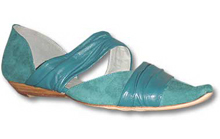
Unfortunately, I cannot get about in sneakers, blunnies or kleenex boxes all the time on account of the increasing number of appearances and other formalish events I do. These require that I dress up in outfits that are not typically improved by said sneakers, blunnies and kleenex boxes.

The lovely Anne Ishii came to my rescue by telling me about her fabulous friend Meghan Cleary, the shoe goddess. Miss Meghan has written a book about shoes, The Perfect Fit, does appearances all over the US of A advising women about shoes as well as going on a million and one TV shows talking about the same. I defy you to find someone who knows more about shoes than Meghan.

On Friday Meghan took me shopping. She showed up in fabulous pale python cowboy boots (want!), jeans and a gorgeous deep green top that looked like she’d stolen it from a very hip elf (double want!). We liked each other instantly and started gas bagging, joshing, and generally having the best time in the world, gossiping happily about all the people we know in common, as well as those we don’t (poor Gwyneth and Tom—their ears musta been aburnin’).

Then she gave me a divine little show bag1 full of natty things that make your shoes more comfortable and stop them from giving you blisters. Today I put the insoles with gel shock absorbers into my years-old blunnies and they became even more comfie than they already were. It’s like magic. Why did no one tell me about comfie insoles before? Do you all want my feet to fall off?

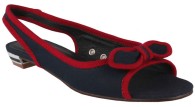
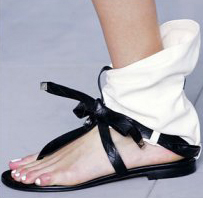
Did you know that jewellery for shoes exists? They’re called shoe clips. I had no idea! Again, people, what’s with the holding out on me? Meghan had these gorgeous little diamante ones that she put on a pair of simple black pointy-toed flats and whooosh! they became a whole other pair of shoes. Admittedly, shoes that my sister would mock me for wearing, but I defy her! I can be girlie if I want to!

Check out the shoe clips at Aliza Dark. Her range pushes me very close to considering bows despite having alway hated them, but I suspect I will probably try one of the stone shoe clips first. I especially like the tiger’s eye. Absolutely Audrey also has a fabbie range. I am covetting quite a few of the antique clips.

Meghan took me into big department stores and walked around pulling shoes off shelves and describing them as she presented them to me. “Would you do lavender metallic pointy-toed ballet flats fit for a science fiction princess? Soft brown leather polo boots? How about these cute little mary-janes? No, I’ve changed my mind. Too mumsie.”
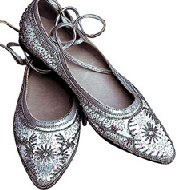
The vast majority of shoes I’ve owned in my life have been black or brown, but Meghan made me try on shoes I would never in a million years have considered if she weren’t there. Purply glittery shoes with tiny bows that looked almost exactly like Dorothy’s no-place-like-home shoes! And yet they looked really cute on and I almost bought them. Dark green alligator skin past-your-knees boots! Ditto. Maroon and black Manolo Blahniks! I swore I would never ever try a pair of Manolos on. Fortunately a) they were uncomfortable and b) they looked bad on me. Phew!

The shoe goddess showed me all sorts of divine shoes, but tragically too many times the salesperson would shake their heads and smile sadly. “I’m sorry. They’re all sold out.” Apparently if you are between size 7 and 10 and you do not go shoe shopping the first week the cool shoes appear, you’re doomed. They’re all gone. If you want winter shoes in NYC you have to hit the shops in July. If you want spring shoes you need to be there in December. You have been told.
I wound up with two pairs of the same simple-but-elegant flats. One in brown and one in black. Yes, I know that doesn’t exactly push me out into startlingly new-and-different shoe territory, but they didn’t have those ones in my size or price range, okay?

Besides, the immediate spoils are not the point. Meghan calls what she does with folks like me “shoe therapy” and my several hours with here were mucho therapeutic. She taught me way more about figuring out if a shoe is comfortable or not, how to customise them to make them even more comfie, and how to turn an ordinary daytime shoe into something sparkling and fabbie for the night, not to mention giving me the courage to be considerably more adventerous in my choice of shoes.

Thank you, shoe goddess!

NOTE: All shoe pictures were swiped from shoewama.com.

UPDATE: They were swiped to show a variety of flats, NOT because I think they are fabulous. Some of them are hideous in the extreme.

  1. As a Sydney girl I have been permanently warped by the Royal Easter show into thinking show bags are the most desirable thing in the entire universe even if they’ve got nothing in them but yukky chocolate, coffee and licorice. []

Brrrr

Wow, it’s cold here in NYC. Must be close to time for me to rack off back to Sydney where it’s heap big much warmerness. But of course I’m doing my usual thing of being completely besotted with the place I’m in and not wanting to leave.

So here’s a short list of things I love about NYC:

  • The crystalline light in Autumn (I’m betting Margo’s against crystalline)
  • Getting to wear a hat and coat and scarf
  • Hearing two perfectly civilised people come close to killing each over who has dibs on a cab
  • Being able to hang out with some of the best writers in the business pretty much any day of the week
  • Watching steam rise up through the street
  • Being able to order awesome food to come to my house any hour of the day or night

New York may be way too cold right now. But it’s also inhale-and-hold beautiful. Sometimes I wish I could stay just a little bit longer.

Interior Decorating

I’ve had a bunch of people ask me recently why I don’t blog about politics, given that I have strong opinions on the subject. (Like there’s anything I don’t have strong opinions on. Why is no one wondering why I don’t blog about interior decorating? For the record: wall-to-wall carpet is an abomination.)

There are lots of reasons I don’t rant politics here, but the main one is I hate flamewars. Don’t get me wrong I quite enjoy following them on other people’s blogs. But I have no interest in having them here. The minute you start talking about current politics, people will come and people will yell. And then I’ll have to waste my time deleting everyone. That’s right the blog overlord will censor discourse on this blog.

I really enjoy the comments here. I’ve been blogging for more than a year and the vast majority of the conversations have been civil and fun. I want things to stay that way. Thus I won’t be blogging about party political stuff.

But feel free to share all your interior decorating hates. Is there anything worse than carpet on the walls? Actually, I think I just hate carpet . . .

Milan Kundera & the Unbearable Lightness of Wankery

The 9 Oct New Yorker features an article by Milan Kundera called “What is a Novelist: How great writers are made”. And, um, I really, really hope it was written with tongue firmly in cheek cause otherwise these are the pearls of wisdom Mr Kundera offers:

    Novelists are like lyric poets except that youth is the lyrical age and novelists are old.

    To be a novelist you must tear away your lyrical chyrsalis.

    We are always wearing make-up.

    The novelist must tear through the curtain of pre-interpretation.

    Girl characters are actually based on boy characters.

    Readers don’t read novels they read themselves reading novels.

    We must all embrace the Whole.

    Beat your grandmother.

To which I can only say, “Innit!”1

  1. “Innit” is the one word in the entire world that has the magical property of instantly undoing the pretentiousness of anything previously said. I imagine Mr Kundera must have to use it A LOT. []

Everything dates (updated)

Quite a few writers of books for teens are deathly afraid of producing works that seem old-fashioned and dated within minutes of publication. To avert this dread fate they aim for timelessness and classicness by avoiding slang and brand names and pop culture references. I have good news and bad news for them.

  • The good news is that there are books with dated slang and brand names what remain in print decades after their first printing.
  • The bad news is that all books become dated.

It’s pretty much impossible to write a book without using the language of your time and place. Lots of phrases and words that don’t seem like they could ever date, do. Take “gay”, for example. It used to mean happy and carefree. Remember Cary Grant dancing around Katherine Hepburn’s family house in 1938’s Bringing up Baby, wearing a frilly nightgown and screaming, “Because I just went gay, all of a sudden!” He didn’t mean what you think he means. But who cares? The new meaning of “gay” makes it even funnier. (Update: Walter Jon Williams sets me straight—so to speak.)

Every single one of the movies I love so much from the 1930s and 40s are dated. And yet they’re still widely available and consumed and loved and written and talked about.

Same for the books. Dawn Powell, Dashiell Hammett and Raymond Chandler are all dated. Very. People don’t talk like that now (if they ever did). The world isn’t the same. Those versions of New York and San Francisco and Los Angeles are long gone. But you know what? The best of their books are still fabulously readable despite their weird forms of address (“doll”?) and the strange way the characters dress (hats at all times for everyone; suits and ties always for the men; gloves for women).

So should you pay attention to advice that says at all costs avoid contemporary slang, avoid referring to things by brand name, and avoid pop culture references?

Yeah, you prolly should, at least, most of the time.

Here’s why. The time when datedness is the biggest issue is in the early days of your book’s lifespan. You have to remember that there’s usually (at least) a year’s gap between a book being finished and a book coming out. A lot can happen in a year. Words that are hip and happening now can be torpid and dated then.

If your characters are obsessed with the hit TV show Dale Susskind’s Food Frolics, but before your pub date the show is cancelled because of the financial and sexual scandal that enveloped Susskind, and “Let’s frolic!” the hip catch-phrase that your characters say a lot has become a reference to a sad and incarcerated man. Reviewers are likely to make note of it and mock you more than somewhat. You better pray your book is good enough for it not to matter.

But in twenty, forty, sixty, two hundred years time most people won’t have heard of Dale Sussskind’s Food Frolics. Your book will no longer create cognitive dissonance for your readers.

Think of it as like fish. There’s the fresh, good-to-eat period shortly after being caught, then there’s the hideous rotting stage, but then—glory of glories—there’s the fossilization phase where the stink’s gone forever. And if your fish was lucky enough to be smoked it stays edible and tasty even longer.

Of course, the bad news is that most books go out of print within six months no matter how fresh they were on publication. But then not many fish make it to the fossilization stage either.

Arduous Research

So I have a genius idea for a book1 that requires me to watch lots of old American movies from the 1930s, 40s and 50s. It’s tough but someone has to do it. Plus Scott’s never seen a lot of these movies and I consider that to be criminal. Do you know before he met me he’d never even heard of Preston Sturges? What kind of a life is that?

So far we’ve worked our way through the films of (natch) Preston Sturges, George Cukor, and Douglas Sirk. As well as almost all the ones starring Rita Hayworth (Yay Gilda!).

Today we watched Mildred Pierce. Bless it. Bless Joan Crawford and Anne Blythe. The role of Veda is such a hoot. Has a greater bitch ever graced the silver screen? Sure, probably, there’s always Eve Harrington in All About Eve which we watched the day before. Scott had never seen it and is now smitten. Who wouldn’t be? Such a fabulous movie!

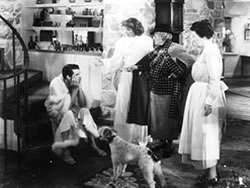
Yes, that's Fredi Washington again. Write a book about her already!Watching these more-than-fifty-year-old movies I’ve been struck by how many of them are written by women and how many of them are driven by women. They have not just genuine starring roles, but also lots of juicy supporting parts. There are women older than forty in these movies.

Last time I went to the movies I sat through the regulation ten minutes of shorts and did not see a single woman. Not one. The time before that there were two women and both seemed to be in the girlfriend role and were a long, long, long way off forty. What on Earth happened in the intervening years? How come most of the good roles for women are now on the tellie?

I’d love to hear your theories. Lauren, ex-Hollywood producer friend of mine?

And bonus question what are your favourite movies from the first three decades of talking pictures? (Doesn’t have to be American.) I’d tell you mine but it would take hours . . .

  1. Scott does not believe in the existence of this genius idea. He thinks I just like watching the same old movies over and over. I’ll show him! []

Giving up

How long before you give up on a writer that you once loved? Or a TV series you adored? Or film director? Or actor? Or band you loved? How many dud books, TV eps, movies or songs before you say, “That is it. I’m never spending money on you again?”

Or do you never give up and keep hoping against hope that they’ll regain form?

I’d tell you who this was apropos of, but then I’d have to kill you.

Dope, proofs, hoops, words

Today is going to be insanely off-the-charts busy so instead of the long and thoughtful post on the meaning of the “sublime” that I’ve been working on I’ll

  • recommend Sara Gran‘s Dope what I recently read and loved. Imagine a noir 1950s novel if it was written much more spare, set in New York, and narrated by an ex-(teetering on the edge of non-exness) junkie prostitute who now makes a living boosting jewellery. Not going to tell you another thing about it. Just that it’s short, there’s not a word out of place, and it made me cry. (Mind you Qantas ads make me cry.) Read it immediately!

    Any of you read any read-immediately books you’d like to recommend? Dope was recommended by Marrije. Thank you!
  • and exhalt in the page proofs of Magic’s Child what arrived. It looks like a real book! All typeset and stuff! So purty! So far the proofer has spotted a minor plot oopsie (someone not having something and then somehow out of nowhere having it) and reminded me once again that I’m the world’s worst punctuater. All she does is shift my commas around and remove and add semi-colons. Bless her! And sigh on my inability to ever understand the simple comma.
  • boast of my squeaky wheelness. I wrote to one of my favourite blogs, women’s hoops—twas a mournful letter whingeing that they hadn’t blogged the Aussies winning the World Championships and here’s how they responded. Bless ’em!
  • The ABC has this fabulous wordmap project where they’re trying to map the regionalisms of Australian English. It doesn’t take a second to add regionalism of your own. My problem is I’m not at all sure where I picked up the words I used. I had no idea “grouse” was more of a Victorian word. I’ve never lived in Victoria. Only New South Wales, the ACT and Northern Territory. I reckon tellie, books, and radio must muddy the waters of pinning down regionalisms more than somewhat.

And now I roll up sleeves and get to work.

Chocolate proms

Maureen Johnson is being funny again—this time about her prom.

I did not have a prom. In Sydney1 they’re called school dances (or at least they were in my day) and they are nothing like the big deal they seem to be here in the US of A. And, no, I didn’t have a school dance either on account of going to a tiny hippy school with only about two hundred students. (We didn’t “date” either. Not in the American sense of the word. I don’t think I’ve ever gone on a bona fide “date”.)

Anyways my knowledge of proms is gleaned from Hollywood movies, YA novels, and my American friends. I find prom (and “date”) stories deeply fascinating in an anthropological way. And Maureen’s is a beaut. If you’ve got any fun stories of your own—spit ’em out! Bonus points if you can explain the whole cottilion/debutante ball thing.

In other news it turns out that chocolate is evil. Thus I’m a very very good person because I don’t like it. Don’t believe me? Then read this. Via Elizabeth Bear.

  1. I can’t speak for the whole of Australia—for all I know there may be some small town somewhere that does have proms. Or where school dances are a huge deal. I’ve already discovered that not everyone says “grouse”. Poor blighters. []

More on banned books week

Us Asif! authors have been chatting more than a little about the whole books-being-banned situation and we don’t always agree. Some of us do think there are books that are inappropriate for kids. For instance, I would not be totally wild about a ten-year-old reading the Marquis de Sade.

On the other hand, when I was ten I picked up Henry Miller’s Tropic of Cancer (I blame my parents!) and promptly put it back down ’cause it was not only gross, it was really really really boring. I read it again in my late teens and had the exact same response. I imagine the ten-year-old me would have had the same response to the Marquis. As a kid, much like the kid in The Princess Bride, I skipped all the kissing bits. Boooring!

nullMost of us Asifers agree that there are books that kids shouldn’t be reading, but none of us can agree on what those books are or what the magic age of being able to read “adult” stuff is. I read and loved Alexander Durrell’s Alexandria Quartet at an early age, along with a slew of other “inappropriate” books. I think it had no ill effects on me (others may disagree).

The problem with the banning of books in the US of A is that there are different rules in every state. Hell, there are different rules in every school. In a lot of cases individual principals (head masters) and school librarians are removing books from shelves, or not ordering them in the first place.

Now, obviously school librarians need a certain amount of discretion. They have budgets. They can’t buy every book and it’s their job to buy books that are appropriate for their students. You can’t do that without making judgements.

The school librarians and principals are the ones on the frontline. They’re the ones dealing with parental complaints. They’re the ones looking at catalogues and deciding what to order. If their school is in a particularly conservative area they might see a book titled Sex Kittens and Horn Dawgs fall in love listed as a middle grade book and decide that ordering it just isn’t worth the grief, no matter how tame the content.

As it happens that’s exactly what’s happened to Maryrose Wood’s book despite it being as pure as the driven snow and its title being the raunchiest thing about it. And yet the title fits the book to a tee. Should her publishers have called it something else? Should people read books before they rush to ban ’em?

Is banning books ever a good idea? How about just limiting access? There are some kids who are horribly freaked out by books. I babysat for this one little boy and if I read him stories that were even a teeny tiny bit scary he would not be able to sleep for a few nights. When he was a little older and reading on his own, Grimm’s fairy tales deprived him of sleep for weeks. He wasn’t ready for it and was a much happier and saner kid when he stuck to sport and pony books.

But there are young kids who adore the scary stuff. Why should they be deprived of their reading pleasure cause some other kid is scared by the same books? Kids mature at different rates. One size really does not fit all. And besides, that kid I babysat for—he self-regulated. He stopped reading the fairy tales after the first two. Every time he decided a book was scary he stopped reading. I suspect a lot of kids do the same thing.

So usually it’s not a question about what a kid does or doesn’t want to read; it’s about what their parents do or don’t want them to read. And, yes, parents have every right to do that. But they do not have every right to regulate what all the kids at their child’s school can read.

And, frankly, I worry about parents who are that controlling. When I was in primary school one of my friends was not allowed to read any books her olds deemed sexist or racist. So she read those forbidden books (mostly by Enid Blyton) over at my place and we’d pretend to be members of the Famous Five (with huge fights over who got to be George) or pretend we were in boarding school at Mallory Towers and have midnight feasts (though sadly we never managed to stay up till midnight for them).

Forbidding her those books and not allowing her to watch television did not protect her from racism or sexism. It just made the forbidden items more desirable. It’s incredibly hard to control the cultural artefacts your child comes into contact with and even harder to control what they make of them.

I understand the impulse, but that doesn’t make it a good idea. (I also understand why authors feel compelled to respond to bad reviews.) I also wonder what exactly is the harm that parents think their child will contract from reading books they deem “inappropriate”. Is it a bid to put off having awkward conversations? To protect the child from how foul the world is? Is it an attempt to mould your children in your own image? (Good luck with that, by the way.)

What do you lot reckon?

Write me this book!

My intensive google research has revealed that there is no biography of Fredi Washington. I demand that one of you get off your arse and write one immediately! (Or use your better research skills to find me one.)

Who is Fredi Washington, you ask? Why, let me tell you:

Fredi Washington as Peola in Imitation of LifeFredi Washington was a light-skinned black actor and dancer. She largely starred in movies for the Jim Crow circuit and often with her skin darkened. She was such a compelling screen presence that the Hollywood bigwigs in the thirties offered to make her a big star if she’d pass as white. She told ’em all where to go. Yay, Fredi! (I also want to know if that’s actually true.)

Ironically, her one big role in white movies was playing the “tragic mulatto”, Peola, in the original Imitation of Life.1 She steals the movie. Everytime she’s on screen she’s where you’re looking.

I want to know more about her. I demand to know more about her! I want a big fat bio on the scale of the Tiptree one. I want it to be as thoroughly researched and as beautifully written and I want it right this minute.

On your bikes, people!

  1. I totally recommend watching the two Imitations of Life back to back. The 1934 one followed by the 1959 Juanita Moore one. Fascinating to see the shifts in representations of race relations. Though in both, Peola/Sara Jane’s decision to pass as white seems inexplicable.

    If you were an alien watching the movies you’d be scratching your head trying to figure out what was so very terrible about being a black person. Other than the only other black people being servants, but there are so few of them you’d think maybe they’re off enjoying cool jobs elsewhere. In neither film are there any cafes with signs saying “Whites Only”. The black characters never have to sit at the back of the bus.

    There is one horrible scene of racism in the 1959 version, but it plays out like racism is just that particular person’s problem, not anything systemic. The most you get in the 1935 version are the kids at school looking shocked when they discover that Peola is passing. Their reaction shot lasts less than five seconds. []

Why do you like sport?

This is not a question I get asked very much. Not directly, anyway, but every single time I post about sport someone writes and asks me when I’m going to post about interesting topics again. That’s right, the biggest complaint I get from you, dear readers, is that I talk about sport too much.1

Now I ain’t never gonna stop writing about sport, no matter how many of you are bored into a coma by it. I writes about what I wants to write about. You can suggest topics if you want but if I can’t be arsed to write on that topic then it ain’t gonna happen.

I digress. The complaints do get me thinking about why it is that I like sport so much. Seriously, for me to learn the rules of a sport is for me to become addicted. I’ve had to start studiously avoiding contact with new (to me) sport just to have enough hours in the day to, you know, get books written. I try very hard to only pay attention to cricket, the Tour, and women’s basketball. And the Olympics. I cannot get any work done when the Lymps are on.

I’m not that fussed about playing it. Tennis is great fun, I love swimming and riding my bike but I have zero interest in doing any of them competitively. (Gah!) But I can watch pretty much any competitive sport and I can do it for days and days and days. For me it brings together the aesthetic pleasures of watching athletes at the top of their form, with the soap-opera like joys of a long-running story (what can I say I’m a narrative junky in all its forms), together with the gossip and politics. A good sporting scandal is prolly my most favourite thing in the world.

Clyde Walcott, one of the West Indies' greats.I love how knowing about the history and politics of cricket (West Indies not getting a black captain until the 1950s and then only after a long-running campaign orchestrated by C. L. R. James; the long campaign to get an Untouchable to play for India), and about women’s basketball (Title IX, and when it was allowed into the Olympics, and how little coverage it gets in the mainstream press) adds so much to watching any individual game.Picture purloined from abc.net.au

I love the majesty and pomp. I love supporting (and hating) individual players and countries.

Why do you love the particular sports you love? Sing it, please!

No offence intended but I’m uninterested in why any of you don’t like sport. I’ve been hearing it long and loud from my fellow arty-farty types my entire life. I get that you’re an oppressed minority. I feel for you. But enough already! Let us sport obsessives bond for a bit. And, yes, I will delete anti-sport diatribes.

So fellow sport lovers—time to share that love!

NB The first image is of Sir Clyde Walcott who died earlier this year. He was one of the greats of West Indian cricket. Bless him.

The second is of the Australian women’s basketball team winning the world cup. Bless ’em.

  1. It’s particularly weird as I’ve hardly blogged sport at all this year. Very little mention of cricket, the World Cup, or the Tour de France; pretty much nothing about the Liberty’s unhappy WNBA season, and hardly any mention of all the various Australian triumphs this year. I’ve been busy, okay? []

Changeling

Delia Sherman’s latest book, Changeling, is a middle grade fantasy that doesn’t resemble anything else I’ve ever read.1 It has many recogniseable elements: fairies, changelings, mermaids, dragons, New York City, but they’ve never been brought together like this before.

Delia Sherman's ChangelingSherman’s New York City is unlike any NYC I’ve read about.2 She’s transformed it into “New York City Between”—a wonderland populated by fairy folk and characters from well-known children’s stories like Eloise—and she’s done it in a way that keeps the city entirely recogniseable and yet utterly different. Central Park is just as easy to get lost in, Wall Street is just as crazy busy, but it’s run by the dragon of Wall Street. If you know NYC at all well you’ll be delighted, no matter how old you are, and if you don’t know the city it doesn’t matter. Changeling stands up on its own.
I hesitate to say it because the word has such a bad wrap, but Changeling is utterly charming. I was entranced by Neef and her New York Between from the very first page. I can’t wait to read more about both of them. Here’s to it becoming a series of many, many more books!

If you don’t believe me, check out these other folks who loved it as much as I did.

  1. Except her earlier short stories set in the same world. []
  2. I would love to see the complete list of magical New Yorks. I bet it’s really really long. A truly complete version would have to list Dawn Powell’s New York as well as Eloise’s. []

A true omnivore?

I just realised that coffee, chocolate, gin, tonic water and licorice are the only foods or drinks I cannot imbibe without having to spit ’em out. There are no savoury foods I hate. I’m down with much that revolts other folks: anchovies, sweet breads, liver, blood sausage. All of them are mucho yummo. I loves me some offal! Hell, I love all food that wobbles!1

I think of myself as an unafraid eater who’ll find something to eat no matter what situation I’m thrown into. I only get into trouble at dessert which is no big deal.

But there’s got to be people out there who truly will eat everything.2 Do any of you have no food or drink hates or intolerances or allergies? Cause how cool would that be?

Or are there no true omnivores anywhere in the world?

  1. Unless it’s been contaminated by the aforementioned five dread substances. []
  2. And I mean someone with functioning taste buds—I met this guy once who had no sense of smell or taste. Food was just fuel to him. He didn’t care what he ate. And, yes, he was very depressed. []

Aussie! Aussie! Aussie! Oi! Oi! Oi!

We won! For the first time ever we won the world championships of women’s basketball!!

Penny Taylor was awesome! As was Kristy Harrower and Lauren Jackson!

Opals win!
(Picture purloined from abc.net.au)

I am so very very very very very happy!

Aussie! Aussie! Aussie! Oi! Oi! Oi!

Banned books week

It’s banned books week, people. Check out the following links and then go out and adopt a banned book. Bring it home, love it, read it, blog about it. Encourage others to love the many banned books.

Here are banned books links courtesy of the lovely E. Lockhart:

Most Challenged Books of the 21st Century (2000-2005)

The fabulous asif site. I’m a proud member of Asif!

Badges (buttons) and other images you can use.

The Freedom to Read foundation.

THE BOOKSENSE TOP TEN BANNED BOOKS

1. TO KILL A MOCKINGBIRD, by Harper Lee
2. GEOGRAPHY CLUB, by Brent Hartinger
3. THE GIVER, by Lois Lowry
4. THE STORY OF LITTLE BLACK SAMBO, by Helen Bannerman, Christopher H. Bing (Illus.)
5. THE BLUEST EYE, by Toni Morrison
6. BRAVE NEW WORLD, by Aldous Huxley
7. FOREVER, by Judy Blume
8. HARRY POTTER AND THE PHILOSPHER’S STONE, by J.K. Rowling
9. WE, by Yevgeny Zamyatin
10. WHALE TALK, by Chris Crutcher

My favourite banned book at this exact moment in time is To Kill A Mockingbird if only to make Truman Capote turn in his grave.

What’s your favourite banned book? Don’t forget you can find longer lists here.

A solemn vow (updated)

I, Justine Larbalestier, do solemnly swear never to comment on an Amazon customer review. If I ever succumb to said stupid temptation you have my permission to force-feed me a mixture of the five vilest substances known to humanity: coffee, chocolate, licorice, tonic water and gin.1

I invite all published writers to join me in this vow.

  1. Apparently there are some weirdos who find the concoction above inviting. Those benighted souls must substitute five things they despise. I’ll have no cheating! []