The Former Me

In my previous life I was an academic. Not a very successful or prolific one. I spent four and a half years researching and writing my PhD thesis, while on a scholarship and doing paid-by-the-hour teaching (what’s known in the US as being a TA) as well as IT support. After that I was awarded a three-year post-doctoral fellowship that my university extended for nine months. In that time I wrote and published one book, The Battle of the Sexes in Science Fiction, and edited a collection of stories and essays, Daughters of Earth as well as writing a bunch of essays and papers (and on the sly I wrote short stories and a novel.)

Twas an eight-year-and-three-month career that ended more than four years ago. Yet, people write to me disturbingly often asking me my opinion of the field I studied, about what books I think are at the cutting edge, and curly questions about my two scholarly books which I wrote ages ago and can’t remember a thing about.

I haven’t read any scholarly work since it stopped being my job. I have no idea what the latest work on science fiction is. I don’t even read science fiction novels anymore. It was never my favourite genre and having to read it for more than eight years put me off for life. Though I don’t mind YA science fiction. I pretty much enjoy YA everything.

Not having to read scholarly work any more is one of my greatest joys. Too much of it is turgid and boring, which is why I’m so relieved I don’t have to write it any more. I hated having to second guess every possible objection to every sentence I wrote. It’s a joy not having to write as if I have constipation or to footnote every single argument.

The only things I loved about being an academic—research and hanging out with like-minded people—I still get to do. For the Magic or Madness trilogy I read a scary amount of books on mathematics and number theory (I’m not saying I understood ’em). For the book I’ll be writing after The UFB I’ve been going back and reading gazillions of ballads. I even plan to crack open some ballad scholarship. For the book after that I’ll be doing lots of research on [redacted for reasons of spoileration] and [also redacted for the same reason].

The glorious thing about research for fiction is that if the research doesn’t fit I can ignore it. I’m writing fiction—most often fantasy—so I twist the facts to fit my books not the other way round. Such bliss!

I’ve written five novels since I quit being an academic. I can’t remember my research for the Magic or Madness trilogy so I really can’t remember any of my scholarly projects. I’m not alone in this. I remember hearing Jonathan Lethem say that when Motherless Brooklyn came out he was taken up by the Tourette’s Syndrome community. But by that time he was onto the next book and had forgotten all his Tourette’s research. We writers are a fickle short-term memoried lot.

To sum up: please don’t ask me about my scholarly books. I know nothing.

Does she have to be black?

Two weeks ago I mentioned that I’d been criticised for making the main character in the Magic or Madness trilogy black when the story isn’t about her being black. I said I’d write more about it and then didn’t. Mostly because there are so many disturbing assumptions in that criticism that it makes my head explode. And also because I was secretly hoping someone else would post about it.

Well, yay! Tempest did:

Why, they ask, does the character have to be non-white if the story isn’t about being non-white? Because, I say, every story of my life isn’t about my non-whiteness. Sometimes it’s about my ability to let go of a crush, or figure out what raptor birds are doing on my fire escape at night, or what I plan to do with my life after college, or why I love the view from on top of a mountain yet fear the way up. If that’s true for me, it’s true of other non-whites, too.

And, you know, there are lots of non-white people in this world. It’s all right to have a few stories where they just exist, okay?

Specifying race helps to fill a character in, but doesn’t necessarily mean that the filler is standard and clichéd. When the reader first reads that Brenna is of a specific ancestry rather than a general, unspecified one, it makes her more real. Same with Reason. That’s what it adds to the story.

Many white writers are nervous about writing characters who aren’t white and seem to think that if they do so there must be a reason for it. They fear being criticised for writing people who have a different skin colour to them, they fear getting it wrong. On the other hand they worry about being criticised for having no non-white characters. Damned if you do and damned if you don’t.

To which I say, well, der. Of course, you’re going to be criticised. If you write and people read the words you have written some of them will not like those words. Doesn’t matter if you’re posting on your blog, writing an email, or publishing a novel.

My trilogy has been criticised for being too Australian and for being not Australian enough, for getting the American characters completely wrong, for getting Sydney and New York City wrong, and for many other things. That’s what happens when stuff you write is out there where people who don’t know or care about you can read it.

If you’re not going to write something because you’re afraid of criticism why bother writing at all?

As for why Reason has to be black: It’s because she is black, okay?

Also, Tempest, you have raptor birds on your fire escape at night? Really? That is so cool.

Magic or Madness in Italian


I know I said blogging about writerly achievements is tedious but I have to share when my books are translated. That’s not a writer skiting thing; it’s a publishing geek thing.

I love seeing what books are called in other markets. In this case Magic or Madness, the first book of the Magic or Madness trilogy, becomes The Revelation, book one of the Blood of the Witch trilogy.

Dark Magic is the name of the imprint. Also published on that list is none other than Margaret Mahy (!). Quite possibly the world’s finest living YA writer (along with Diana Wynne Jones). Not too shabby company, eh?

But what’s with the cat on the cover? There are no (living) cats in the trilogy! There is a key, but.

Awards

So, um, I seem to have won three awards this year. I know! I was as shocked as you. Anyways, I thought it might be fun to have a squiz at ’em. For annoying scheduling reasons I managed not to be at any of the award ceremonies so I’ve only just got my hands on two of them and have yet to see the third. It’s back home in Sydney being babysat by my parents (thanks Jan and John!).

Here’s the Susan Koppelman (thanks for accepting it for me, Brian):


Photo by Scott Westerfeld

The Norton (thanks, Eloise):


Photo by Scott Westerfeld

And the William Atheling (thanks, Sean):

William Atheling Jr. Award
Photo by Niki Bern

Contrast in awards styles, eh? I loves it!

Third book blues

I have on several occasions mentioned how I hard I found writing the third book of the Magic or Madness trilogy and how it was way way way harder than writing the other two books. I’ve also seen others struggle with the third book of a trilogy so I don’t think it’s just me what finds them super tricky.

Recently Cedar Librarian asked what was so difficult about writing the third book:

Okay, now I’m curious to know why the third one is always the hardest to write. I’d always thought it would be the easiest, because haven’t books one and two been pointing to book three all this time?

I didn’t answer then, but I will now.

When I first wrote the proposal of the trilogy I had a very clear idea of how it would end. However as I wrote books one and two they got further and further away from the proposal. When I got close to the end of the third book my original ending no longer worked.

But I wrote it anyway.

This was just sheer cussedness on my part. I had always had that ending in mind and by Thor’s mighty hammer I was going to have that ending!

It made no sense. I rewrote the ending at least six times. Probably more. And each time I changed the ending I had to go back and rewrite the rest of the book to match. More than six times!

I can’t imagine all writers are as stupidly stubborn as I am. But even if I hadn’t insisted on writing that wrong ending it still would have been a struggle. Cedar Librarian is right, books one and two do point the way. But they don’t only point in one direction, they point to lots of different ways to wrap up the trilogy. For two books you’ve been throwing a tonne of balls up in the air. In book three you have to some how catch them all and then arrange them in a way that makes sense.

That is brain-breakingly hard.

Also if the books in your trilogy are getting published as you go then you can’t go back and change things in books one or two to fit the changing storylines. You’ve created your bed and you have to bloody well lie in it.

As I wrote the third book there were many many things I wanted to add or change in the second book. But I couldn’t. It was finished and on shelves. It drove me mad!

If I ever write another trilogy (and I have taken a vow that I won’t) I’d like to write all three books first and only then sell them. I wonder if anyone’s ever done that? Very tricky. Cause it means writing three whole books with no money coming in. You’d have to write very quickly, or be working on other books at the same time, or be independently wealthy.

I’d love to hear from other trilogy writers. As I’ve only written one I’m hardly an expert. And I clearly made a stack of beginner errors.

Do any of you find the third book of a trilogy the hardest?

Do you have any tricks to avoid such trouble?

Do you prefer writing trilogies or series to writing standalones? (Diana just wrote very thoughtfully about series writing on her agent’s blog. I recommend it.)

I’ll admit I’m tempted by the idea of a series. But only one in which every book stands alone. There are continuing characters and the same world, but each book tells a complete story. I think it was the three-book arcs that did my head in.

I hope I’ve answered your question, Cedar.

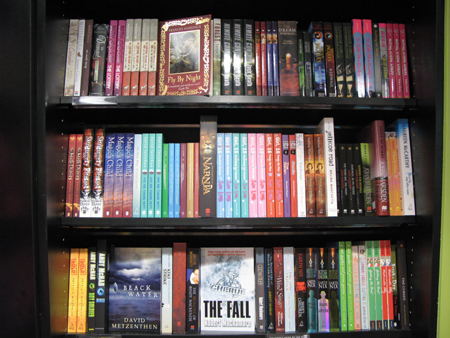
airport bookshop happiness (updated)

On our way to Adelaide way back when, I checked out the bookshop at the Qantas domestic terminal in Sydney.

bookalicious!

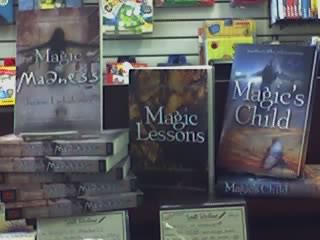
Lo and behold, there were multiple copies of Magic’s Child. Woo hoo! I’ve never seen one of my books in an airport bookshop before. But even better there were books by Maureen Johnson and David Levithan and Garth Nix!!! All friends of mine.

And now looking at the photo I see there are books by Jack Heath (who I met at Reading Matters in Melbourne) and Melina Marchetta (who we house swapped with) and Sonya Hartnett (who I briefly met at Reading Matters). So not only is one of my books in an actual airport bookshop, it’s there with books by people I know and adore who are amazing writers. Woo hoo!!!

Yes, it is very sad what gets writers excited.

Update: Wow. That was quick. Someone just emailed to say they can’t tell which book is which.

Here’s a closer look:

closer

From right to left left to right. Sonya Hartnett’s Forest, Jack Heath’s Remote Control, and Maureen Johnson’s 13 Little Blue Envelopes. Then there’s Magic’s Child and David Levithan’s Are We There Yet?. And, last but definitely not least, Melina Marchetta’s Jellicoe Road above many Garth Nix books.

Admin Day

Today I am doing lots and lots of admin. Such joy!

Top of the list is putting together a list of all the typos in Magic’s Child as well as writing a teeny tiny essay about the trilogy to go at the back of the paperback edition.

If you came across any typos please tell me now!

Also if you have any ideas of what you would like to read in a short essay about Magic’s Child and the other books in the tril now’s the time to let me know.

My waiting continues. It’s been more than a month. Le sigh. Definitely helps not being alone.

Wow

I appear to have won an Andre Norton Award for the first book in the Magic or Madness trilogy. Someone pinch me!

This is super amazing because:

  • The books on the shortlist with Magic or Madness are absolutely fantastic.
  • It means I’m in the very tiny club of Norton Award winners with the brilliant Holly Black who won the inaugural award last year for Valiant.
  • I’ve won an award named in honour of one of the most important writers of young adult fantasy books. How cool is that?
  • Now when I’m described as an award-winning author it’s true!

Here’s the speech that Eloise Flood who published and edited the trilogy (as well as Scott’s Peeps and Maureen’s Devilish, which were also up for the award) delivered on my behalf at the ceremony:

Wow. Really. Wow.

This is such an honour. I’m a huge fan of genre YA and in particular of every book on this year and last year’s Norton shortlist. I’m not kidding. These are some of the best books out there: genre or not, YA or not. I can’t believe I’m on this list. And I REALLY can’t believe I won. You guys did read the other books on the list, didn’t you?

I’m bummed that I can’t be here but thrilled that Eloise Flood, who discovered me, nurtured me, and made me as a YA author is accepting on my behalf. Thank you for everything, Eloise! And thank you Liesa Abrams, Andy Ball, Margaret Wright, Kristen Pettit and the whole Razorbill team. You’re all awesome.

Thanks to everyone who nominated and voted for this award. Genre YA1 is in the midst of a Golden Age. The books are better than ever before. More kids and teens are reading than ever before. And these readers are the future of our genre and the future of literature.

This is a truly amazing time. I’m so proud to be part of it. I bet Andre Norton would be thrilled as well to see what she has wrought.

  1. Actually I think all of YA is in the midst of a Golden Age, not just genre. This has been an amazing week. I’m bouncing! []

Spreadsheets revisited

Off to Paris today. I’m not sure what my intramanet access will be like while there, plus I’ll be busy, so I figured I’d best leave you with a slightly meaty post given as I’m not sure when I’ll be posting again.

For your delectation some thoughts on the efficacy of spreadsheets for novel writing:

A while back I posted a tongue-in-cheek guide on how to write a novel in which I suggested using a spreadsheet. I’m still getting letters from folks telling me what a revelation that was, how it’s transformed the way they write, solved all their plotting problems, and made their teeth whiter.

And I’m still coming across comments from those who are appalled and outraged by the very idea. A spreadsheet! For creative work! The utter utter horror! Spreadsheets are for accountants! The muse is allergic to spreadsheets. What kind of philistine is this Justine Larbalestier? (If that is her real name.)

I don’t get the outrage.

A novel is a large document containing a whole world with a population that can range from one (boring navel-gazing novel about a man trapped inside a unicycle) to billions or more (space opera where the Empress of the universe destroys a whole planet and the reader follows the last day of each inhabitant of said planet). Keeping track of all of that is tricky. The longer or more complicated the novel the harder it is to keep all of it in your head.

I’m sure some writers can do it. Some writers can also write entires novels in their head and produce but one perfect draft.

But pretty much every writer I know has some method of tracking their novel. It might be a set of notes, a wall chart, a spreadsheet, a ouija board, an outline they annotate as they go, index cards, pigeon entrails, their ghostwriter, whatever. They have some kind of a thing that is not their novel that tells them stuff they need to know about their novel.

My first novel is an epic, 145 thousand words long,1 spanning many years, with a cast of gazillions, and multiple point-of-view characters. I wrote the first draft using another word document to note down who was related to who, what the countries were, the different language groups, the seasons, things I needed to change, and etc. By the time I finished the first draft, my notes about the novel was almost longer than the actual novel. I needed another document to keep track of it. And then I needed another one to keep track of the one keeping track of the notes keeping track of the novel. Spot the problem?

My boyfriend of the time (thank you, Geoff!) suggested I use Microsoft Project. I fell in love. It was the first (and only time) I’ve been smitten by any of Microsoft’s software.2 Project was exactly what I needed: I could chart each character in relationship to the other characters over a period of days, months, years, whatever I needed. At a glance, I could see characters who disappeared with no explanation, who remained pregnant for two years, babies who stayed at the baby stage even though five years had passed since their birth.

It made rewriting much easier.

My second novel was much more straightforward, shorter, and told from only one point of view. A very short file was all I needed to keep track. And to be honest I didn’t use it much, which might be why it’s so very bad, and will never ever see the light of day.

My third novel was Magic or Madness, which while not as complicated as my first, had its own challenges, such as being set in Sydney and New York City. Towards the end of the first draft, Scott introduced me to his spreadsheet method, which made it much much much easier to track what time it was in the two different locations as well as the shifts in points-of-view.

I used the same spreadsheet for all three books of the trilogy. It made me happy.

For the Great Australian Mangosteen Monkey Knife-Fighting Elvis Cricket Fairy Young Adult book I also used a spreadsheet, but it served mostly procrastinatory purposes. The book is told from one point of view and is pretty much beginning, middle, end. It woulda been just as easy to write it without one.

So there you have it: spreadsheets neither write your novel for you, nor do they stab the grand muse of writerising through the heart. They’re just this sometimes-for-some-people useful thing, ya know?

And now I believe I have a plane to catch.

  1. For contrast all the Magic or Madness books are around 65 thousand words. []
  2. And, of course, Microsoft instantly stopped producing a Mac version. So I never got to use it again, which is a shame because it is the most excellent instrument of procrastination novel tracking I have ever used. []

Oh. My. Elvis.

I just found out that Magic Lessons is on the shortlist for a Locus Award. Check out who else is on the list:

    Best Young Adult Book

    Spirits That Walk in Shadow by Nina Kiriki Hoffman
    Magic Lessons by Justine Larbalestier
    Voices by Ursula K. Le Guin
    The Keys to the Kingdom: Sir Thursday by Garth Nix
    Wintersmith by Terry Pratchett

Talk about stellar! Those are some of the best writers in the YA universe! I’m on a shortlist with Ursula Le Guin! I think I’m going to faint.

There are other wonderful books up for Locus awards, including Samuel R. Delany’s About Writing and Julie Phillips’ Tiptree biography for best non-fiction, Ellen Kushner’s Privilege of the Sword for best fantasy, Ellen Klages’ Green Glass Sea and Naomi Novik’s Temeraire for best first novel. Woo hoo!! Congratulations to them all! And if you haven’t already read these then you really really ought to!

Last two Texas appearances + Spoiler FAQ

Very flaky internet access—the wifi keeps dropping to one bar so I’m keeping this short. Also I don’t seem to be able to reply to emails, but I’ll be back in NYC by Saturday and will catch up then. If it’s urgent call me on the mobile.

We’re doing two more Texas appearances. Details here. Come say hi.

Also I’m getting a lot of people asking me the same questions about the ending of the trilogy so I’ve started a SPOILER FAQ over here [scroll down]. If you have questions about the trilogy that aren’t already answered you can ask them on the comments thread over there and I will respond. But please don’t ask spoiler questions in the comments for this post. Lots of this blog’s readers have not read Magic’s Child yet.

Hope no one’s too damp in NYC.

Okay, now I attempt to post this . . .

What happens to Reason

Courtesy of Marrije, I now know what happens to Reason after the Magic or Madness trilogy:

She’s now working advertising coffee in the Netherlands!

See the eerie resemblance?

It’s a huge relief to me to know that at least one of my characters is not going to starve just because I’ve stopped writing about them. Phew!

Butterflies are ubiquitious (updated)

Best book ever!Oh noes! My evil friend Shana has pointed out that butterflies are all over book covers right now. My wee Magic’s Child is just part of a trend. It’s not unique and lovely and its own sweet self! (I mean aside from the other books in the trilogy. I’m down with it looking like Magic or Madness and Magic Lesson.)

Still as book cover trends go, I’d much rather have butterflies than the dismembered women and girls that have been on the front of so many books for the past few years. You know the ones I mean? Where only torsos or feet and legs are visible. Scary headless women! Shapely legs and feet girls!

I find them all deeply disturbing. Especially as they’re frequently on the covers of some of my favourite books. Like Maureen Johnson’s wonderful Thirteen Little Blue Envelopes and the new anthology, 21 Proms which is one of my fave recent anthos with stories from some of my fave writers like Libba Bray and, well, there are too many of them to name.

Best anthology ever!I mean look at Ms Thirteen Little Blue Envelopes above. I bet she misses her head. I miss her head!

And those Prom girls? How are they going to dance with the top halves of their bodies missing? Plus wouldn’t there be blood spurting everywhere? Isn’t that a bit too Carrie? Most of the stories are funny not bloody.

I’m not saying there aren’t lovely dismembered women covers. The 21 Proms isn’t too bad at all. I’m just so very sick of them! Think of something else already. (But not butterflies. Forget about butterflies.)

What cover trends are you most annoyed by? A while back I thought that if I saw another period painting cover I’d start throwing things. They were all so obviously an attempt to suggest that the book you have in your hands is a serious and deeply worthy book, one what will win awards. How could it not with a grand master certifiably genius painting on the front?

So how about youse lot? Are there any trends in book cover designs that drive you spare?

Update: Anne Ishii of Vertical Books says that right now it’s all about the eggs.

Eggs!

Giveaways

Right now there are not one but two competitions to win a copy of Magic’s Child.

Go to Diana Peterfreund’s blog and make a comment and you’re in the running. She promises that she will ship the book anywhere in the world. I signed it and all! Or you can to the Teenreadstoo site to win a copy. The intermanets are positively dripping with free copies of Magic’s Child!

More Skiting

Things are going well for me back home and I am happy.

Today is the official pub date of Magic’s Child in Australia and New Zealand. First person to send me photographic evidence gets a signed copy. Why should the North Americans get all the prizes?

Yay Magic’s Child! What now exists on two continents!

If that weren’t enough I just found out I’m up for not one, but two Ditmars for Daughers of Earth. Wow.

    Professional Achievement

  • Angelia Challis for establishing Brimstone Press as a mass market publisher
  • Cat's Daughter's cover

  • Bill Congreve for Mirrordanse Press and 2 issues of the Australian Year’s Best Science Fiction and Fantasy
  • Russell B Farr for Ticonderoga Publications
  • Gary Kemble for work on ABC’s Articulate and promoting the genre through radio and other mediums
  • Alisa Krasnostein for providing new paying markets for readers and writers of both fiction and non-fiction, art as well as forums for reviews and interviews within the speculative fiction genre, enhancing the profile of Australian speculative fiction
  • Justine Larbalestier, for editing Daughters of Earth: Feminist Science Fiction in the Twentieth Century

I’m really honoured to be part of that list. What fabulous achievements! But, um, spot the odd one out: You know, the nominee who put one measly book together (and whinged about it a lot) and did bugger all to enhance the profile of Australia. *Cough* *Cough*.

And then I’m also up for

    The William Atheling Jr Award for Criticism or Review

  • Miranda Siemienowicz for her review of Paraspheres appearing in Horrorscope
  • Justine Larbalestier for Daughters of Earth: Feminist Science Fiction in the Twentieth Century
  • Robert Hood for “Man and Super-Monster: A History of Daikaiju Eiga and its Metaphorical Undercurrents” Borderlands #7
  • Grant Watson for “Bad Film Diaries – Sink or Swim: The Truth Behind Waterworld” Borderlands #8
  • Kathryn Linge for her review Through Soft Air ASif

William Atheling was the penname for James Blish’s critical writing. This is the second time I’ve been up for this award. Yay! It’s a real honour and not just because Blish was a hell of a critical writer. It’s wonderful to be recognised by the Australian science fiction community. Thank you!

There are lots of fabulous nominees in all categories this year, but selfishly the one I’m most excited about is Cat Spark’s nomination for best artwork for her unbelievably fantastic cover for Daughters of Earth. I’ve had a lot of wonderful covers for my books, but this is my favourite. Thank you, Cat! I really really really hope you win!

Fourth Anniversary

Today is the fourth anniversary of my becoming a full-time freelance writer. That’s right, on 1 April 2003 I stopped getting a regular salary and set about trying to earn dosh with the words I write. What more appropriate day than April Fool’s day?

It was Scott who convinced me to do it.

For the previous eighteen months my regular salary as a post-doctoral fellow at the University of Sydney had been the bulk of our income, but Scott’s earnings as a freelancer were on the rise. It would be more than enough, he asserted, to support both of us while I found my legs as a writer. There were several academic jobs I could have applied for, but Scott convinced me not to. It wasn’t hard, while I preferred being an academic to any other job I’d had, I liked writing way more. “It’s the only thing you’ve ever wanted to do,” he told me over and over again. “Now’s the time to do it.”

I thought he was mad.

I was right.

The next three years and a half years were filled with financial anxiety: loans were taken out, credit cards were juggled, and tonnes of panic was panicked. Two freelancers living together is not for the faint of heart. It’s not even a good idea for nerves of steel, lion-hearted types.

I received my first freelance money—the advance on signing for the Magic or Madness trilogy—in December of 2003, which was eight months after I’d gone freelance. It was my first professional sale. The offer came in September so by publishing standards I was paid very quickly. But it was an awfully long time to be bringing in no money. In the meantime Scott signed up for two separate three-book deals (the Uglies trilogy and the three Razorbill books—So Yesterday, Peeps, and The Last Days) to keep us from going under. Problem was those books were on top of the Midnighters trilogy he’d already sold.

Suddenly he was writing three books a year and experiencing the joys of shingles. All because I’d gone freelance prematurely.

Do I regret it? (The real question is: Does Scott regret it?)

No. I’m proud of what I’ve achieved. In my first four years of freelancing I’ve written four books, edited another one, and published four: the Magic or Madness trilogy and Daughters of Earth. I sold my first novel only five months after going freelance. Not bad, eh?

Of course, I’d been trying to sell a novel since 1999, so it was four (almost five) years from first finished novel to first sold novel. And I’d been trying to sell short stories for much, much, much, much longer than that (way back into the eighties). I still haven’t had a pro sale for any of my short stories.1 And since I’ve pretty much stopped writing them, or sending them out, that’s unlikely to change any time soon.

Although the trilogy hasn’t earned out (bloody joint accounting!) it’s close and with the foreign sales of the trilogy (thank you, Whitney Lee) I’m now earning enough to support myself.2

But if someone who’d never sold a novel asked me whether they should go freelance I would tell them no.

No matter how talented or promising you are, going freelance without a single professional sale is madness. Perhaps you have a partner or a parent or a patron who’s willing to support you—it’s still dangerous and scary to try to make a living at something you’ve not proved yourself at. And there’s no guarantee that your partner or parent or patron will continue to support you. They might one day get jack of the whole thing. You might never make a single sale. Lots of extraordinarily talented people have failed to make a living as writers.

I have no idea what the future will bring. I’ve seen too many writers with stalled careers after even the most brilliant of starts to be sanguine about my own. The young adult market is thriving right now and advances seem to be going up all the time, but who knows how long that will last?

Yet despite the financial insecurity, the never knowing if my next book will sell or not, and the destruction of Scott’s health, these have been the best four years of my life. All the books I’ve published are the very best that I could make them at the time. There’s no book out there with my name on it that I’m ashamed of.

Turns out that I love being a writer. It’s what I’ve always wanted, and now I have it, it’s better than I imagined. Fingers crossed that it lasts.

Happy anniversary to me! And thank you, Scott, for everything.

NOTE: I apologise for the complete absence of April First Foolery. Fortunately others in the blogosphere are more than making up for my seriousness.

  1. When I sold to Strange Horizons in 2001 it wasn’t classified as a pro market. []
  2. Or to support the alternative me what doesn’t have expensive tastes and lives in Dubbo. []

My Future Writings

Magic’s Child only came out last Friday and already I’ve had a stack of letters and some comments here asking when there’ll be another book in the series.

Wow! I’m stoked at the enthusiasm and thrilled that you like the Magic or Madness world so much you want more. I’m not sure there’s a bigger compliment you can offer a writer. Thank you.

But right now I have no plans for more books set in that world.

Don’t yell at me! I’m not saying there won’t be books in the future. But there won’t be any in the immediate future.

Why? Lots of reasons but mostly because I need a break. I started work on the trilogy in June 2003 and had been thinking about it for months before then. I finished making corrections to Magic’s Child in early November 2006. So I spent more than three years solidly in that one world, with those same characters, and for now that’s enough. We need our space. Both the characters and me. Otherwise ugliness would ensue.

Also at the moment I have no idea what happens next. No clue at all. It’s very hard to write a book without any ideas.1

Right now I’m busy rewriting the fairy book (otherwise known as the Great Australian Elvis cricket fairy mangosteen YA novel), and on the weekend I started a new book.

What book was that? Remember I asked you all to vote on what I should write next?

Well, you voted and you chose by an overwhelming majority—

drum roll

very big drum roll

so big it’s still rolling

and rolling

and rolling

rolling

rolling

rolling

    The lodger book.2

So I started the sexy cricket one instead.

Nah, just kidding.

I really did start the lodger book. You know how sometimes starting a book consists of hours and hours of staring at the screen, lots of deciding the front room needs to be tidied, or that there’s urgent mail to be sent, or that it’s a long time since the sock (ew!) drawer was rearranged, or that perhaps a long walk is needed to get the thoughts to coalesce into words and sentences and paragraphs?

Not this time.

I sat down to write the lodger novel and had several thousands words in a matter of seconds. Scary excellent stuff! (I mean the writing process. I can’t tell about the words yet.) This book is practically writing itself. Yum.

Here’s hoping my Magic or Madness fans will enjoy also the fairy book and the lodger book. Oh, and that they find a publisher . . .

  1. I’m not saying it hasn’t been done. Do not ask me for examples! []
  2. The votes:
    Lodger book: 12
    Liar book: 8
    Cricket romance: 7
    Werewolf snowboarding epic: 6
    Baby killing ghost novel: 6
    Vintage clothes shop book: 4
    Hollywood book: 1
    NT family epic: 1
    Short story: 1 []

Norton nominee interviews

John Joseph Adams doesn’t quite have the full set (that would be Scott who’s not done his bit—he’s too busy writing Extras) but here are his interviews with the other Norton nominees:

I finally took a break from inhaling manga to inhale Susan Beth Pfeffer’s Life as we knew it. Wow. I’ll admit I’m fond of post-apocalypse books to start with, but this is a decidely superior example. I read it in one sitting. Could not put it down. Go forth and read! My only complaint: It’d be nice to read one post-apocylpse where New York City and Sydney were not wiped off the face of the earth. Is that too much to ask?

If I were a SFWA member my head would be exploding trying to figure out which book to vote for. They’re all so good (take it as read that I’m not talking about Magic or Madness). Devilish and Peeps are so funny, Touching Darkness so scary and Life as we knew it made me cry.

But I’m still leaning towards Megan Whalen Turner’s King of Attolia. That trilogy is breath-takingly fabulous. I’ve read the first two books, The Thief and Queen of Attolia, many times and King twice. They get better with every read. I hug them to my chest. I honestly can’t think of a better fantasy trilogy. I really hope it wins.

You’ve read the Morm trilogy, now what?

I just received a lovely letter from a fan saying they’d just finished reading Magic’s Child (that was quick!) loved it and now want to know what to read next. They want something that will give them the same “glowy” feeling. *Blush*

Now because I wrote the trilogy I feel really weird saying what books I think are similar. Might make it look like I’m writing tickets on myself and my trilogy. So can you help out my fan? What books would you recommend as a follow up to my trilogy? Preferably books that are readily available.

Thanks!

First sighting of MC in the wild!

Magic's Child at Books Inc

This comes from Jennifer Laughran at Books Inc in San Franciso who reports:

It’s on the register! And we’ve already sold two in the five mins its been out of the box!!!!!!!!

Woo hoo!!!!

Now since Jennifer works at a book shop I thinks it’s only fair that I keep the prize open. So if you don’t work in a book shop and you’re the first to send me a piccie of my book out in the wild there’s a signed Magic’s Child and matching book marks just for you.

But you’ll still get your prize, Jennifer. You were first first.

National character

Shashi Tharoor has written a wry op ed piece for the New York Times on the World Cup and how Americans are oblivious to what is preoccupying a billion plus folks at the moment. It ends thus:

In any event, nothing about cricket seems suited to the American national character: its rich complexity, the infinite possibilities that could occur with each delivery of the ball, the dozen different ways of getting out, are all patterned for a society of endless forms and varieties, not of a homogenized McWorld. They are rather like Indian classical music, in which the basic laws are laid down but the performer then improvises gloriously, unshackled by anything so mundane as a written score.

Cricket is better suited to a country like India, where a majority of the population still consults astrologers and believes in the capricious influence of the planets — so they can well appreciate a sport in which, even more than in baseball, an ill-timed cloudburst, a badly prepared pitch, a lost toss of the coin at the start of a match or the sun in the eyes of a fielder can transform the outcome of a game. Even the possibility that five tense, hotly contested, occasionally meandering days of cricketing could still end in a draw seems derived from ancient Indian philosophy, which accepts profoundly that in life the journey is as important as the destination. Not exactly the American Dream.

Ha ha! That makes me giggle. Though to be honest I’m not convinced. Cricket’s popularity in India and elsewhere is an historical accident. If in the early days of cricket in America they’d had some home-grown cricketing heroes demolishing visiting English players and some ambitious entrepreneurs touring the game around the country and bringing in the dosh I reckon things woulda turned out differently.

Cricket’s also bloody popular back home. I’m pretty sure the majority of Australians don’t consult astrologers or believe in the capricious influence of planets (of pollies? yes, but planets? not so much). Or certainly we don’t do it any more than Americans do.

I’m always suspicious of sketches of “national character”. I’m not saying there aren’t difference between nations. I’m often amazed by the extraordinary confidence of the middle and upper classes in the US, especially the white folk. So many of them seem to have this sense of the inevitability of their own success (whether it’s happened yet or not). I’ve never met so many people who are just waiting for their first million, their first broadway show, big movie role, bestselling novel. No question in their mind that it will happen. Even if they’ve never acted or ever written anything longer than a limerick.

But I’ve also met enough Americans who are not like that, and Australians who are, to be wary of typing a whole people. People are complicated and large groups of them even more so and you can never discount regional and class and racial and gender differences.

I also wonder how much of that disturbing confidence is real and how much of it is people saying what they think they’re supposed to be saying.

Back home you’re emphatically not supposed to say stuff like that. If you do you’re a wanker who writes tickets on yourself. Being up yourself is one of the worst things anyone can say about you.

Here that attitude doesn’t seem nearly so wide spread. For instance American English has no home-grown synonyms (that I’ve heard) for “writing tickets” “being stuck up”, “getting above yourself”, “being up yourself”, or “being a wanker”. Mostly because they almost never accuse anyone of that kind of behaviour. Nor do they have the terms “tall poppies” or “cultural cringe”.

So while it might be true that on the whole Americans=confident and Australians=not confident. It could also be that we just know what we are and aren’t allowed to say out loud. If an Aussie says “I’m a genius!” odds are they’re being sarcastic. If a Usian says it not so much. But does the Aussie secretly think they are a genius while the Usian secretly fears they are not?

There are, of course, lots of exceptions to all of this. And things are changing in both countries. I even know Americans who adore cricket.


And, um, did I mention that I have a new book out, Magic’s Child? And, er, it’s not too foul. Really. Well, um, other people think it’s okay. Sorry. Don’t mind me. I’ll get out of your way now . . .

Perhaps today’s the day + non-crappy prize

That’s right, the final book of the trilogy, Magic’s Child should now be available in the US of A (and possibly Canada too). You can celebrate by

  • buying Magic’s Child
  • borrowing it from your library (or getting them to order it in ’cause they’re very unlikely to have it already)
  • reading it
  • reading the whole trilogy through all in one go (please to let me know what that’s like)
  • reading the first draft of the first book in the series, Magic or Madness and laughing at how bad my first drafts are
  • downloading a special Magic’s Child screensaver (they’re on the sidebar to your right—pretty flutterbyes!)
  • Reading through the various reviews of Magic’s Child
  • Making origami ammonites

Or if you’re me, the mad author, you sit and play with the hardcovers of Magic or Madness, Magic Lessons and Magic’s Child and chuckle madly to yourself “I did it! I did it! Look at my pretties! All finished! All finished!”

[Accompanying image of mad author assaulting her books censored. Your eyes are grateful.]

The first person to send me photographic evidence of actual copies ofMagic’s Child in an actual book shop will win a signed copy of the book complete with matching Magic’s Child bookmarks.

My very first online ad & other matters

For the next month, there’s an ad for Magic’s Child up on Locus online. Tis my very first one and I’m dead excited. Ordinarily, I can’t stand ads but somehow it’s different when it’s an ad for one of my books. That makes me want to pat it and sing it songs. Lovely, lovely ad. Designed by the fabulous Courtney Wood who also made those beautiful screensavers which you can now download from the links in the sidebar.

There is now a cover for the Science Fiction Book Club’s 3-in-1 version of my trilogy. It’s called The Magic or of Reason.

In other vainglorious news, the Hathor Legacy likes Daughters of Earth, describing it as the “perfect marriage of fantastic stories and excellent critical analysis”. Yay! That’s what I was going for.

And to stop skiting for a second, wouldn’t it be great if this happened? An ODI series between India and Australia right here in NYC? I could bring all my USian friends what want to learn about the noble game and convert them to the glories of cricket in their own country. Bliss!

Also this could be the day Magic’s Child is released into the wild. i await reports. Remember there is a prize for the first person to send me photographic evidence that my latest book exists and it may not be as crappy as I said.

An appearance + prize

If you’re around the fair city of New York in the Manhattan vicinity on Saturday, you might consider wending your way to the fabulous Books of Wonder children’s book shop where me and some other writers for teens will be talking about our stuff. We will even sign books for those who desire it:

Saturday, 24 March 2007, Noon to 2PM
Great Teen Reads
Lisa Barnham, Olivia Birdsall, Celeste Conway,
Justine Larbalestier, Lauren Myracle and Margo Rabb
Books of Wonder
18 W. 18th St
New York, NY

I met Olivia Birdsall last night (thanks for putting us in touch, Kelly!) and I can vouch that she is decidely witty. I have never met Lauren Myracle but her wit is legendary and New York Times bestselling certified! And I’m sure Lisa, Celeste and Margo are also wit personified. You would be crazy to miss this appearance.

I’m now hearing that Magic’s Child is actually out on Thursday. First person to spot it in a shop and send me photographic evidence wins a prize. It may be a crappy prize, but it will be a prize!

A real life Reason Cansino

Reason Cansino, the protag of my Magic or Madness trilogy, is somewhat of a mathematical prodigy, but she pales in comparison to Terence Tao:

By age two, he had learned to read. At 9, he attended college math classes. At 20, he finished his Ph.D.

Now 31, he has grown from prodigy to one of the world’s top mathematicians.

. . .

“I always liked numbers,” he said.

A 2-year-old Terry Tao used toy blocks to show older children how to count. He was aquick with language and used the blocks to spell words like “dog” and “cat.”

. . .

At age 5, he was enrolled in a public school, and his parents, adminstrators and teachers set up an individualized program for him. He proceeded through each subject at his own pace, quickly accelerating through several grades in maths and science while remaining closer to his age group in other subjects. In English classes, for instance, he became flustered when he had to write essays.

“I never really got the hang of that,” he said. “These very vague, undefined questions. i always liked situations where there were very clear rules of what to do.”

Assigned to write a story about what was going on at home, Terry went from room to room and made detailed lists of the contents.

I love that last image of the boy writing lists, rather than a story. Though, of course, depending on how he ordered them, they could well wind up being one. Harper’s Index is jampacked with stories. Many of them deeply disturbing.

I can’t imagine Reason making lists in quite that way (though in the early chapters of Magic or Madness she is pretty methodical as she notes the contents of the rooms of her grandmother’s house) but I can totally see her using blocks to teach other kids to count. And if she were to survive the last book of the trilogy1 I see her going on to be a mathematician. Maybe she’d be working on primes just like Mr Tao. They do sing to her.

The Times article on Tao is a lovely portrait of someone who hasn’t been wrecked by being a prodigy. Nice to have a counter to all those stories of prodigies who crash and burn.

  1. Do not ask for I will not tell you. []

Magic’s Child Screensavers + manga

Now available for your delectation: gorgeous Magic’s Child screensavers complete with animated butterflies. I just tested it and it made me squeal with happiness. It comes in mac and pc flavours. Happy sigh. Thank you, Courtney Wood, for all your hard work!

What better way to celebrate the final book in the Magic or Madness trilogy’s arrival (just eleven more days) then to have pretty butterflies flutter across your computer screen?

And now I will return to my manga binge. I gave myself a much deserved (truly!) holiday: I went out and gathered up armloads of delicious manga and now I’m reading it. Why, oh why, did I only get the first four volumes of Monster?! What was I thinking? Everyone told me it was awesome! I need more. I must have more.

Heh hem. Don’t mind me. I’m off to read more of Her Majesty’s Dog. Mmmmm, manga!

Magic’s Child & Other stuff

The first offline review of Magic’s Child has appeared in Kirkus Reviews. They seem to like it. The entire review is riddled with spoilers so here are the highlights:

In this sizzling conclusion to a mordant fantasy trilogy, magic is more curse than blessing for 15-year-old Reason. . . . Alternating chapters by Reason, Jay-Tee and their friend Tom recount this crackling blend of fantastic adventure and soap-opera angst with vivid splashes of Aussie and American slang. . . . [A]dolescent readers will be left pondering their own hard choices. Not a stand-alone story, but the entire trilogy is a worthwhile purchase.

Not bad, eh? A number of pullquotes. Thank you, Kirkus!

In other news scifi.com’s Scifiwire is interviewing various award shorlistees, like, um, me for the Norton Award. I hear there’ll be interviews soon with Maureen Johnson and Scott Westerfeld. I assume they’ll also talk to Susan Beth Pfeffer and Megan Whalen Turner. Hope so!

In other news Rebecca designed this T-shirt in honour of Scott and mine’s visit to Houston. Isn’t it awesome?

Is that not the coolest Magic or Madness/Midnighters combination you ever saw? There are even butterflies! I love it!

Two excellent things

1. I am now officially an award-winning author. Sort of.

Daughters of Earth just won the Susan Koppelman Award for Best Anthology, Multi-Authored, or Edited book in Feminist Studies in Popular Culture which is given by the Popular Culture Association. How cool is that? No book of mine has ever won an award before.

As I didn’t write Daughters—other than the introduction anyways—I’m not sure this qualifies me as an award-winning author. I guess what I am is the editor of an award-winning book. I sure did put a lot of work into it and so did all the contributors. We’re very proud and thrilled that someone else likes it well enough to give it a prize. Woo hoo!

Thank you so much Brian Attebery, Joan Donawerth, L Timmel Duchamp, Andrea Hairston, Joan Haran, Cathy Hawkins, Veronica Hollinger, Josh Lukin, Mary E. Papke, Wendy Pearson, and Lisa Yaszek for writing such fabulous essays. What a fabulous bunch1 of scholars!

2. A bunch of us Young Adult writer types will be doing a reading next Wednesday:

Eireann Corrigan (Ordinary Ghosts)
Erin Downing (Prom Crashers)
Justine Larbalestier (Magic’s Child)
Leslie Margolis (Price of Admission)
Maryrose Wood (Why I Let My Hair Grow Out)
Daniel Ehrenhaft and Adrienne Maria Vrettos (reading from the 21 Proms anthology)
Wednesday, 7 March, 6-8PM
Tompkins Square branch
New York Public Library
331 E. 10th Street (cnr of Ave B)

Hope you New York types will be able to join us. Tis quite the lineup.

  1. What should the collective noun for a group of scholars be? A folio of scholars? A vellum? Footnote? A tenure? (Though that’s harsh on those without and the independent scholars.) A reference? []

Norton shortlist

The Norton shortlist is now final:

    Devilish—Maureen Johnson (Penguin Razorbill)
    Magic or Madness—Justine Larbalestier (Penguin Razorbill)
    Life As We Knew It—Susan Beth Pfeffer (Harcourt)
    Midnighters 2: Touching Darkness—Scott Westerfeld (Harper Eos)
    Peeps—Scott Westerfeld (Penguin Razorbill)
    The King of Attolia—Megan Whalen Turner (Greenwillow Books HarperCollins)

All the books on the list are wonderful1 (except mine obviously). I’m so honoured to be in such incredible company. Wow.

Yet despite the glories of Maureen’s catholic school girls demon fighters and Scott’s reimainged vampires and magic twenty-fifth hour, if I were to vote right now2 I would vote for King of Attolia.

I’ve mentioned before how much Megan Whalen Turner’s trilogy means to me. It’s stunning. Beautifully written and it pushes all my buttons (in a good way). It would be awesome if she won the Norton because it would be not just for this book, but for the whole trilogy. She’s one of my favourite living writers and deserves every honour going.

Hey, I just noticed there’s three Razorbill books on that list! How bout that? Eloise Flood created one hell of a list.

  1. The only one I haven’t yet read is the Pfeffer which I’ve heard from people I trust is amazing. I can’t wait to get my mitts on it. []
  2. And if I were a member of SFWA. []

Fan art and librarians

Writer and artist, Chris Howard, was so inspired by reading Magic or Madness he painted a portrait of Reason:

It amazes me that my books have inspired some folks to commit art. Makes me all teary!

I’m also made teary1 by the awesomeness of the vast majority of librarians. The recent kerfuffle over a dog’s scrotum has led many to think that librarians in the US of A are all for banning books over a single word. This is emphatically not the case. The American Library Association has a whole division that goes to battle to protect intellectual freedom in the US of A. They’re the ones who bring us banned books week. They fight the good fight! They are all godesses. (Even the boy librarians.)

Teariness also comes over me as I contemplate all the kids’ books that have the word “scrotum” in them. (Mostly because if I had one I would cry if these things were done to said body part. I mean, OW!) Via Read Alert.

  1. Best segue ever, eh? []

I expose myself

Given that it’s now late February and Magic Lessons is available in a corrected and cheaper paperback edition in the US of A, and Magic’s Child is a mere month away from pubbing,1 I thought I would celebrate by posting the very first draft of the first two and a bit chapters of Magic or Madness:

Chapter One

Reason missed her mother. She lay on her new bed in her new home missing her mum, Sarafina, so much it hurt. It was her first day in her grandmother’s house. She should get up, explore, do things, but all she could think about was how much she missed her mother.

Compare and contrast with what wound up in the final version of Magic or Madness many, many, many, many rewrites later:

Chapter One: Reason Cansino

My name is Reason Cansino. I was named Reason because my mother, Sarafina, thought it was prettier than Logic or Rationality or Intellect and had better nicknames, too. Not that Sarafina has ever called me anything but Reason. My mother believes in all those things: logic, reason, and the rest, and in mathematics, which fortunately wasn’t on the list of possible names. I’m grateful to have a head full of numbers, but I wouldn’t want to answer to the name of Algebra, Trigonometry, or Calculus.

I have mentioned before that my first drafts are really bad. Now you have proof!

“Reason missed her mum.” Has there ever been a less dynamic first sentence? Or first paragraph? “I miss my mum and instead of doing anything I’m going to whinge.” I’d keep reading that. Not!

I hope this encourages you in your own writing endeavours. The first draft ain’t nothing but the very roughest of beginnings. It exists only to be enbiggened and embettered.

Hmmm, maybe I shouldn’t have posted the first draft after all?

Justine backs away slowly from the computer.

These are not the droids you’re looking for!

  1. Two months if you are in Australia or New Zealand. Many more months if you’re looking to score a copy in a language other than English. []

Reviews

The ethics of accepting free things for review is being debated amongst comic reviewers. Can you give an unbiased opinion about a book or comic or DVD or whatever if it’s a freebie? Etc etc blah blah blah.

Please! Of course, you can.

I have to admit I find this debate a bit yawn-worthy. Reviewers and critics have been getting stuff for free and then completely slamming the stuff they don’t like since the dawn of the printed word. If someone out there is giving only good reviews to the free stuff then they’re not worthy of the name “reviewer” or “critic”. They’re poorly paid advertising. Readers can tell the difference.

Colleen Mondor agrees the debate is pretty silly. She also makes a really excellent point over at Comics Worth Reading:

I am sure it is frustrating for creators to know their books (or comics) are being sent out there and then not hear anything from reviewers, but it is just one more step in the long frustrating game of publication. Honestly, I think writers should be glad that there are so many more venues for their books to be reviewed now then in the past —at least with the web you can get your work reviewed by literally hundreds of places, rather than relying on a very few the way it was twenty years ago. At least you have a decent shot to get some publicity.

This is so very true. In the last six months or so I’ve been finding accidentally stumbling across roughly a review a week of one of my books somewhere on the intramanets. Some are just a line or two, others are much longer. That’s a lot of talk about my books that would not have existed ten years ago. Or even five. Not all are positive, not all sites have a tonne of traffic. So they’re not generating oodles of sales. Doesn’t matter. It’s absolutely delicious to be able to read what my audience thinks. To have tangible proof that I have an audience. No matter how small.

I remember way back in 1993, at my very first science fiction convention, meeting a published writer who had already published five or six books. She told me one of the things she liked best about cons was getting to meet people who’d read her books. “Otherwise, I’d just be writing in a vacuum. Most of my books haven’t been reviewed anywhere.”

My eyes bugged out. It had never occurred to me that you could be a published author and not be reviewed. (It had never occurred to me that you could be a published writer and not be living on champagne, mangosteens, and caviar with rainbows of happiness cascading all around you.) Now, of course, I know better.

I’ve just finished a trilogy. The first book was widely reviewed in the offline press, the second book—not so much. I’ll be interested to see what happens with the third. I’ve heard that the longer a series goes on, the less you get reviewed. (You know, unless you’re J. K. Rowling.)

But I do know that even if I get no “official” reviews at all. There’ll still be online ones. There have already been a few. I came across the lastest one today. It’s from one of the regular commenters here, Rebecca, and it’s her very first book review. I think it’s excellent, but I’m incredibly biased. She says

Magic’s Child does everything I could have hoped for and more. If you aren’t already reading it, or on the waiting list to borrow my copy of Magic or Madness (hehe, I have a waiting list), then you should go out and get the books RIGHT NOW. Plus, Magic Lessons just came out in paperback. And so I must conclude that Magic’s Child is awesome and was an excellent, surprising, and exciting end to the trilogy (which, incidentally, I pulled an all-nighter to read. Yes–it’s that good 😀 ). Read it. Everyone. Now. 🙂

So, yeah, what Colleen said. This writer is very glad indeed that the intramawebbies has produced so many more venues for reviewing and talking about the things we love. Yay intramanets!

A slight oversight

It has been brought to my attention that the US paperback of Magic Lessons—the middle-but-still-loved book of the trilogy—is now available and has been for a week.

So, um, if you’re a paperback kind of a person—there you go! The first two volumes are now in the cheaper and more portable version.

And if you see or have seen copies out in the wild please to let me know. Because, as I’ve mentioned it’s been too cold for me to leave the flat. I mean it’s still in the minuses. I need positives before I’ll venture out there. (Today a piece of ice fell onto our window sill. That is a thousand kinds of wrong.)

I should also mention that the paperback edition is the authorised-with-way-less-typoes version. You know, if that kind of thing matters to you.

It does to me.

I’m obsessed with getting rid of all possible typoes and other whoopsies from my books. Unfortunately, in order to do that I have to go over them a lot. And, well, if you write a book you’ve been over it close to a billion times before it gets into print. Once it’s in print the very last thing in the world you want to do is read it again. So typo elimination is an onerous task.

Which is to say, should you ever find any typoes in any of my books please let me know so I can get them corrected for the next edition.

I know I’m not the only one driven insane by typoes. Nor am I the only writer who is unfond of re-reading my writing. Step up and confess, people. You write but you don’t like to read it, do you? And typoes? They’re a sharp pain in your side, aren’t they?

How to reconcile the two?

Excuse the digression. My point was: Magic Lessons out now in paperback. Please to add to your collection. Or suggest your library do so. I need new shoes!

Oh happy day!

I just found out that Penguin Australia has moved forward the publication of Magic’s Child. Instead of September, it’s going to be out in April. That’s right, only two months away instead of seven. Brilliant, eh?

It’s especially great since I go home in early May. This will be the first time I’ve been in Australia when one of my books just came out. Yay!

And they’ll be keeping the US cover:

How gorgeous is that? Very. It’s even more beautimous in three dimensions. I know this because Razorbill (my US publisher) just couriered across a copy of it. I’ve held Magic’s Child in my hands and caressed it. The colours are even richer, and the title has sweet, sweeet embossing. Woo hoo!

So there you have it. The US edition in hardcover will be out in March and the Australian in paperback in April. Followed by all three books in Thailand in October. Then all three come out in Germany in 2008 with two month gaps between each one.1 World domination is nearly mine!

  1. As soon as I have release dates on the other editions I’ll let you know. []

Woo hoo!

Both Magic Lessons and Daughters of Earth have made the the Locus Recommended Reading list. Scott also makes an appearance with not one, not two, but three of his books making the cut: The Last Days, Specials and Blue Noon.

Then there’s my compatriots Margo Lanagan (making four appearances) and Gath Nix. Others on the list that I’ve read and loved are the two stories from Christopher Rowe, as well as Julie Phillips’ Tiptree biography, Ellen Kushner’s Privilege of the Sword and Naomi Novik’s Temeraire. Woo hoo! If you haven’t read these you really need to.

I’m sure there are other wonderful books and stories on there, but I confess I haven’t read hardly any of them. I am bad.

In other news UK author Kevin Wignall of Contemporary Nomad likes Magic or Madness and Magic Lessons. Check it out! Though Oz English is not a dialect of Pom English. No way!

This has been a very head-swelling year thus far. May it keep on keeping on!

RW7: Inspiration

Little Willow asks:

What inspires you to write?

This is one of those questions that make me go all monosyllabic1 and grunty and I-dunno, I-dunno, I-dunno. Cause most of the time I have no idea where story ideas come from. None.

But sometimes I know exactly where. Like the Magic or Madness trilogy which began something like this:

I was reading a fantasy novel that suddenly took a turn for the deeply lame. So lame that I wound up throwing it across the room. Here’s what caused the book hurlage:

“I am in trouble!” quoth the hero. “Fortunately I have a magic pill of trouble-destroying properties! I will swallow it! All will be well.”2

This reader couldn’t swallow it. I was so cranky I started writing a book of my own. One where the magic wasn’t there to fix every problem the hero (or author) encounters; a book where, indeed, magic is the problem. That book became Magic or Madness.

It probably reflects poorly upon me that I am more inspired by books I hate than books I love. Sigh.

But I’m not alone, am I? Someone tell me I’m not alone . . .

  1. Don’t you love how the word for speaking in one syllable words has many syllables? []
  2. No, I will not name the book. You people know the drill. []

Magic’s Child anxiety

Tansy Rayner Roberts has reviewed Magic’s Child for As If: Australian Speculative Fiction in Focus. Be warned: it’s deeply spoilerific.

Roberts enjoyed Magic’s Child as much as Mr Doctorow of boingboing did:

Magic’s Child, like the other two books in Larbalestier’s Magic or Madness trilogy, is one of those clever novels that, because it is so easy and enjoyable to read, might fool you into thinking it is slight when it is actually rich with dark ideas and chewy themes. The series is also great entry level speculative fiction, heartily recommended as a way to introduce non-fantasy readers into the genre.

My books are gateway drugs! Woo hoo!

I’m as chuffed by this review as I was by Roberts’ review of Magic Lessons and for similar reasons. Once again she’s pointed out a few things about the book and the trilogy that I hadn’t noticed. Cool, eh? But I can’t discuss ’em on account of most people haven’t read it yet. Remind me in a few weeks!

Because it was such a difficult book to write, it’s not only a relief to be getting positive responses, but a bit of a shock. I have no perspective on Magic’s Child. None at all. I’m not sure I’ll be able to read it again.1 The writing and rewriting of it (especially the ending—how many endings were there? Do not ask!) was fraught and ugly and brain destroying.

That folks are enjoying it is huge compensation for those dismal days. It’s even more pleasing that no one (so far) has accused me of doing a Pullman ripping them off with a crappy unsatisfying ending.

Because that’s the other big fear: Does the ending work? The biggest complaints about series and trilogies is that the ending ends more whimpery than bang-y, or goes off somewhere new and unprepared for, that it does not resolve all that was set up in the earlier books. I’ve been that ripped-off reader; I did not like the idea of perpetrating the rip off.

Of course it’s all early days. Magic’s Child isn’t out till March. Plenty of time for readers to hate it!

We writers are hopeless. Sensitive and crazy overprotective about our books. Melina Marchetta expresses it perfectly. When a new book comes out:

  1. You want to be very cool and say that you love your novel and are very proud of it, and if your readers don’t feel the same way, that’s fine. First big lie. You want everyone to love it.
  2. You tell everyone that a bad review doesn’t affect you because you know other people (your mum) loved the story. Second big lie. I received a really bad Jellicoe review and I spoke about the fact that I wasn’t going to speak about it for days and days (but it was a very very mean spirited review).
  3. You tell a friend that it’s okay that they’ve never read any of your novels. Third big lie. When they’ve read that mumbo jumbo Ulysees and forced you to read Camus, then the least they can do is get the DVD out and pretend they’ve read one of your novels.

And as I said I’m particularly nervous about the reception of Magic’s Child. If me the author don’t know how I feels about it, then how can others love the poor wee thing? (Yes, I am aware of the many logical fallacies here. Not least that how I feel about the book is entirely immaterial to how anyone else feels about it. I did say we writers are hopeless, didn’t I?)

Well, these people seem to like it. Phew!

  1. Except the epilogue. I’m dead fond of the epilogue. The glossary and acknowledgments aren’t bad neither. Though I’m ashamed I forgot to thank all my English teachers from primary and high school. What was I thinking? []

I am boingled and doomed!

I’ve been boingled again! Mr Doctorow has now read the whole trilogy, yes, including Magic’s Child and has many kind words to say. Like this, for example:

Justine Larbalestier has concluded her wonderful young adult fantasy trilogy, Magic or Madness. The third volume, Magic’s Child, brings the series to a really satisfying, complex conclusion that’s both brave and thought-provoking.

This trilogy is ready-made for smart, curious kids who look to fantasy for more than escape—who look to fantasy literature to stretch their understanding of the real world.

I blush.

For those of you who want to rush out and grab a copy of Magic’s Child, it’s available for pre-order, but won’t be out till March.

In the meantime, Magic or Madness, the first book in the trilogy is still available and it’s in paperback. Cheaper than hardcover plus I made corrections so the paperback is my preferred version. The Bookshelves of Doom recently found it not too foul:

Set in Sydney and New York City, Magic or Madness focuses on three teens—two Australian, one American. And get this—depending on who the focus is, the spelling and the vocabulary change. So as the reader, you really feel the shift between cities. Pretty rad, huh? That alone probably would have made me rave. But wait, there’s more. There’s mystery and treachery and characters that you’ll care about and more mystery and a very cool magic system.

This is one of the few reviews to actually talk about the language thing. Thank you for noticing! And enjoying.

Magic Lessons will be out in paperback next month. It, too, has been all corrected and stuff, not to mention having a sneak preview of Magic’s Child at the back.

Okay, now I’m going to go stick my head in a bucket of cold water so it will return to normal size.

Norton awards

It has been brought to my attention through various means such as comments here, my email box, and this lovely loudmouth that me and Scott are on the preliminary ballot for a Norton Award.

What does that mean?

The award is given in memory of the late great Andre Norton to honour her considerable contribution to fantasy and sf young adult fiction. While it’s administered by SFWA and is announced along with the Nebula Awards, it is not actually a Nebula Award. This is the second year the Norton Award has been given. Last year it went to the fabulous Valiant by Holly Black. Woo hoo! (And much fun was had celebrating that win, wasn’t it, Holly?)

At the moment the preliminary ballot consists of Magic or Madness, Peeps, and Touching Darkness. Observant readers will note that those are books by me and Scott. Fear not! It will not be a solely Larbalestier/Westerfeld contest, the special dedicated panel for the Norton will add three extra titles from their own extensive reading, leaving a shorlist of six books for the award.

Correct me if I’m wrong on any of this, SFWAns.

Several people have written to ask, “How does it feel to be competing against each other for an Award?”

Firstly, I’d like to point out that this is the fourth time we’ve been on a shortlist together. Last year we were both up for an Aurealis and a Ditmar. This year we’re both up for an Aurealis and now a Norton.

Salient fact: so far someone else has won every time. That’s right, last year neither Scott nor I won the Aurealis and Ditmars we were up for. Will that trend continue?

But to answer the question: It feels very cool. I love that enough people are liking our books that we wind up on shortlists and best of the year lists. It’s beyond brilliant.

To be honest neither of us are particularly fussed about winning awards. This is not because we’re particularly zen or humble, but because we’ve both judged awards and voted on them and we know exactly how it works. Brilliant books win; brilliant books don’t even make it onto the short list. In judged awards it’s frequently the book everyone liked second or third best that wins, because the judges just can’t agree. Awards are a lottery. Always were, always will be.

What’s really cool as hell is to get on the ballot and be there together.

My chuffage is oceanic. (And, no, that doesn’t get in the way of walking.)

Woooooooo hooooooo!!!!!!!

Last Day of 2006

It’s been another good year for me professionally and I will now skite about it: My second and third books, Magic Lessons and Daughters of Earth, were both published to some very nice reviews and reader responses. The whole Magic or Madness trilogy sold to Editora Record in Brazil, Magic or Madness and Magic Lessons sold to Mondadori in Italy, while Magic Lessons and Magic’s Chld sold to Amarin in Thailand. And then there was the recent sale of the trilogy to the Science Fiction Book Club for a 3-in-1. Not to mention Magic Lessons being on the shortlist for the Aurealis.

It was a great year for Scott who hit the New York Times bestseller list not once, not twice, but three times! Woo hoo! Twice for Specials and once for Pretties. Also my friends Yvette Christianse’s (Unconfessed), Kate Crawford (Adult Themes), Ellen Kushner (Privilege of the Sword), Julie Phillips (James Tiptree Jr.: The Double Life of Alice B. Sheldon) and Delia Sherman (Changeling) all published wonderful books that were well-received. If you haven’t already read them—do so immediately!

Other dear friends also published fabby books, but these are the ones that I saw through gestation. In the same way I’m very excited to see how Holly Black’s Ironside and Cassandra Clare’s City of Bones fare next year. Do yourself a favour and get hold of copies as soon as you can!

Next year I have three English-language publications on the horizon:

  • Magic Lessons will appear in paperback in February.
  • The final book of the trilogy, Magic’s Child, will be out in hardcover in March.
  • Also in March—the SFBC’s 3-in-1 edition of the trilogy.

As you can imagine I’m dead excited to find out what my readers think of the complete trilogy. Do not hold back! (Unless what you have to say might harm a writer’s delicate sensibilities. Always remember: praise is good!)

This year has also been a great one for me blog. Readers way more than doubled this year, which is just lovely. I’m particularly excited to have picked up so many more readers here in Australia. Especially the ones I don’t know and am not related to. (Not that there’s anything wrong with my friends and relatives, mind. Well, not that much wrong.) Thank you so much everyone for hanging out and commenting. Your comments are more than half the fun. Without you there wouldn’t be much point. Much appreciated.

Last year on this day I set out my goals for 2006:

I’m aiming to write two books (both of which I’ve already started) in 2006 and sell one (two would be nice, but I don’t want to jinx myself). I also plan to spend the majority of the year in Sydney, cause now that I’m home I just want to stay. And I really, really, really want to get tickets for the Sydney Ashes test. Ideally for every day of play.

How did that work out?

I finished one book: Magic’s Child, but it wasn’t one of the books I was talking about above. So I didn’t finish either of the books I aimed to. Though I got awfully close to finishing the first draft of the great Australian feminist monkey knife-fighting mangosteen cricket fairy young adult novel. (So close I can smell it! Oh the frustration!)

This year I have the same goal: to finish two novels. My odds are much better given that I’m mere days away from finishing the fairy book . . . And I’ve made good starts on six other novels. Dunno which one I’ll write next. What fun not to know!

I didn’t sell any books on account of not finishing any to give to my agent for said selling. I won’t be declaring my intent on sales again because it’s pointless. I have some control over how many books I write; but none over how many I sell.

The big change this year was my decision not to sell any books until I’ve finished them. (Another explanations for no sales this year.) It’s also why I’m finishing this year without any dread deadlines over me. Much less stressful!

I spent only five months in Sydney and even though that’s more time than I spent anywhere else I still did not see nearly as much of my family and friends here as I’d like. Sigh.

There was way too much travelling this year. And while I loved all the places I visited—Bologna and Kyoto especially—I haven’t stayed anywhere for more than three months since 2003. I’m sick of it. I’d love to travel less, but already 07 is shaping up to be very travelly. Come June though and I believe we’ll be applying the breaks. Aside from it being exhausting and conducive to the contracting of viruses, travelling that much in aeroplanes and staying in hotels is terrible for the environment and no amount of offsets makes up for that.

I did get tickets to the Sydney test. Fourth day. Can’t wait. And we Aussies reclaimed the ashes what should always be ours. Bliss. Now I have to figure out how to get coverage of the world cup while we’re in the US of A. We may even cough up for satellite coverage. Would be fabulous to get over to the West Indies, but see above on wanting to travel less.

To sum up: Life is good. I hope yours is too.

I have a very good feeling about 2007, not just for me, but for the wider world.

Happy new year!

Magic Lessons shortlisted!

Magic Lessons has just had its very first Australian award shortlisting—it’s up for an Aurealis. I’m dead excited! And Scott’s The Last Days is nom’d too. Woo hoo!

Here’s the full list Young Adult shortlist:

Monster Blood Tattoo: Book One. Foundling. D.M. Cornish (Omnibus)

The King’s Fool. Amanda Holohan (ABC Books)

Magic Lessons. Justine Larbalestier (Penguin)

Wildwood Dancing. Juliet Marillier (Pan Macmillan)

The Last Days. Scott Westerfeld (Penguin)

The rumours I’m hearing are that Monster Blood is going to take it. And why not? Great title. Plus it’s illustrated! Why don’t my books have pretty pictures? Not fair!

Many fine writers are shortlisted in other categories such as Deborah Biancotti, Grace Dugan, Margo Lanagan, Lucy Sussex, Anna Tambour, and Sean Williams. Damn my country is full of talent!

Titles

Seeing as how I’ve talked about chapter titles I figured I should talk about book titles, too. But, buggered if I know what to tell you. I’m terrible at titles! I’ve already mentioned they’re useful and that you definitely need one, but as to what it should be? Dunno.

I’ve heard that these are the sure fire ways to make a title:

  • a phrase from the bible or Shakespeare or Yeats or some other well-known poet (best for your literary has-a-shot-at-the-Booker type novels)
  • a line from a pop song or nursery rhyme (best for genre novels, particulary crime)
  • The+concrete noun+of+abstract or proper noun (best for high fantasy, think The Lord of the Rings)

Anyone think of any title formulas I’m missing?

I can also point you to Diana Peterfreund’s recent posts about same, which are packed with info. I know lots of folks who imagine that the titles of books are always decided by their authors. As Diana explains, not always true. More often than not it’s the marketing department who has final say on the title. Best not to get too attached to whatever you’ve chosen to call your darling.

Sean P. Fodera explained a while back that calling your book Untitled is not the best way to go. I’d never even thought of the contracts side of things. I will now never call a book Untitled again.

Not that I ever have. I need to call my books something even if it’s as lame as The Fairy Novel. That’s because the great Australian feminist monkey knife-fighting mangosteen Elvis cricket young adult fairy novel is a bit of a mouthful. Yes, I have a weakness for joke titles. It is no accident that Magic Lessons and Magic’s Child were both originally called Magic! Magic! Magic! Oi! Oi! Oi!.

That said, titles are enormously important. A really fabbie title—A Great and Terrible Beauty anyone?—can get people to pick up a book who otherwise mightn’t.

On the other hand, titles don’t matter at all. Lots of books with truly dreadful titles (no, I’m not going to name any) have done incredibly well. Many agents have taken on clients despite the woeful titles of their books. Many books have been written without titles, and many others haven’t gotten their proper final title until the very last minute. Magic’s Child was written with a different title that we all deemed too spoilerific. My Brazilian contract for the book is under that title.

And, of course, a title that you originally thought was completely naff starts to grow on you as you begin to love the book. Fortunately, this also applies to songs, bands and people.

I love my job: part the millioneth

There are many reasons I love my job: I don’t have to wake up at any particular hour, I get to work in my pjs, I get to travel and meet lots of fabulous people, and I get paid to make shit up. But all of that pales in comparison with the joy of having fans and their wonderful responses to my work. Tis really the best thing about being a writer.

Breca Halley has created a movie poster for Magic or Madness. Isn’t that fabulous? I particularly like the idea of Rupert Grint as Tom. And at one point Keisha Castle-Hughes’ name came up as someone who could play Reason. (That option never happened, alas. Hollywood! They just toy with you.)

And Kate Egan has created some more Magic or Madness art. I’m putting it behind the cut on account of it is a tiny bit spoilerish for Magic Lessons Continue reading

Best of the year list

Magic Lessons just made a best book of the year list. The insideadog (inky) favourites of 2006. Woo hoo! I’m particularly gratified because poor wee little Magic Lessons has not been getting the critical love that Magic or Madness did. Despite it being the better book. At least I think it is. And I wrote so I should know, right? (Oh, hush!)

What’s more the insideadog list is fabulous! (Not surprising given what a fabbie site it is.) Of the fourteen books on it I’ve read and adored eight* (obviously not counting Magic Lessons). I can’t remember the last time I saw a list I was so simpatico with. I am now going to run out and get the books on it I’ve not already read. You should too.

What young adult books do you think have been overlooked this year? Or not just YA—what were your favourite critically and/or popularly unappreciated books of 2006? Is there a book you’ve been going on and on about that seems to be flying under everyone’s radar? Speak up!


Nick & Norah’s Infinite Playlist by Rachel Cohn & David Levithan
Looking for Alaska by John Green
We Are the Weather Makers by Tim Flannery
Notes from the Teenage Underground by Simmone Howell
The Betrayal of Bindy Mackenzie by Jaclyn Moriarty
Dairy Queen by Catherine Gilbert Murdock
Temeraire by Naomi Novik
Peeps by Scott Westerfeld

Reading

The response to my bitching about chapter titles was interesting. Much skiting from the virtuous I-read-evey-single-itty-bitty-little-thing camp. And much guilty admissions from those of us with less patient reading approaches. Thank you! Nice to know I’m not alone.

Though I always read acknowledgments and dedications. Hello! That’s gossip. I adore gossip!

I do however read the acks last and thus prefer them to be at the back of the book. (I insisted on it for the Magic or Madness books.) That way you won’t be spoiled by finding out that the author’s thanked an expert on eighteenth-century Spanish daggers. I mean, please! You might as well scream that the protag is going to be gravely wounded by an eighteenth-century Spanish dagger! What’s the point in reading after you’ve learned that?

But like many of you I never ever read the jacket or cover copy before reading a novel for the first time. Oh, how I hates them! If I’m checking to see if a novel’ll grab me I give it the first-paragraph test. I never turn it over to see what vile spoilers or lies are printed on the back.

Of course, I realise that I—and I bet quite a few of you—prolly do both kinds of reading. The first time I read a novel is when I greedily bolt it down, almost skimming in my urgency to find out what happens. On my second read I’m less out-of-control. I’ll read the copy (marvelling at its lies and/or spoilers) and the introduction. I might even start noticing stuff like point of view, the cunningly little set-ups, and, um, maybe even chapter titles. Though probably not until my third or fourth read.

The sloppiness of my first reads is prolly why I re-read so often. There’s alway a tonne more for me to discover—even on the millionth read. See? Smarty pants we-read-every-little-word people? I’m virtuous too!

What are your fave re-read books? Mine are all comfort reads and they’re almost all by Jane Austen, Georgette Heyer, and Raymond Chandler. I know, I know. How predictable!

Lovely news

A couple of weeks ago Mr Andrew Wheeler of the Science Fiction Book Club mentioned that he had read Magic’s Child:

    The third book in the trilogy that started with Magic or Madness; this doesn’t publish until March, so I won’t talk about the plot.

    But it does end well, and it finishes up the trilogy nicely, and all three books take place in less than a week, so they should make a great 3-in-1. Now, if only there were someone who could do such a thing . . .

At the time I thought that might possibly be a hint. I certainly hoped so because I love the idea of an omnibus (don’t you adore the word “omnibus”) edition of the Magic or Madness trilogy. How stellar would that be?

Turns out that it was a hint and it really is happening. So next March at the same time Magic’s Child is published the Science Fiction Book Club will be releasing their 3-in-1 edition titled The Magic of Reason. It will be 200,000 words long. Mighty substantial, eh? I wonder what cover art they’ll use?

When I was a kid I loved 3-in-1 collections. I loved all sorts of omnibuses. The magic of one book actually being many books blew my little mind. I still love them. They’re particularly handy when travelling. I first read Eva Ibbotson in an omnibus, which makes her even more special to me than she otherwise would be.

And at last there will be people who read about Reason but aren’t mad at me for keeping them waiting to find out what happens. That’ll be nice!

Tis my very first book club sale and my very first ominbus. Happy day!

Outlining

Rebecca asks: Do you outline? Or do you just have a general concept of what you’re going to write? I know you do that spreadsheet thing, but do you start out that way, or not until after the first draft? Or something else entirely?

I have outlined. And I prolly will again in the future. But I hates it. There, I’ve said it: Nothing drives me crazier than outlining.

The Magic or Madness trilogy was outlined. It had to be because I sold it as a partial.1 And when you do that the editor wants an idea of what they’re getting. It took me weeks and weeks of round-the-clock work to produce that outline. It was hell. It made me scream and throw things. All I could think was, Why am I wasting my time writing this sketch of the novel when I could just be writing the bloody novel?

Writing that outline was far more painful and agonising than writing Magic or Madness. But I have a sneaking suspicion that part of why MorM was so fun and relatively easy to write was because of that outline. Everytime I got stuck, I pulled it out, had a good old squiz, and hey presto was back on track.

On the other hand, my first (unpublished) novel was written without any kind of outline and I had a lot of fun writing it too. But it was written under only self-imposed deadlines and over many many many many years—I started it in 1988 and finished the first draft in 1999.2

I also wrote the first draft of Magic’s Child without an outline. But the ending kept not working. I rewrote it countless times and it kept defying me, until I had a sitdown with my editors, Eloise and Liesa. For the meeting I had to rough out a new non-crappy ending. That’s right, I had to outline it. Did I enjoy doing it? No. Was it better than rewriting the ending uselessly another hundred times? Yes.

So for me outlines are an occasionally necessary evil. The book I’m writing at the moment seems to be swinging along fine without one, but if I get stuck I may just find myself sketching out the rest of the book in order to figure out what’s going to fly and what isn’t. I imagine it beats writing and rewriting the ending a gazillion times.

I may also find myself outlining my next novel, because it has a very tricky, scary structure and outlining might be the only way to figure it out satisfactorily. But I’ll start writing it first to see if I can wing it and only if that fails will I resort to a yukky outline.

But all of this is just me. I know lots of writers who swear by outlines. And others who won’t even use them to the begrudging extent that I do.

It’s like everything else—if it works for you then do it, and if it don’t, don’t.

  1. A partial is the suggestion of a book. In my case that suggestion included an outline of all three books and the first three chapters of the first book in the trilogy and assorted other bits and pieces. []
  2. Wasn’t being lazy. I got two degrees in that times as well, you know! []

Writing Goals

I’ve seen and read various writers admit to various goals they have for their writing careers, but most of them seem to be of the win-Booker or become-New-York-Times-bestselling-author type, which I don’t think you can realistically aim for. Sure you can hope, but what can you do to make those dreams come true? Other than write the best books you can, which don’t guarantee a bloody thing.

My goals are a tad more possible. For example, I aim to publish a book in every one of these categories:

Romance
Historical
Crime (what some call mysteries)
Thriller (the John Grisham, Tom Clancy etc etc genre1)
Fantasy
SF
Comedy (do you call ’em comedies if they’re books?)
Horror
Mainstream (you know, Literature: professor has affair with much younger student in the midst of mid-life crisis)
Western
YA

I chose the categories cause those are all the ones I’ve actually read and think I have a bit of a shot at writing and publishing. Though Thriller and Mainstream will prolly be my biggest stretch. I just don’t seem to get many ideas for books without magic or werewolves or bloodshed or fairies. It was my goal to write in all of these categories long before I ever sold a book. In fact I’ve written romantic, science fictonal, horrific and funny short stories. Very few of them published, though. (Short stories are not my thing.)

As you can see, I’ve got a wee bit of a ways to go. I’ve written an historical but until it’s published it doesn’t count. Why am I not counting the unpublished ones? Cause I’m talking about my career and unpublished manuscripts no matter how fine are not a visible part of my writing career.

Some would say that for those writing for the grown ups publishing in so many different categories is career suicide. “Build your audience! Don’t abandon them or expect them to follow you!” But I don’t write for adults so I can publish in every one of those categories and still have my books shelved in the same place in a bookshop. Ah, the many wonders of writing YA!

The other beautiful thing about my goal is that I can knock over several birds with one stone. For example, I reckon the great Australian monkey-knife fighting feminist cricket mangosteen fairy novel is a romance as well as a comic science fiction novel. Bam! Three categories crossed off for the one novel. Excellent, eh?

It’d also be fun if I managed all of these:

First person
Second person
Third person limited
Omniscient

I’ve crossed off first and third limited as I used ’em both in the Magic or Madness trilogy. I guess technically I didn’t write a whole novel in either, but I’m the one who decides what counts . . .

Also these:

Standalone
Trilogy
Series

The idea of writing a series is a little bit scary. I’d like to write one where every book is self-contained but the characters and world are shared. I suspect that the great Australian monkey-knife fighting feminist cricket mangosteen fairy novel might be the first of a series. But what if I run out of ideas after two or three books but more are wanted? Many more? Worse—what if I’d actually sold more . . .

I’ve written (but not published) two standalones so the prospect scares me not at all.

Some might have noticed that “short story collection” is not on my list. That’s because I’m more likely to win the Booker than I am to get a short story collection published. I need my goals to be realistic!

Writing across all those different genres, experimenting with person and form will not only be good for me—it’s learning and improving, innit?—it’ll also keep me from being bored out of my skull.

What are your writing or publishing goals?

  1. I’m using “genre” and “category” interchangably cause now that I’m no longer an academic—I can. []

Another Magic’s Child Preview (with notes)

A number of you have been begging for more, so borrowing a trick from me old man, here’s the first line of each chapter of Magic’s Child:

1. [too spoilery]1

2. Even though my belly was full of bacon, eggs, fried onions, and mushrooms, I still reached for my fourth rambutan.2

3. Jennifer Ishii walked around my room slowly.3

4. [too spoilery]

5. Jay-Tee wasn’t thinking about God either.

6. As I lay in bed, Jennifer Ishii’s sadness settled over me, heavy and cloying.

7. Tom listened calmly to Cathy reaming him out for not returning her call earlier or answering her emails.

8. Jay-Tee tried the handle of the door to New York.

9. [too spoilery]

10. “No! How? Where?” Jay-Tee spluttered.4

11. [too spoilery]

12. “Whoa,” Jay-Tee said, blinking rapidly.

13. “Oops?” Tom asked.

14. The 610 tiny smudges of light smeared across space, swirling into a spiral that opened out into infinity.5

15. [too spoilery]

16. It wasn’t the same.

17. [too spoilery]

18. Tom woke to the smell of something clean and damp roaring in the distance, and a hard, cold floor under his back.6

19. [too spoilery]

20. They led me out of their home, past the soccer-playing boys, who studiously avoided looking at me.

21. “Rita seems nice,” Jay-Tee said.

22. [too spoilery]

23. It was after two in the afternoon.

24. [too spoilery]

25. [too spoilery]

26. I staggered, tripping over a tiny rock wall into greenery.

27. Jay-Tee woke to the sound of pounding coming from downstairs.

29. [too spoilery]

30. [too spoilery]

31. [too spoilery]

32. “What on earth?” Tom said.7

33. [too spoilery]

34. [too spoilery]

35. [too spoilery]

36. [too spoilery]

Epi: [too spoilery]

  1. All excessive spoilerage has been redacted []
  2. Never forget to let your characters eat. Otherwise they’ll die. []
  3. Go adverbs! Go adverbs! Go adverbs!
    []
  4. And a big woo hoo for verbs of utterance that aren’t “said”!! []
  5. Clearly, this is the “metaphysical” that Lauren Myracle was talking about. []
  6. You may ask, “How can the smell of something ‘clean and damp’ make a sound?” To which I would answer, “Synaesthesia, people, synaesthesia!” []
  7. Isn’t that a big old spoiler, Justine? I mean clearly something’s up! How dare you reveal that something happens in your book! In fact, pretty much every one of these opening lines is a spoiler. You’ve revealed that Tom and Jay-Tee are in Magic’s Child and that there are two new characters, Jennifer Ishii and Rita. Why the hell would I read your book now? I know everything! Damn your eyes, Justine Larbalestier! Plus I count 4 adverbs and 10 adjectives. You’re a hack, Larbalestier! A hack! []

Lovely review

It’s not often that a writer gets a review that totally understands what they were trying to do. Well, Magic Lessons just got one from Tansy Rayner Roberts in As If: Australian Speculative Fiction in Focus:

    The lesson you will take away from this book is that magic hurts. There are countless stories that tell us magical power should come with a price (and even more countless stories that don’t), but it’s rare to find a story that demonstrates that price in such a realistic and stomach-wrenching manner as Larbalestier does in Magic Lessons. You have to respect an author who makes her characters suffer quite so miserably, and yet still keeps the reader glued to the page.

That’s what I was going for! I also really enjoyed her discussion of Esmeralda. A character I’ve found endlessly intriguing to write about. Thank you, Tansy!

A word of warning: the review features excellent plot summaries of both Magic or Madness and Magic Lessons and is thus deeply spoilerific. I wish I could summarise my books so well . . .