Due to boring circumstances beyond my control, I will not be online much in February. Fortunately I’ve been able to line up a number of stellar guests to fill in for me. Most are writers, but I also thought it would be fun to get some publishing types to explain what it is they do, teach you some more about the industry, and answer your questions, as well as one or two bloggers.
Today we have an editor, Alvina Ling, who’s more than happy to take your questions about her job of editing. Remember, that she’s writing specifically about what it’s like to work in publishing in the USA. The job of editing is different in different countries. I’m hoping to be able to bring you a post by some Australian editors to give you a sense of some of those differences. Enjoy today’s wonderfully informative post.
– – –
Alvina Ling is a Senior Editor at Little, Brown Books for Young Readers where she has worked for over ten years. She has also been a bookseller for Barnes and Noble, and interned at the Horn Book and in the children’s room of the New York Public Library. She edits children’s books for all ages, from picture books to young adult novels, with some nonfiction mixed in. Some of the books she has edited include Where the Mountain Meets the Moon by Grace Lin; Wabi Sabi by Mark Reibstein, illustrated by Ed Young; The Curious Garden by Peter Brown; Eggs by Jerry Spinelli, North of Beautiful by Justina Chen Headley, Geektastic by Holly Black and Cecil Castellucci, and the upcoming Guardian of the Dead by Karen Healey (April). She can be found at her blogs bluerosegirls and bloomabilities as well as her twitter feed.
My job as a children’s book editor
Hi all! I’m honored to be a guest blogger here. Justine has asked me to give you folks an idea of what the job of a children’s book editor entails. Warning: this is not going to be a short post. But I do hope it will be an informative one.
I’d say the job of a children’s book editor consists mainly of:
Emailing, project management, acquisition of book projects, meetings, preparing for meetings, cheerleading, reading, selling, networking, juggling, negotiating, more emailing. Oh yeah—and editing.
Basically, the role of an editor in terms of the publishing process is that of a project manager, with books being the “project.” Publishers generally publish their books according to lists. Little, Brown has two lists a year: Spring/Summer and Fall/Winter. I generally handle five to eight titles per list, or ten to sixteen per year. As the editor, I’m involved every step of the way. I also think of the editor as being a juggler—we have to keep multiple projects moving at the same time. And if you imagine juggling objects that change each time they reach your hands, that’s kind of what the publishing process is like. For example, we review a first draft of a manuscript, and then a second, and then a third, and eventually a final draft. Then it goes to copyediting where it changes again. Then it goes to Design and Production and it changes again. I review each stage of the project until we end up with the final book, working closely with copyediting, design, and production. My duties also include things such as writing catalog and jacket copy, presenting my books at Sales meetings, coordinating with marketing and publicity, and in general just being the go-to person for my titles.
Right now, I’m working on editing the novels on my Spring/Summer 2011 list, while at the same time reviewing 1st-pass pages (this is when the book is designed and typeset so it looks like the finished book will look like) of novels on my Fall/Winter 2010 list. I’m also reviewing color proof of my Fall/Winter 2010 picture books, and manuscripts and sketches for my Spring/Summer 2011 picture books. And while I’m doing all of this, I’m reading submissions and looking to acquire books for future lists.
If you’re curious about what my typical workday is like, check out this blog post.
Okay, are you back? I hope that didn’t make you too tired.
I’d like to talk a little bit more about the two jobs of an editor that everyone knows about, the two roles that are perhaps the most “glamorous.” The first is the acquiring of books, and the second is the actual editing of books.
How I acquire a book:
Little, Brown is a closed house, which means that we only accept agented submissions. However, I’ll also sometimes approach authors directly—for example, if I’m a fan of an adult author I may write to him or her and ask if they’ve ever wanted to write a children’s book. I may write to journalists who have written an article I’ve liked. I might also pitch ideas to established authors that I want to work with (an example of this is the project I recently acquired from Barry Lyga, I HUNT KILLERS. Read more about this book here.) I’ll also go to writers’ conferences and invite the conference-goers to submit to me. But mainly I’m continually getting to know agents and making sure they know my taste in books so they’ll send the appropriate submissions to me.
So, let’s say I read something I love and want to acquire—I’ll need to bring it to our editorial meeting to get additional editorial reads. If it gets positive reads, then it also needs to be supported by our editorial director (for novels) or editor-in-chief (for picture books) before it goes to our acquisitions meeting. This is the meeting run by our publisher and attended by all the directors—Sales, Marketing, Publicity, School and Library Marketing, and so on. Sure, sometimes I pine for the old days when editors can decide on their own if they want to acquire a book (and this certainly is still the case at some publishing houses, although it’s rare), but I do think there are advantages to this so-called “Publishing by Committee.”
There are a lot of materials that have to be prepared for this meeting a week in advance, including a profit and loss report (P&L—basically shows us if we’d make money if we publish the book), our cover letter with a summary of the project and my pitch, selling handles, competitive titles, etc. It can take my assistant and me anywhere from two hours to days to prepare the materials for this meeting. I also spend about an hour the day of the meeting preparing for how I’m going to present the project, writing down my “speech” and key points. I try to anticipate what the objections might be to a project and be prepared to counter them.
At the acquisitions stage, I always have two hats on: my editorial hat, and my sales hat. Because projects are never completely ready for publication at acquisitions stage, I have to make sure that the committee understands my vision for the project. I’ll oftentimes include some basic editorial notes with the proposal so they can see the types of things I hope to work with the author on before publication. In terms of my sales hat, I try to come up with a sales pitch, like someone would pitch a TV show or movie. A couple of real pitches I’ve made for books are “Juno meets Stargirl” (SORTA LIKE A ROCK STAR by Matthew Quick, pubbing in May) and “Donnie Darko meets Charlie Kaufman meets the Matrix.” (FADE TO BLUE by Sean Beaudoin) I also pitched WHERE THE MOUNTAIN MEETS THE MOON by Grace Lin (which just won the Newbery Honor—yay!) as the Chinese Wizard of Oz.
I also have to think about things like, “where would this be shelved in the store?” and “who is the audience?” I try to think of as many selling handles as possible, such as “perfect for holiday promotions” or “author’s blog gets 1,000 hits a day.” Sometimes they’re silly, like, “Ninjas are the new Pirates!” and sometimes serious, like “tackles the important topic of verbal abuse, an issue that is not widely known about or understood.”
How I edit:
Once a project is under contract, the first step is to actually edit the book and work on it with the author. The legendary editor Richard Jackson, who edited Judy Blume, Paula Fox, and Virginia Hamilton, said this of editors: “Editors aren’t nobodies. They are of use; they should be goads, good listeners, and allies—though invisible in the published work.”
Basically, I believe that the role of the editor is to act as the reader–a very careful and discerning reader. Over my ten years as an editor, I’ve developed my own editing process, which is basically a five-step process. I’ve already written about this on one of my other blogs, so if you’re interested in reading more about my process, read this.
One thing that complicates this process is that at the same time I’m editing one novel over and over, I’m also editing all of the other books on that same list. And because I may have up to eight books on one list, it’s a real juggling act (gee, I wish I actually knew how to juggle!). Edit, send letter, get in revision, edit, send letter, get in revision of other novel, edit, send editorial notes for third novel, get in revision of second novel, edit picture book text, review sketches for picture book, read, edit, send letter, review revised sketches, lather, rinse, repeat, review final art for picture book, review third revision of second novel, etc. etc. Final manuscripts are due to copyediting about a year before the pub date, so in April for Spring/Summer books, and October for Fall/Winter books. As you can imagine, the two months or so leading up to those months are especially hectic.
This editorial process repeats until the manuscript is “done.” Generally, the first editorial letters are more general, and as we go I get more nitpicky about the little things, and the last edit is just “clean-up” of all of the little things that are left. I’ve never taken less than two rounds, and on average it takes three or four, oftentimes more. And I put “done” in quotations because sometimes it feels like it’s never really done to the author–they want to keep tweaking and revising.
I love the editing process—I love diving into a meaty novel with an author, I love how we work together to make the novel stronger. However, I would say considering the scope of my job, the actual editing part is probably only 10% of my job. The reading submissions part is also just about 10% of the job. I remember thinking that as an editor I’d just be reading all day. Nope!
This is getting long, so I’ll wrap things up. As I said earlier, the editor is the project manager. Or if you compare it to the movie business, my job would be closest to the director/producer. I’m also sometimes the casting agent, as on occasion I have to choose illustrators to match with a picture book text. As an editor, I have to wear many different hats—a marketing hat, sales hat, designer hat, business hat, and more.
There are things I dislike about my job: I hate negotiating contracts. I hate not having enough time to do everything I have to do in a timely manner. And most of all, I hate having to decline manuscripts and stomp on people’s hopes and dreams. If you’re interested in becoming a children’s book editor as a career, be prepared to do all of this. Be prepared for the job to take over your life—I’m constantly struggling with my work/life balance. Be prepared to work nights and weekends, and for not that much pay. But also be prepared to love your job, to be fulfilled. I love working with books. I love working with others who love books. I love making people’s dreams come true. I love helping to create books—love holding the finished book in my hands for the first time. I love working with authors and illustrator and agents. I love being the cheerleader for my authors and books. I love knowing that children and teens out there are reading books that I’ve edited. I’m awed by the responsibility, and hopeful that the books I edit are affecting readers positively.
Children’s book publishing is my life, and it’s a good thing that I love it!
I’m happy to answer questions. My apologies if my answers are delayed . . . I have a busy workday, after all!
Thanks for this opportunity, Justine. Thank you all for welcoming me!




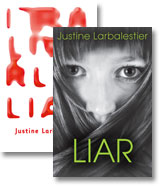 In the last few weeks as people have started reading the US ARC of Liar they have
 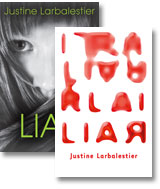 As it happens I was consulted by Bloomsbury and let them know that I wanted a cover like the
 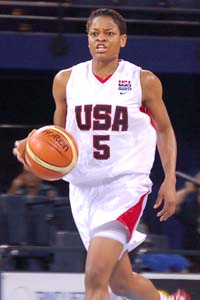 I never wanted a girl’s face on the cover. Micah’s identity is unstable. She spends the book telling different version of herself. I wanted readers to be free to imagine her as they wanted. I have always imagined her looking quite a bit like Alana Beard,

