Category Archives: Sydney/Australia

Merry, Merry, Happy, Happy

I hope everyone who celebrates today or any of the cluster of days around it—or who’s just enjoying the days off work or school—has a most excellent end of the year. I plan to.

I’d like to adopt the USian custom of giving thanks (yeah, yeah, I know they do it on a different day—whatever!). Here’s what I’m thankful for:

    That I’m home in Sydney living in the best place ever: Flying foxes at dusk! Huge decks! Huge bath tub! Views! Amazing pubs, cafes & restaurants within spitting distance! Southerly breezes!

    That I’m home in the land of continuous cricket coverage! Of beautiful beaches! And the best avocadoes (yes, Mely, you need to move here, not smelly California) and mangosteens and mangoes and all the other yummy fruit and veg my heart pines for!

    Rediscovering all my CDs what have been in storage since forever. Most especially Sepharad: Songs of the Spanish Jews by Sarband. Best CD ever!

    The books beside my bed: The Tale of Genji—started it, but am intimidated by its enormousness, though I really want to take part in this amazing discussion; Harry Potter and the Half-Blood Prince—started it; Shaman’s Crossing by Robin Hobb; The Fencing Master by Arturo Pérez-Reverte—finished it, loved it!; The Big Ship: Warwick Armstrong and the Making of Modern Cricket by Gideon Haigh—started it; Zuleika Dobson by Max Beerbohm—started it.

    My writing career, and that I can type those words without cacking myself. Yes, I really do have a writing career!

    My family and friends. Especially my family: Jan, John, Niki and Scott, with whom I’m about to do the whole yummy food and wine, pressies, playing-lots-of-games thing! Bring it on!

Hope most everything is wonderful with you lot as well.

Settling in

Slowly, very, very slowly, and not that surely, I’m settling back into life in Sydney. I have some bookshelves, though no where near enough to cope with all my many, many books. But for the first time in almost three years I can sit and gaze at my first editions of Geek Love, Wide Sargasso Sea, Fireworks, Black Glass and The King Hereafter and all my other beloveds and try to figure out which to re-read first. I’m very, very tempted to start with the Lymond books.

Right now a whole bunch of LJers are reading The Tale of Genji. Having just unearthed my never-read copy I’m very tempted to read along with them. So very tempted . . .

Sadly, the third Magic or Madness book is due scary soon and I’m not exactly on top of it. I have fifty thousand words. Remember? Pretty much the same fifty thousand words I had at the end of my San Miguel sojourn. Not good. But maybe The Tale of Genji will be inspiring . . .

Lovely Texas and other matters

A few things:

1) I got my intramanet back!! In my very own home. My excitement is beyond words: email! dictionaries! blogs! posts! The whole world at my fingertips!

2) Magic or Madness made its third best books of the year list, the Tayshas reading list put together by the Young Adult Round Table of the Texas Library Association. I’m particularly chuffed about this one on account of I got family in Texas—that’s where my in-laws hail from and my uncle-in-law is the principal of a high school in Houston. Also there are many very cool books on the list. Not just Scott’s Uglies, but the work of at least two other Aussies: Fiona McIntosh’s Myrren’s Gift and Marcus Zusak’s I Am the Messenger. Very pleasing.

3) In our new flat we can go out onto the balcony and watch the nightly exodus of flying foxes from the Tannie gardens. I love them.

4) The nothing changes convo continues (so fab to see the nattering continue without me—I love youse guys!) and is taken up by David Moles and a cast of thousands on his blog. All fascinating stuff. Oh, and Claire & Lauren? I’m so with you on Ghost World. I was double plus unthrilled by that movie. Especially cause the Bollywood music opening sequence was luverly.

Quick this and thating

Still no interwebby thing in our new home (I’m at my parents), but at least we can watch the cricket!

There’ve been some comments from actual editors on the gender balance question thing I posted about a while back. Confirming once again that there is no vast conspiracy—it’s all much more complicated than that.

I’m loving our new neighbourhood, Surry Hills, but am less than thrilled about the whole unpacking, organising, cleaning, not finding necessary things etc. Turns out that our flat while fab, lacks certain essentials. There’s hardly any storage, making unpacking really hard cause there’s no where to put anything. And a lack of hooks and railings for the hanging of towels in the bathroom is driving me nuts. Hanging the hand towel from one of the drawers is not the best solution. Also what is it with modern built-in wardrobes being narrower than most coathangers? I mean how did anyone think that was going to work out?! Aren’t wardrobes meant to protect clothes, not squish them?

I’m in love with Dwayne Bravo. What a miracle worker he is. And how much better has this third test been than the first two? So very good to be home in the land of cricket and wry understatment and really really good Thai food. Green mango salad . . .

Moving

Tomorrow we move to our brand new flat what we rented while still jetlagged, which may not be quite as fab as we remember. Scott tells me the bath isn’t torquoise, that it doesn’t come with jetpacks, nor is there an airship tethered to the roof. I could’ve sworn . . . Oh well, as long as the monkeys were real.

All our stuff will be hauled out of storage for the first time in an age. What larks will abound! ‘Cause everyone knows how fabulously fun moving is . . . almost as blissful as flathunting.

Internet access in the new flat isn’t lined up yet, so not sure when next I’ll blog, or answer emails, or google, or read anyone else’s blog. Sob.

Wish us luck!

Many Things

Hung out with Agnes and Lili of the Centre for Youth Literature and talked books. Tried to remember all the cool, hot YA books of this year and failed, so raved about A Rabbit’s Eyes yet again. Agnes raved about Adam Rapp and his books 33 snowfish and Under the Wolf, Under the Dog. I want to read them right now.

I found out that Magic or Madness is a Magpies pick of 2005 for older readers. That’s the second best book of the year list for MorM. How bout that?

Afternoon spent at the Penguin Australia offices where we were champagned and cheesed and got to meet more of everybody. Yay all of them! And had our very first meeting with the sales people, which was fabulous. We got to sit and talk about us and our books, which is pretty much all we talk about anyways. Much fun.

Last of all dinner with the mighty Tessa and wild-eyed Rjurik. Very very very silly. They are excellent.

Agnes Nieuwenhuizen

We’re in Melbourne, running around like crazies, and having fun. Spent all day yesterday at the fabulous School Libraries of Victoria conference, which was a blast. Shook me out of my jetlag. And Monday we get to hang out out with our Australian publishers at the Penguin offices, and also with the wonderful folks at the Centre for Youth Literature, Mike Shuttleworth, Lili Wilkinson and the fabulous Agnes Nieuwenhuizen. Agnes is profiled in today’s Age. She’s one of the most formidable, intelligent, engaged and engaging people I’ve met and today’s profile actually captures that.

Must dash!

The good side of jetlag

One of the best things about being jetlagged is getting to watch the sunrise. In my normal life I never see it. This morning though I watched my parent’s backyard go from pitch black to completely light. And because it’s spring their backyard is gorgeous. The jacaranda tree is covered in purple flowers. There are other plants in bloom with white and pink flowers. I just saw my first flock of rainbow lorikeets, chirruping back and forth at each other as they zoomed by. I should be up at this time more often.

The only noises I’m hearing are birds, the hum of the fridge from the kitchen, and various house creaking noises, but mostly birds. I’m so not in New York City anymore! It’s so wonderful to be home.

Busy

I was asked yesterday what I’m looking forward to when I get back home. I answered, “cricket, warm weather, and seeing my family and friends”. But, obviously, not necessarily in that order. It occurred to me today that I’m also looking forward to not being so busy or surrounded by so many busy, busy, busy people.

New York’s just like that. You invite people to a party here and a bunch of them won’t even respond: they won’t say they’ll be there, they won’t say they can’t make it, and then they won’t show up. It’s not because they hate you. It’s just because they’re busy, overwhelmed, drowning. And when I’m here I wind up just as busy, just as behind with everything, unable to get all my work done, see all my friends, do all the cool things that I’ve heard rumours can be done in NYC.

It’s not that we’re not busy in Sydney. I’m a feelancer. My workload’s pretty much the same wherever I am. It’s not that I don’t have lots of busy friends there—hey Kate! It’s just that, I don’t know, busy is bigger in New York City. Wider. Denser. Hungrier.

Sydney’s slower, calmer, and much more relaxing. I can’t wait to get back there.

The Gulf

When the tsunami hit we were in Sydney. Psychically, Indonesia, Thailand, the whole of southeast asia, just doesn’t feel very far away from Australia. They are our neighbours. Yet the tsunami hit, thousands of people died and we ate our breakfast of mangoes, bananas and passionfruit, granola and yoghurt like always. Sure we cried, followed the coverage, donated money, but our life in Sydney was unaltered. We thought about other things, went out with our friends, laughed.

Now New Orleans is destroyed, hundreds are dead in Mississipi and Louisiana but life in New York isn’t any different. We’re in the same country, but we’re miles and miles away, here water is plentiful. We’ve cried at the coverage, donated money, but our life is just the same. Tonight we’ll watch the second playoff game between the New York Liberty and Indiana with friends. I still want the Liberty to win. I’ll scream at the tellie when there’s a bad call from the refs. I’ll yell happily when we score.

I don’t know what I was expecting. I don’t even know what I’m saying.

Tipping

The 5 September issue of the New Yorker has an informative piece by James Surowiecki on tipping. Apparently it didn’t become widespread in the US of A until after the Civil War and some states were so appalled by it they even banned the practice. Who knew?

There’s just one problem with the piece, he claims that Australia and Japan are countries where they don’t have tipping. Now, I don’t know about Japan, but it ain’t true about Australia. Tipping isn’t as widespread back home as it is here (thank God!), but tipping wait staff in restaurants is standard. Though unlike the USA, you don’t have to tip if the service sucks; and unlike New York City, 20 per cent is an epic tip, not de rigeur.

I hate tipping. I never know how much I’m supposed to give or to who. Taxidrivers? Yes. The lovely woman who delivers the mail? No. Huh? It’s so random! I hate the stress of going to the hairdresser and not knowing how much it’s really supposed to cost. I just wish people would charge me up front and leave out the guessing game. I hate the moment of handing over the tip. I feel like I’m trying to bribe someone. The whole thing is too bloody stressful. I wish people were simply paid decently and weren’t dependent on customers to make a living.

Thus endeth the rant.

Australian Writing—sucky or not? (Updated)

I dunno, but sometimes I reckon us Australians are just a wee bit too insecure about our doings. There’s been much debate around the traps about whether oz genre stuff now is as good as it used to be, or world beating, or in a crisis, or something. Sonya Hartnett (bless her) reckons it’s all crap (except her). I reckon she’s bloody good and so are other Oz writers (sticking to children’s/YA writers). But I also reckon they’d be fine writers were they born somewhere else (providing they got the same opportunities). Obviously, they wouldn’t be the same writers, but they’d still be excellent.

Hmm, dunno what I’m trying to say here. Go read a really good book, like, Peeps for example, which was written by an honorary Aussie (he’s a permanent resident and does a truly excellent Adam Gilchrist impersonation) . . . it being Peeps week and all.

Update: David Moles makes mock of me and my people.

This an’ that

Read this article in the New York Times about art by the stolen generation. Gorgeous, gorgeous work produced under the most appalling circumstances.


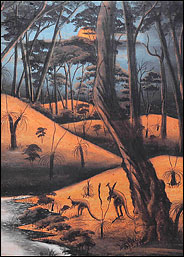
The Picker Art Gallery
“Down to Drink,” by Parnell Dempster.

Australian young adult writers are conquering the entire universe. I was dead proud that Magic or Madness had already sold in five countries (USA, Australia, Taiwan, France, and Thailand), now I see that I’m underachieving. This article by Rosemary Neill is also startling because it’s so well-researched. It’s refreshing to read something in a mainstream news source about publishing and actually learn something. Via Yoof Literature (thanks, Lili!).

Speaking of research . . . Did anyone else watch the NBC so-called “news” report on the shocking new content of teen novels which aired Monday night? I watched it because R. A. Nelson who wrote Teach Me was interviewed. He spoke for about six seconds. The report consisted of people saying, “Look at the cover of this YA book!” Cut to cover of Gossip Girl or the like. “This book has shocking content! Should we let our children read books with shocking content?” Cut to a parent. “I’m shocked that my children are reading books with shocking content!” Cut to some random other person who is also “Shocked! Shocked by teen books with shocking content!” The 2 minute report ended with an admonition to parents to be wary of the shocking, shocking, shocking content of teen books.

I hadn’t watched “news” on television for ages and I gotta tell you I was shocked, shocked, shocked by the “content” of that report too!

Too Young to Publish

Recently I’ve had a number of letters from teenagers wanting advice on how to get their novel published and wondering whether their age will make it harder for them to get it into print. Specifically, would they be discriminated against because they were only thirteen/fourteen/fifteen/sixteen or whatever?

The simple answer is no. When you submit a query letter to a publisher or agent you don’t have to tell them how old you are. You’ll be rejected or accepted on the quality of your submission.

Being young can be an advantage in getting published. I was first published when I was nine. A short poem in The Newcastle Morning Herald (now The Herald). My mother sent it in and it was published with my age listed. While the poem was clearly a work of genius, odds are that if I hadn’t been nine, it wouldn’t have been published. As it happens I was more embarassed by the publication than I was proud. The kids at school teased me non-stop for the rest of the year. Happy days.

Up to the age of 15, I had a number of other poems and stories published. Without motherly intervention even. Every one of them with my age beside my name. After that, nothing of mine was published until I was in my thirties.

What happened?

Another simple answer: I started competing with adults. I stopped listing my age and started sending to more grown up venues. My work was not as good as that of the grown ups. I didn’t find my way into print again until I was way past my child prodigy days.

The teenage me was cast into deep, dark despair by this. On my seventeenth birthday I had a midlife crisis. There I was seventeen years old and still no novel published! I was a complete and utter failure! What was wrong with me?

Another easy answer: I wasn’t good enough yet and I wouldn’t be good enough until I’d learned to write and rewrite and rewrite again. Until I got past thinking my first drafts were perfect and that rewriting involves a wee bit of chipping at the surface of a story. It’s much, much harder than that. And, I’m belatedly learning, more fun too.

If you’d have told me back then I wasn’t good enough and had a lot more to learn about writing I would not have believed you. Actually come to think of it, people did tell me back then. But they were polite about it saying that I had a "great deal of promise" and a "bright future ahead". Blah, blah, blahdy blah. I didn’t want to hear it. I wanted to be published immediately! Before I hit twenty-one or, worse, thirty and was too decrepitly old to enjoy it.

Now, of course, I’m incredibly grateful that no one did me the disservice of publishing me back then. I’ve kept a lot of my juvenilia and, well . . . it shows promise.

I have a couple of friends who were not so fortunate. They were first published in adult venues when they were still teenagers. Both of them are horrified that their learning and growing as a writer has been done so publicly and that there’s nothing they can do to make all that evidence of early missteps go away. They both wish they’d spent more time honing their craft and less time desperately trying to get into print.

But how do you hone your craft?

Read a lot. Write a lot. In that order. There are very very few good writers who aren’t also good readers.

Never send off a first draft for publication. Even though the temptation to do so is enormous. I mean you wrote a complete draft! A whole poem/story/novel! It has a beginning, a middle and end! The sense of accomplishment is enormous you can’t wait to show your work of genius to the rest of the world.

Resist that feeling.

Wait a few weeks after writing something, then reread it, rewrite it (and I don’t mean just fixing typoes), then give it to some people you trust for comments. (Not your parents. Most’ll just tell you it’s wonderful no matter what.) If you have friends who read a lot give it to them. Or to a teacher you trust. Give it to as many people as you can think of. Trust me, most of them will not get back to you with comments.

Ask the ones who read it to tell you when they got bored. Ask them to tell you the plot. This is a great way to figure out if your readers are reading what you think you wrote. It’s amazing how often they aren’t.

When they get back to you with all their comments, rewrite it again. Many of the comments will be intensely annoying and boneheaded and will make you want to end the friendship with the idiot who said them. Resist your urge to do so. Resist the urge to tell them how moronic they are. Also resist the urge to cry (I still haven’t quite mastered this one). Instead look for parts of your story/poem/novel that all readers had problems with. Figure out how to fix it. Most likely the solution you find won’t be the one they suggested. (Later on when you’re published you’ll find this also applies to your editors.)

Learning to take criticism is one of the major prerequisites of being a professional writer. Once your work is accepted for publication, your editor will criticise what you have written and ask you to rewrite it. Usually many, many times. And after it’s gone through all those rewrites she will often forget to tell you good it is. There will be few gold koala bear stamps. Your editor’s primary concern is to get rid of that which sucks. It should be yours too.

Just as important: don’t get too caught up in the praise your readers offer you. If your readers only have good things to say about your manuscript, enjoy it, but then be suspicious. Very few pieces of writing are perfect first go. (I rewrote this essay several times and then gave it to Scott to read and it could still stand a bit more rewriting.)

Once you’ve made your manuscript as good as you can possibly make it—if it’s a novel that should take months, maybe even years—then and only then do you send it out for publication.

But how do you get a novel published?

With great difficulty. Getting published is very, very hard no matter how old you are. Most novels never find their way into print. Even really good ones.

Ian Irvine outlines the whole process in his essay, The Truth About Publishing (the link’s in the menu on the left). I strongly advise reading the whole document through to the end. It’s depressing, but it’s also very very useful. I wish I’d read it back when I was fifteen.

Good luck. Do not despair when you are rejected. Welcome to the club. There isn’t a writer in the world who hasn’t been rejected. Many, many times.

New York City, 13 August 2005

The Hebrew translation is here.

For those young writers who are angered by this please read my clarification.

A Few Words about the unique-to-the-Australian-edition afterword

I’ve had some inquiries from folk who want to know what they’re missing out on by not having the Australian edition of Magic or Madness with its unique-to-the-Australian-edition afterword. One person was convinced that the Oz afterword contains the answers to all the questions left unanswered at the end of the book.

Not so.

It’s just this wee little thing that you wouldn’t understand if you aren’t Australian. Nothing to bother your non-Australian heads about. So you can just relax and get on with your day.

If it makes you feel the better the USian edition has a glossary and the Oz edition doesn’t. So it’s special too. As are you!

Magic or Madness in Australia

Two copies of the Australian edition of Magic or Madness just arrived. They’re beautiful. All tradepaperbacky and shiny and lovely and Australian, complete with the unique-to-the-Australian-edition afterword. It’ll be available in book stores there next month. My birthday month. Yay! Only sad thing is I won’t be there to see ’em till November. Sob. Why am I never in the country in which my books are coming out when they come out?

Here’s what it looks like being read by Marlowe, one of our Aussie house guests:

Marlowe thought the book was okay, but a bit lacking in train engines and explosions. I shall attempt to correct that in the sequel.

Most Excellent Breaking News (updated)

Margo Lanagan, brilliant author of Black Juice and many other fine books now has a blog! Woo hoo! And a bloody superb one it is too! This news has made my day.

She’s even linking to some of her bad reviews and posing excellent questions such as: “Since when is ‘polished and clever’ the definition of good writing?” Since never, says I.

My only complaint is that so far she’s not enabling comments, thus depriving us all of the pleasure of welcoming her to blogland; and her of the pleasure of editing our comments (scroll down).

Update: as noted by Marrije in the comments, Margo has now enabled us all to get in amongst it with her and comment to our heart’s content. Yay!

Expensive Cities

So I spend most of my time in two top 20 most expensive cities in the world: Sydney at number 20 and NYC at number 13. Tokyo and Osaka top the list.

Of course, it’s the real estate prices that do it. Both cities can be damn cheap to eat in, and to buy clothes, and a host of other goods and services. Most expensive leg wax I ever had was in Madison, Wisconsin. Cheapest: right here in NYC. It wasn’t very good, but.

via Vertical Books

Australian versus US English

Pardon me while I geek out about the diversity of the English language.

One of the cool things about writing a trilogy populated by Australian and US characters, and attempting to use both vernaculars, has been coming across differences between Australian and US English. Yesterday, while defining "bitumen" for the glossary of Magic Lessons, I learned that not only do USians not know what "bitumen" is, they don’t call a road made from bitumen a "sealed" road. I don’t know why but it had never occurred to me that a sealed road could be called anything but a sealed road. Apparently they call them paved roads. Huh.

This is weird to an Australian because "paving" is something you do to garden paths, or around swimming pools, not to roads or streets. Unless they’re made of cobble stones and frankly, I’ve not come across many cobblestoned streets in Australia.

Here’s the Macquarie Dictionary (Australia’s premier dictionary—I adore it) definition of "sealed road": a bituminised road. (That’ll explain everything to a bewildered USian.) And of "pavement": 1. a walk or footway, especially a paved one, at the side of a street or road. 2. a surface, ground covering, or floor made by paving.

Naturally enough, Webster’s and the American Heritage Dictionary don’t have a definition of "sealed road". But here’s how the American Heritage defines "pavement": 1.a A hard smooth surface, especially of a public area or thoroughfare, that will bear travel.

Not the same are they? To "pave" something in the US can include laying out asphalt on a road. The Maquarie Dictionary definition of "to pave" is you have to be laying out tiles, stones, bricks, the stuff that we refer to as "paving". It took many minutes of incomprehension between me and Scott before we sorted it.

I also had a US character say, "He wants in to the house". My editor queried it. I didn’t understand what the problem was, so I asked Scott, who changed it to "Looks like he wants to get into the house." To my ears that sounds too formal, but apparently in US English "to want in" can only mean that you want to be included, as in "Jo wants in on that bank robbery". In Aussie English "wanting in" can mean both wanting to be included and wanting to be (literally) inside.

At one point another of my US characters said that they were "made to go" there. Once again my editors cranked out the red pen, and once again I was confused. Turns out that to a USian if you say that you were "made to" do something, it means that you were created for the purpose of doing that thing, not that you were forced to do it. In Australian English we have both meanings, so that "I was made to write the first great Australian, feminist, monkey knife-fighting, cricket & Elvis novel" can mean either that you were created for the purpose of writing such a novel (which I was) or that that you were forced to write it (which I could be if someone would pony up the dosh).

I also learned that US English doesn’t include "a dog’s breakfast", "demountables", or "unco". Which made me sad for US English, until I remembered some of their great words and expressions, such as "write me", "geek out", "sketchy" and my all-time favourite: "discombobulate". Best word ever!

New York City, 2 May 2005

A Brief Respite from Deadlines

It’s 7:30AM on Thursday morning and I’ve been awake for an hour, lying on the couch, watching a repeat of yesterday’s cricket in New Zealand (NZ versus Sri Lanka) and reading C. L. R. James’s Beyond a Boundary. I watch Jayawardene batting beautifully, lots of lovely attacking shocks, including some quite exquisite cover drives while C. L. R. James (I love using all his initials) bitches about defensive, boring batting in the 1950s. (His theory: it was because the 1950s was boring.)

I’m having a lovely morning, not just because of wall to wall cricket (I’m also checking scores around the world on my laptop), but because I don’t have to feel guilty about it. The last few months have been work, work, work. But now I’ve met all my deadlines. I turned in the anthology last week and the latest rewrites on Magic Lessons (sequel to Magic or Madness) last night. For the next few days, before my pesky editors get back to me, I can do whatever I damn well please and I choose cricket.

Especially as it’s just this second gone live: the fourth day of play has begun. And even more especially because in just over a week I’ll be stuck in that cricket-free zone: the US of A with little hope of getting to England to watch Australia destoy them in the Ashes. So here’s to inswingers, yorkers, googlies, cover drives, front-foot play, back-foot play, silly mid-on, short square leg and french cuts. And to W. G. Grace, Ranjitsinhji, Learie Constantine, Peggy Antonio, Sid Barnes, Weekes, Worrell and Walcott, Keith Miller, Garfield Sobers, Dennis Lillee, Viv Richards, Micheal Holding, Bruce Reid, Zoe Goss, Makhaya Ntini, Adam Gilchrist, Steve Bucknor and Belinda Clarke. How I shall miss you all!

Sydney, 7 April 2005

Playing Wife

Scott Westerfeld is the final week tutor at Clarion South, an intensive six-week writing workshop for sf and fantasy writers. And I’m the tutor’s wife. This involves getting up at the same ungodly hour he does to make him breakfast, while he goes over his notes and scribbles on the stories that will be critiqued that morning. I kiss him goodbye as he grabs his bag and heads out the door. "Have a good day at work, sweetheart," I say.

"Sweetheart" is not a word that normally passes my lips. To me Scott is Scott not darling, sweetie, sugar, possum, love or anything else. Clearly, this playing wife thing is destroying my brain. I’ll start wearing gingham and aprons and long for a house with a white picket fence. I’ve been making him lunch and dinner as well as breakfast and doing all the washing up, cleaning, tidying and laundry. It’s just exhausting.

Or it would be if I was a bit more conshie about the whole thing. Fortunately I’m not. I let the dishes sit. And my version of tidying is more of a gather and dump process. I haven’t gone near the mop or vacuum cleaner or dusted or anything that requires true exertion. I’m a pretty crap wife, really.

One night instead of rushing back to cook dinner for knackered husband I sit around and drink beer with the students, gossiping and swatting blood-bloated mozzies, before belatedly dashing back to the flat and taking over the dinner-making proceedings from the exhausted and ravenously hungry husband. "Is that beer on your breath?" he asks, suspiciously. "I was near people who were drinking beer," I answer honestly. Scott is turning into a husband.

Neither of us quite realised how much work a Clarion workshop involves. Scott presides over the crit room from 9AM to 1PM where he and the 17 students dissect the day’s stories and he dispenses pearlers about writing that involve the following phrases: "first shoe", "Brechtian law of dialogue", "information assymetery", and "sweating commas". The students diligently write down everything he says. I worry this will go to his head.

Sometime between 1:10 and 1:30PM he comes home for lunch. We eat, briefly converse, then in the few minutes left before he begins the one-on-one sessions with students that will occupy the rest of the day (usually three or four one-hour session), he plunges into reading and re-reading more of their stories.

He returns for dinner. We eat and exchange possibly as many as fifty words, before he starts reading the next day’s stories: all 20,000 words of them. Long before he’s finished I go to bed, read, pass out.

While he’s away critiquing and being wise, I’ve been rewriting the Magic or Madness sequel, working on the Daughters of Earth anthology or slacking off. Slacking off is best. I had a lovely lunch with Kim Wilkins where we talked writing, babies, academia and frocks and I managed to douse myself with a glass of champagne, which the kind restaurant replaced without charge. I’d had only one sip before it filled my lap.

Mostly I went into the city to visit my mate, Ron Serdiuk, at his wonderful sf, fantasy and crime bookshop, Pulp Fiction. We gossiped and I watched him sell four, five, six or more books to customers who come in just looking for the one. Ron’s passionate and knowledgeable about those genres and it shows. He pays attention to what his customers do and don’t like and recommends accordingly. Very dangerous indeed. Yes, I bought books too. Louise Welsh’s latest (Ron got me hooked by loaning me The Cutting Room) and Devil in the White City.

I also helped out the young man from Mallorca with very little English who came in looking for Spanish-language books. I’m pretty sure I translated Ron’s directions to a shop that sells such books reasonably accurately. Though I do tend to get left and right mixed up. Still, we gave him a map, and I got to talk Spanish. By the time I got home I was exhausted. I took one look at Scott and revised my assessment of my fatigue to mildly peaked.

Yesterday I helped out Grace Dugan, Clarion South’s co-founder, with printing out the stories for the following day. There were four of them ranging in length from nine pages to thirty-seven. Just under 20,000 words. The author of the shortest manuscript neglected to add page numbers so I numbered the 153 pages by hand. The printer freaked out several times and started printing a line of garbage at the top of otherwise blank pages and would not stop until we’d done everything we could think of to fix it several times. At which point the stapler started buggerising around with us. Two hours later we had 72 copies of the stories to distribute to students and tutor. It gave me a tiny glimpse of the hard work that makes this workshop run. The conveners: Robert Dobson, Kate Eltham (the other co-founder), Heather Gent and Robert Hoge look every bit as tired as the students.

To recover from the printing ordeal I went swimming with Grace and Lily Chrywenstrom (one of this year’s students). It was rather gorgeous, despite the crushing disappointment of a short-course pool. I expect such mingy pools in the USA, but in Australia! The horror. The day was balmy and humid and lovely, the water warm strewn with leaves from the surrounding gum trees. We swam, laughed, floated, sank and gossiped, while I tested my new boardies, rashie and fins, and swam fast as Thorpie (or almost). We agreed that swimming is good, so is writing, and that hard work is best avoided. The last one may just have been me.

Grace led us to the path through the bush that connects the two Griffith Uni campuses, Nathan (where the workshop is held) and Mount Gravatt (where the swimming pool is), and we walked back past gums and paperbarks and grass trees and other plants that Grace knew the names for but I’ve now forgotten. We saw butterflies, bush turkeys, heard many different birds calling to one another, but saw only crows which we dubbed singed rainbow lorikeets (you had to be there). The walk was even lovelier than the swim.

Earlier in the week I spent forty minutes stalking a goanna, just shy of two metres long from head to tip of tail. It took a while to find just the right stalking distance; every time I got too close it froze, clearly hoping I would stop seeing it and go away. Only at ten metres did it believe I was gone. I watched the goanna being divebombed by birds when it ventured too close to their nests, and at last reaching its goal: a garbage bin. It climbed in and out of the bin always having some part of its body peeking out, tail, hind legs, or head, snout and eyes. A strange clicking hissing sound came from inside as if the goanna were torturing a cicada.

The goanna waddled rather than walked, its stocky limbs moving in a circular motion that made it resemble one of Tolkien’s grumpy dwarves. When it was startled by a group of US exchange students it ran half way up a tree, where it froze in its you-can’t-see-me pose. The Americans were transfixed, unable to believe the size of it. I told them it was still a baby and would grow much much bigger. Who knows? It may even be true.

When Ellen Klages, another—despite her many acclaimed stories, recent first novel sale (to Sharyn November at Penguin USA) and growing reputation—Clarion student, stumbled across a goanna, it reared up on its hind legs and hissed at her. Surely it can’t have been the same one. It was strange seeing Ellen here in Australia. I’ve known her for years, but only in North America, and only at conventions. This is the first time we’ve hung out together when her accent has been the odd one out. It’s most peculiar. She’s as exhausted and worn out as all the other students, who’ve not only been reading and critting the 20 thousand words of stories every day for the last six weeks, but have been writing a sizeable number of them too. I’ve never seen her happier.

It’s just after midnight, the beginning of Friday, the last day of Clarion South 2005. Scott’s reading the last and longest story for tomorrow. He’s not a fast reader. It’ll be at least an hour before he crawls into bed. The bags under his eyes are meeting up with the stubble on his cheeks. It’s not a good look.

He arrived knackered, worn done by a long hard year of writing way too many books, all of them written to his ridiculously high standards. I’m still not sure how he managed it. The Clarion South experience hasn’t exactly been a rest cure, yet he’s loving it here. He uses the word "rejuvenated" frequently, even though he’s so tired he stumbles over that many syllables. He’s full of praise for the smarts, sharpness, energy, creativity, and dedication of his students: Mark Barnes, Nike Bourke, Nathan Burrage, Alison Chan, Lily Chrywenstrom, Suzanne Church, Shane Jiraiya Cummings, Rjurik Davidson, Evan Dean, Ellen Klages, Tessa Kum, Deborah McDonnell, Anne Mok, Emma Munro, Trevor Stafford, Susan Wardle, and Kenrick Yoshida. He says he’s learned as much about writing as they have, has been forced to put into words ideas about the craft that had floated about in his backbrain but never surfaced before. He’s sad it’s almost over.

On Monday we go to Heron Island with Ron and Sarah. Six days without computers: no writing, no internet, no critiquing, just tennis, snorkelling and mango daiquiris. I’ll stop playing wife and we’ll be back to being Scott and Justine again. We can’t wait, but neither one of us would have missed this week for the world.

I crawl into bed now. Scott keeps scribbling in red.

Written Brisbane, 11 February 2005; posted Sydney, 21 February 2005

Wine

Deb Biancotti recently wrote about how much she loved the US movie, Sideways, while I don’t remotely agree with her about the film (love was not the emotion it roused in my breast), I did very much enjoy her thoughts about wine. She’s right: loving wine, appreciating wine, gets a very bad rap. It’s pretentious, it’s snobby, it’s blah blah blah. "That doesn’t really smell like passionfruit or taste of cat’s piss. You’re just making that up. Wanker."

Like Deb, I love wine. I love them, red, white, sticky sweet and dry as bone. I don’t care about the grape variety: pinot gris, malbec, cab sav, merlot (yes, merlot, I have no idea what that guy’s problem is), sav blanc, semillon, riesling, chardonnay, shiraz and so on. And I especially love wine with bubbles. Not just champagne, I’m also in love with heaps of Australian, New Zealand and Italian bubblies. What can I say? They tickle my nose and float across my tongue. What I care about is quality. Every grape variety can produce crap wine and they can all produce absolute glories.

I love the performance around tasting wine: checking out the wine’s colour in the glass, smelling it and trying to figure out what those smells are, what they remind you of, and then best of all, tasting it. Does the taste match the smell? Does it taste the same at the beginning as at the end of a sip, of a glass, of a bottle? (A bottle shared with others, obviously. Drink only in moderation.)

I totally agree with Deb: "It’s earthy and real. I think it’s a way to focus inwards on your body’s sensations and to feed those sensations through your brain and turn them into words. It’s sensual. Kinda—dare I say— sexy."

When we were in Buenos Aires recently we drank a lot of malbec, a red grape variety I’d never drunk before and this weird thing kept happening: the waiter would pour the taste, I’d sip, my mouth would pucker, and the first word that wanted to escape my mouth would be, "b’dna’gah!" or maybe "ack!" The waiter would smile and say, "Too much tannin?"

"Rather a lot, yes," I’d say, squeezing the words out of my shocked lips. The waiter would then assure me that it would taste fine in a few minutes. We just had to wait. So we did. Without fail the next sip would be smooth, almost creamy, yet still a big red, still with some astringency. I’ve never drunk wines before that changed so dramatically so quickly. Very very fabulous.

For my birthday last year, Scott gave me the most excellent present ever (except for all the other really great ones, like the watch I’m wearing, my silver wedding skirt, that tropical fruit basket, everything my sister and parents have given me ever, and all the stuff I’ve forgotten cause my memory is crap): Le Nez du Vin (yeah, yeah, it’s French and all about wine, colour it very prententious indeed, and no, he didn’t pay full retail price. Jeeze what do you think we are?). It’s a set of 54 wee bottles of the key essences found in wine: cinnamon, vanilla, pepper, cut hay, lychee, butter, mushroom and 43 other ones. Each essence is matched with a beautifully written and illustrated card that tells you its chemical components, history, and what wines it’s found in. And each essence smells exactly like what it says it smells like. The green pepper smells like green pepper (well, okay, it smells like green capsicum). Fresh, crisp and faintly like grass. The honey like a light, straw-coloured honey. Come on, you know the kind.

We’ve spent hours and hours learning to identify them all. (For extra kink value we’ve even done it blindfolded. Cor!) All our friends have been into it too (blindfolded and everything! Double cor!). It’s a tonne of fun and much much much harder than you imagine. Most people’s sense of smell doesn’t get the same kind of work out that sight and hearing do. None of the folk who’ve played with our kit has gotten even fifty per cent right first go. I kept finding myself holding the teeny bottle under my nose, going, "I know this! I know this! Tip of the tongue! It’s . . . it’s . . . Oh, oh, oh. Bugger. What is it?"

"That would be lemon."

"Aaargh! I knew that."

We’ve played with it so much we know the 54 smells off by heart. We’ve learned that after about the ninth one your nose packs it in and everything smells like cloves. The smell starts coating your mouth. You taste it. I started flashing back to my time in Jakarta and all those clove cigarettes (bloody kretek). Turns out Proust was on the money: memory and smell are intertwined. So many of the guesses began, "Oh, oh, oh! It smells like that summer at my aunt’s place and the ice cream factory down the streeet and the—vanilla. It’s vanilla!"

Both Scott and me have gotten a lot better at isolating different smells in wine, but not just in wine, in foods, in garbage (hmm, I believe that was once a stew flavoured with thyme), in pretty much everything. And our writing has changed—it’s a lot more pongy that it used to be. Used to be I’d go for pages and pages without hitting any odours. My characters would see, and see, and see, and also hear, touch, and taste, but rarely would they smell so much as their dog’s farts, and when they did they’d smell in familiar, unarresting ways. In similies, like clean hair, rosemary, vomit, whatever. I’d rarely take the smell apart, really describe it. There’s a reason for that. It’s really hard and using the chemical components rarely makes for evocative writing. Most people don’t know many beyond H2O and it doesn’t have much of a smell.

I’m still not very good at it, but the kit, and drinking and appreciating wine, has at least gotten me thinking about how to write smells better. Some day soon it should translate into words on the page.

Sydney, 28 January 2005

Some Award Ceremonies are More than Tolerable

I am bored rigid by awards ceremonies. Every single one of them. The Oscars are sort of tolerable, but only if watched with friends while drinking and mocking the frocks with the tellie on mute (because who wants to hear anyone thanking their agent/God/studio/husband/mother/children and blah, blah, blah). I’m baffled that anyone watches the Logies, the Golden Globes, or any of the myriad awards shows that get televised. What on earth compels people to inflect such tedium on themselves?

The only awards ceremonies I’ve attended have been at science fiction conventions, most of which (but not the joyous Tiptree Award) have rivalled the Oscars for brain-numbing length. They remind me of school assembly. In fact, I suspect this is why I loathe them so. Remember school assemblies? Row upon row of listless, cranky students sitting on uncomfortable, prone-to-collapsing, fold-up chairs/hot bitumen/the floor while the teachers and head master on stage took it in turn to drone on about school spirit (or as often our lack thereof), how much money the cake stall raised, our glorious sporting achievements, and how the area behind the demountables was not created for students to illicitly smoke/pash/plot revolution and anyone caught there would get detention until the end of time even if they were back there writing the great Australian novel. Each assembly would end (or was it start? Thankfully it’s lost in the fogs of time) with a droning, spiritless rendition of the school anthem set to the music of "Gaudeamus Igitur" or "Rule Britannia" or "My Bonnie Lies over the Ocean" or "Pop Goes the Weasel".

I went to a lot of different schools, and experienced many different assemblies, but they were all the same: utter utter torture. Same exhortations and lamentations and threats, same lame school anthems (and the school mottoes were even worse. My favourite: Manners Maketh the Man. That’s practically commie. Be polite? Way to inspire the kiddies to go out and make their dreams come true. And what’s with the "maketh"? Lisping is somehow polite?).

There’s only one school assembly that I remember distinctly. A boy two rows in front of me started making strange noises. Loud strange noises. Like a baby dinosaur being strangled. Turns out the noises came from his very unhappy tum-tum. Seconds later he let loose with the most amazing projectile vomit I’ve ever seen (sorry, Ron, but sometimes these stories are necessary). A long arc of it, which managed to cover at least ten rows in front of him. Fortunately, the incident happened on PE day and all those, um, effected, by it had their PE uniforms to change into (and weren’t they overjoyed about that). Even better, it happened at the beginning of assembly. In the enusing chaos, not only did we miss out on assembly, but most of the class immediately afterwards. Most excellent. That boy became a hero.

So every time I go to an awards ceremony and find a seat amongst the row after row of listless, cranky science fiction people, the full horror of school assembly comes rushing back. I am possessed of a need to pass notes, make smartarse comments, and skip out as early as possible without the teachers noticing. Even when friends or myself are up for an award, on those occasions it just adds a little anxiety into the mix. Boredom plus nervousness, not a great combination. Perhaps that projectile-vomiting boy had been up for the post of monitor or something? (Not that such a post exists outside of Enid Blyton novels.)

Saturday’s Aurealis Awards in Brisbane run by Fantastic Queensland (an organisation which fully lives up to its name) was nothing like that. No boredom, no projectile vomiting. Just a very fetching animated alien called Bruce and well-edited, well-conceived short videos introducing each award. They made everyone giggle. The speeches from presenters and winners were short, and either funny or touching, or both. And Scott Westerfeld won, as did Cat Sparks and Sean Williams and Margo Lanagan (whose short story collection, Black Juice, is the best collection I’ve read in ages), which made it even more fabbie.

Aurealis Awards are pretty.

The theme of the night was community. Or as Jeff Fenech once put it: "I love youse all". Winners didn’t just thank individual people who’d helped them, but the whole community. Scott thanked the Australian sf community for welcoming him so warmly, and said that winning for the first book he wrote in Australia, Midnighters: The Secret Hour, was the icing on the cake of that splendid welcome. Sean Williams talked about community too, thanked all the various groups he’s part of, and warmly welcomed the Clarion South students to the fold. Cat did too, and neatly managed to guilt us all into buying copies of every anthology she publishes from now until eternity. I will, I promise. Their graciousness made everyone feel warm and welcome and, well, part of the Oz sf community.

Then we all went to the cocktail party and drank and ate and gossiped with old friends and made new ones (those frisky Clarion kids), and generally carried on like communities do, and it was more than tolerable.

I didn’t think of school assembly, not even once.

Sydney, 24 January 2005

Living by the Sea

I caught the ferry to Manly (a beach suburb of Sydney) with my friend Donna today. We walked along beside the ocean, watched waves splash against rocks, up on to the sandy beaches, watched hundreds of people snorkelling, swimming, splashing, playing in the water. But we couldn’t help trying to imagine what it would be like if all the water was sucked away and then a ten-metre high wave moving at 70 kph came crashing in on us all. Swimmers gone, snorkellers gone, hotels and bars gone.

What happened to the coasts of India, Sri Lanka, Indonesia, Thailand, the Maldives, Malaysia, Burma, the Seychelles, Kenya, Somalia and Tanzania yesterday is past imagining. So many thousands of people dead and missing and dispossessed, many of them doing the things people were doing in Manly today: playing, fishing, out on their boats, living by the sea. I have lived by the sea for the majority of my life.

My grandparents came to Australia in the late 1930s. They were jews from huge families, each with nine or ten brothers and sisters. Each of those brothers and sisters had children. After the war only four of their many nieces were left alive. Their parents, brothers, uncles and aunts, cousins, nephews and other nieces—everyone else was dead. Once, I asked my grandmother if she ever thought of going back to Kolomyya. "Why would I do that?" she answered, looking at me as if I was stupid. "Everyone I knew who lived there is dead. All my family, all my friends, what is there for me?"

All my life I’ve tried to understand what that must have been like. The majority of your family and friends dead, your world gone. I’ve never been able to. Now in parts of Southeast Asia, the subcontinent and Africa thousands of people have to face the life of a survivor who has nothing and no one. There are many places online where you can donate money to help them. I’m going to. I hope you will too.

Sydney, 27 December 2004

Average First Novel Advances

Skads of random people come to my website expecting reams of knowledge (and pictures) on topics that I do not, in fact, cover. The most common of these (after "my sister naked") is "first novel average advance" or some variant thereof. Every day four or more people come here hoping for guidance in this area. I imagine that they are people who are thinking idly about a career as a novelist and just want to make sure before they start typing that such a career is as lucrative as they imagine. Or perhaps some are first-time novelists who’ve just sent their babies out into the world and are wondering what they can hope for in return. Or maybe that wise and esteemed sage Google has been asked the question by some lass who’s just been made an offer and is in shock. "Surely, such a paltry amount of money can’t be normal? Surely this publisher thinks I’m a naive fool whose work can be bought for cowrie shells?"

I decided it was time I provided these questing souls with the answers that they seek, so I did a (very) little research. I emailed a bunch of people I know who have sold a novel and asked them what they got, half-expecting them to instead tell me where to go. Every single one answered—some within nanoseconds. Writers very much want to tell you what they got, no matter how little. I also emailed a few editors with the same question and heard back from none of them. (In their defence it is Christmas time and they may be on holidays and possibly haven’t seen said email yet. Still, interesting, eh?)

However, before I begin, I suspect some of you are only hazy on what exactly an advance is. An advance is a sum of money that is paid (or advanced) to a writer by a publisher against the future earnings of a book. I sold my first book (not a novel) to Wesleyan University Press for US$1,000. I got to keep that money no matter what happened, but I didn’t get any more cash from Wesleyan until the royalties on the book exceeded the $1,000 needed to pay Wesleyan back for this advance.

So what’s a royalty? It’s a percentage of the book’s sale price. In this case every time a copy of Battle of the Sexes sells I get 7.5% of the total, that is, about $1.50 a unit for a $20 book. Only after those $1.50 cuts added up to $1,000 did I start getting more money from Wesleyan. The royalty money comes (once or twice or four times year, depending on how the publishing company does their accounting) in the form of a royalty cheque. Given the peculiarities of the publishing industry (such as the returns system) it can take a long, long time (years) for royalty cheques to start wending their way to your home. A big fat advance up front makes a writer’s life a whole lot easier!

So to first novel advances: I asked fellow Aussies, folks from the UK, Canada and the US how much they got for their first novel. Because the majority are USian I’ve translated everything into US dollars. Here are the answers with year of sale. I have not adjusted for inflation because it kind of tells it’s own tale, doesn’t it?

1962: $1,000
1965: $3,000
1970: $10,000
1976: $700
1982: $7,500
1984: $7,500
1985: $2,500, $8,000
1989: $3,000
1990: $15,000
1995: $4,000
1996: $4,000
1997: $7,500
1999: $2,500
2002: $6,500
2003: $13,500
2004: $350, $10,000

Average advance: $5,920

Ah ha! See the pattern? No? Nah, me neither. Someone in 1970 got the exact same amount as someone in 2004. Except they didn’t, did they? According to the American Institute for Economic Research’s cost-of-living calculator, the lucky sod in 1970 received the princely sum of US$48,659.79 in today’s dollars. Ten grand went a lot further in 1970 than it does now.

The thousand-dollar advance in 1962 ($6,251.66 today) went to Samuel R. Delany for The Jewels of Aptor, the long half of an Ace Double. At the time Chip was paying "56 dollars a month, for a four-room 2nd floor apartment on the dead-end of East 5th Street on the Lower East Side." So his first novel advance paid for almost a year and a half’s rent. Scott Westerfeld’s $4,000 advance for his first novel Polymorph in 1996 was enough to pay four and a half’s months rent on his two-room apartment a mere three blocks (and thirty years) away from Chip’s old flat. (In the meantime that section of the "Lower East Side" had become "the East Village" and the rents had gone up and up). Nowadays, of course, getting a four-room flat in the East Village for less than $2,500 a month is a miracle of the first order. The larger of the two advances in my table from 2004 would cover four months’ rent for such a place, the smaller, 0.14 of a month (also known as four days).

The advances listed above were paid in four different countries and by a variety of different publishing houses. The $350 advance from 2004 was paid by a small but prestigious press, who offset their tiny advances with higher royalites, in addition to keeping none of the media or foreign-language rights. One of the authors wrote, "I’ve heard that in London at least, low advances for new signings have made a comeback in the last decade, but I don’t ask, and folks don’t usually tell. For your inquirers’ benefit, and in case they were even wondering, getting a low advance is a Very Bad Thing, and anything the publisher says to defend it, they are lying. Always ask for more money, just to see what happens. It’s counter-intuitive, but this is the only demand that never gives offence."

Another writer told me that "publishers will pay as little as they think they can get away with. I was royally screwed on my first sale and not just with the paltry sum offered: I was left with no subsidiaries either. Got myself an agent quicksmart after that."

The other thing to remember about these advances is that with one exception they were all paid for genre (fantasy, sf, YA, horror, children’s, crime) books, mostly by genre imprints. Everything I’ve read and heard tells me that mainstream novels still get more money than genre novels. And non-fiction gets more still (university presses like Wesleyan aside). One of my correspondents also writes non-fiction. Their first non-fiction advance was $20,000, considerably more than their fiction advance, indeed more than any of the advances listed here. An agent has told me that the average advance for a non-fiction book amongst the big New York publishing houses is more like $30,000.

Of the 18 people I asked, only seven are full-time writers (no, Samuel R. Delany is not one of them, he earns his dosh as a university professor) and of those only two of them are doing fine writing fiction (New York Times‘ bestseller, Shut-up! or I’m-getting-the next-round advances fine—definitely no longer worrying about where the next cheque is coming from). The rest are in their words "scraping by" or "barely comfortable" and depend overly much on their credit cards, except for Mr Scalzi who is smart enough to also make money writing non-fiction. The good news is that almost everyone got more money for their second novel than their first.

So my sage pieces of advice to someone contemplating a career as a novelist who begins by trying to find out what the average advance is? First I’d like to congratulate you—if you’re in this game for the money it’s a good idea to find out as quick as you can that there’s not a whole lot to be made writing novels. Find another way to make dosh. Personally I’d recommend plumbing.

For those who’ve just sent out their novel to the hard cruel world and are wondering how much dosh to expect. Well, gird your loins, expect rejection, not money. Because that will come first and more often. Scalzi has some choice words (scroll down to no. 7.) on the subject.

For the poor lass who just got the insultingly low offer? Well, I think the table above demonstrates that you’re in good company. My advice? Ask for more. If they offered $1,000 ask for $10,000. If $5,000 ask for $15,000. If $10,00 ask for $20,000 and so on. They won’t give you what you ask, but they most likely will give you more. But, if at all possible get yourself an agent. They know how to do all this stuff, how to make sure you don’t give away your subsidiary rights (that is, the film and TV rights, audio book rights, translation rights, graphic novel rights etc., etc.), how to protect you from selling a series of books that are joint accounted (that is, that all the books you sold have to earn out their advance before you get any royalties. This takes long enough when it’s one book at a time).

And there you have it: The life of a novelist is, financially speaking, a mug’s game. Enter at your own peril. And don’t ever give up your day job (scroll to no. 10)!

PS I plan a followup musing, if anyone wants to comment, tell me what their first novel advance was etc., email me at the address below.

Sydney, 24 December 2004

UPDATE (25 Dec): there’s a fascinating discussion of this topic to be found at metafilter.

December is the Anaemic Month

It’s pouring right now. Buckets and buckets of lovely rain which I hope is filling Warragamba dam all the way up. (Sadly, it’s also raining in Brisbane which means no cricket. Sob.) I’m taking a tiny break from writing the second volume of Magic or Madness (tentative title: Magic! Magic! Magic! Oi! Oi! Oi!—my compatriots will understand why that’s funny). The deadline of which just got moved forward. Gulp. That’s one of the reasons I’ve not been musing much of late. (A friend of mine is not sure about my use of the term "musing"—she thinks of it as a "loathesome, villain-chin-stroking or fantasy-heroine-in-a-reverie kind of word" which is kind of why I chose the word in the first place—it makes me giggle.)

I also haven’t been musing on account of all the work I have to do on Daughters of Earth, the collection of twentieth-century feminist sf I’m editing. As well as sundry other reasons that also have to do with the need to do paid writing rather than fun writing. Tingle Alley discusses the dilemma eloquently here.

Also I haven’t been feeling very "villian-chin-stroking" or "fantasy-heroine-in-a-reverie" of late, which puts a real damper on my ability to muse. Plus it’s December and I’m Australian and am thus hardwired to be lazy during this the first month of summer.

So basically what I’m saying is, there’ll be more here, but, you know, later.

Enjoy your holidays.

Sydney, 10 December 2004

Australia’s Not Perfect

Some of my regular readers and friends (and not just the non-Australian ones) have tentatively suggested that I might want, perhaps, to refrain from writing yet another one of my yay-I’m-back-home-in-Australia musings. They’re tired of my overly rose-coloured view of my home country and wish for me to start dishing the dirt. As one of them put it: "Australia’s not perfect, you know. Nowhere is. Not even your precious Sydney. Write something critical for a change. I’m bored."

Their wish is my command. Here are my trivial (not in the mood for being serious) objections to my homeland:

I was back home for less than two days before I heard an ABBA song. Did you know, my dear fellow Australians, that there are parts of the world where you can go months—months I tell you—without hearing ABBA once? Shocking, but true. Why, we were in Mexico for three months earlier this year and I never heard an ABBA song. Not one. (Okay, except for that time I got a wee bit tipsy, climbed on the roof and sang "Mamma Mia".)

Sydney is now infested with Starbucks and Krispy Kremes. They are a blight on the landscape. They are wrong, evil and produce horrible smells. (Can someone explain the Krispy Kreme thing to me? I mean, they’re doughnuts. Overly sweet batter fried in oil. I have eaten them in North Carolina—apparently the home of Krispy Kreme, where they are at their very best—I have feigned delight in doing so to appease my obsessive Krispy-Kreme-loving friends. But they were just doughnuts. Oily, sickly sweet, horrible doughnuts. I don’t get it.)

Many Australians are just the tiniest bit parochial about Aussie food. There is, in fact, I’m not making this up, people, good food available elsewhere on this fine planet of ours. Lots of it. All over the place. I can’t think of a country I’ve been to—even England—where I haven’t had some good tucker. Sydney and Melbourne are not the only sources of fine nosh. Truly.

And on that subject—and this one will come as even more of an assault to your delicate Australian sensibilities—but here goes: there’s even good wine to be had elsewhere. I swear on my grandmother’s grave. I’ve had spectacular wines from Argentina, Chile, South Africa, Spain, Italy, France, Germany, Hungary, even—and this one will shock you—the US of A.

It will never cease to make me sad that no-one in Australia ever says, "Don’t come the raw prawn with me", much less "stone the crows". Actually I say "stone the crows", but even I am aware that it’s a sad, pathetic attempt to keep the phrase alive. Someone else please, please join me. Do you people really want our language to die?

Everyone’s obsessed with real estate. At least here in Sydney they are. I do hope it’s just a Sydney thing. We’ll be in Melbourne and then Brisbane over the next few months, and I swear I’ll tear off my own ears and eat them if I have to listen to more natterings about whether it’s a buyer’s or a seller’s market, how much rents are, how much that cute little terrace in Redfern went for, or how much interest rates are going to shift. Aaargggh! Talk about something else, people! Some of us have never, and most likely, will never own property and we just don’t care!

When I’m home in this fine sunburned country it is impossible to forget that the British royal family exists. In the past year I’ve been to Mexico, Argentina and the USA. My friends in those countries—lucky buggers—have no idea what the names of Diana’s little boys, the British royal princes are. Well, I know. I don’t want to know, but I do. Here you can’t open a magazine, turn on the tellie, or listen to the radio without hearing about them. Who cares? I mean, honestly, does anyone truly care? And why? These are people whose only achievement is to be born. Well, I managed that. Come to think of it every single person on the planet pulled that spectacularly untricky accomplishment off. At least movie stars and pop singers and all the rest actually did something to get famous. Even marrying someone is a bigger achievement than just popping out of someone’s womb.

And, hey, people here vandalise sacred Dickens’ sites, (though they also fix them afterwards).

There you have it: my country not perfect. Happy now?

Sydney, 26 November 2004

Miss Havisham Restored

Eliza Emily Donnithorne, the model for Miss Havisham in Charles Dickens’ Great Expectations, has had her vandalised gravestone repaired. A report on the current affairs show, The 7:30 Report, tonight showed the gravestone being repaired by TAFE students and stonemasons. It looks almost good as new. Donations from The Dickens Society and the Rookwood Anglican Cemetery made it possible.

The Sydney Morning Herald and the ABC also have the story.

Isn’t that grand?

Sydney, 25 November 2004

Judging Awards

As I write this I am home in Sydney, physically anyway. The jetlag thing is putting a glass wall between me and everything else; the world comes to me slowly and full of distorted echoes.

One of the pings that has gotten through is the winners of the US National Book Awards, and I got to thinking about awards and the judging process and the controversies that the major ones often seem to generate. I have been on the shortlist for three different awards and, more importantly, I have been a judge on a number of awards.

But first: I am so thrilled that Pete Hautman’s Godless won the young adult award. I loved it. Run out, secure yourself a copy and read it, people. Forget the young adult (YA) label—this is a book that should be read no matter how old you are.

Is Godless the best young adult title by a USian published this year? I don’t know because I haven’t read them all. More to the point, I haven’t read all the 180 books that were nominated for the YA award. This year I also loved Christopher Paul Curtis’s Bucking the Sarge and my husband’s Midnighters and So Yesterday and Katherine Hannigan’s Ida B: …And Her Plans to Maximize Fun, Avoid Disaster, and (Possibly) Save the World (which is really more of a kid’s than a YA book). There are also a bunch of books I’ve heard a tonne about that I haven’t gotten around to reading yet like Lois Lowry’s Messenger and Sharon Dennis Wyeth’s Orphea Proud. None of these books were on the shortlist, which means either they weren’t nominated (by their publishers) or the judges didn’t like them enough to list them.

Rarely is one book clearly superior to all other books published that year. It would be more useful if all these awards switched to publishing a list of five or ten fab books of the year. They could still have their big party of an awards’ night. The short list would be of twenty or fifty books and on the big night the select five or ten would be named. I know I can’t tell you which was the better book Godless, Bucking the Sarge, So Yesterday or Ida B. I loved them all.

Juried awards like the National Book Award are decided by a number of judges, usually five because that’s the perfect number. (Trust me, I was once on a jury of three and it sucked—two against three is no fair.) The judges read through all the nominees—all 272 if you happened to be one of the judges of the adult fiction National Book Award this year. The same group decides which five books should be on the final list and which of those should win. This can be a fraught experience.

When I was on the James Tiptree, Jr. Memorial Award (which was mostly an absolutely wonderful experience) we decided that we didn’t have to agree about the books on the shortlist (and mercifully we were not limited to just five), but that we did about the final winner. (The Tiptree Award is a particularly flexible award in that every jury gets to change procedure if they want. Other juries in other years, I’m sure, did it differently.) So our short list was an eclectic mix reflecting the various passions of the various judges.

Agreeing to the final winner was hard. Some of us were passionate about books that other judges despised, muttering, "Over my dead body does that book win." We had a veto and we exercised it, which meant we were left with books and stories that we all loved, but about which, perhaps, some of us weren’t as passionate as we were about other, vetoed, books.

Because that’s the thing about fiction that knocks you out; the book that you adore will always have the exact opposite effect on someone else. This is particularly maddening if you happen to be on a literary jury together. I happen to think American Beauty is one of the worst films ever made, but I know lots of reasonable, smart, interesting people who love it. Equally I am passionate about Dorothy Dunnett’s books, but you just have to read a few of the reviews on Amazon to know there are people out there who want all her books burned. Getting five people in a room and getting them to pick the best, frequently leads to compromises, to the award going to the book that some of the judges liked second best. We were lucky in the end all five of us was happy with our choices.

But as with every award ever, some people weren’t. This happens again and again with awards. People get invested in one book that year and when it doesn’t win it’s an affront to God and the natural order of things. It’s not. The answer to what kind of books win awards entirely depends on what kind of people are on the jury giving the award.

This year the five National Book Award judges for adult fiction came up with a list of books written by "five women from New York." There has been much bitching in The New York Times and elsewhere about the apparent same-sameness of their books (I have no idea if that’s true as I haven’t read them—I’m on a YA bender—but the plot synopsises certainly don’t sound that similar. I’m just cranky The Jane Austen Book Club wasn’t on the list). Shouldn’t there be more variety? Shouldn’t there be a limit on obscure books? Before all the publicity, none of the five had sold more than 10,000 copies and some less than a thousand (now the winner, Lily Tuck’s The News from Paraguay, is in Amazon.com’s top one hundred). Certain people argued that their low sales figures disqualify them from making the shortlist. Others have said that rewarding so-called "literariness" over accessibility is a slap in the face to ordinary readers.

What’s interesting about this year’s controversy is that instead of the usual argument about who got robbed (though there was some of that—poor Mr Roth) what’s being discussed is this—what are awards for? Pointing out good books to readers? Supporting the publishing industry by rewarding the books that they’ve poured all their money into via big advances and a large advertising budget? Rewarding the best books regardless of how obscure or how popular they are?

A shortlist is not just a list of the books the judges deem to be best, it’s also a list that says something about the publishing industry that year. It’s a message from a small group of people (the five judges) who are (usually) passionate about books to the wider publishing, writing and reading community (not to mention the media and wider population of people who don’t think about literature except when it gets in the news) and when it sparks such a debate and the kind of thoughtful commentrary I’ve been reading all over the blogsphere then that’s a very good thing indeed, regardless of who’s on the shortlist and who wins.

Sydney, 19 November 2004

The Original Miss Havisham

Via Gwenda Bond, who prefers to be shaken and stirred

In my novel, Magic or Madness, two of the characters visit my favourite Sydney cemetery, St Stephen’s in Newtown (though I grew up calling it Camperdown cemetery), and look at the grave of the reputed original for Miss Havisham from Dickens’ Great Expectations. Emily Eliza Donnithorne was jilted on her wedding day and left the wedding splendour, including the cake, to moulder for more than thirty years. Yesterday vandals broke Emily Eliza’s gravestone in half.


Photo by Brendan Esposito

Here’s how Reason (the protagonist of Magic or Madness) reacts to being taken to the cemetery for the first time:

The delight on Reason’s face pleased Tom so much that despite his resolve to kill his inner dag (must not be too enthusiastic), he clapped. Reason clapped too.

"Bloody hell," she said. "You’d hardly know you were in the city. It looks like a country graveyard. Only, I don’t know, spookier."

"Isn’t it great? You step from the street and the cars to this, and whoosh, everything’s changed. This place is so old they don’t even bury people here anymore."

The cemetery is full of huge old fig trees, surrounded by a high stone wall that blocks out many of the sights and sounds of busy Newtown. It’s a glorious haven from the city. I’ve been going there since I was a kid to walk, think, and hang out. I can’t understand why anyone would want to destroy it.

New York City, 11 November 2004

UPDATE: the gravestone is fixed.

One More Week

It’s almost summer back home in Australia and in just one week I’m going to be there. Home in Sydney where the jacaranda and flame trees and wattle will be in bloom and the cricket season already started, filling the air with the sound of leather on willow (cricket ball against cricket bat). New Zealand and Pakistan will soon be touring and I’ll get to sit in the stands at the SCG and scream my head off. Or more likely: remember not to scream my head off cause that’s more of a basketball thing than a cricket thing.

The water temperature is already rising to bearable levels and in just one week’s time I’m going to venture into the ocean at Clovelly to snorkel in search of the blue grouper. Well, okay, it’s not that much of a search given that the grouper is almost always around, but I haven’t seen him in well over two years.

In just one more week I can walk from Annandale Street to the Bicentennial Park admiring the gobsmackingly beautiful view of the city on the way. Then I can walk into the city or catch the fabulous light rail and go to the Botanical Gardens and pay homage to the flying foxes and native ibis. I can do and see and hear all the things I’ve been missing.

I’ve already said my goodbyes to New York City, stood on the roof and blown kisses to the Brooklyn Bridge, Chrysler and Empire State Buildings, the church next door, Tompkins Square Park, the East River Park, gone one last time to all my favourite restaurants and bars. Given my very first New York reading. Done the full round of farewell dinners, lunches and brunches with my friends. I am so so so ready to be out of here. It’s too cold already and everyone (including myself) is way too gloomy.

Now all that’s between me and going home is admin: getting my taxes together to file when I get home, figuring out what to take and what to leave, packing, finishing off all the work that must be done before heading to warmer, happier and homier climes. Then twenty-hour hours in two planes and I’m home. I can’t wait.

New York City, 8 November 2004

An Average Day

A few people who don’t actually know me read these musings. One of them sent me an email asking if I would write a description of an average day in my life, since I appear to write about everything but. What do I do on an average work day? Is it different depending on whether I’m in Sydney or New York City? My reader found it hard to credit that an average day for me involves sitting around contemplating the differences between Sydney and NYC after attending a Liberty game or a science fiction reading or convention or handing out voter registration cards during a blackout.

Point taken. (Except about contemplating the differences between Sydney and New York City; barely an hour goes by when I’m not thinking about that.) Problem is that I earn my living writing and an average day involves sitting in front of a computer tapping away at the keyboard. A writer’s working day just isn’t the most rivetting thing to write about.

Today I typed, yesterday I typed, tomorrow I will type. Words were written, words were deleted. Dictionaries and thesauruses and Scott (do Americans say "poxy"?) were consulted, as were various other reference books, and things were googled. Then there was more typing. And around about five or six I gave up and had a glass of wine, unless it was an alcohol-free day (curse them!) in which case I merely contemplated the glass of wine I’d be having on the next non-alcohol-free day.

You can see why Hollywood struggles so mightily to make writers’ lives look interesting. In the olden days they could show the typewriter (infinitely more photogenic than a computer screen). There was always the money shot of paper being ripped from said typewriter, crumpled and hurled in the general direction of the wastepaper basket. Mostly writers in Hollywood movies are not writing, but battling the dread writer’s block, and going crazy, and trying to kill their wife and children (Hollywood writers are almost always boys), or if they are writing it’s to pay off loan sharks (because publishers are simply legendary for always paying at the exact minute you hand in your manuscript). Give me films about musicians any day—especially fabby ones like Ray.

There you have it: a typical working day involves lots of typing and some contemplation of how terrible Hollywood depictions of writers are. (How come they’re so uniformly awful? After all they’re written by actual writers. I don’t get it!)

Does my working day differ when I’m in Sydney rather than New York City? I don’t think so. A writing day is pretty much the same no matter where I am: type, think, consult dictionary/thesaurus/Scott, google, think, type and repeat.

New York City, 7 November 2004

Good News from Home

I’m bouncing as I type, which, yes, makes typing tricky. I just heard the most wonderful news from back home: Penguin Australia is going to publish Magic or Madness. I’m finally going to have a book published in my own country.

The book’s set in my two favourite cities: Sydney and New York and has both Australian and US spelling, vocab and grammar (there are two Aussie point-of-view characters and one US). The thought of it being published in New York and not Sydney was hurting my head. But now balance has been restored. Big sigh of relief.

And how cool is it that my first novel’s already going to have two editions and it’s still not due out for another five months? Pardon me while I continue to bounce.

New York City, 29 October 2004

Homesick

I’m homesick.

I wrote in a café today and at the table next to me, three women—none of them native New Yorkers—talked about their immigrant experience, about living far from home. A huge wave of homesickness washed over me, for a moment I could smell the jasmine and honeysuckle coming into bloom in Sydney, see the view from the bottom of my parents’ street, of the timber yard, Bicentennial Park, Rozelle Bay, the Glebe Island Bridge and the city beyond it. Glass skyscrapers reflecting the intense daylight (never mind that in Sydney it was dark and the wee hours of morning), container ships loading and unloading, the enormous Moreton Bay fig trees by the water, and maybe some pelicans floating in the bay. My longing for home was so intense that I had to bite my lip and dig my fingernails into my palms to keep from crying.

September’s hard. It’s so beautiful back home and it’s my birthday month. Birthdays have always been a very big deal in my family. It’s never quite the same being birthday girl far from home. I miss my family and my friends and my bicycle. I miss Bowen Island breads, James Squire’s Amber Ale, Coonawarra reds, Tasmanian sparklings, Victorian stickies, Hunter semillons, and the fantastic organic garlic that we found at this health food store on King Street—so fresh that they practically peel themselves. I miss the sound of flying foxes at night and rainbow lorikeets during the day. I miss the smell of the harbour.

I miss being surrounded by people with accents like mine who know what a jumper is and understand that there’s a dipthong in "no" and have heard of Paul Keating and Miles Franklin and Shane Warne and Judith Lucy. I miss no one finding my accent even slightly cute.

I miss the light and sense of space—horizons everywhere you look. I miss the tannie gardens with their ibis and flying fox infestations. I miss playing lawn bowls and drinking really cheap beer. I miss cycling everywhere. I miss hills. I really, really miss the cricket (even if the poms did just beat us at the loser pyjama version of the game).

Hell, I’m even missing the current election campaign. Surely it can’t be as bad as the one here? I miss everything and everyone, but especially all of you.

New York City, 27 September 2004

So Yesterday

Scott’s latest book, So Yesterday, came out this week. Among other things, it’s a love letter to New York City. He started writing it not long after we arrived back here last summer after almost two years of living in Sydney. He was supposed to be writing the second Midnighters book, but instead So Yesterday came rushing out.

Scott had to write it. He was so happy to be back in his city to stay for awhile. He hadn’t been here for more than a couple of weeks since December 2001 and he was hurting. We had to visit all his old haunts, coffee shops, cafes, restaurants, bars, bookshops, movie theatres, and make sure they were still there, still with his favourite wait staff and bartenders. We had to mourn the closing of a favourite coffee shop across the street and a used book store around the corner, and sit in Tompkins Square Park to chuckle at the NYU students walking by.

Our first few weeks here were one long sustained sigh of relief for Scott. Writing So Yesterday was another one. He poured all his love and irritation and fears and delight in New York City onto the page, writing about a seventeen-year-old kid, Hunter Braque. The kind of kid Scott might have been at the same age if he’d been living in Manhattan, rather than Dallas, and had been a little savvier and, well, cooler. Hunter’s a cool-spotter, living in New York City, loving it, and working hard to pass as one of its hip inhabitants even though a part of him will always be convinced he’s a daggy kid from Minnesota. Which he isn’t. (I kind of have a crush on Hunter.)

So Yesterday is the first book Scott has written since we got together that I’ve seen move from conception to sitting on the shelves of a bookshop. I was with him when he was rewriting Succession (The Risen Empire + Killing of Worlds), and I was there for the first draft of Midnighters, but its outlining stage had been a long one, starting way back before we’d even met. I saw the entire gestation of So Yesterday—all ten minutes of it. Scott over the breakfast table, sipping his coffee, saying, “You know what would be fun to write? A novel about a cool-hunter in New York City.” After breakfast he started writing it. Several weeks later (told you it just poured out of him) I read an extremely polished first draft. And a year and some later there it is, prominently displayed at Books of Wonder and Barnes & Noble.

So I’m stoked, and not just because I was there from woe to go, not just because it’s fabulous, not just because my book will be published by the same imprint, Razorbill, next March, but also because it’s Scott’s first book to be published in Australia. It comes out back home next month. I can’t help feeling that being published in Australia cements his relationship with my homeland just a little bit more. First he married an Australian, then he became a permanent resident, and now he has an Australian editon of one of his books. Here’s hoping it’ll be the first of many.

New York City, 14 September 2004

Eight Weeks in San Miguel de Allende

Feels like we’ve been living here for years. San Miguel is every bit as fabulous and addictive as Scott warned me. It’s cured my writer’s block, improved my Spanish, and kept throwing the most amazing people across my path, though none so wonderful as Silvia (the maid at our first rental house) and Alejandra (my Spanish teacher).

Since we arrived on the first of December I’ve written the entire first draft of my first sold novel (crikey!); read a novel in Spanish; discussed local politics (old mayor versus new mayor), Australia/USA and Mexico/USA relations (sadly the Mexico/Australia relations conversation is not a long one) and many other topics with Silvia and Alejandra; and met many writers, layabouts, journalists, cartoonists, teachers, adventurers and travellers (okay, only one cartoonist).

We’ve eaten at almost every restaurant in town: from your friendly hole in the wall to fancy pants high-end, where we’ve consumed sopa azteca, mole, guava mousse, hibisicus quesadillas, jicama, fresh fruit salads, devil eggs, mushrooms in garlic chilli sauce, dry soup, mango tacos, and guacamole and pastries until they’re coming out our ears. We’ve drunk (in order of volume) water (see, parents, we very good), the best tequilas I’ve tasted in my life, margaritas, red wine and piña coladas (yeah, yeah, whatever, but they’re yummy).

We’ve seen the insides of five San Miguel houses: from the two we’re renting here (cheap and small for the first two months; bigger for the last month when the guests arrive: Hey Gwenda! Hey Christopher! Hey Lloyd & Betty!) to a several centuries-old huge dark pile which has a plaque on the outside declaring that it was used during the Inquisition—I’m guessing not for making hibisicus quesadillas. Every one of them gorgeous with high ceilings, lots of light, gardens, patios, roof-top areas for watching the sun set, fountains, and best of all, no firm boundary between inside and outside.

What I love most about the houses here is that from street level you have absolutely no idea what you’re going to find inside. All you see is a door and occasional windows in a flat wall, not telling you a thing. In Sydney I can tell from the front of a Newtown terrace or cottage the exact layout inside, how many rooms, where the stairs will be, frequently how it will be decorated. New York City, too, you have a pretty good idea of what to expect from the outside of an apartment in each particular neighbourhood.

In San Miguel you can find almost anything behind those huge wooden doors with their beautiful brass handles. The five houses all have completely different layouts. I’ve opened the door and stepped into a huge courtyard with balconies from the surrounding rooms looking down. Or a large foyer with places to hang your coats, leave your umbrellas, tether your donkey, and then up an elegant winding staircase to the house proper with its persian carpets and grand piano. Another front door opens onto a hallway with two large guest rooms on either side. At the end of the hallway another door leads to an elaborate garden with a fountain, the rest of the house is on the other side. We peaked through the doorway of one place we pass all the time, only to discover that there’s no house there at all, just a huge garden, with what my Sydney eyes identify as Moreton Bay fig trees (could that be possible?).

We’ve started looking in real estate agent windows here, checking out the prices of houses, but failing a bigtime Hollywood movie option, they’re all out of our reach—not New York City or Sydney out of our reach, but still way too rich for our blood. Looking at houses is a sign of wondering what it would be like to live here for a year or more, not just three months. San Miguel is a sticky place. We keep meeting people who came here on a holiday five, ten, twenty years ago and somehow never quite managed to leave.

I’ve met Italians, English, French, Canadians, Australians, Moroccans and, of course, lots of USians who live here. I’ve heard that as much as ten per cent of the population is foreign born. Many of the Mexican (not to mention some of the foreign) population complain that the foreigners have made the prices of everything go through the roof, especially real estate. Many born-and-bred Sanmiguelenses can no longer afford to live in the centre (this is a sentiment I understand, harbouring similar feelings about North Shore types moving into the Inner West of Sydney). The foreigners have also, and I’m quoting Mexicans here, led to a cleaner town, better restaurants, more active charities, a much better library and the improvement of many other services from the internet to sanitation.

Other than real estate prices, the most common complaint I hear is about how many of the gringos (and it is largely the USians) arrogantly expect everyone to speak English—despite this being Mexico where English is not, in fact, one of the national languages. I have seen a USian woman at the artisan’s market trying to bargain a man down on the price of a small trinket. He was asking about AU50c and she wanted him to drop down to around AU30c (or pretty much free in USian money). She waved her jewel-encrusted hands about, hectoring the poor man in English of which he clearly understood not a word. To be fair, Silvia claims that it’s more tourists who are like that than residents.

I always speak Spanish first, but many times people respond in English and stay in English no matter how long I go on replying in Spanish. Alejandra says it’s because they’re so used to gringos demanding English and not because my Spanish sucks so much they can’t bear to hear me speak it. She is perhaps too kind; I don’t see that the two explanations are mutually exclusive.

The other unavoidable horror has been the weather. While New York City’s been tormented by snow, ice storms, and blizzards and the temperature’s dropped to 20 below zero, here in San Miguel we’ve also been suffering colder than usual weather. Several nights it’s gotten below zero (that’s below 32F for the celsius challenged) and there have been days where we had to wear more than a T-shirt and jeans. I have been very good and not entered into any bitter recriminations with Scott about keeping me away from another glorious Sydney summer (not to mention the cricket season). I haven’t even complained during the golden hour when we sit on the roof watching the sunset, with great flocks of birds flying overhead, sipping our beers doused in lime, eating jicama and sweet cheese pastries and I’m shivering despite the extra jumper (sweater, USians) and jacket.

San Miguel de Allende, 26 January 2004

Going Home

Jetlag makes me cry. Or maybe it was going to see Japanese Story with no warning that it is a very sad film (Toni Collette looks so chirpy on the movie poster). Or maybe it was arriving and still having major deadlines to churn through in the first few days. (Apparently the elves hadn’t been busy writing articles for me while I was in the air. Bastards.) Or discovering that Blundstones have gotten way more expensive than they used to be.

Or it could well be the jetlag. A week of not being quite sure what day or hour or continent or hemisphere it is. Of crippling tiredness when the distance between wide-awake volubility and deep REM sleep is about half a second. The only warning you get is a Boris Karloff-like voice in your head intoning: Must Sleep Now. Even if you’re in the middle of a fabulous dinner with friends, or an ultimate frisbee game, or some other event at which falling down and snoring is not the done thing. (Is there a social event at which falling down snoring is de rigeur? And if not, why not?)

Going home for me involves twenty-four hours of travel, at least two changes of plane, running the gauntlet of security, crying babies, airplane food (You ordered vegetarian? I’m sorry, ma’am, we didn’t get that order. We do, however, have many stale bread rolls.), dreadful movies, running out of books (I thought you were bringing the books!) and wishing I was rich and thus sitting, or rather, lying in first class, with an endless supply of good books and movies.

One of the many horrifying things about plane legs that are fifteen hours long is that even when you’re half way there’s still another seven and a half hours to go. Just to make sure you don’t forget for a second that it takes forever to get home, there’s a screen with a tiny image of a plane on the route between LA and Sydney. Every time you glance up the little plane appears not to have moved a milimetre, even though you could have sworn the last time you looked was more than two hours ago.

The only way to endure it without going completely barking mad is to remember that when you were a kid you loved flying. Truly. You’d look out the window and delight at the cloud formations, you’d revel in the free kids’ pack with its fabulous colouring-in and join-the-dot opportunities and best of all—free pencils. If that doesn’t work remind yourself that the journey from Madrid to Sydney is much much worse.

The reward at the end of the horror is that you’re in Sydney. And honestly, after that hell where would you rather be than Heaven on Earth? Every day (that isn’t pouring torrential rain) I walk down the streets with tears of joy (or jetlag-induced fatigue) in my eyes singing because I’m home and the bottle brush, jasmine and jacaranda trees are in bloom, the air full of rainbow lorikeets by day and flying foxes by night. I’m surrounded by people with accents like mine, who know who Aunty Jack and Sherbert and Tracy Moffatt are. (Well, okay, at least the folks over thirty know.) I get to hang out with my family and friends every day. And I can buy a new pair of blunnies even if the price is edging up on outrageous, though not enough to make me cry.

Sydney, 9 October 2003

Ten Things Australians should know about the USA

1. Yes, Virginia, there are USians with a sense of irony. The streets of NYC are paved with it. A few weeks ago I saw a gorgeous caricature of a woman with lots of makeup, high heels, big hair, in tight capris, flimsy T-shirt emblazoned in sparkling gold lettering with the word "darling", walking along with her tiny pet chihuahua and her enormous body-builder boyfriend. The dog, who was slightly bigger than my hand, fell into a hole in the footpath and got stuck, taking some coaxing and tugging to set it free. "See, honey?" she said to her man. "I told you this dog was too big." Try reading the stories of Terry Bisson, Kelly Link, or Howard Waldrop, or pretty much any good writing from the South (Flannery O’Conner, Kate Chopin, Florence King, Tennessee Williams, Truman Capote). I appear to be implying that irony is a largely south-of-the-Mason-Dixon-line thing. Au contraire. Read the sex advice columns of Dan Savage, check out the Onion, the Julia/Julie project, Bellona Times, or Izzle Pfaff. And, yes, sarcasm does count. I love sarcasm.

2. Very few USians are blonde. Even in California. Hell, especially in California.

3. USians are not all the same. Come on people, the USA has a population creeping up on 300 million and every last one of them is the same? You want diversity? Come to the United States of America. In NYC just walking a block you hear more accents then I’ve ever heard in Sydney, and I’m not simply talking about the Russians and Dominicans and French and Italians and Chinese, but the folk who hail from Kentucky and Minnesota and Rhode Island and Alabama and New Jersey. Unlike Australia, the USA has three strong colonial influences: the English, the Spanish and the French. It shows. For instance, Texas has been under six different flags: the Spanish, the French, the Mexican, the Texan, the Confederate and now, of course, the US flag. Texans will never forget those glorious five seconds when it was the nation of Texas. It’s the only state where the school kids have a clearer idea of what the state flag looks like than the national one. All the cities I’ve visited are markedly different: Austin is nothing like New York City which bares no resemblance to San Francisco which could not be more different from Los Angeles which sure as hell ain’t Chicago which can’t possibly be in the same country as Miami. And I’ve never been to New Orleans, the one everyone says is a whole other world.

4. USians do not uniformally dress badly. But I may not be the person to judge. Me, I like Hawaiian shirts.

5. They’re not all ignorant. Try telling that to any number of the world-class scholars here. Or to the bartender who told me in great detail about the war with Canada. "The USA went to war with Canada?" I repeated, ignorantly. I thought he was having a lend, apparently not. There’s not a country in the world, including Australia, that isn’t full of people who know only about their immediate (and I mean immediate) local area. I’ve met Australians who don’t know who the premier of their state is or, more shockingly, the prime minister (oh, okay, it was a five-year-old kid, but still!) Many non-Sydney-siders seem to be under the impression that every suburb of that fair city is on the beach, and that all the cops are corrupt. Such sad ignorance.

6. USians only rarely have names like Gidget or Rock. Disappointingly that turns out to have been a fifties thing. I have, however, met several Randys, a Sue-Ellen and a Cory (but he’s Canadian).

7. It may comes as a shock to some, but there are many USians who dislike the current adminstration. I’ve met many people here who do not suffer from the delusion that Iraq had anything to do with the attacks of 11 September, or that giving incredibly rich people massive tax breaks will help the poor. Not just people from predominantly liberal cities like Austin, NYC, Seattle, Madison, or San Francisco, but from Crawford, Texas (supposedly Bush country) and Lexington, Kentucky, from Maine, New Hampshire, Missouri, Alaska and Nebraska, from all over the USA. Yes, this is the country that produced Ronald Reagan and Ann Coulter, but it also produced Woody Guthrie and Paul Robeson.

8. Some of the most annoying USians are actually Canadian: William Shatner, Jim Carrey and Celine Dion are not their fault.

9. Yes, you really do have to tip everyone for everything: you should tip waiters; everyone at a petrol station; tattooists (though possibly not if they’ve botched it by etching "LIGHTING" on your forearm when you asked for "LIGHTNING"); maids and bellboys; the hairdresser, hairwasher and receptionist; your friends; anyone who smiles at you in any service situation ever (or snarls for that matter). The amount varies radically, not just from state to state, and city to city, but from neighbourhood to neighbourhood. The richer the area, the bigger the tip. Try to relax about it. Tipping only becomes an issue if you don’t tip or you tip too little. When that happens they will sure as hell let you know by threatening violence to your person (cab drivers are particularly touchy about tips) to avert disaster thrust $20 in their hands and run. Fortunately, unlike in socialist countries, tipping too much seems not to bother them.

10. Anything you can say about the USA is most likely true. It’s a big place; there are bound to be aliens landing in flying saucers somewhere.

In answer to the query: I use the term "USian" because all my Canadian and Mexican friends get cranky when I use the term "American" if I don’t mean them as well. Canadians are very scary.

New York City, 7 September 2003

Ten Things Folks in the USA Don’t Know About Australia

1. Errol Flynn is Australian (yes, I know he’s dead). How do you guys all manage not to know that? The debauchery, rabble rousing and general larrikinism were all learned in Australia; the Nazism and other vile habits he picked up later. Most likely in London, though Hollywood will have helped. Mel Gibson was born in New York (state not city, thanks Josh) and Russell Crowe in New Zealand. Neither of them are our fault.

2. We don’t have the death penalty and we do have free universal health care. Just like every other first-world country, except the USA.

3. Australia is not nearly as religious as the USA and thank God for that (sorry, couldn’t resist). If you mention that you are an atheist there’s little risk of anyone keeling over in shock. We’ve had prime ministers who were completely open about not believing in god. Weirdo fundamentalist lunatics have no political power or influence in Australia. Unless you include this Queensland sect whose name I can’t remember who claimed they control the prime minister with their powerful mind rays. Maybe they do. It would explain a lot.

4. New Zealand is our Canada and Indonesia our Mexico. And Australia is the same size as mainland USA.

5. Sport is the main religion, and a very well-funded one too. Every medal we won at the Sydney Olympics cost several squillion gazillion Australian dollars. And why not? Who needs better hospitals? Or no child living in poverty? Cricket is the main religion and soap opera in the country. Thank you, Shane Warne. I’m not sure how a country can claim to be civilized without cricket. Or for that matter, without Shane Warne.

6. Australia is as racist/homophobic/sexist/ageist/jingoistic etc. as the USA.

7. How is it that the one thing you all think you know about us is our film actors? All those famous Australian movie stars and directors you’ve heard of—New Zealanders—every last one of them (except Errol Flynn).

8. 99.94% of us live in cities, not in the bush. (Or is that Don Bradman’s career batting average? Whatever.) Australia is the most urbanised country in the world. Forget about the Crocodile Hunter already.

9. Miles Franklin, Tracy Moffat and Howard Florey are Australians. Not that you lot would care. You haven’t heard of them, have you?

10. We do not have cute accents. You are confused. That would be the Irish and Jamaicans, not us.

New York City, 26 August 2003

Sydney versus New York City

Okay, people endlessly ask me about the differences between these two cities and which one I like best. Up front I have to say, hello? Born and bred in Sydney! What do you think I’m going to say? But I’m a reasonable person, I can give an actual opinion unswayed by the fact that me, my mother, my father, and my sister were all born in the one hospital (which no longer exists, alas) in inner-city Sydney. I can forget the fact that my whole family and many of my friends are there, that I tasted good whisky for the first time there, read the majority of my favourite books, my favourite movies, did the majority of my schooling there, including high school, my undergraduate and graduate degrees, and that there is no city in the world that I know as well as I know Sydney, I can overlook all of that, and give a fair assessment of the differences between the two cities.

The Weather

In Sydney the weather is pretty much perfect. I am a total wimp. Can’t stand the cold. One time I looked up the cities around the world that rarely drop below 10C (55F) in winter and rarely get above 35C (95F) in summer. And guess what? Sydney was bang on. The winters are mild and gorgeous with a tonne of sunlight. The summers are deliciously hot with a fabulous fresh southerly wind to cool you down at the end of the day. There really isn’t an autumn or a spring in Sydney (cause why bother?). The flowers are in bloom all year round.

In NYC the weather is almost total crap. Winters are foul and involve snow (uggh). It NEVER snows in Sydney. Summers are vile. Intense heat with no relief at all (except for when the winter just keeps going, until one day it is suddenly replaced by vile hot humid summer). NYC has no cooling winds. Spring is damp and chilly. Autumn on the other hand is the only reliably excellent season. It’s cool, but by September everyone’s dying for things to get cool. And it’s crisp cool not freeze-your-tits-off cool. The farmer’s market is full of the most amazing apples and tomatoes you ever tasted. The trees all change colour. Spectacular. Beautiful. Compensates for the vilely cold days and the stinky hot ones. A NYC autumn is great for wearing (Sydney) winter coats.

The Food

Sydney’s food is superb. (Except for Mexican, NEVER eat Mexican in Sydney.) Tetsuya’s, Rockpool, Boathouse. I could go on and on. But the fabulous thing about Sydney is that it’s not just the over-the-top high end places that are amazing. There’s places like Singapore Gourmet too. Where two of you can stuff your face for less than AU$15 (US$10). There are noodle joints in chinatown where you can stuff yourselves for less than AU$10 (US$7). (And you don’t have to tip.) The Thai food is so good it will make you weep and I’m not just talking about Sailor’s Thai. The fruits. Oh my God! In summer there’s rambutans and mangosteens and pineapples and mangoes and longans and lychees and everything that makes a person smile. In winter there’s custard apples. All year round you can get sugar bananas. The fruit and veg in Sydney is just amazing. I could go on and on and on.

NYC food is also superb. (Except for Thai, NEVER eat Thai in NYC.) I’m just a block from Frank’s, and Supper, Prune, and The Tasting Room are pretty damn close too. There are more excellent vegetarian restaurants than anywhere else on the planet (my current favourite is Counter). Had my first raw food restaurant experience here, way richer than I expected. Then there’s the joys of cheap Mexican. Cheap Ukrainian. There’s fabulous Ethiopian, Venezuelan, Indian and Korean. There’s organic produce everywhere you look. A wonderful farmers’ market at Union Square five times a week. You can get almost anything you want (if you’ve got the money for it) from caviar to arugula to Belgian fries (something you can’t easily find in Sydney). There’s even a peanut butter restaurant.

The Bars

Sydney has more of a pub culture than a bar one. There are lots of fab pubs that I like a lot, but none of them makes me as happy as my favourite bars in NYC. I know, I know, I’m a hideous traitor. Would it make things better if I say that James Squire Amber Ale is way way way better than any American beer? Comparisons are so invidious. Okay, how about: There’s no NYC equivalent of the humble RSL or Lawn Bowls Club where you can buy four drinks with a ten dollar (Aussie) note and be given change that you’re not expected to hand straight back as a tip (and you have the added pleasure, if you’re a bloke, of having the old codgers hiss at you to take your hat off, Show some respect, son!). Plus you get to play lawn bowls. There’s no where to play lawn bowls in NYC.

I can admit it when NYC is way ahead. And when it comes to bars NYC wins hands down. Not really a contest. Though it makes me sad to say it, the bars in NYC piss all over those in Sydney. The majority of bartenders know how to make every cocktail under the sun. There are bars with superb food. There is no Sydney equivalent to Veloce (great Italian wine and fabulous panini), to Decibel (an unbelievable number of different sakes, not to mention great dumplings, edamame and any other Japanese snack food you can think of), to any of the hundreds of other bars I could name.

Wildlife

Sydney wins. Our birds are more beautiful: rainbow lorikeets, sulphur-crested cockatoos, the unbelievably beautiful black cockatoos. Hell, even pesky myena birds are better looking than any NYC bird. Flying foxes, possums, penguins, lizards, skinks, foxes (okay they’re evil and bad, but they don’t have them in NYC). Sharks. Tropical fish. We win! We win!

The birds of NYC: seagulls, sparrows, pigeons, starlings, robins and the occasional raptor which invariably dies horribly. That’s right, NYC only has the crap beige or grey birds. There are squirrels, but who cares? They’re just rats in drag. They have rats out of drag too. But we’ve got those in Sydney too. Tougher and bigger. NYC is very animally deprived. Their cockroaches are small and can’t even fly.

Regionalism

I could crap on about how foul certain areas of Sydney are, S such as the Eastern Suburbs, the North Shore, Sutherland Shire, but it would be sheer prejudice. I’m a firm believer you have to live in a place for a while before you have the right to say it sucks. I don’t always follow that precept, but, hey, this is written down, not bitching with my mates. I’ve only ever lived in the inner-city. Places like Annandale, Camperdown, Chippendale, Newtown, Stanmore. There are differences between them but they’re not huge. What would I know about Chatswood or Vaucluse or Sylvania Waters? I’m sure they’re all lovely.

I’ve covered a much bigger area of New York City. Two boroughs: Manhattan and Brooklyn. Six different neighbourhoods: Hell’s Kitchen, Upper West Side, Cobble Hill, Lower East Side, East Village and Washington Heights. In Manhattan I’ve lived all the way down on Houston and as far up as 188th Street. The only one I didn’t enjoy was Hell’s Kitchen and with such an excellent name I really tried to like it.

Parochialism

Sydney might well be the most parochial city in Australia. She’s definitely the most hated. There’s way more to Australia than just Sydney. But neither is it the seat of all corruption, vice, crassness and self-infatuation. It is true though that Sydneysiders frequently forget there are other cities in Australia.

NYC might well be the most parochial city in the USA. She’s definitely the most hated. There’s way more to the USA than just New York City. But neither is it the seat of all corruption, vice, crassness and self-infatuation. (I’ve many friends in the USA who live outside NYC, I’m sure they would agree that the big apple totally forgets the rest of the country exists.)

Roof tops

When I was twelve or thirteen, me and my friend Michal climbed up onto the roof of my parents’ house in Annandale. I think we had recently seen To Catch a Thief and had visions of fleet-footed running from roof top to roof top. We ran and leapt, all the time talking a million miles an hour, gossiping about school, exclaiming about the view, and how cool it was to be running around like Cary Grant’s body doubles. We didn’t come across anyone else up there. Just birds. Later that day while Michal and I were at the movies, my parents answered the door many times to complaining neighbours who had not only had to deal with elephant thuds on their roof but could relate loud snatches of twelve-year-olds scintillating conversation which my parents gleefully quoted back at me when I got home. Apparently in the south of France (or on that Hollywood backlot) the noise doesn’t carry quite as much as it does in Sydney.

I had a lot more success up on the roof of various buildings at the University of Sydney (sadly, the access to almost all of them has now been blocked). Up on those roofs the only other people you’d see would be workers toiling endlessly to stop the Main Quad from falling to pieces. There’d always be signs that other non-workers had been there before you: empty beer bottles, cigarette butts, grafitti, yet we never ran into them. The views up there! 360 degrees. The city, Glebe Point Island Bridge, the Harbour Bridge, the harbour. On one of those crystalline, perfect days when the air is so clear everything stands out in sharp relief you could see all the way to the Blue Mountains. So beautiful. I miss home. Sometimes October seems a very long way away.

New York rooftops are a whole other world. You can live in an apartment block right smack dab in the middle of town and find escape by climbing the stairs and going out onto the roof. This year we watched the Fourth of July fireworks from a friend’s rooftop in Brooklyn (I love Brooklyn). We sat up there drinking champagne, oohing and ahing the fireworks from the four barges in the East River with their Manhattan skyline backdrop, the Empire State Building, the Chrsyler. There was a crescent moon. It was spectacular. Though confusing: I kept wanting to yell Happy New Year! I mean, hot weather, champagne, fireworks, what else could it mean? (Though, naturally, Sydney New Year’s Eve fireworks are better.)

Up on the roof of our eight-story building you can see the Brooklyn, Manhattan and Williamsburg bridges, the Chrysler and Empire State Buildings (My verdict? Chrysler prettier by day, Empire State by night). We’re taller than most of the buildings close by. So we can look down at all the other people on the surrounding roofs, sunbaking, escaping the heat, reading, hanging out with their mates, drinking a beer or two at the end of the day. You can see water towers, and rooftop gardens stretching in all directions. Some looking like minature rain forests, elaborate and expensive, and clearly employing several gardeners, others simply a matter of a few plants in pots. The light, the breeze, everything is different up there. There’s so much sky. Down on the ground in Manhattan you can be forgiven for forgetting there’s a sky at all. For having no idea about the spectacular sunsets. Up on the roof everything’s glorious.

Anti-Intellectualism

I was lucky enough to receive a government-funded Australian Research Council (ARC) Postdoctoral Fellowship which meant that for three years (think of it!) I had funding to research and write full-time about science fiction in New York City in the forties and fifties. When that fellowship ended the University of Sydney stepped in and continued my funding for another nine months. Both institutions thought my work was important enough to support it. Without that funding I would not have published my first book or have a contract for my second or be very nearly finished a third. It transformed my life and turned me into a real scholar and writer. I could not be more grateful. There are very few countries in the world that have such long-term research fellowships available.

However, when in Sydney, whenever I was at a party or in a situation where the what-do-you-do question came up I would tell the person and once they had grasped the concept of a research fellowship I would get the following response: “Geeze, nice work if you can get it! So you’re telling me the Australian government pays you to sit around and read science fiction novels? Must be nice. I’m so glad my tax money’s being well spent.” I’ve never encountered this response anywhere else in the world.

When I first went to university I was so jazzed at the prospect of finally getting to sit in a room full of my peers who were all excited about ideas and writing. At last! I thought. The shock of that first English tutorial. There they were the same people I’d been in high school with. They still couldn’t be arsed doing the readings, they still rolled their eyes when anyone ventured an opinion. There was still only one or, at most, two students in the room (other than me) who’d not only done the reading, but were itching to talk about it. It was pretty much the same throughout my undergraduate degree.

Sydney is full of smart women and men pretending to be dumb, affecting to be more interested in sports than in anything intellectual (as if the two are somehow antithetical. Where did that ridiculous idea come from?) I’ve never heard anyone in Sydney describe themselves as an intellectual without then apologising for it. Sometimes I don’t miss Sydney at all.

I know very few people in New York City who are full-time researchers working on their own projects. The PhD students are mostly funded from year to year (though I know some who are funded for only a semester at a time) and that year’s funding does not include the summer months. Australia has a postgraduate allowance that is an untaxed stipend that runs for three years with the option, if you need it, of a six month extension (in Australia PhD programs are thesis only, no course work, so it doesn’t take ten years. The [to my ears] ludicrous notion of All But Dissertation does not exist). You never have to line up summer work. Once you finish your PhD at an American university, there are fellowships available (the majority of them privately endowed). As far as I can tell very very few of them run for more than a year. Let alone the three years of a postdoc, or the five years of the senior ARC fellowships.

However, when in New York City, whenever I was at a party or in a situation where the what-do-you-do question came up I would tell the person and once they had grasped the concept of a research fellowship I would get the following response: “Wow. The Australian government is fully funding your research here? That’s amazing. You must be a hell of a scholar. What an incredible opportunity for you. Can you tell me more about it?”

My friends who went to NYU, Columbia, the New School, Vassar, and other New York universities I’ve forgotten the name of tell tales of all-night phisophical and literary debates amongst ten or twenty of their peers. They talk like these were a regular thing. I have friends in NYC who never went to (or didn’t finish) uni who tell tales of similar evenings. I’ve never met so many interesting and interested autodidacts as I have here. People who’ve read (and understood) Gramsci and Foucault and Judith Butler and Donna Haraway without having been made to. How incredible is that?

I’ve never met anyone in NYC who tried to hide their intelligence. Though I’ve met a tonne who are under the delusion that they’re way, way, way smarter than they actually are. There are lots of intellectuals here who enjoy sports but they don’t feel they have to make a big deal out of it to somehow make up for their being an intellectual.

Swimming Pools

In Sydney there are more swimming pools than there are people. Every person has their own Olympic fifty metre pool. Okay, not really, but everywhere I’ve lived in the city I’ve been an easy walk from at least one swimming pool and often two or three. All of them fifty metre. Proper swimming pools.

We also have a tonne of beachside salt water pools. They’re not chlorinated and the water is from the sea: flowing in at high tide and flowing out at low. (Though never so much that you can’t swim.) They’re completely excellent.

Everyone in Sydney can swim.

There are no Olympic swimming pools in New York City. Or those that exist are well hidden on the top of the Trump Tower or underground and only really rich people can go to them. The public swimming pools are crap. You start your lap and after two strokes you’re at the end of the pool, that is if you can get past the thousands of other people, and actually swim a lap.

I’ve met lots of people my own age in New York City who have never learned how to swim. How is that possible? How do they cope? What kind of a no-diving-in-at-the-deep-end, no-middle-of-the-pool-tickle-fights, no-contests-to-see-who-can-dive-the-deepest-longest-bestest, pathetic, miserable life is that?

Pedestrian Traffic Lights

In Sydney the little green man signalling that you can walk is on for approximately 10.4 seconds. If you are less than hale and hearty you will not make it across before the little red man appears and starts flashing. If you are hale and hearty the flashing red light means sprint for your life: the cars are about to mow you down.

I have seen the less than hale and hearty stuck at the lights for hours cause 10.4 seconds isn’t even enough time for them to step off the curb. Many of the them stick to driving or simply walk round and round the one block, gazing wistfully across at the other side of the road, so near, yet so so far.

In NYC the signal for walk means that you have time to buy a bagel and pick up a copy of The Village Voice before you begin your leisurely crossing. The flashing light means that perhaps you should skip the bagel, but you can still grab The Voice before crossing. In New York City, well, okay, mostly in Manhattan, the pedestrian is ruler of them all.

Except for the insane bastards car drivers who seem to think they can turn a corner mowing down any pedestrians who happen to be legally crossing on account of that four-hour long walk signal. In Sydney there are arrow signals to prevent such a manoeuvere during the 10.4 seconds pedestrians can legally cross the road. If only there could be some kind of trade-off between the two systems . . .

Sexual Harassment on the Street

This is always a difficult one to talk about. There’s still this weird idea that if you mention guys calling out to you in the street, you’re somehow boasting about it. “Hey, I am so damn hot, that this paralytically drunk guy with no teeth lurched across the street, vomited in front of me, and said: ‘Show us your tits, love’.” Boy, was I thrilled. Someone out there finds little old me attractive. My day, no, my life, is now complete.

So let’s just skip that crap, eh? You know and I know that most of the time men you’ve never met before in your life feeling free to comment on your appearance (negatively or positively: I’ve had several blokes in Sydney feel moved to tell me how ugly I am) is a pain in the arse. You’ve just lost your favourite jacket, your job, your best friend, and some charming bloke thinks it’s his duty to say, Give us a smile, darls. Now there’s a killing offence. And even when they don’t say anything there’s that horrible prickling feeling along your skin that you are being looked at, and at any moment someone may be moved to demand you show off your mammaries or perform sexual favours for them.

I hate to say this about my beloved home city but the harassment there is world class. I and my friends have heard more choice misogynist nastinessess in the glowing Emerald City than we’ve ever heard anywhere else in the world. Gross, scary things. Now it could be that that’s because we couldn’t understand what was being yelled in Tel Aviv or Bangkok, or because we lived in Sydney during the peak period of a girl’s life for copping this crap. It’s possible. Let’s just say that none of us, despite being told that one day we would miss the catcalls and invitations to suck a total stranger’s bed flute, are experiencing said sadness as we get older and hear fewer and fewer of those oh-so-flattering invitations.

In the parts of Brooklyn and Manhattan I and my friends live the harassment is much less nasty than Sydney. Like I said this could be because me and my peer group are longer in the tooth than we once were. Maybe the seventeen year olds are copping it every bit as bad as me and my mates did at that age. I hope not. Or maybe we’re more sure of ourselves and less intimidated. I hope so.

That said, there’s a lot more of it. A woman on her own walking down those beautiful New York City footpaths is hit with dazzling smiles, lots of hellos, how’re you doings (yeah, yeah, I know, that’s just friendly), and hears a lot of the kinds of noises people make to attract the attention of their cat. If she responds in any way, the guy will elaborate further with comments on her hair, skin and clothing. (Including the dreaded, Show us a smile, sweetheart.) Or possibly a suggestion that they indulge in some form of love making together.

New Yorkers altogether seem more inclined to talk to people they don’t know. Especially on the subway, at Madison Square Garden, on the street, in lines for the toilet anywhere at all, and in bars. Women in NYC often comment on the clothing of strangers. Always positively, sometimes a little too positively. One woman on the subway, after telling me that she loved my coat, offered to buy it from me. “Er, no,” said I. “Thanks though, quite happy with coat.” I have even been so bold as to tell the occasional resplendent stranger in this fine and well-dressed city how fab their coat/hair/tattoo is, though I always keep walking to make it clear it’s a strings-free compliment.

I’ve got nothing against compliments, me. Just, you know, as long as a fella doesn’t think it entitles them to anything. Begad! Did I write that? Could have leapt from the pages of a Georgette Heyer novel. (Not that that would be a bad thing, given that she was one of the twentieth century’s most talented humorists. And invented a whole new genre. I’d love to invent a new genre. Who wouldn’t?)

List subject to growth. Stay tuned.

New York City, 22, 28 June and 6, 24, 25 July 2003
Elvis Presley in the Northern Territory

When I was little my family lived for a time on two different Aboriginal settlements in the Northern Territory: Ngukurr in Arnhem Land and Djemberra (now called Jilkminggan) not far from the predominately white town of Mataranka.

Those times are the most vivid memories I have of childhood. I remember the hard red earth, the heat making everything in the distance shimmer, towering termite nests, brolgas, eating food that had been hunted or found that day: kangaroo, emu, goanna, crayfish, turtle eggs, wild honey, fruits and tubers I don’t remember the names of and have never seen or (more sadly) eaten since.

I remember being allowed to run wild with a pack of kids (and dogs) of assorted ages and skin colours (though none so pale as me), swimming in the Roper River, playing games like red rover for hours. I remember learning that I was white and what that could mean, and that the Aboriginal kinship system my family had been adopted into meant that I could have many more mothers and fathers, brothers and sisters, aunts and uncles and grandparents than the bare handful I’d been born with. I became fluent in a whole other language, of which only two words remain: "baba" meaning brother or sister, and "gammon" meaning bullshit (sort of).

The Northern Territory is also where I first discovered Elvis Presley. My first Elvis memory is of the juke box in one of the pubs in Mataranka. There were only two pubs which in Australia means that it was a very, very small town—nearly microscopic. The jukebox had records by Slim Dusty and Elvis Presley and no-one else. When Slim Dusty played it caused the child-me physical pain. As far as I was concerned it was noise not music. But when Elvis played, well, that was heaven. The best music, the best voice I’d ever heard. For years I couldn’t stand Slim Dusty, but I’ve always loved Elvis.

I would beg money from my parents and play Elvis as much as possible in the short times we would stay there. I was frequently annoyed that they only ever had one beer each and never drank it slowly enough for me to hear more than one or two songs. My favourites back then were "Burning Love" (which I thought of as "Hunka Hunka") and "His Latest Flame".

My second memory is of watching the best Elvis movie ever made, Stay Away Joe, on the outdoor basketball court at Ngukurr. The screen was hung over the hoop. We all crowded onto the court, restless (the last few movies had been total busts) and excited (there was always the hope that this one wouldn’t suck), sitting in each others’ laps or on our haunches on the gravel. We’d pull each others’ hair, poke each other with fingers, elbows, feet and knees, throw handfuls of gravel at each other and the adults would laugh at us, or tell us to shut up.

This time the rowdiness only lasted through the opening credits. We settled down quick cause we all loved it. Stay Away Joe is set on an American Indian reservation. Elvis plays an Indian. Everyone on the basketball court recognised what they were seeing up on screen. Like the movie reservation, Ngukurr was full of crap cars, there were dogs everywhere, and almost everyone was unemployed. There was also a tonne of singing and dancing.

The film was such a hit that they played it every night for a week. We all sang along to the songs and when it got to the final scene—there’s a party which turns into a fight which results in the total destruction of the new government-issue cheap and shoddy housing—everyone would get up and yell and mock punch each other. And when Elvis said, "That was one hell of a fight!" we all said it along with him. Even after Stay Away Joe was long gone, doing its rounds of other communities, we’d sing songs and act out scenes from the movie.

Some of us kids really thought Elivs was Native American. I’m sure my parents disabused me of that notion pretty quickly, but for a long time I wasn’t quite sure who or what Elvis was. The way I discovered Elvis made him seem racially fluid.

Even now hearing "Burning Love" or "His Latest Flame" or any of his songs I first heard on that Mataranka juke box, I think of sitting with dozens of kids on that basketball court, bum itchy from the gravel, watching Elvis driving around in the car he was selling off piece by piece. I think of turtles and lily root and days that were either wet-hot or dry-hot and flies—more flies than I’ve ever seen before in my life. And kids who were smart, funny, gorgeous, generous and mean as hell. Kids I haven’t seen since I was eight years old, and already losing my innocence about the difference between being white or black in Australia. A world I haven’t known since I moved back to cities where the houses I live in never fall apart.

That’s my Elvis.

New York City, 19 July 2003